Itineraries
Mont Blanc and Switzerland in 14 days: a loop from Geneva by car
We may earn a commission when you book through links on this page, at no extra cost to you. We don't visit or try the places we cover: we summarize published sources. How we work
Day by day
- Days 1-2Annecy: old town, canals and the lake
- Days 3-4Chamonix-Mont-Blanc: the valley and its lifts
- Days 5-6Zermatt: cross into Switzerland, Matterhorn views
- Days 7-8Lucerne: old town, lake cruise, Pilatus or Rigi
- Days 9-11Interlaken: Jungfrau region and the two lakes
- Days 12-13Montreux: Chillon, Lavaux and Vevey
- Day 14Short drive back to Geneva Airport
Where to sleep
- Annecy2 nights
- Chamonix-Mont-Blanc2 nights
- Zermatt2 nights
- Lucerne2 nights
- Interlaken3 nights
- Montreux2 nights
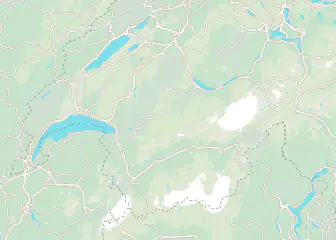
Opens the trip planner with these stops and nights already filled in. Add a stop, drop one or change the nights.
In short
- A 14-day loop from and back to Geneva Airport: Annecy, Chamonix, Zermatt, Lucerne, Interlaken and Montreux, 13 nights, six bases.
- About 799 km (496 mi) and 11 h 25 of driving in total; the longest day is Zermatt to Lucerne, 3 h 10.
- Two countries, one border crossing each way (France in on day 1, Switzerland in on day 5). A Swiss-sector rental car includes the Swiss vignette.
- Declare France and Switzerland when you book: the rental company must authorize every country on the agreement.
Mont Blanc and Switzerland fit into one loop if you accept six bases and a car for the transfers. This route starts and ends at Geneva Airport (GVA) and runs through two countries: France for Annecy and Chamonix, then Switzerland for Zermatt, Lucerne, Interlaken and Montreux. It suits travelers who want lakes, glaciers and mountain railways in one trip and who are happy to spend most days in one valley before moving on.
The driving is light. The seven drives add up to about 799 km (496 mi) and 11 h 25 over 14 days, and the longest single day is Zermatt to Lucerne at 3 h 10. Most transfers leave you time for a first walk on arrival. The route is a loop, so you return the car where you picked it up. Annecy and Chamonix are covered in our Savoie guides; for the rest we rely on our Switzerland guides, and where a place has no guide of its own we say so.
The route at a glance
| Days | Base | Nights | Drive from previous base |
|---|---|---|---|
| 1-2 | Annecy | 2 | Geneva Airport (GVA): 40 min, 49 km (31 mi) |
| 3-4 | Chamonix-Mont-Blanc | 2 | Annecy: 1 h 15, 101 km (63 mi) |
| 5-6 | Zermatt | 2 | Chamonix-Mont-Blanc: 2 h 20, 148 km (92 mi) |
| 7-8 | Lucerne | 2 | Zermatt: 3 h 10, 194 km (120 mi) |
| 9-11 | Interlaken | 3 | Lucerne: 1 h 05, 69 km (43 mi) |
| 12-13 | Montreux | 2 | Interlaken: 1 h 50, 148 km (92 mi) |
| 14 | Geneva Airport (GVA) | - | Montreux: 1 h 05, 90 km (56 mi) |
Compare rental companies in Geneva
When you compare, tick or ask for the cross-border option and list both France and Switzerland.
Day by day
Days 1-2: Annecy
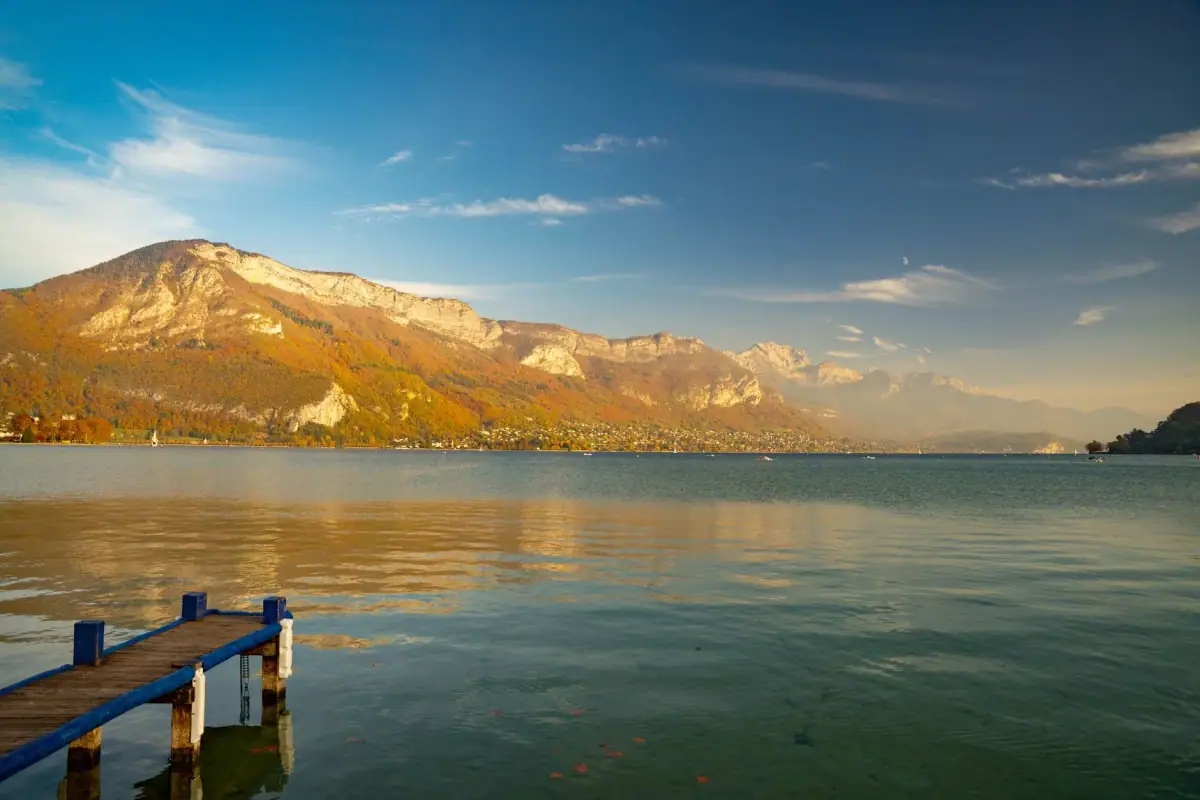
Pick up the car at Geneva Airport and drive to Annecy: 40 min, 49 km (31 mi). This is also your first border crossing if you rented on the Swiss side (see the borders section below). Annecy is compact: the old town is built around the Thiou canal, with the Palais de l’Île, arcaded streets and Annecy Castle on the hill. Our guide to visiting Annecy lists the sights, and in summer a car is more of a handicap in the center, because parking is expensive and fills quickly.
Use day 2 for the lake. The 3 days around Lake Annecy itinerary suggests the east shore from Veyrier-du-Lac to Menthon-Saint-Bernard and Talloires, with swimming and a picnic, or a boat cruise if you would rather not drive again. Things to see around Lake Annecy adds the Semnoz viewpoint and the Petit Lac near Duingt. Annecy is busy in July and August, so book ahead. Hotel prices are in the budget section. Hotels in Annecy. For where to stay by district, see where to stay in Annecy.
Days 3-4: Chamonix-Mont-Blanc
Drive from Annecy to Chamonix: 1 h 15, 101 km (63 mi). Our guides give Chamonix as the heart of the Mont Blanc region, with the massif and its glaciers above the valley. We have no separate Chamonix guide in English, so we only describe its classics from the one week in Savoie by car itinerary: the Aiguille du Midi cable car, the Montenvers train to the Mer de Glace, and walks on the valley floor. Conditions depend on the weather, so check forecasts and operating conditions the day before, book ahead in high season and keep a plan B for cloud. Put the lift on the clearer of your two days.
For a lower-key half day, the neighboring Pays du Mont-Blanc has the Mont Blanc Tramway at Saint-Gervais (generally summer to early fall) and the Baroque chapel of Notre-Dame-de-la-Gorge at Les Contamines-Montjoie; see what to see in the Mont Blanc region. Hotels in Chamonix-Mont-Blanc and activities in Chamonix are one click away.
Days 5-6: Zermatt
Day 5 is the crossing into Switzerland. From Chamonix, the road to Zermatt goes through Martigny and the Col de la Forclaz: 2 h 20, 148 km (92 mi). Zermatt is car-free; combustion-engine cars are not allowed in the village, and the car stops at Täsch, from where you continue by mountain train. Check with your hotel how it handles luggage and parking.
Zermatt is not covered by a stand-alone guide of ours. What the guides say: the Matterhorn, about 4,478 m (14,692 ft), dominates every view; the Gornergrat railway climbs to a balcony facing the Matterhorn and many glaciers. Rooms are limited and fill quickly in high season, and the village is among the more expensive resorts. For a rail excursion from here, the Glacier Express leaves from Zermatt, but it takes nearly eight hours to St. Moritz, so it does not fit this loop. Hotels in Zermatt.
Days 7-8: Lucerne
This is the longest drive of the trip: Zermatt to Lucerne, 3 h 10, 194 km (120 mi). Lucerne’s old town is walkable in a few hours: the Chapel Bridge, the quieter Spreuer Bridge and the Lion Monument. Visit the Chapel Bridge early or late in the day, when the groups are smaller. Day 8 is for the lake and a summit. Per our Lucerne, Pilatus and Rigi guide, pick Pilatus (about 2,100 m / 6,890 ft, the steepest cog railway in the world, the “Golden Round Trip” loop) for drama or Rigi (about 1,800 m / 5,905 ft, gentler, a wide panorama) for a softer day. One of the two is enough on a short stay. Rain plan: the Swiss Museum of Transport or the Rosengart Museum. Hotels in Lucerne; our where to stay in Lucerne compares areas.
Days 9-11: Interlaken
Lucerne to Interlaken is short: 1 h 05, 69 km (43 mi). With three nights you can match the sky to the plan. Our Interlaken guide covers the Höhematte meadow, the Harder Kulm funicular and boats on Lake Thun and Lake Brienz. The Jungfrau region guide suggests three kinds of days: a high-altitude day (the Jungfraujoch or the Schilthorn) on the clearest morning, a mid-altitude day (First above Grindelwald, or the Lauterbrunnen Valley), and a fallback day on the lakes.
For the Jungfraujoch, the ticket guide says a seat reservation is mandatory from May 1 to October 31, 2026, at CHF 10 for a guaranteed seat, and recommends booking 2 to 7 days ahead while watching the weather. The Schilthorn and First are cheaper alternatives. Check the webcam before you go. Hotels in Interlaken; see also where to stay in Interlaken.
Days 12-13: Montreux
Drive from Interlaken to Montreux: 1 h 50, 148 km (92 mi). Montreux is on the “Vaud Riviera” with Vevey, and the Geneva, Lausanne and Lavaux guide describes the options. Chillon Castle, on a rock at the water’s edge, is reached from Montreux by a lakeside walk or local transport; allow one to two hours. Lavaux, with its UNESCO-listed terraced vineyards, is best on foot between wine villages, and the train runs along the vineyard for an easy return. Vevey has the Chaplin museum in neighboring Corsier-sur-Vevey. Hotels in Montreux.
Day 14: back to Geneva Airport
Montreux to Geneva Airport is 1 h 05, 90 km (56 mi). Return the car to the sector where you picked it up (see below), and leave extra time before your flight. Geneva itself is covered in our Geneva guide if you want an extra night at the end.
Crossing the borders
This route has one border, crossed twice. All five Alpine countries in our fact sheet, including Switzerland, belong to the Schengen area, so there are no routine checks at the land border. Switzerland is outside the EU customs union, so a customs check is possible: keep your passport and the rental papers within reach. The EU Entry/Exit System applies when you land from outside Schengen at the airport, not at these land borders, and ETIAS is not in operation as of November 2026 (check travel-europe.europa.eu/etias_en). For visas and entry rules, read your own government’s advice: travel.state.gov (US), gov.uk/foreign-travel-advice (UK), travel.gc.ca/destinations (Canada), smartraveller.gov.au (Australia). The border rules for the whole tour are on the borders section of the tour page.
The two crossings: on day 1, from Geneva Airport into France on the way to Annecy; on day 5, from France into Switzerland between Chamonix and Martigny. Declare both countries when you book. The authorization must appear on the rental agreement. Some examples of published terms: Enterprise Switzerland lets Swiss-rented cars go to France “without any additional charges”; Enterprise France charges €55 (~$64) per rental (2026) for neighboring countries and wants the car back in mainland France. Fees vary, vans and luxury cars can be restricted, so compare. Once the cross-border trip is authorized, the rental company’s insurance covers you in Switzerland and France; there is no border insurance to buy.
Geneva Airport has a Swiss sector and a French sector, reached through a customs road from Ferney-Voltaire. A car rented on the Swiss side is a Swiss car, with the vignette included. A car rented on the French side is a French car, to be returned to the French side, and the Swiss vignette is not guaranteed. Since nine of your 13 nights are in Switzerland, the Swiss sector is the simpler choice for this route. If you take a French-side car, buy the vignette before you reach a Swiss motorway: CHF 40 (2026), valid for the calendar year (the 2026 one runs until 31 January 2027), no short-term version, sold on the official e-vignette shop at via.admin.ch/shop and linked to the plate. France has motorway tolls but no vignette. France (Crit’Air) can require environmental stickers in some cities; ask the rental company.
Long summer queues are an issue at the external borders of the Schengen area; both land crossings here are inside it. Currencies: France uses the euro, Switzerland the Swiss franc (CHF). Some shops in tourist areas accept euros in Switzerland, but at an often unfavorable rate; pay in francs by card.
Getting there and away
Fly into Geneva Airport (GVA) and out of it. Zurich, Munich, Milan and the other Alpine airports serve our other itineraries, not this loop. A one-way rental to a different airport would break this loop: international one-way fees are high and vary by company (Avis Austria, for example, lists €100 to €5,000 for a drop-off in another country; Sixt shows a fixed fee by car group before you confirm), while a loop back to the pick-up airport is usually much cheaper. We do not list flight routes.
When to go
July and August are the busiest months in Annecy, Chamonix and the lakes, with higher prices and frequent afternoon storms in the mountains (Savoie guide). In Switzerland the best mix of beauty, crowds and price is September and October; lifts run fully from May to September, and mid-altitude and high-mountain hiking runs from late June to September. The Mont Blanc Tramway generally runs from summer to early fall, and some mountain lines and boats reduce service in winter. For a first visit, early September fits this route best. In Zermatt, Grindelwald and Lucerne, hotels fill weeks ahead for July and August: aim for two to three months ahead. See the best time to visit Savoie and Switzerland.
Budget
From the Savoie budget guide (budget for Savoie): a double room around Annecy is €120 to €180 (~$140 to $210) a night on average, with lakeside rooms above €200 (~$230) in summer; a 2-star hotel in Chamonix averages about €158 (~$185), from about €70 (~$81) to over €500 (~$580). The Aiguille du Midi round trip was about €83 (~$96) in 2026. A set lunch is often €15 to €25 (~$17 to $29).
From the Swiss guide (Switzerland travel budget): a 3-star hotel averages CHF 199 a night in Lucerne and CHF 174 in Montreux. A mid-range traveler spends about CHF 250 to 350 a day per person, flights excluded; a restaurant lunch is CHF 20 to 28. The Jungfraujoch round trip is about CHF 205 from Grindelwald in that guide, while the ticket guide lists “from CHF 119.60”: check the fare when you book. The Swiss vignette is CHF 40 (2026). We have no rental price: compare companies for your dates.
Adapt it
For a shorter loop, drop Chamonix or Zermatt and stay three nights in Interlaken, or end at Lucerne. For a longer trip, add Geneva (geneve) at the start or end, then Zurich (zurich) or St. Moritz (saint-moritz) after Lucerne; Lugano (lugano) and Como (como) are further stops on the other Alps itineraries. A train-only version of the Swiss half is in our 7-day Switzerland itinerary by train.
Frequently asked questions
Do I need a car for this Alps loop?
A car makes the transfers between six bases simple, and the drives are 40 minutes to 3 h 10 each. Zermatt is car-free, so you leave the car at Täsch there. Our guides also describe train-only versions of parts of this trip.
Which car do I pick up at Geneva Airport, Swiss or French sector?
A car rented on the Swiss side is a Swiss car with the vignette included. A car rented on the French side is a French car, must go back to the French side, and needs a Swiss vignette before it uses a Swiss motorway. Nine of the 13 nights are in Switzerland.
Do I need a vignette?
Yes for Swiss motorways: CHF 40 (2026), valid for the calendar year. Swiss rental cars normally carry it. France has no vignette, only motorway tolls.
Can I drop the car in another city or country?
International one-way fees are high and vary by company. This route is a loop back to Geneva Airport, which is usually much cheaper and simpler.
Is passport control needed between France and Switzerland?
Both are in the Schengen area, so there are no routine checks at the land border. Switzerland is outside the EU customs union, so a customs check is possible. Check your own government's travel advice for entry rules.
Ready-made
Alps road trip itineraries
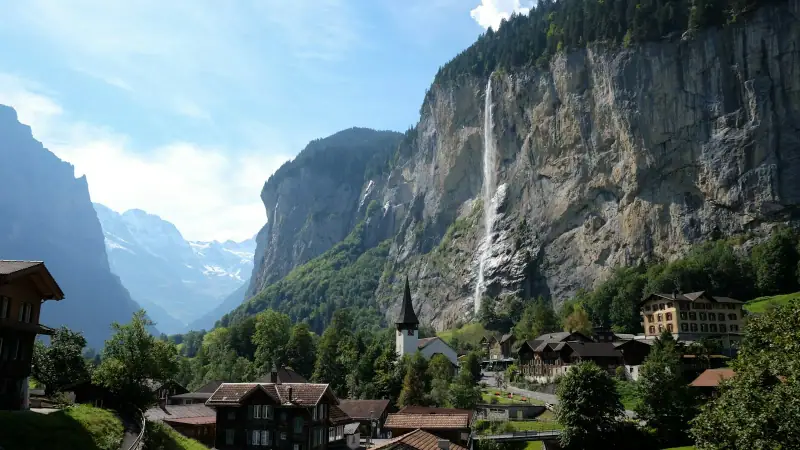
14 days
The Alps in 14 days: Switzerland, the Italian Lakes and the Dolomites, a loop from Zurich
LucerneInterlakenZermattStresaBellagioOrtisei (Val Gardena)Innsbruck
Can be adapted in the planner
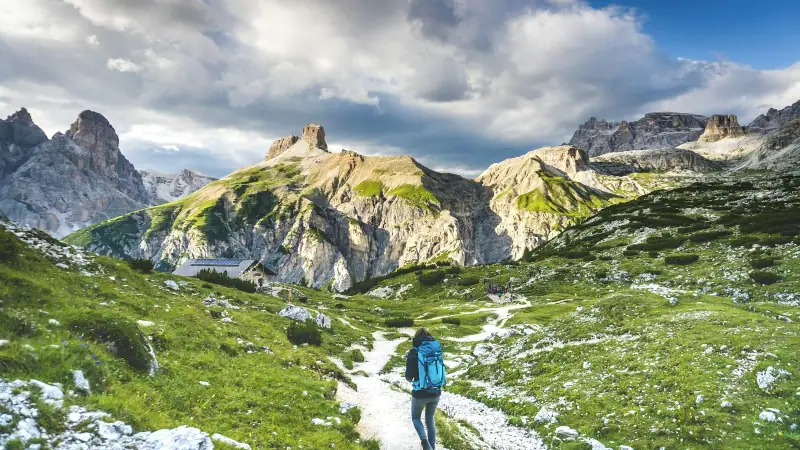
21 days
The Alps in 21 days: a loop from Munich through Germany, Austria, Switzerland and Italy
FüssenLucerneInterlakenZermattStresaBellagioRiva del GardaOrtisei (Val Gardena)Cortina d'AmpezzoInnsbruckBerchtesgaden
Can be adapted in the planner