Where to stay
Where to stay in Interlaken: neighborhoods and types of accommodation
We may earn a commission when you book through links on this page, at no extra cost to you. We don't visit or try the places we cover: we summarize published sources. How we work
In short
- Interlaken West (station and Höheweg) is the simplest base for a first stay; around Interlaken Ost saves a connection if your days go to the Jungfrau region.
- The two stations are about 2.5 km (1.6 mi) apart, roughly a 20-minute walk along the Höheweg.
- Unterseen, Matten and Wilderswil are usually gentler on the budget; Lauterbrunnen and Grindelwald are more spectacular but have fewer rooms.
- Book as early as possible for summer, sunny weekends and school-holiday periods; two to three nights cover the town, the lakes and one excursion.
Interlaken owes its name to its position: the town stretches along the narrow strip of land between Lake Thun and Lake Brienz, with the Aare linking them. The peaks of the Bernese Oberland dominate the horizon, and it is the best-known base for reaching the Jungfrau. That reputation comes with a challenge for the traveler: knowing where to drop your bags. Two stations, a long center, neighboring districts with very different atmospheres and valley villages a few minutes away by train: the choice is subtler than it seems.
This guide goes through Interlaken’s areas, the neighboring villages, then the types of accommodation, the pitfalls to avoid and ways to cut the bill. Rates change sharply from one season to the next: check them for your dates. To place Interlaken among the country’s other bases, see our guide where to stay in Switzerland, and to plan your days, our article visiting Interlaken.
How Interlaken is laid out
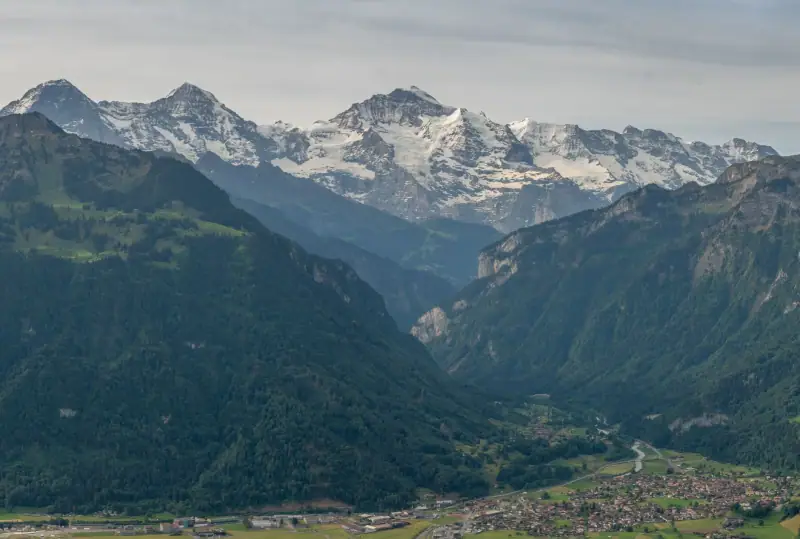
The town is elongated from west to east. In the west, Interlaken West station is near the shopping center, the Lake Thun quays and the big Höhematte meadow. In the east, Interlaken Ost station is where trains leave for Lauterbrunnen, Grindelwald and the Jungfraujoch, as well as the Lake Brienz boats. The two stations are about 2.5 km (1.6 mi) apart, around a 20-minute walk along the Höheweg, the broad hotel-lined avenue linking the two poles. Trains and buses also connect them.
Across the Aare, the districts of Unterseen and Matten have their own, more residential atmosphere. This geography matters: a hotel listed “in Interlaken” can be twenty minutes’ walk from one station or the other. Always look at the map and the real distance to a station rather than just the name of the town.
If you plan to take many trains, boats and cable cars, our article on the Swiss Travel Pass helps you decide whether this pass pays off for your stay.
Around Interlaken West: the most central
The area around Interlaken West station and the start of the Höheweg concentrates most of the hotels, restaurants, shops and excursion agencies. The Höhematte, a vast open meadow in the middle of town, offers a clear view of the mountains. The Lake Thun boats leave near the station, which simplifies days on the water.
Pros:
- Everything is within walking distance: station, shops, restaurants, promenade.
- The choice of accommodation is the widest in town, from simple hotels to large historic properties.
- The station is well linked to the rest of the country, with connections to Bern, Lucerne and the Valais.
Cons:
- It is one of the most expensive areas, especially for rooms facing the Höhematte or the mountains.
- The shopping streets are busy in summer: ask for a courtyard-side room if you are a light sleeper.
- To reach the Jungfrau region, you must take the train to Interlaken Ost or change lines.
It is the right choice for a first stay, a short visit or a trip without a car.
🏨 Compare hotels in Interlaken: town center, Höheweg or station surroundings, compare rates and amenities for your dates and budget.
The Höheweg: the avenue of grand hotels
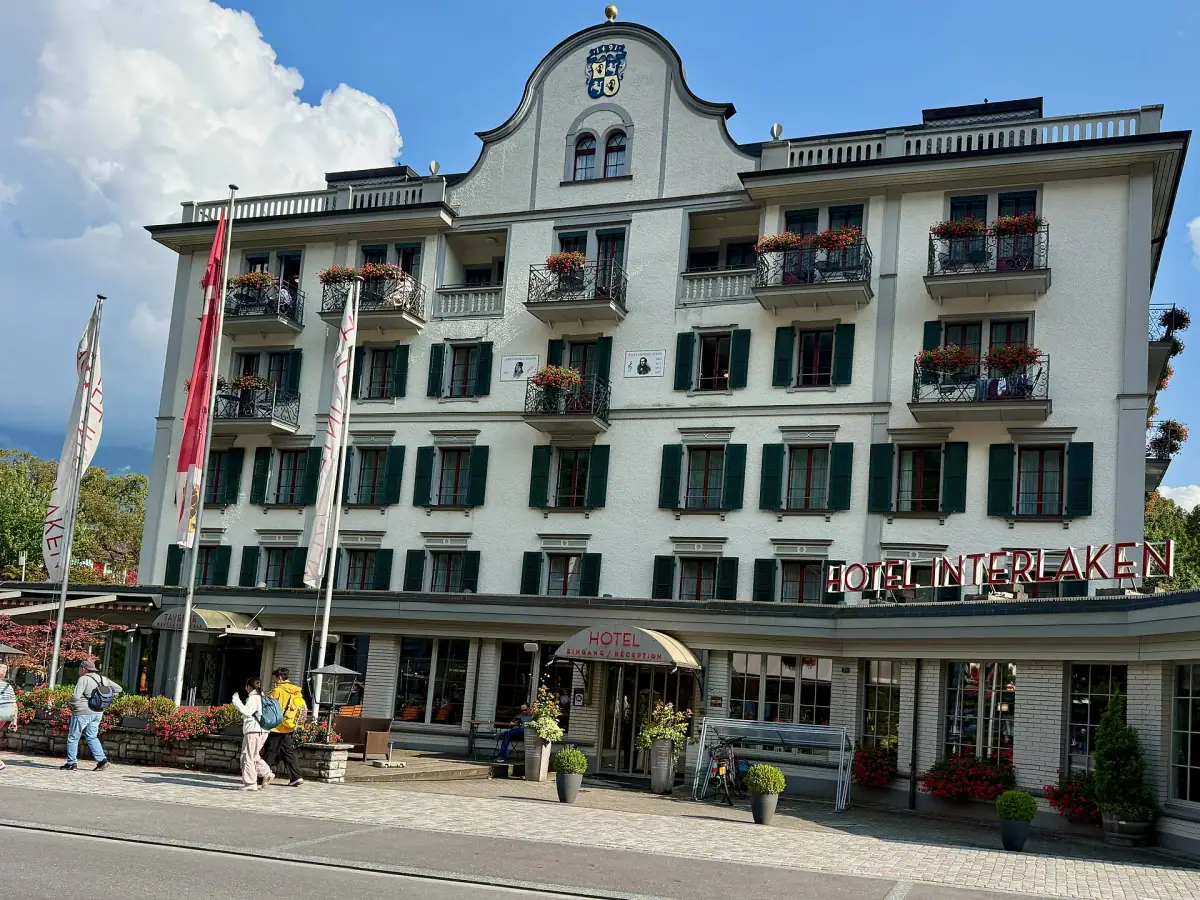
The Höheweg is Interlaken’s historic promenade. It is lined with several traditional hotels, established here since the time when 19th-century travelers came to admire the Jungfrau from the meadow. Sleeping on this axis means waking up facing the Höhematte and the mountains, with the center within walking distance and the two stations linked by a single straight line.
Rates are generally high, particularly for rooms with a view. The setting is elegant and the location practical, but the atmosphere is more touristy than local. To enjoy the setting without paying top price, some travelers book a mid-range property a street or two from the avenue and make the promenade their living room.
Around Interlaken Ost: the gateway to the Jungfrau
The area around Interlaken Ost station is more functional and less picturesque, but it has a decisive advantage if your days are devoted to the Jungfrau region: the trains for Lauterbrunnen and Grindelwald leave from here, and you avoid a connection and about twenty minutes of travel from the west. The Lake Brienz boats are also close.
You find mid-range hotels, a few budget properties and several hostels. The atmosphere is that of a station district: practical, well served, without the charm of the Höheweg. It suits travelers who leave early in the morning, come back late and want to cut travel time, as well as those on a limited budget. To choose your excursions, see our guide to the Jungfrau region.
Unterseen: the charm of the old village
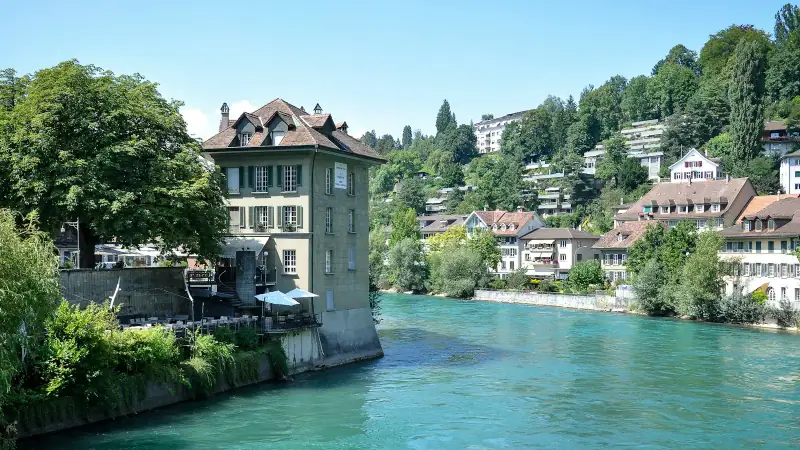
Crossing the Aare, you reach Unterseen, an old district whose small-town atmosphere contrasts with the bustle of the Höheweg. Lanes, old houses, neighborhood restaurants and the banks of the Aare make a calmer setting, about ten minutes’ walk from the center according to specialist guides.
Accommodation here is more modest: small hotels, guesthouses and rooms in local homes. Rates are often gentler than around the Höheweg, for a more authentic setting. The district suits couples, travelers who like quiet places and those who want to save money without going far. The main drawback: the choice is more limited, which means booking early in high season.
Matten and Wilderswil: more affordable, a little farther out
Matten is a neighboring municipality, on the southeast side, often cited for travelers on tight budgets. It is a little farther from the center but remains linked by public transport, and several budget properties are concentrated there. Prices are generally lower than in the center, and rooms quieter.
Wilderswil, a village a few minutes by train from Interlaken on the Lauterbrunnen line, is the starting point of the Schynige Platte railway. It appeals to travelers who want a rural setting while keeping the station within reach: the village atmosphere is strong, restaurants are few and trains set the rhythm of the day. It is an interesting alternative if you are looking for quiet and your excursions mostly head to the valleys.
Bönigen and the shores of Lake Brienz
On the north shore of Lake Brienz, the village of Bönigen has a lakeside-resort feel: a waterfront promenade, mountain views, swimming in summer. It is a few minutes from Interlaken by bus and boat. Farther along the lake, villages such as Iseltwald attract lovers of quiet.
These areas suit those staying several nights who prefer lake shores to urban bustle. The drawback: dependence on bus and boat timetables, fewer restaurants in the evening and, for some properties, a season-limited opening. Check the dates before booking.
🎟️ Activities and excursions from Interlaken: lake cruises, paragliding, canyoning and day trips to the neighboring valleys.
Staying in the valleys: Lauterbrunnen, Grindelwald and higher up
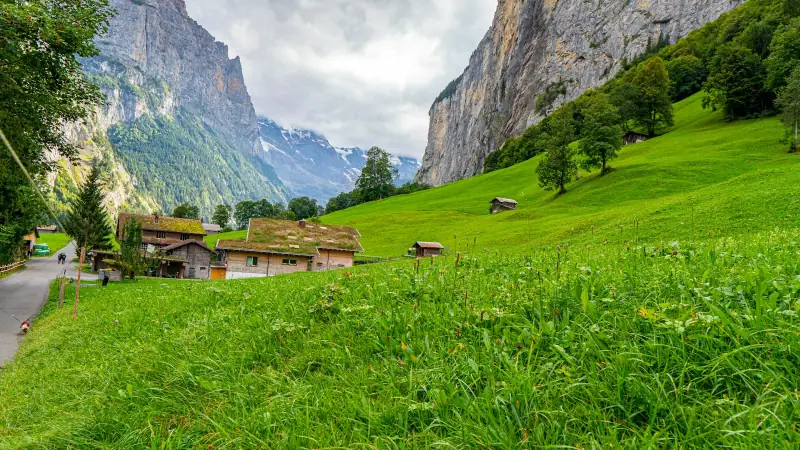
Many travelers wonder whether it is better to sleep directly in the valley. Lauterbrunnen, at the foot of dizzying cliffs and waterfalls, and Grindelwald, at the foot of the Eiger, are linked to Interlaken by frequent trains: allow about twenty minutes for the first and half an hour for the second. Perched villages reached by cable car or mountain railway, such as Mürren, add a more isolated dimension.
Why stay there:
- You are right there early in the morning and late in the evening, before and after the crowd of day-trippers.
- The setting is spectacular, with the cliffs and peaks visible from your window.
- Hiking trails start almost at the door.
The trade-offs:
- The choice is more limited than in Interlaken, so more sensitive to dates.
- High-season rates can be high and small properties are full long in advance.
- Restaurants and shops are fewer, and train times matter in the evening.
A common compromise is to split the stay: one or two nights in Interlaken for the town and lakes, then one or two nights in the chosen valley for the mountains. Our article on the Jungfrau region details what each valley offers.
Types of accommodation in Interlaken
Hotels
The town offers the whole range, from the grand historic hotels of the Höheweg to mid-range properties around the stations, with small family-run hotels in between. Rooms with mountain views cost noticeably more than those facing the street: decide whether the view is worth the extra. Many hotels offer family rooms, a useful point if you travel with children.
Hostels and dorms
Interlaken is a destination for young, active travelers, which means more hostels and dorms than in many Swiss towns. It is the cheapest option, often with a common area where you meet other travelers. Check the conditions for private rooms, any supplements for linen or breakfast and the atmosphere: some places are very lively in the evening.
Apartments and chalets
For three nights or more, an apartment with a kitchen saves money on meals, which are pricey in restaurants. There are more in the villages than in the center. Read the cancellation terms, cleaning fees and arrival arrangements carefully before paying.
Rooms in local homes and guesthouses
Several small guesthouses, often in Unterseen, Matten or the villages, offer a more personal welcome and a homemade breakfast. They are ideal for travelers who enjoy local contact, sometimes with a limited number of rooms: book early.
Camping
Campsites are found around Interlaken, notably between the town and the lakes, and in the neighboring valleys. They suit travelers with a tent, van or caravan, mainly from late spring to early autumn. Check the opening dates, the distance to a station and the facilities before choosing.
When to book and which pitfalls to avoid
Interlaken is one of the busiest stops in the country: from late spring to early autumn, sunny weekends and school-holiday periods push prices up and fill the hotels. Winter also attracts snow-sports fans to the neighboring resorts. Spring and autumn, outside events, are gentler on the wallet and quieter. To choose the best period, see our article on when to go to Switzerland.
A few pointers to avoid unpleasant surprises:
- Check the nearest station: West or Ost, with a twenty-minute walk between them, changes the logistics of your days.
- Read the cancellation terms: non-refundable rates are often lower, but risky if your plans depend on mountain weather.
- Check the tourist tax, which is sometimes added to the displayed price, and what your rate includes.
- Check the arrival arrangements if you arrive late: some small properties have no permanent reception.
- Stay flexible: mountain weather is changeable and may make you swap two days of your plans.
To estimate all your spending, from accommodation to meals, read our article on the budget for a trip to Switzerland.
Cutting the bill without sacrificing the stay
Interlaken is not a cheap destination, but a few habits help keep the budget in check:
- Sleep in Unterseen, Matten or Wilderswil: slightly off-center lodging is often much cheaper, and only a few minutes away by train or bus.
- Opt for a dorm or a simple room in a hostel if you spend little time indoors.
- Eat breakfast elsewhere: the hotel often charges a lot for it. A neighborhood bakery is a cheaper alternative.
- Travel on weekdays or off-season, when rates are lower.
- Take a room with a kitchenette if you stay several nights.
- Compare several districts and several dates before booking.
Many of Interlaken’s pleasures are free: strolling the Höheweg, sitting on the Höhematte, walking along the Aare or enjoying the lake shores. For a guided activity, compare the offers rather than booking at the last minute.
Which neighborhood for your profile?
For a first stay and a short visit, Interlaken West and the Höheweg are the simplest. For a Jungfrau-focused base, the surroundings of Interlaken Ost save a connection. For an authentic, calmer setting, turn to Unterseen. To save money, look at Matten or Wilderswil. For the lakes and swimming, Bönigen is a good option. For mountains outside your window, Lauterbrunnen or Grindelwald are worth the trip, to be booked early.
In every case, train, bus and boat make each area an easy starting point: do not focus on the distance to the center, but on the proximity of a station, the quality of recent reviews and how well the place fits your travel dates.
🏨 A quiet stay near the lakes: neighboring villages, shores of Lake Brienz or valleys, compare accommodation in the region for your dates.
See accommodation in the Bernese Oberland Compare on Booking.com
In short
Interlaken West and Höheweg: central and practical, high rates. Interlaken Ost: the gateway to the Jungfrau. Unterseen: calm and authentic. Matten and Wilderswil: more affordable. Bönigen: lake and quiet. Lauterbrunnen and Grindelwald: mountains outside your window. Book early in summer, compare dates and keep an eye on cancellation terms. With the right accommodation, Interlaken is an easy base to enjoy, rewarding hikers and anyone who simply likes watching the boats go by.
Frequently asked questions
What is the best neighborhood to stay in Interlaken?
For a first stay, the Interlaken West area, around Interlaken West station and the Höheweg, is the simplest: shops, restaurants, Lake Thun boats and the Höhematte meadow are all on foot. If your days are devoted to the Jungfrau region, the area around Interlaken Ost station saves a connection.
What is the difference between Interlaken West and Interlaken Ost?
They are two separate stations about 2.5 km (1.6 mi) apart, around a 20-minute walk along the Höheweg. Interlaken West is closer to the center and Lake Thun; Interlaken Ost is the departure station for trains to Lauterbrunnen, Grindelwald and the Jungfraujoch, and for Lake Brienz boats.
Is it better to stay in Interlaken or in Lauterbrunnen and Grindelwald?
Interlaken offers more choice, generally more varied prices and very good transport links. Lauterbrunnen and Grindelwald are more spectacular and put you at the foot of the mountains, but there is less to choose from and booking early is essential in high season.
Is Interlaken an expensive place to stay?
It remains an expensive destination, like the whole of Switzerland, especially in summer and school-holiday periods. Rates vary a lot by date: compare several districts, several days of the week and the neighboring villages before booking.
How many nights should you plan in Interlaken?
Two to three nights are enough for the town, the lakes and one excursion. With four nights or more, you can add one or two days in the neighboring valleys, since mountain weather is changeable.
Do you need a car to stay in Interlaken?
No. The town is served by train and boat, and the Jungfrau valleys are linked by frequent trains. A car is only useful for exploring the surroundings away from the main lines; in that case, check that your accommodation has parking.
When should you book accommodation in Interlaken?
As early as possible for summer, sunny weekends and school-holiday periods. Outside high season, a few weeks ahead is generally enough, but small properties and hostels fill quickly.
More Switzerland guides
Keep reading
Where to stay in Bern: neighborhoods and types of accommodation
Old town, station, Länggasse, Kirchenfeld, Lorraine or Marzili: compare Bern's neighborhoods, types of accommodation and tips for choosing well.
Where to stay in Lucerne: neighborhoods and types of accommodation
Old town, station, Hirschmatt, Tribschen or lake villages: compare Lucerne's neighborhoods, types of accommodation and tips for choosing well.
Where to stay in Geneva: neighborhoods and types of accommodation
Pâquis, Carouge, Plainpalais, Old Town or Eaux-Vives: compare Geneva's neighborhoods, types of accommodation and tips for cutting the bill.
Ready-made
Switzerland itineraries
Glacier Express and panoramic trains in winter: routes, prices and reservations
Glacier Express, Bernina Express and GoldenPass in winter: 2026-2027 running dates, reservation prices, recommended routes and tips for seeing the snow.
Glacier Express or Bernina Express: which panoramic train should you choose?
Glacier Express or Bernina Express: duration, scenery, reservations and passes. Compare Switzerland's two panoramic trains and pick the one for your trip.
7 days
7-day Switzerland itinerary by train: Lucerne, Interlaken, Zermatt and Lake Geneva
LucerneInterlakenZermattLausanne