Itineraries
Glacier Express or Bernina Express: which panoramic train should you choose?
We may earn a commission when you book through links on this page, at no extra cost to you. We don't visit or try the places we cover: we summarize published sources. How we work
In short
- The Glacier Express runs Zermatt to St. Moritz in nearly eight hours (290 km / 180 mi); the Bernina Express runs Chur or St. Moritz to Tirano in about four.
- Seat reservation is mandatory in the panoramic cars of both trains, even with a Swiss Travel Pass; book early for summer.
- Regional trains use largely the same tracks with no reservation and no panoramic cars, a cheaper way to keep the scenery.
- Both lines run year-round, but timetables and frequency change with the season.
Two trains make Switzerland’s railway reputation: the Glacier Express and the Bernina Express. Both run on meter-gauge tracks, cross stone viaducts and passes, and are sold as “panoramic trains.” Yet they do not offer the same experience. One is a long crossing of the Alps, the other a spectacular descent to a Mediterranean climate.
This guide helps you choose according to your time, your budget and your itinerary. Fares and timetables change every season: check them for your dates before booking.
The Glacier Express: the grand crossing between Zermatt and St. Moritz
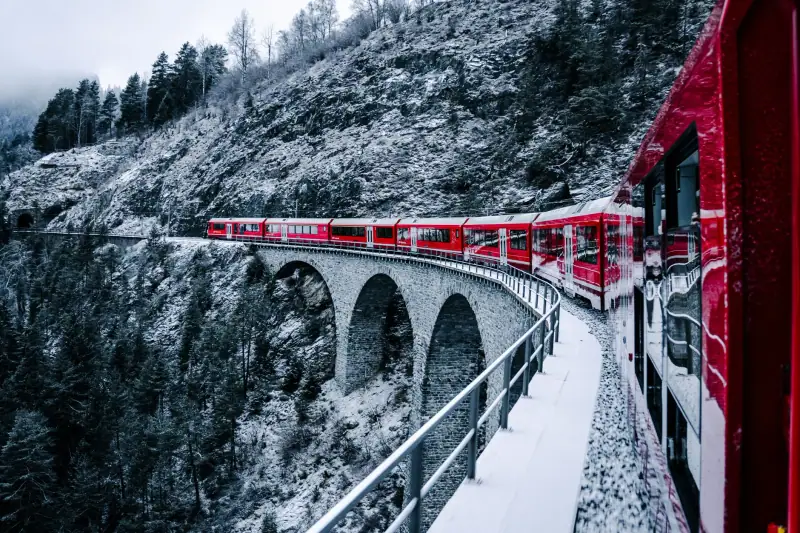
The Glacier Express links Zermatt to St. Moritz, over about 290 km (180 mi). The trip takes nearly eight hours, which earned it the nickname “slowest express train in the world.” That is intentional: you do not take this train to arrive quickly, but to watch the mountains go by through big windows.
Along the route, the train crosses nearly 300 bridges and about 90 tunnels. Its highest point is the Oberalp Pass, at about 2,030 m (6,660 ft). Major stations dot the journey: Brig, Andermatt, Disentis and Chur. Between Brig and Andermatt, the line passes under the Furka through a base tunnel of about fifteen kilometers (9 mi), which avoids the old high-altitude crossing.
What you will see: the valleys of the Valais, the high plateaus around Andermatt, then the Vorderrhein gorges and the villages of Graubünden. Depending on the season, the meadows are green or the slopes covered in snow. Departures are possible in both directions, and the trip suits a full day with no other visit.
The Glacier Express is the right choice if you want the grand crossing, if you like long train days and if you want to link the Valais to Graubünden without driving. It is less suited if you have little time: eight hours seated is long for children or travelers who do not like staying in place.
To sleep on the Valais side before leaving, Zermatt is the natural base. The town is car-free and the station is in the center.
🏨 Sleep in Zermatt before departure: with an early morning train, staying near the station simplifies the day. Compare the hotels available for your dates.
The Bernina Express: from Chur to Tirano, from glaciers to palm trees
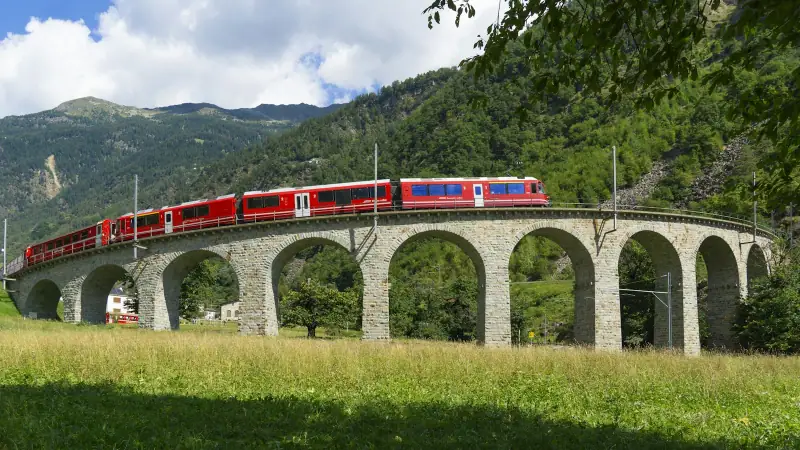
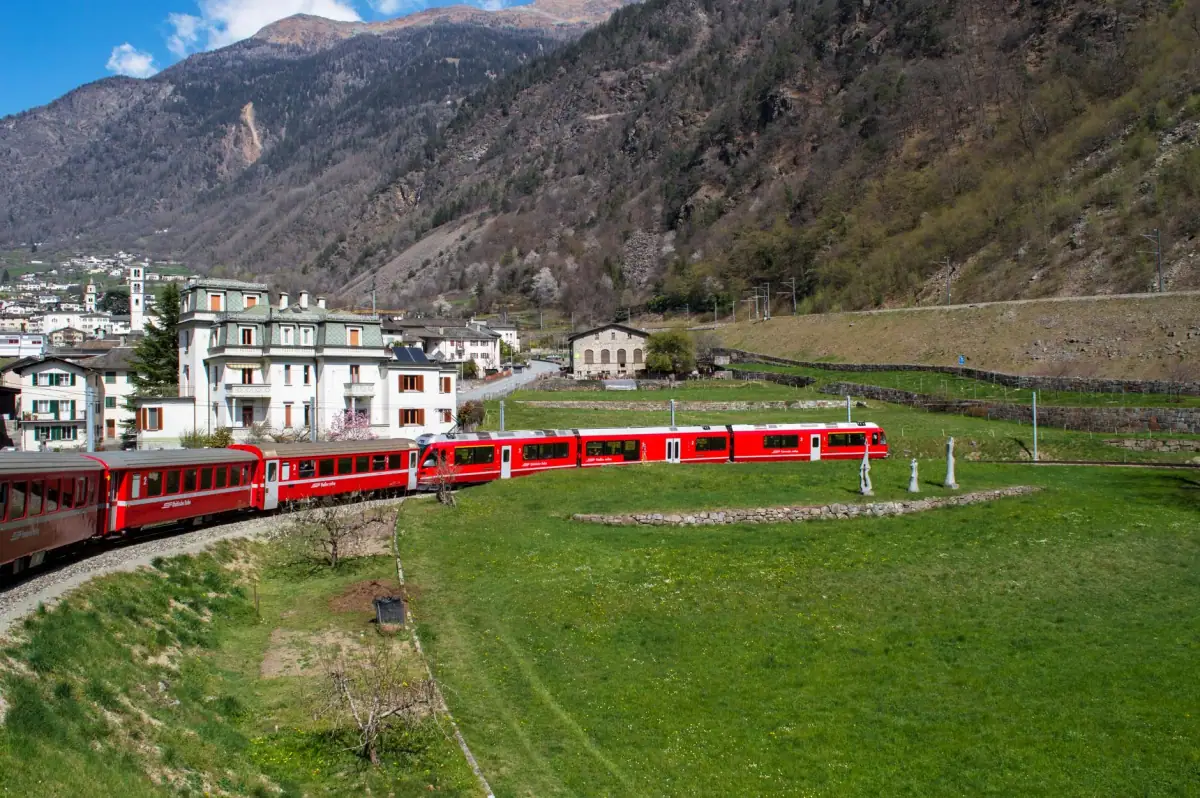
The Bernina Express runs between Chur (or St. Moritz) and Tirano. From Chur, the trip takes a little over four hours; from St. Moritz, about two and a half hours. The train has about 55 tunnels and nearly 200 bridges.
Its highest point is the Ospizio Bernina, at about 2,250 m (7,382 ft). From there, the train descends to Tirano, at around 430 m (1,411 ft), on a steep grade with no rack: some sections reach about 7%. The contrast is striking, from high-mountain landscapes to Mediterranean vegetation.
The Albula and Bernina lines have been UNESCO World Heritage since 2008. The Brusio circular viaduct, where the track makes a full loop to lose altitude, is one of the most famous passages. Higher up, the Landwasser Viaduct, on the Albula section, is among the most photographed images of the network.
Tirano is in Italy, in Lombardy. This guide does not cover the Italian side. If you stay on the Swiss side, a bus link connects Tirano to Lugano in season, which lets you close a circuit with Ticino.
The Bernina Express is the right choice if you have half a day to a day, if you like engineering feats and if you want to cross into Italy without a car. To catch the best views, favor a daytime trip and sit on the view side.
🎟️ Excursions around the panoramic trains: organized tours, guided visits and mountain outings in Switzerland are worth comparing online before departure.
Comparing the two trains: duration, scenery, pace
The picture is simple. The Glacier Express is an east-to-west (or the reverse) crossing of the Swiss Alps, long and steady. The Bernina Express is shorter, more dramatic in elevation change, and ends outside the country.
- Duration: nearly eight hours for the Glacier Express, a little over four hours for the Bernina Express from Chur.
- Scenery: high valleys, plateaus and gorges for the first; viaducts, a pass, a descent and a Mediterranean climate for the second.
- Pace: a full day for one, half a day to a day for the other.
- Destination: the Glacier Express stays in Switzerland; the Bernina Express ends in Italy.
- Audience: the Glacier Express charms fans of grand crossings, the Bernina Express those who like technical feats.
If you can only do one, choose the Bernina Express for a short stay or a circuit toward Ticino. Choose the Glacier Express if you like long trips and your itinerary naturally links the Valais to Graubünden.
Reservations, passes and regular trains
In the panoramic cars of both trains, reserving a seat is mandatory. That is true even if you travel with a pass: the Swiss Travel Pass generally covers the journey, but not the reservation supplement. We detail how the pass works in our article on the Swiss Travel Pass. Book early for summer and holidays, because window-side seats go fast.
An economical alternative exists: regional trains use largely the same tracks. You lose the panoramic cars, the meals served at your seat and sometimes a few minutes of comfort, but you keep the scenery. For a traveler hesitating over the budget, it is a very good option, notably on the Bernina, where the line is served all year.
A few practical tips:
- Reserve the panoramic trip as soon as your dates are fixed.
- Plan something to eat if you do not choose onboard dining.
- Keep a time margin for connections if you link to another train.
- Check the season’s timetables: they change between summer and winter, and our guide to panoramic trains in winter details the dates, prices and reservation for 2026-2027.
- Check the weather: a clear sky changes the day.
Where to sleep and how to organize your circuit
Both trains fit easily into a circuit in Switzerland. For the Glacier Express, sleep the night before in Zermatt or St. Moritz depending on the direction chosen. For the Bernina Express, St. Moritz and Chur are the most practical starting points. Our guide where to stay in Switzerland compares the most useful bases depending on your stay.
If your circuit continues south, Ticino is the logical next step: Lugano, Locarno and Bellinzona are easily reached from Graubünden. In season, the bus link from Tirano makes this route smooth.
🏨 Sleep in St. Moritz or in Graubünden: to fit an early departure or a late arrival, compare hotels in the region for your dates.
Our view: which to choose for your profile
- First stay, little time: the Bernina Express, shorter and very spectacular.
- Fan of grand crossings: the Glacier Express, for a full day devoted to the train.
- Small budget: a regional train on the same line, with no panoramic car.
- Circuit toward Ticino or Italy: the Bernina Express, with the bus connection to Lugano in season.
- Family trip with young children: favor shorter sections rather than the full crossing.
In every case, these trips cannot be improvised: choose a good-weather day if possible, book early, and keep room in your schedule. Finally, remember to take out suitable travel insurance before departure.
Sources
- Glacier Express: figures checked November 2026
Frequently asked questions
What is the difference between the Glacier Express and the Bernina Express?
The Glacier Express links Zermatt to St. Moritz in nearly eight hours, through the Valais, Andermatt and Graubünden. The Bernina Express links Chur or St. Moritz to Tirano, in Italy, in about four hours from Chur: it is shorter and crosses a UNESCO-listed line.
Do you need to reserve the Glacier Express and the Bernina Express?
Yes, seat reservation is mandatory in the panoramic cars of both trains, even with a Swiss Travel Pass. Book early for summer.
Does the Swiss Travel Pass cover these trains?
The pass covers the journey, but not the mandatory reservation supplement. Check the current conditions at the time of purchase.
Can you make these trips without the panoramic trains?
Yes. Regional trains use the same tracks, with no reservation and no panoramic cars. The scenery is the same, with more ordinary windows.
Do these trains run in winter?
Yes, both lines run all year, but timetables and frequency change with the season. Check the official timetables before you go.
More Switzerland guides
Keep reading
Switzerland budget: what a trip costs, item by item (2026)
How much to plan for a trip to Switzerland? Real costs by item, three budget profiles in CHF and tips to spend less without giving up the scenery.
What to see in Graubünden: Chur, the Engadine, the National Park and UNESCO trains
What to see in Graubünden: Chur, Rhine Gorge, Flims, Engadine, St. Moritz, Swiss National Park, Müstair and UNESCO trains. Itineraries and practical tips.
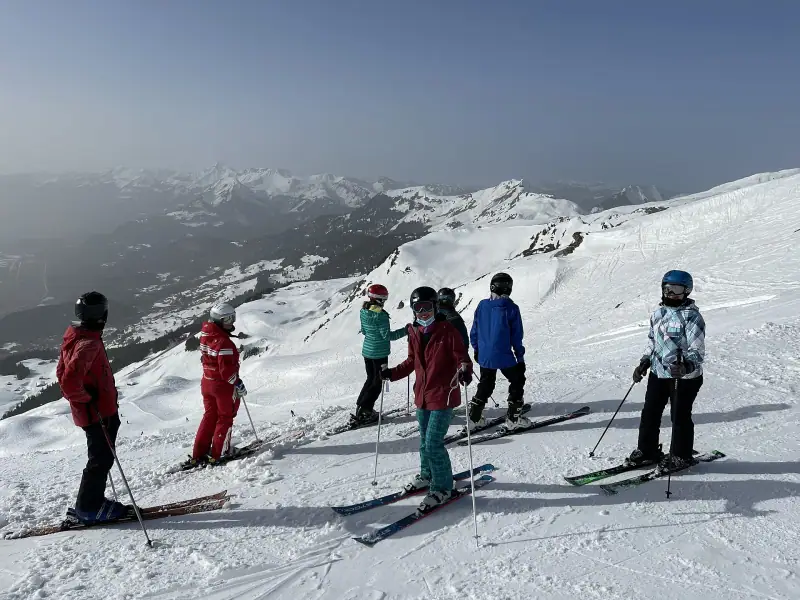
Switzerland's best ski resorts: Zermatt, Verbier, St. Moritz compared, with budgets
Zermatt, Verbier or St. Moritz: ski areas, atmosphere, access, lodging and budget. Compare Switzerland's three big resorts before booking your winter.
Ready-made
Switzerland itineraries
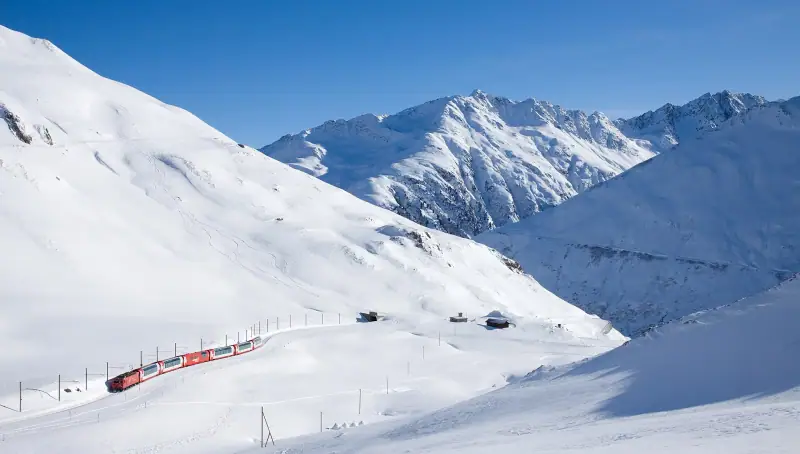
Glacier Express and panoramic trains in winter: routes, prices and reservations
Glacier Express, Bernina Express and GoldenPass in winter: 2026-2027 running dates, reservation prices, recommended routes and tips for seeing the snow.
7 days
7-day Switzerland itinerary by train: Lucerne, Interlaken, Zermatt and Lake Geneva
LucerneInterlakenZermattLausanne