What to see
Visiting Interlaken: what to see and do between Lake Thun and Lake Brienz
We may earn a commission when you book through links on this page, at no extra cost to you. We don't visit or try the places we cover: we summarize published sources. How we work
In short
- One day covers the town, the Harder Kulm and a waterside walk; two to three add a lake cruise and a sport; with the neighboring valleys, plan three to five.
- Interlaken Ost is the station for mountain trains to Lauterbrunnen and Grindelwald; Interlaken West is closer to Lake Thun; they are about 20 minutes apart on foot.
- From Bern it is a little under an hour by train, from Zurich about two hours, from Geneva a little over two and a half hours.
- No car is needed; paragliding and other activities depend on weather, so keep a spare slot.
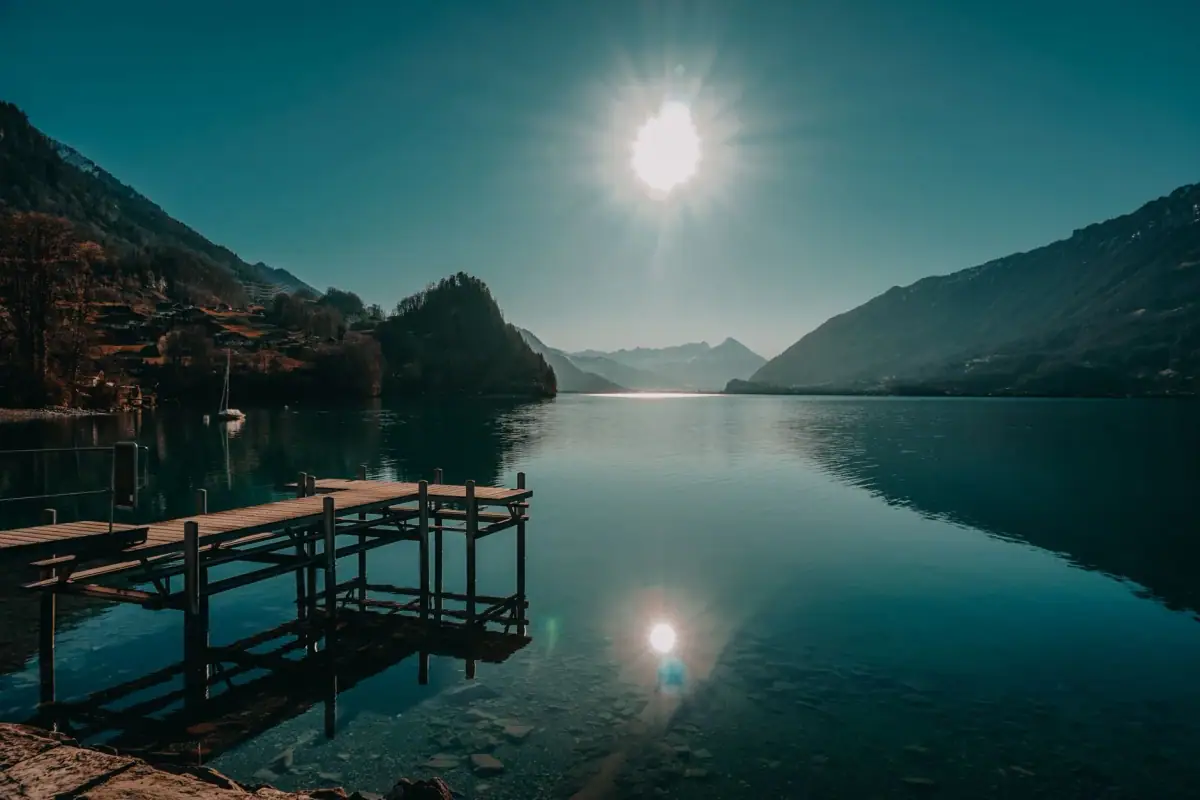
Interlaken lives up to its name: the town stretches along a flat strip of land between Lake Thun and Lake Brienz, linked by the Aare river. Around it are wooded hills, rock walls and, in clear weather, the snowy peaks of the Jungfrau standing out to the south. This setting makes it one of the best-known gateways to the Bernese Oberland.
Many travelers see it only as a practical stop before heading to the mountains. That is a pity: Interlaken deserves at least a full day, with viewpoints, waterfront walks and old-style boats. This guide helps you decide what to see, how to organize a stay of one to three days and how to avoid common mistakes. For the big high-altitude excursions, our article on the Jungfrau region takes over.
Interlaken at a glance: what to expect
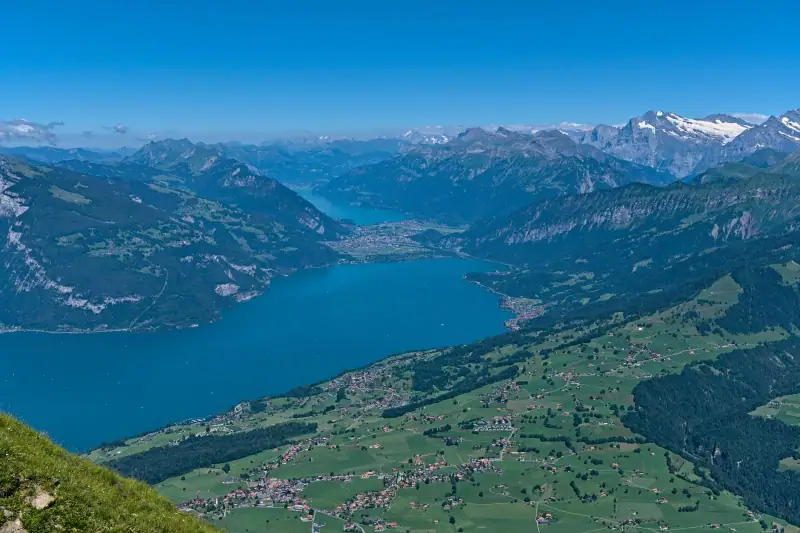
The town is small and walkable. It is organized around the main avenue, the Höheweg, which links the two stations, Interlaken Ost and Interlaken West. Ost, in the east, is the station for mountain trains to Lauterbrunnen and Grindelwald; West, in the west, is closer to Lake Thun and its boats. Between the two, allow about a twenty-minute walk.
In atmosphere, Interlaken is an openly touristy town: historic hotels, souvenir shops, watch and knife stores, international restaurants. It also welcomes many visitors from Asia, the Middle East and the Americas, which gives it a cosmopolitan side. The local language is German, or rather the Bernese dialect, but English is spoken everywhere and French is understood in tourist services.
The real charm lies in the surroundings. A few minutes’ walk from the center, you are already by the water or on a forest path. That is what makes the town pleasant even when weather hides the high peaks.
The Höhematte and the Höheweg: the heart of town
The Höhematte is a vast meadow in the middle of town, bordered by the Höheweg’s historic hotels. It serves as a public lawn, a picnic spot and, sometimes, a landing strip for paragliders coming down from the neighboring heights. From this lawn, the view goes straight to the Jungfrau: it is one of the town’s finest free viewpoints.
The Höheweg, which runs alongside it, is an elegant promenade. The late 19th-century facades recall the time when the Bernese Oberland attracted wealthy travelers from Europe. Take the time to stroll there late in the afternoon, when the light falls on the peaks.
A few practical tips:
- Favor early morning or the end of the day for photos: the light is softer and organized groups are fewer.
- If clouds hide the Jungfrau, come back later. The sky often clears during the day.
- Make the most of the benches and lawns for a picnic bought at a supermarket, which limits the budget.
The Harder Kulm: Interlaken’s viewpoint
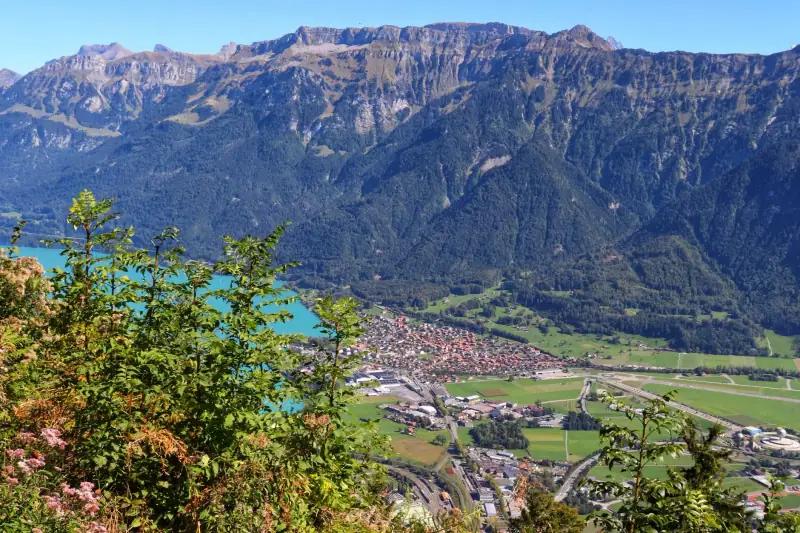
If you could make only one high-altitude excursion from town, this would be it. The Harder Kulm is the wooded hill that overlooks Interlaken to the north. A funicular leaves from the bank of the Aare, near Interlaken Ost station, and climbs in about ten minutes to the summit, a little over 1,300 meters (4,265 ft) above sea level.
From up there, you see both lakes on either side of the town, the rooftops of Interlaken below and, to the south, the line of the Jungfrau and its neighbors. An overhanging panoramic platform, sometimes called the “two lakes bridge,” lets you take in the scene. A restaurant occupies the summit; check the service and opening hours there, which vary by season.
The funicular does not run all year: it generally stops for a closing period in the off-season. Find out before planning. Hikers can also walk up a steep forest trail, allowing about two hours at a good pace, then come back down by funicular.
Sunset is an excellent time, but remember to check the time of the last return. In uncertain weather, rely on the town’s webcams before going up.
🏨 Where to stay in Interlaken: hotels near Ost station or the Höhematte let you do everything on foot and easily reach the mountain trains. In summer and during holidays, rooms go fast: compare offers for your dates.
Lake Thun: castle, boats and caves
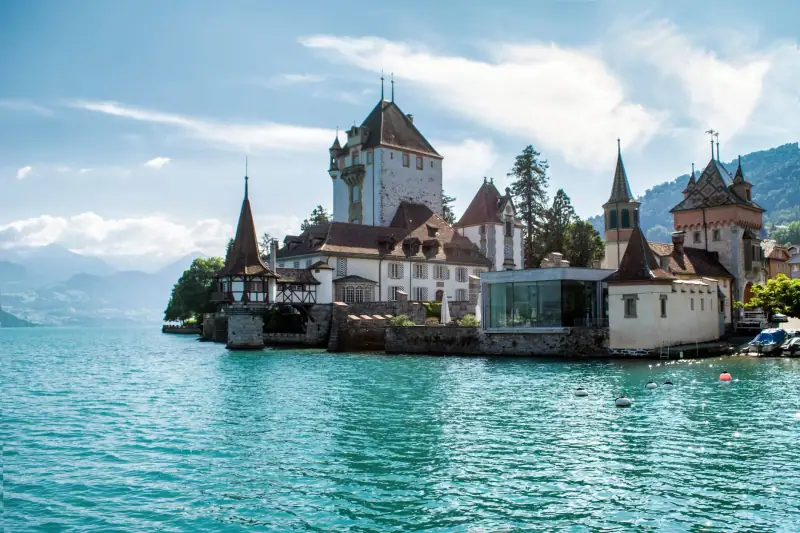
Lake Thun stretches west of the town. Its intense green-blue water and shores lined with villages make it an ideal setting for a quiet day. Scheduled boats, some of them period paddle steamers, link Interlaken to Thun, calling at several small ports. The full crossing takes several hours, which makes it an excursion in itself rather than a simple transfer.
Among the most popular stops are the St. Beatus Caves (Beatushöhlen), limestone cavities visited on foot on the lake’s north shore, with a walkway and lit chambers. At the other end, Thun has a castle overlooking the old town and a long two-level shopping street. The village of Spiez, on the south shore, also has a pleasant castle and small port.
The simplest plan is to board at Interlaken, pick two or three stops, then return by train. Boat timetables, service days and rates depend on the season: check the navigation company’s site before you go. If you have a Swiss Travel Pass, the regular lines are generally included: our guide to the Swiss Travel Pass details what it covers.
Lake Brienz: waterfalls and wooden villages
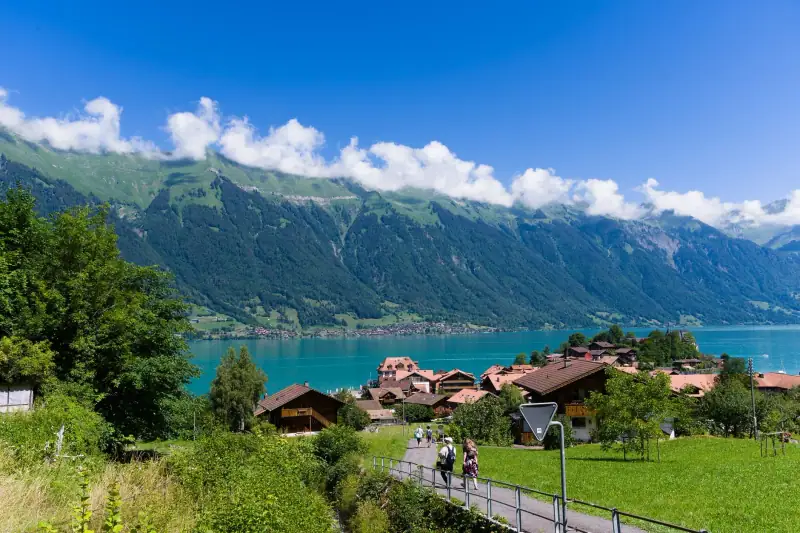
To the east, Lake Brienz is wilder and more enclosed. It is famous for its turquoise color, due to the glacial particles settling in it, and for its steep, forested shores. From Interlaken, boats serve several small ports, including Giessbach, where a series of waterfalls descends in steps through the forest. An old funicular gives access to the historic hotel overlooking the falls.
The village of Brienz, at the east end of the lake, is known for wood carving: it has a violin-making and woodcarving school, as well as many craft shops. It is also the starting point of a steam rack railway that climbs the Rothorn in season. Nearby, a large open-air museum devoted to Swiss rural traditions, Ballenberg, presents houses from all over Switzerland rebuilt on a vast estate. Allow at least half a day if you want to visit it.
In short, Lake Brienz suits travelers who like rugged landscapes, craft traditions and short forest walks. Lake Thun is more classic, more populated and easier to combine with a city day.
Paragliding, canyoning and sports: Interlaken’s playground
Interlaken has built a reputation as the capital of outdoor sports. Operators offer, among others:
- Tandem paragliding, with takeoff from the neighboring heights and landing near town, sometimes on the Höhematte. It is the best-known activity.
- Canyoning, in the gorges and ravines of the surroundings, in wetsuit and helmet, led by guides.
- Rafting and whitewater outings, depending on river levels.
- Bungee jumping and rope parks, for thrill seekers.
- Kayaking and paddleboarding, calmer, on the lakes.
All these activities depend on weather and season. A paragliding flight can be canceled the day before because of wind or low clouds: keep a spare slot in your schedule. Choose a licensed operator, read the cancellation terms and check that your insurance covers risk sports.
🎟️ Activities and excursions from Interlaken: paragliding flights, lake cruises, canyoning, guided excursions in the valley. Compare offers, schedules and cancellation terms before booking.
Neighboring villages and valleys: day trips
Interlaken is an excellent base for fanning out across the Bernese Oberland. Mountain trains leave from Ost station and reach the two big neighboring valleys in under forty minutes.
- Lauterbrunnen: a glacial valley carved between vertical walls, with many waterfalls. A train links it to town in around twenty minutes.
- Grindelwald: a mountain village at the foot of the Eiger north face, starting point for many hikes and the First cable car.
- Wengen and Mürren: two perched villages, with no car traffic, reached by rack railway or cable car from Lauterbrunnen.
- The Jungfraujoch: the big high-altitude excursion, with trains and glaciers, best planned for good weather.
Our article on what to do in the Jungfrau region details these excursions, their advantages, their price and their dependence on weather. The idea is to pick one or two big outings depending on the weather, rather than chaining everything in a few days.
For a more urban day, Bern is under an hour away by train, and Lucerne is reachable in a day: our guide to visiting Lucerne, Pilatus and Rigi helps you prepare this outing.
What to do in one, two or three days
If you have only one day
Go up the Harder Kulm in the morning, come back down for lunch near the Höhematte, then devote the afternoon to a walk along the Aare or a short cruise on Lake Thun. Finish with dinner downtown.
If you have two days
Keep the first day for the town and the Harder Kulm. The next day, set off for a big day on one of the lakes, with a stop at Giessbach or the St. Beatus Caves, or for a sports activity. It is a good weekend format.
If you have three days
Add an excursion to Lauterbrunnen or Grindelwald, depending on the weather. Decide the day before, based on forecasts and webcams. Keep the trip up the Jungfraujoch for the clearest day.
Getting to and from Interlaken
Interlaken is served by a dense rail network. Direct trains or trains with a single change link the town to Bern, Zurich, Lucerne and Geneva, with travel times ranging from a little under an hour from Bern to over two and a half hours from Geneva. Always check the exact timetable on the official railway app on the day you leave.
In town, you can do everything on foot, by bus or by train. The two stations are linked by the railway line, which saves walking if you are carrying luggage.
A car is not needed for a stay in Interlaken. It only becomes useful if you then plan an itinerary off the main rail routes, for example toward passes or secondary valleys. In that case, compare rental companies before booking.
🚗 Rent a car in Switzerland: useful if you continue your trip away from train lines. To stay in Interlaken and the neighboring valleys, public transport is enough. Compare rental companies.
Where to stay: Interlaken or the neighboring villages?
The question comes up often. Interlaken offers the largest choice of accommodation, from hostels to historic hotels and apartments, and its prices are generally lower than in Grindelwald or Wengen in high season. It also has the best train connections.
Conversely, Lauterbrunnen and Grindelwald are more immersive: you wake up facing waterfalls or the walls of the Eiger. They work well if you want to walk from the morning without taking transport. They have fewer rooms, and rooms are booked long in advance in summer.
A good strategy is to combine: two nights in Interlaken for the town and lakes, then one or two nights in a valley for hikes. Our guide where to stay in Switzerland compares the main regions to help you choose.
When to go and budget
From June to September, the lakes, trails and outdoor activities are at their best; it is also the busiest and priciest period. May and October offer a compromise: fewer people, gentler rates, but some lifts and boats run at reduced service or are closed for maintenance. In winter, Interlaken serves as a base for the neighboring ski resorts, while the town atmosphere is calmer. To compare seasons across the country, read our article on the best time to go to Switzerland.
On budget, Interlaken follows Swiss prices: lodging, dining and activities are expensive. To limit the bill:
- Compare accommodation outside the center or in well-served neighboring villages.
- Have lunch with a daily menu or a supermarket picnic.
- Fill your bottle at drinking-water fountains.
- Choose a single big paid excursion, and complete it with free walks.
Our article on the budget for a trip to Switzerland details the spending categories and tips for saving.
Mistakes to avoid
- Planning only one night: Interlaken is a base, not just a stopover. A single night does not let you take advantage of changeable weather.
- Booking the big excursions with no margin: visibility decides everything. Keep a day of flexibility.
- Ignoring the seasonality of boats and funiculars: some services stop in the off-season.
- Confusing the two stations: Ost for mountain trains, West for Lake Thun. Check the departure station on your ticket.
- Betting everything on the summit: in cloudy weather, the lakes, caves and villages remain good options.
In short
Interlaken is not Switzerland’s most picturesque town, but it offers a rare location: two lakes, peaks as a backdrop, trains in every direction and a wide range of activities. A stay of two or three nights is enough to sample it all: the Harder Kulm panorama, a day on the water, an excursion into the valley of your choice. Stay flexible with the weather, book early in high season, and you will leave with far more than photos taken from the station.
Frequently asked questions
How long do you need to visit Interlaken?
One day is enough for the town itself, the Harder Kulm and a walk by the water. Two to three days let you add a cruise on one of the lakes and a sports activity. If you also want to explore the neighboring valleys, plan three to five days from a fixed base.
Is Interlaken worth the detour?
Yes, for its exceptional location between two lakes and at the foot of the great peaks, and because it is a convenient base for the whole region. The town is more functional than picturesque: it is the surroundings that make it interesting.
Where to stay: Interlaken or Lauterbrunnen and Grindelwald?
Interlaken offers the most choice, somewhat more reasonable prices and excellent rail links. Lauterbrunnen and Grindelwald are more immersive, but smaller and pricier in high season. Interlaken works well if you want to vary your excursions.
How do you get to Interlaken from Zurich, Bern or Geneva?
By train, with one change in most cases. From Bern, allow a little under an hour; from Zurich, about two hours; from Geneva, a little over two and a half hours. Check the exact timetable on the Swiss Federal Railways app.
Do you need a car in Interlaken?
No. The town is served by two stations, buses and boats, and the neighboring valleys are linked by mountain trains. Parking is limited in the mountain villages, where a car is often more of a nuisance than a help.
What is the best time to visit Interlaken?
June to September for the lakes, hiking and outdoor activities. Autumn offers beautiful light with fewer people, and winter suits ski fans in the neighboring resorts, but several lake activities stop in the off-season.
Can you paraglide in Interlaken?
Yes, it is one of the town's signature activities. Tandem flights with professional pilots are offered, subject to weather and wind. Book with a licensed operator and keep some flexibility in your schedule.
More Switzerland guides
Keep reading
What to see in Graubünden: Chur, the Engadine, the National Park and UNESCO trains
What to see in Graubünden: Chur, Rhine Gorge, Flims, Engadine, St. Moritz, Swiss National Park, Müstair and UNESCO trains. Itineraries and practical tips.
Visiting Bern: what to see and do in 1 to 2 days
Visit Bern in 1 to 2 days: UNESCO old town, arcades, Zytglogge, Münster, Bear Park, the Aare, Einstein and Paul Klee. Practical tips and budget.
Visiting Geneva, Lausanne and Lavaux: a stay on Lake Geneva
Geneva, Lausanne and the Lavaux vineyards: what to see, how to get around by train and boat, how many days to plan. A guide to a stay on Lake Geneva.
Ready-made
Switzerland itineraries
Glacier Express and panoramic trains in winter: routes, prices and reservations
Glacier Express, Bernina Express and GoldenPass in winter: 2026-2027 running dates, reservation prices, recommended routes and tips for seeing the snow.
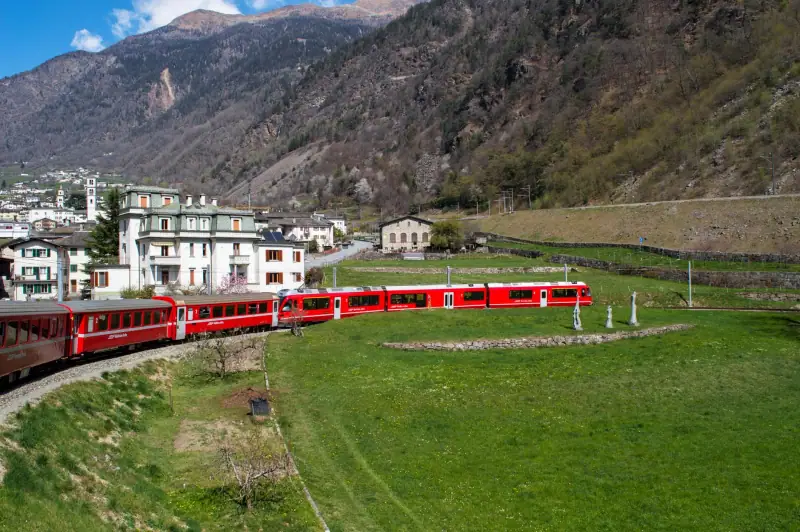
Glacier Express or Bernina Express: which panoramic train should you choose?
Glacier Express or Bernina Express: duration, scenery, reservations and passes. Compare Switzerland's two panoramic trains and pick the one for your trip.
7 days
7-day Switzerland itinerary by train: Lucerne, Interlaken, Zermatt and Lake Geneva
LucerneInterlakenZermattLausanne