Itineraries
Tanzania and Zanzibar in 12 days: a northern safari, then the beach
We may earn a commission when you book through links on this page, at no extra cost to you. We don't visit or try the places we cover: we summarize published sources. How we work
Day by day
- Day 1Land at Kilimanjaro, transfer to Arusha
- Days 2-7Guided safari: Tarangire, Manyara, Ngorongoro, Serengeti
- Days 8-9Fly to Zanzibar, Stone Town
- Days 10-11East coast beaches at Paje or Jambiani
- Day 12Transfer to Zanzibar airport, fly home
Where to sleep
- Arusha1 night
- Northern safari circuit (Tarangire, Serengeti, Ngorongoro)6 nights
- Stone Town (Zanzibar)2 nights
- Paje or Jambiani (east coast of Zanzibar)2 nights
In short
- Fly into Kilimanjaro (JRO), spend six days on a guided 4x4 safari through Tarangire, Manyara, Ngorongoro and the Serengeti, then fly to Zanzibar and out of ZNZ.
- The safari is guided: a driver-guide and a 4x4 with a pop-up roof are the norm, so there is no car rental on this trip.
- Zanzibar has two bases: two nights in Stone Town, then two on the east coast at Paje or Jambiani, about 50 km (31 mi) across the island.
- June to October suits both the parks and the beaches, but it is also the most expensive and busiest period.
This 12-day trip is for travelers who want a classic northern Tanzania safari and a few easy beach days in the same trip. It uses open-jaw flights: you land at Kilimanjaro International Airport (JRO) and leave from Zanzibar’s Abeid Amani Karume Airport (ZNZ), so you never double back. The safari is guided, with a driver-guide and a 4x4, so there is no car to rent and no driving to plan.
The shape is simple. One night in Arusha, six days on the northern circuit, then a plane to Zanzibar for two nights in Stone Town and two on the east coast. The longest road days are on the safari, notably the drive from Ngorongoro across the Serengeti and the way back to Arusha. On Zanzibar, the biggest move is a 50 km (31 mi) taxi ride across the island. For a detailed look at the safari, see our 7-day safari in northern Tanzania; for the island, our 7-day Zanzibar itinerary.
The route at a glance
| Days | Base | Nights | Getting there |
|---|---|---|---|
| Day 1 | Arusha | 1 | Transfer from Kilimanjaro airport (JRO), about 45 to 50 km (28 to 31 mi), close to an hour |
| Days 2-7 | Northern safari circuit: Tarangire, Lake Manyara, Ngorongoro, Serengeti | 6 | Guided 4x4 safari from Arusha, with lodging near the parks, around Karatu and in the Serengeti |
| Days 8-9 | Stone Town (Zanzibar) | 2 | Flight to Zanzibar, then a taxi of about 6 to 7 km (4 mi) |
| Days 10-11 | Paje or Jambiani (east coast) | 2 | Taxi across the island, about 50 km (31 mi), 50 minutes to 1 hour 15 |
| Day 12 | Departure from Zanzibar (ZNZ) | - | Taxi back to the airport |
Day by day
Day 1: Arrival and Arusha
Kilimanjaro airport sits on the road between Arusha and Moshi. Arusha is about 45 to 50 km (28 to 31 mi) away, or close to an hour by road. If your flight lands late at night or very early, our guide to sleeping near Kilimanjaro airport compares a night by the airport with going straight to town. Ask your hotel to arrange the transfer.
Arusha is the departure point for most northern safaris. It sits at about 1,400 m (4,590 ft), so nights are cooler than you might expect. Use the evening to meet your operator, confirm the program, change money or withdraw shillings, and buy water and sunscreen. If you land early and have a free half day, Lake Duluti is a small crater lake about 14 km (9 mi) from the center for a canoe trip and a walk, 20 to 30 minutes by car outside traffic jams. For hotels, our guide to where to stay in Arusha and Moshi covers the options, and see Hotels in Arusha.
Days 2-7: the northern safari circuit
This block follows days 2 to 7 of our 7-day northern circuit. Your vehicle and driver-guide are usually supplied by the operator, and park entrance fees are generally included in operator packages: check this before comparing offers. Departures are early, because the best viewing is in the morning and late afternoon. See Safaris and activities from Arusha.
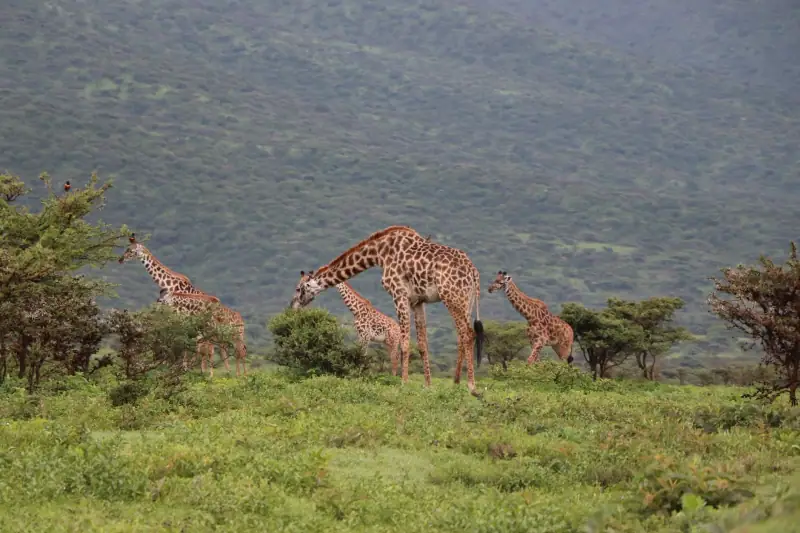
Day 2: Tarangire. From Arusha the park is generally two to three hours away by road. Tarangire is known for its baobabs and its elephant herds, especially in the dry season when animals gather along the Tarangire River. You also often see zebras, wildebeest, giraffes and many birds. Lions and leopards are more discreet. Spend the day in the park with a picnic. Read our Tarangire guide for what to expect. Sleep in a lodge or camp near the park, or continue late toward Karatu, depending on your operator.
Day 3: Lake Manyara and Karatu. Manyara is more compact and can be visited in half a day, with groundwater forest, plains and lakeshore under an escarpment. Baboons, elephants, hippos and many birds are common. In the afternoon the road climbs to the Karatu highlands near the Ngorongoro entrance, where evenings are cool: pack a fleece. Our guide to Karatu or Mto wa Mbu helps you choose where to sleep.
Day 4: Ngorongoro Crater. The caldera is about 20 km (12 mi) across, and its floor holds zebras, wildebeest, buffalo, hyenas, lions, hippos and, rarely and usually at a distance, black rhinos. You descend early on a track reserved for authorized vehicles, and time on the floor is limited by regulation. Giraffes are absent from the crater floor. Bring binoculars and a zoom lens. Our Ngorongoro guide has the day step by step. Afterward you head toward the Serengeti or spend another night around the crater, depending on the program.
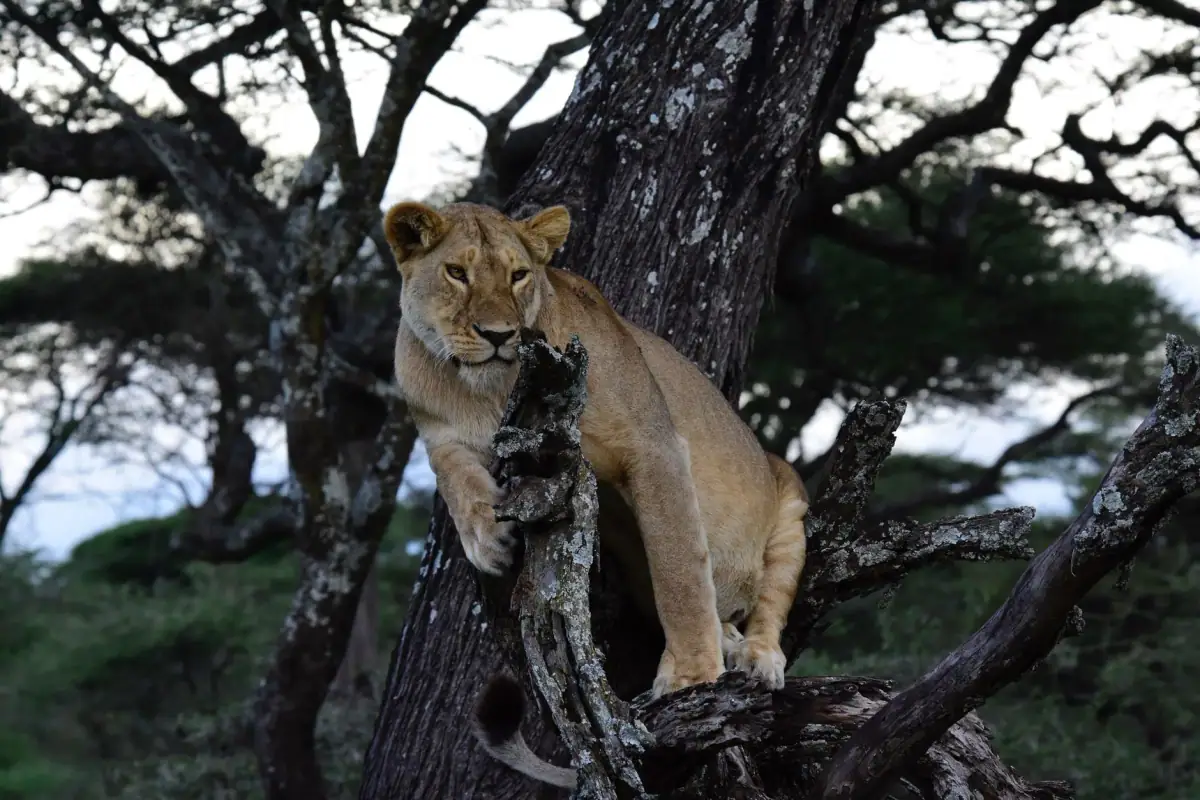
Days 5-6: the Serengeti. The road from Ngorongoro crosses the conservation area and takes a good part of the day. On the way, the guide mentions Olduvai Gorge, a short stop with a small museum. Once in the park, days are built around a sunrise game drive and a late-afternoon one, with a break at the lodge or camp in between. Cats are the main draw: lions, cheetahs on the open plains and leopards in riverside acacias. Our Serengeti and Great Migration guide advises at least two nights in the park, and your choice of area depends on the month. Some travelers fly to the Serengeti from Arusha to save time, an option to discuss with your operator and budget. For more on lodging types, see where to stay on safari in Tanzania.
Day 7: back to Arusha. You leave the Serengeti early, pass back through the Ngorongoro area and drive down to Arusha late in the day, or return on a domestic flight. The 7-day guide leaves the exact nights of days 2 and 4 open, so we name no lodge: ask your operator which one is booked. Sleep in a comfortable hotel and keep a safety margin for the flight the next morning.
Days 8-9: Stone Town
Our guides say Zanzibar is easily reached by domestic flight from the Arusha region. We give no flight time, because none of them does: ask your operator or the airline. The airport is about 6 to 7 km (4 mi) from Stone Town, and a taxi takes 15 to 25 minutes, for roughly $10 to $20.
Day 8. Drop your bags in the old town, a UNESCO World Heritage Site since 2000, then walk the lanes of the Shangani district. In the evening, the Forodhani Gardens waterfront turns into a food market at nightfall, with skewers, urojo, chips mayai and sugarcane juice. A full meal costs €3 to 8 (~$3-9). Pick a hotel in the old town to be inside the maze: see Hotels in Stone Town.
Day 9. Start at Darajani market between 7 and 9 am, when it is busiest. Then follow the carved doors (more than 500, each unique), the Christ Church Cathedral on the site of the last slave market, the Freddie Mercury Museum in Shangani and the Old Fort, built by the Omanis in the 17th century. The House of Wonders has been closed for restoration for several years: check with your lodging whether it has reopened. End at the Mizingani Road waterfront for sunset. A local guide for your first visit costs 20 to 30 USD for 2 hours, and the lanes are easy to get lost in. Details are in our Stone Town highlights guide. If you prefer, the 7-day Zanzibar guide suggests a half-day spice tour (20 to 35 USD) and an afternoon on Prison Island, 20 minutes by boat, known for its giant tortoises.
Days 10-11: Paje or Jambiani
Stone Town to the east coast is about 50 km (31 mi), crossing the interior through Tunguu. A private taxi takes 50 minutes to 1 hour 15 and costs 25 to 35 USD to Paje, slightly more to Jambiani; agree on the price first. Daladalas (shared minibuses) are cheaper, at roughly 1 to 2 USD, but take 1 hour 30 to 2 hours. Jozani-Chwaka Bay Forest, home to the endangered Zanzibar red colobus, lies about 35 km (22 mi) southeast of Stone Town on the same road. It is open daily from 7:30 am to 5 pm, with a guide included in the 10 to 12 USD adult ticket, and it makes an easy stop: see Jozani without a tour.
Choose your village by mood. Paje is lively and international, and it is the kitesurfing hub, with a wide shallow lagoon. Jambiani, about 10 km (6 mi) south, is a traditional Swahili village with seaweed farming and cheaper lodging. For two nights, either works; our east coast guide suggests combining the two, and the Jambiani guide covers the village. See Hotels in Paje.
The big thing to know here is the tide. The east coast sees two high and two low tides a day, with a range of 3 to 4 m (10 to 13 ft). At low tide the lagoon can be almost dry over 500 m to 1.5 km (1,640 ft to 0.9 mi), so plan swimming around high tide. Check the times at your lodging each morning, and read our guide to the tides.
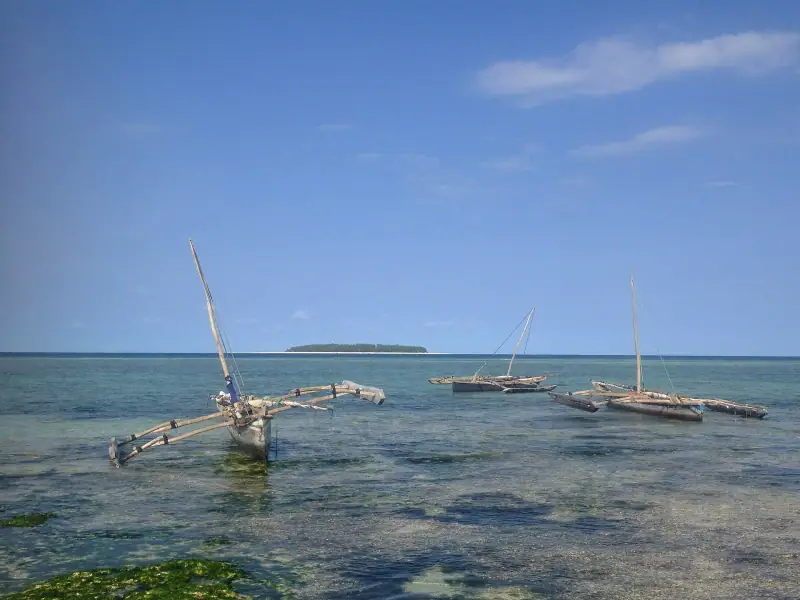
Day 10. Arrive, settle in, swim at high tide and walk the lagoon late in the afternoon. Day 11. Take your pick. Kitesurfing lessons cost about 60 to 80 USD for 2 hours privately. Safari Blue, a full-day dhow trip with snorkeling and a seafood lunch, costs about 60 to 100 USD per person (check whether transfers and marine reserve fees are included). Or rent a scooter or hire a bajaj to Jambiani to see the village and the seaweed at low tide. Book activities through your lodging or see activities in Paje.
Day 12: back to the airport
Book your airport taxi the day before. Our guides disagree on the time and price from the east coast: one gives about 45 minutes and 20 to 30 USD from the airport, another 1 hour to 1 hour 30 from Paje and 35 to 50 USD. Plan the longer figure, add 2 to 3 hours of airport lead time, and leave some margin for traffic. Jambiani and the east coast have few reliable ATMs, so withdraw cash in Stone Town or at the airport before you head east.
Getting there and away
You fly into Kilimanjaro International Airport (JRO) and out of Zanzibar Abeid Amani Karume Airport (ZNZ). These are the two airports of this trip. Our guides say flights to Tanzania generally involve a stopover and depend heavily on the season and the booking lead time, and we do not describe airlines or routes. Book the two airports as an open-jaw ticket, and book the domestic flight to Zanzibar separately or through your operator.
For entry requirements and health information, check the official travel advice of your own government: travel.state.gov (US), GOV.UK (UK), travel.gc.ca (Canada) or Smartraveller (Australia).
There is no car rental in this plan. Park tracks and the Ngorongoro Conservation Area cannot be driven in a regular rental car, and in the parks self-driving is not the usual formula. On Zanzibar, taxis cover the transfers.
When to go
Northern Tanzania has a main dry season from about June to October, with the best viewing conditions and tracks in good shape, and Tarangire’s elephants at their best. It is also the most expensive and busiest period, and the best lodges fill several months ahead. January and February are an underrated alternative, with green landscapes and calving in the southern Serengeti. The long rains run about March to May, and the short rains about November to December.
Zanzibar fits the same calendar. Its long dry season is June to October, rated the best time to visit. December to March is a second good window, hot and humid, with steady winds for kitesurfing in Paje. April and May are the long rains, when many hotels close and sea trips are canceled, so avoid them. November brings a few showers and lower prices. For the Great Migration, July to October is the usual river-crossing period in the north, while January to March is calving in the south. See when to go to Tanzania and the best time to visit Zanzibar.
Budget
Our Tanzania safari budget guide gives no price list, because quotes vary by a factor of three for programs that look identical. Park fees and the vehicle are a fixed base, and lodging, length and season explain most of the gap. The Serengeti weighs most on the budget, and the descent into Ngorongoro Crater is charged separately per vehicle. Always ask for a recent, detailed quote and check what it includes. Tips for the driver-guide and camp team are customary, so build them in. See the safari budget guide.
For Zanzibar, the east coast guide gives these figures:
- Local guesthouse in Jambiani: €40-80 per night (~$46-93). Boutique hotel in Paje: €100-250 (~$115-290).
- Local meal: €4-10 (~$5-12). Beach restaurant: €15-30 (~$17-35) per person.
- Taxi Stone Town to Paje: 25-35 USD. Bajaj Paje to Jambiani: 5-8 USD.
Adapt it
For a shorter trip, drop the Serengeti and use our 4-day safari through Tarangire, Manyara and Ngorongoro, then give the days to the beach. For a longer one, add a night in the Serengeti (the park guide suggests three or four nights if you want to follow the herds) or a third night on the east coast. If you would rather swim at any hour of the day, the 7-day Zanzibar guide uses Nungwi on the north coast, where the tide matters less. Kitesurfers can stay in Paje for all four beach nights.
Frequently asked questions
Do you need a car for this trip?
No. The safari is done with a driver-guide in a 4x4 with a pop-up roof, because park tracks cannot be driven in a regular rental car. On Zanzibar you use taxis for the transfers.
When is the best time for a safari and a beach stay in one trip?
June to October is the main dry season in the northern parks and the long dry season on Zanzibar, so it works for both. It is also the high season, with the highest rates. January and February are also good on both sides.
How do you get from the safari to Zanzibar?
By plane. The guides say Zanzibar is easily reached by domestic flight from the Arusha region. We give no flight time because our guides give none: ask your operator or airline.
How long is the transfer from Stone Town to Paje or Jambiani?
Paje is about 50 km (31 mi) from Stone Town. By taxi, allow 50 minutes to 1 hour 15 and 25 to 35 USD. Jambiani is about 55 km (34 mi) away, with a similar taxi time of 1 to 1.5 hours.
Ready-made
Tanzania itineraries
9 days
Tanzania and Zanzibar in 9 days: a short safari and the island
ArushaTarangire, Lake Manyara and the Ngorongoro CraterStone Town (Zanzibar)Kendwa or Nungwi (north of Zanzibar)