Itineraries
USA in 14 days: San Francisco, Yosemite, Big Sur, then Hawaii's Big Island
We may earn a commission when you book through links on this page, at no extra cost to you. We don't visit or try the places we cover: we summarize published sources. How we work
Day by day
- Days 1-3San Francisco on foot and by public transit
- Days 4-5Drive to Yosemite Valley; a full day in the park
- Day 6Yosemite to Monterey and Big Sur
- Days 7-8Highway 1 to Los Angeles; a day in the city
- Days 9-11Fly to Kona; Ali'i Drive, snorkeling, manta rays
- Days 12-13Drive to Volcano Village; Hawaii Volcanoes National Park
- Day 14Drive to Kona airport and fly home
Where to sleep
- San Francisco3 nights
- Yosemite Valley2 nights
- Monterey and Big Sur1 night
- Los Angeles2 nights
- Kailua-Kona3 nights
- Volcano Village2 nights
In short
- Eight nights in California by car (San Francisco, Yosemite, Big Sur, Los Angeles), then a flight to Kona and five nights on the Big Island.
- The two longest drives are Monterey to Los Angeles (about 6 h 15) and Yosemite to Monterey (about 4 h 25). Highway 1 can close after landslides.
- Pick up the car when you leave San Francisco and return it in Los Angeles: expect a one-way fee. A second car is needed on the Big Island.
- Fly into San Francisco (SFO) and home from Kona (KOA), or from Hilo (ITO) if your flight suits.
This trip is for readers who want two very different sides of the United States in two weeks: the fog, hills and granite of California, then the black lava, snorkeling beaches and active volcano of Hawaii’s Big Island. You fly into San Francisco, drive down through Yosemite and the Pacific coast to Los Angeles, then fly to Kona and finish on the island’s west and southeast sides. It covers 13 nights with six bases.
The shape is simple: 8 nights in California with about 1,130 km (700 mi) of driving between the bases, one flight of about 6 h, then 5 nights on the Big Island with two shorter drives. The two longest driving days are day 6 (about 4 h 25) and day 7 (about 6 h 15). Every other drive is 4 h 25 or less, and the Big Island legs are under 3 h.
The route at a glance
| Days | Base | Nights | Drive from previous base |
|---|---|---|---|
| 1-3 | San Francisco | 3 | 20 min, 22 km (13 mi) from San Francisco International Airport (SFO) |
| 4-5 | Yosemite Valley | 2 | about 4 h 25, 296 km (184 mi) |
| 6 | Monterey and Big Sur | 1 | about 4 h 25, 316 km (196 mi) |
| 7-8 | Los Angeles | 2 | about 6 h 15, 516 km (321 mi), along Highway 1 |
| 9-11 | Kailua-Kona (Big Island) | 3 | flight from Los Angeles (about 6 h), then 20 min, 14 km (9 mi) from Kona airport |
| 12-13 | Volcano Village (Big Island) | 2 | about 2 h 35, 165 km (102 mi) |
| 14 | Departure from Kona airport (KOA) | - | about 2 h 40, 165 km (103 mi) from Volcano Village |
Car rental in the USA
You pick up in San Francisco and drop off in Los Angeles: compare the one-way fee, and book early in summer.
Day by day
Days 1-3: San Francisco
From SFO the drive into the city is about 20 min, 22 km (13 mi), but you do not need a car in San Francisco. Our guides describe a city that is easy to visit on foot, by streetcar and by public transit, where parking is expensive and car break-ins are frequent. Never leave visible items in a parked car.
Plan the Golden Gate Bridge from several viewpoints, Fisherman’s Wharf, the cable cars, Chinatown, Lombard Street and the Victorian houses of Alamo Square. Morning fog is frequent, even in summer, so bring a jacket. Use the first day to adjust to the time change. For neighborhoods and hidden fees, see where to stay in the American West. Compare Hotels in San Francisco with the total price, taxes and fees.
This leg and the next three bases are covered by our 15-day American West road trip and the 9-day San Francisco to Las Vegas route.
Days 4-5: Yosemite Valley
Pick up the car when you leave the city on day 4. The drive to Yosemite Valley is about 4 h 25, 296 km (184 mi), longer with traffic leaving the Bay Area, so start early. Our guides advise sleeping in or near the park rather than doing a day trip.
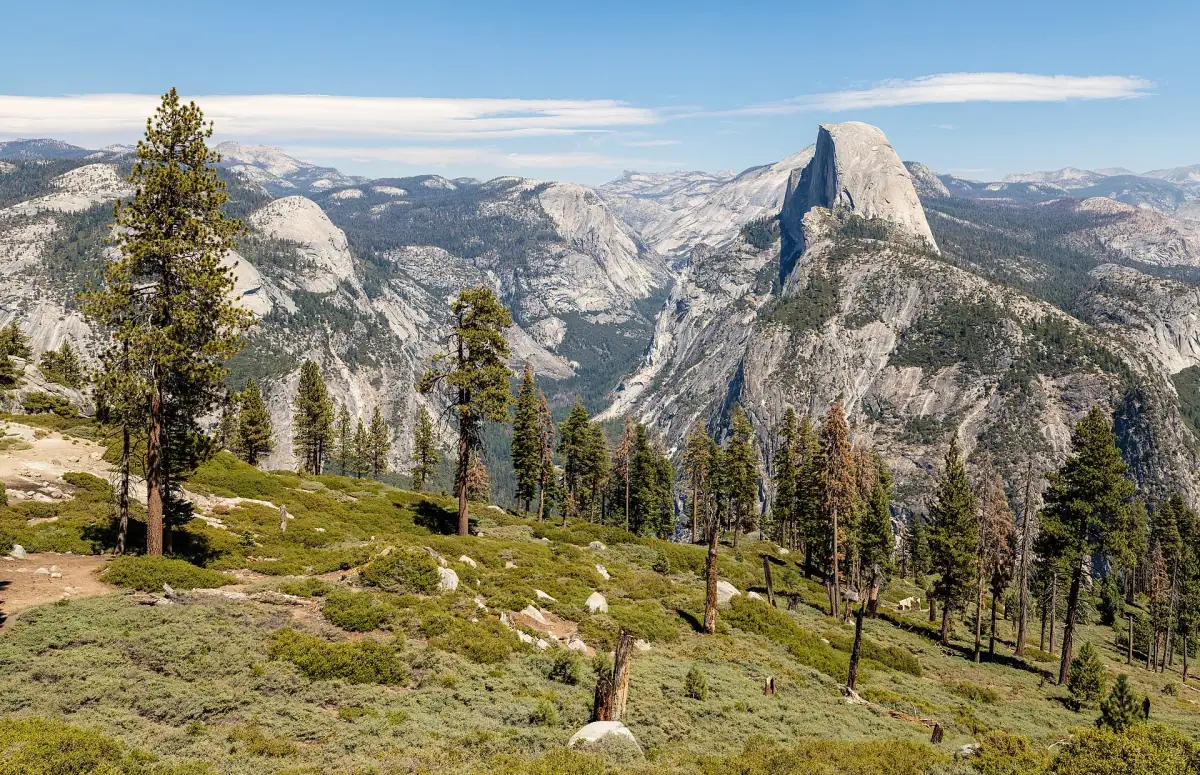
Day 5 belongs to the valley. Tunnel View shows El Capitan, Bridalveil Fall and Half Dome in one glance. Yosemite Falls is among the tallest waterfalls in North America, close to 2,425 ft (740 m) in three sections: powerful in spring, sometimes a trickle by late summer. The Mist Trail to Vernal Fall is demanding and slippery. Glacier Point and Mariposa Grove are other options if you have a third day, and Tioga Road is not on this route. Store food in the lockers provided, because black bears live in the park.
Lodging is the main challenge: the valley is the most practical and the quickest to fill, and the villages at the park gates add 30 min to 1 h of driving. Depending on the season, the park may require an access reservation, so check the official National Park Service website. See our guide to visiting Yosemite and Hotels near Yosemite. You can also compare Yosemite tours and excursions.
Day 6: Yosemite to Monterey and Big Sur
This is the first long day: about 4 h 25, 316 km (196 mi), to the Monterey area. It is a transfer day, with the night on the coast. Our 15-day guide describes Highway 1 as one of the most beautiful road stretches in the United States, with cliffs above the Pacific. Some sections have had closures due to landslides, so check the road status before you leave. Hotels in Monterey are the simplest way to compare the area.
Days 7-8: Highway 1 to Los Angeles
Day 7 is the longest drive of the trip: about 6 h 15, 516 km (321 mi), along Highway 1. The 15-day guide gives about 6 h from Big Sur to Los Angeles without stops, so add time for the small seaside towns along the coast and arrive early enough to avoid evening traffic.
Los Angeles is not covered by a dedicated guide on this site. The complete American West guide describes a sprawling city where everything is done by car, with beaches, Hollywood, Santa Monica and museums, and advises allowing time for traffic. Use day 8 for one or two of those, and compare Hotels in Los Angeles or activities in Los Angeles.
Days 9-11: Kailua-Kona
On day 9 you return the car in Los Angeles. Rental companies usually charge a one-way (drop-off) fee when the car is returned in another city, and it varies by company: check it when you compare offers. Then take the flight to Kona (KOA), which our Kona guide gives as about 6 h from Los Angeles. Kona airport is one of the few open-air airports in the United States. Pick up a new rental car there (see car rental on the Big Island): the airport is 20 min, 14 km (9 mi), from town.
On the first full day, walk Ali’i Drive from Kailua Pier. Hulihe’e Palace has a guided tour of about 45 minutes (adult entry $16), and Mokuaikaua Church, founded in 1820, is across the street. Kahalu’u Beach Park is the easiest snorkeling spot: arrive before 9 am for the best chance of seeing turtles, and keep 3 m (10 ft) away from them, as Hawaiian law requires. A mask and snorkel rental is at the park, about $12 a day.
The evening manta ray trip is the most in-demand activity on the coast. It lasts 2 h 30 to 3 h 30 and costs about $80 to $140 per adult, equipment included. Book a few days ahead, and do it early in your stay, since heavy swell or wind can cancel trips. The rays are never guaranteed. Our guides detail night snorkeling with manta rays. On another day, visit a Kona coffee farm (Greenwell Farms offers a free tour) and Pu’uhonua o Honaunau National Historical Park ($20 per vehicle, valid for 7 days). The Kailua-Kona guide and the 5-day Big Island road trip cover the rest. Compare Hotels in Kailua-Kona and activities in Kailua-Kona.
Days 12-13: Volcano Village
The drive from Kailua-Kona to Volcano Village is about 2 h 35, 165 km (102 mi), before stops. The 5-day Big Island guide suggests breaking it on the south coast, at Punalu’u Black Sand Beach, where green sea turtles often rest on the sand.
Volcano Village sits at about 1,200 m (3,940 ft) in a rainforest, less than 2 km (1.2 mi) from the main entrance of Hawaii Volcanoes National Park. Nights are cool, 12 to 15 °C (54 to 59 °F) according to the 5-day guide, so bring warm layers. Lodging is mostly forest B&Bs and cabins, around €120 to €220 a night (about $140 to $255). There are very few restaurants, so plan your meals. Compare Hotels in Volcano Village.
Day 13 is for the park (entry $30 per vehicle, valid for 7 days). Drive Crater Rim Drive for the Kilauea Overlook and Uēkahuna Overlook, walk the lit Thurston Lava Tube and the Devastation Trail, then take Chain of Craters Road, 30 km (19 mi) down to the ocean. The Kilauea Iki Trail, 5 km (3 mi) and about 2 h, crosses a former lava lake. Kilauea erupts in episodes, so check the NPS or USGS website. If you go at dusk, you may see the glow from the crater. See also the Hilo guide and where to stay on the Big Island.
Day 14: back to Kona airport
Volcano Village to Kona airport (KOA) is about 2 h 40, 165 km (103 mi). Leave early if your flight is in the morning. Alternatively, you can fly out of Hilo (ITO), 45 min and 47 km (29 mi) from Volcano Village, if your flight home suits. Our Hilo guide says direct flights from Los Angeles and San Francisco exist but are less frequent than to Kona, and that Hilo airport has fewer rental agencies.
Getting there and away
Travelers from the US, UK, Canada and Australia can use the two big gateways on this route: San Francisco International Airport (SFO) to arrive, and Ellison Onizuka Kona International Airport (KOA) to leave. Book an open-jaw ticket (into SFO, out of KOA) so you do not backtrack. Our guides do not list airlines or routes from outside the US. Los Angeles International Airport (LAX) is the usual airport for the Los Angeles to Kona flight, which our Kona guide gives as a direct flight of about 6 h.
If you are not a US citizen, entry rules depend on your passport: check your own government’s official travel advice before you book, such as GOV.UK (UK), travel.gc.ca (Canada) or Smartraveller (Australia).
When to go
Spring is good for Yosemite’s waterfalls, at peak flow from snowmelt, but some high-elevation roads, including Glacier Point Road, are still closed. Summer opens every road but brings the biggest crowds, and early summer fog is common around San Francisco. Fall is quieter, with reduced waterfalls; our guides add that the California coast often has its warmest, clearest days in September and October. In winter, Glacier Point Road closes, chains may be required, and the valley stays open.
Hawaii has two seasons: Kau, the dry season, from May to October, and Hooilo, the wetter season, from November to April. The Big Island is split: Hilo and the windward side get about 3,200 mm (126 in) of rain a year, the Kona coast under 500 mm (20 in), so Volcano Village is often gray and drizzly even on good days. April and May are shoulder season with better prices, apart from Memorial Day week. June to August and school vacations are high season, and so is the winter period from December, which is also humpback whale season until April. Read when to go to the American West and the best time to visit Hawaii before fixing dates.
Budget
Our guides do not price this exact route, so here are the figures by region.
- California and the West (from the American West budget guide): per night for a double room, taxes and fees included, about $90 to $130 (economy), $150 to $230 (comfort) and $280 to $400 and more (premium). A rental car runs about $50 to $60 a day (economy) or $70 to $90 (mid-size), extra insurance included. Fuel in California is higher than in Utah and Arizona, sometimes close to $6 a gallon. US prices are shown before sales tax, and a tip of 18 to 20% is normal in sit-down restaurants.
- National parks: since January 1, 2026, non-resident visitors aged 16 and over pay a $100 per person surcharge in 11 parks, including Yosemite, on top of the entrance fee. The non-resident annual pass costs $250 and includes the surcharge. For a couple at Yosemite alone, the surcharge is about $235 with the entrance fee, close to the price of the pass. Check the National Park Service website for current fees.
- Big Island (from the Hawaii budget guide and the 5-day guide): a 3-star hotel is about €100 to €180 a night (about $115 to $210) and a rental about €70 to €150 (about $81 to $175). Cars run €60 to €120 a day (about $70 to $140). Resort fees are $25 to $50 a night at most resorts. Big Island is generally the cheapest island for lodging.
Adapt it
For a shorter trip of 11 days, skip Monterey, Big Sur and Los Angeles and fly from San Francisco to Kona instead, which our Kona guide gives as a direct flight of 5 h 30. With extra days, add Lee Vining and Death Valley by the Tioga Pass road, as in the 9-day route, or an extra night in Hilo on the Big Island. Island hopping to Honolulu or Maui is a short flight (about 45 to 50 minutes from Kona according to our guides). To change the bases, use the regional planners for the American West and for Hawaii. The complete American West guide gives the wider picture.
Frequently asked questions
Is 14 days enough for California and the Big Island?
Yes, if you accept two long driving days in California and keep the Big Island to two bases. The route uses 13 nights: 8 in California and 5 on the Big Island, with a single night in Monterey and Big Sur.
Do you need a car in both places?
Yes. In California the car replaces public transit once you leave San Francisco, and our Hawaii guides say a car is essential on the Big Island, where there is no viable tourist public transport. You return the first car in Los Angeles and rent a second one at Kona airport.
Will you pay a fee to return the car in another city?
Rental companies usually charge a one-way (drop-off) fee when you return the car somewhere other than where you picked it up. It varies by company, so check it when you compare offers. Our guides give no amount.
Do you need a reservation for Yosemite?
Depending on the season, the park may require an access reservation or permits, and lodging in and around the park fills very early. Check the official National Park Service website for your dates before you book.
Do visitors from the UK, Canada or Australia need anything special?
Entry rules depend on your passport. Check your own government's official travel advice before you book: GOV.UK (UK), travel.gc.ca (Canada) or Smartraveller (Australia). Non-residents also pay a surcharge at some national parks, including Yosemite: see the budget section.
Ready-made
USA itineraries
15 days
USA in 15 days: New York, Washington, then the canyon country
New YorkPhiladelphiaWashington, D.C.Las VegasSpringdale (Zion)Bryce CanyonPageGrand Canyon (Tusayan)Las Vegas
21 days
USA in 21 days: the national parks of the West, then Maui
Las VegasSpringdale (Zion)Bryce CanyonPageMonument ValleyGrand Canyon (Tusayan)Las VegasDeath Valley (Furnace Creek)Yosemite ValleySan FranciscoKihei (Maui)Kaanapali (Maui)