Itineraries
Nepal with Kids: A 12-Day Family Itinerary with Gentle Stages and Tips
We may earn a commission when you book through links on this page, at no extra cost to you. We don't visit or try the places we cover: we summarize published sources. How we work
Day by day
- Days 1-4Kathmandu: rest day, Swayambhunath, Boudhanath, Bhaktapur, cooking class
- Days 5-7Pokhara: flight or bus, Phewa Lake boat, Peace Pagoda viewpoint
- Day 8Bandipur, car-free hill village
- Days 9-11Chitwan: road trip, jeep safari, canoe, Tharu village
- Day 12Return to Kathmandu with a comfortable margin
Where to sleep
- Kathmandu4 nights
- Pokhara3 nights
- Bandipur1 night
- Chitwan3 nights
In short
- Twelve days link Kathmandu (days 1 to 4), Pokhara (days 5 to 8), Bandipur (day 8), Chitwan (days 9 to 11) and the return (day 12), with no excessive altitude.
- Plan one main activity a day, a quiet break midday and a margin for the unexpected; the flight is often the best choice between Kathmandu and Pokhara with children.
- October-November and March-April are the most comfortable: mild temperatures and clearer skies. The Terai can be very hot in summer.
- The itinerary is designed for children from about 6-7 years old, and adapts to other ages.
Traveling to Nepal with children is not an expedition reserved for mountaineers. Between the temples of Kathmandu, the boats on Pokhara’s lake, the lanes of Bandipur and the safaris of Chitwan, the country offers short, very visual and often playful days that please the youngest as well as teenagers. The key is to build a slow circuit without altitude, and to leave room for the unexpected.
This 12-day itinerary follows a simple logic: start with the capital to get used to the country’s pace, move through the hills and the lake, then finish in the Terai jungle. It is designed for children from about 6-7 years old, but adapts easily to different ages. If you want a more classic version first, see our two-week itinerary in Nepal.
Preparing the family trip
When to go
The choice of season matters even more with children. October-November and March-April offer the most pleasant conditions: mild temperatures, clear skies, visible landscapes. During the monsoon, roads can be slowed by rain, and leeches and mosquitoes are more numerous in some areas. The details are in our guide when to go to Nepal.
Formalities and insurance
Every traveler, children included, needs a valid passport and the right entry documents. Entry rules depend on your passport. Check the official travel advice of your government before you book: travel.state.gov (US), GOV.UK (UK), travel.gc.ca (Canada), Smartraveller (Australia) (checked November 2026). The steps are explained in our article on formalities for Nepal: always check current conditions and fees before leaving, notably for minors.
Travel insurance with good medical cover and repatriation is strongly advised, especially with children.
Health and travel kit
For the kit, think of:
- Child-friendly insect repellent and high sun protection;
- Hand sanitizer and wipes.
To complete your gear, our selection of accessories for Nepal gives you practical ideas.
Budget
Nepal remains affordable, but family trips cost more than a solo traveler’s: family rooms, private taxis rather than buses, a few domestic flights. Our article Nepal budget helps you establish an order of magnitude according to your travel style.
Days 1 to 4: Kathmandu, gently
Day 1: arrival and rest
After the flight, do not try to see everything. A first day with no program lets children recover from jet lag and get used to the traffic, noise and smells of the city. A short walk around your accommodation’s neighborhood, an early dinner and a full night are enough.
For sleeping, preferably choose a place with a family or connecting room, a garden if possible, and a good reputation for welcoming children. Our guide where to stay in Kathmandu compares the neighborhoods: Thamel is lively but noisy, other calmer areas suit families better.
Find family lodging in Kathmandu
Compare hotels and guesthouses with family rooms before booking your first stage.
Day 2: Kathmandu’s major sites
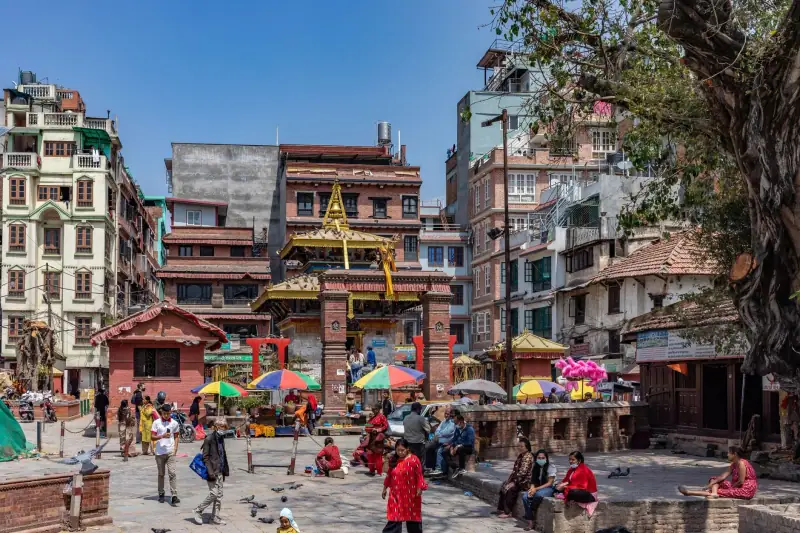
Choose two visits at most, with a long break in the shade or on a terrace. The Swayambhunath temple, perched on its hill, often fascinates children with its painted Buddha eyes and its macaques. Watch your belongings and do not give food to the monkeys, which can be pushy. The Boudhanath stupa, with its prayer flags and pilgrims walking around it, is calmer and easy to visit.
Our guide what to do in Kathmandu details the sites, and the 3-day Kathmandu itinerary offers a fuller sequence if you stay longer.
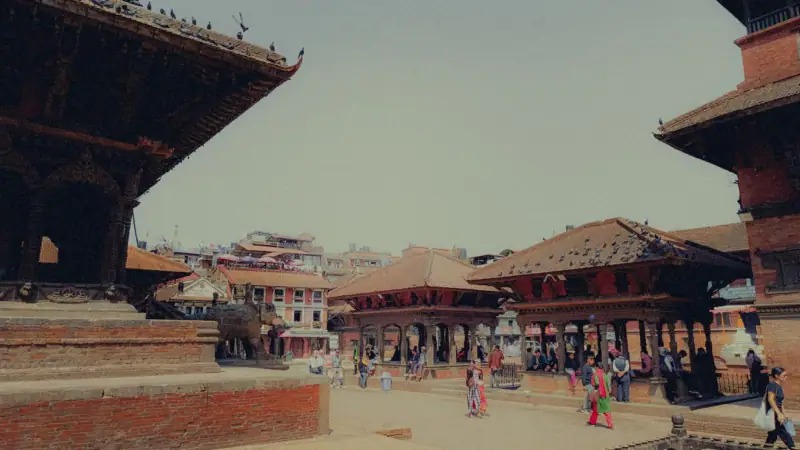
Day 3: Bhaktapur, the city of artisans
East of the capital, Bhaktapur is often the one children like best: less traffic in the center, open squares, potters working in the open air. Let them watch the craft, and suggest they try drawing or spinning a little clay if a workshop allows it. Our article visiting Bhaktapur and Patan helps you organize the day.
Plan a taxi for the day rather than public transport: it avoids lines and complicated connections with tired children.
Day 4: a freer day
Keep this day for what your children liked, or for a calmer activity: a cooking class, a mandala painting workshop, a walk in a garden. Cooking is an excellent way to involve them in discovering the country.
Cooking classes in Kathmandu
Learn to fold momos as a family: browse the workshops and experiences offered by local hosts.
To know what to have them taste, read our article on Nepali cuisine and its specialties: momos, dal bhat and soups are generally well accepted by children.
Days 5 to 8: Pokhara and the hills
Day 5: from Kathmandu to Pokhara
There are two options. The tourist bus or private taxi is a cheaper trip, but long and winding, sometimes slowed by traffic and the state of the road. The domestic flight is much shorter and leaves more energy for what follows. With children, the flight is often the best choice, especially if one of them handles the road badly. Book ahead, because schedules and flight conditions can vary with the weather.
On arrival, settle in a place near the lake and rest. Our guide where to stay in Pokhara presents the neighborhoods, including the lakeside one, practical and lively.
Day 6: Phewa Lake at your own pace
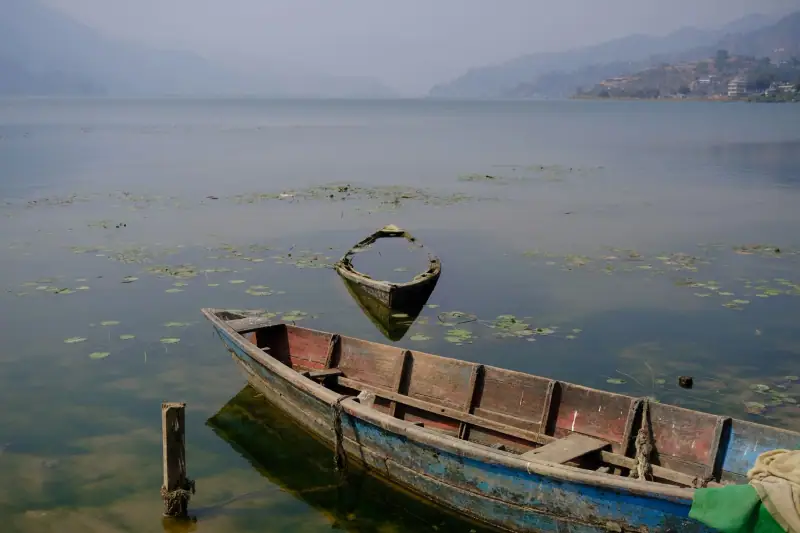
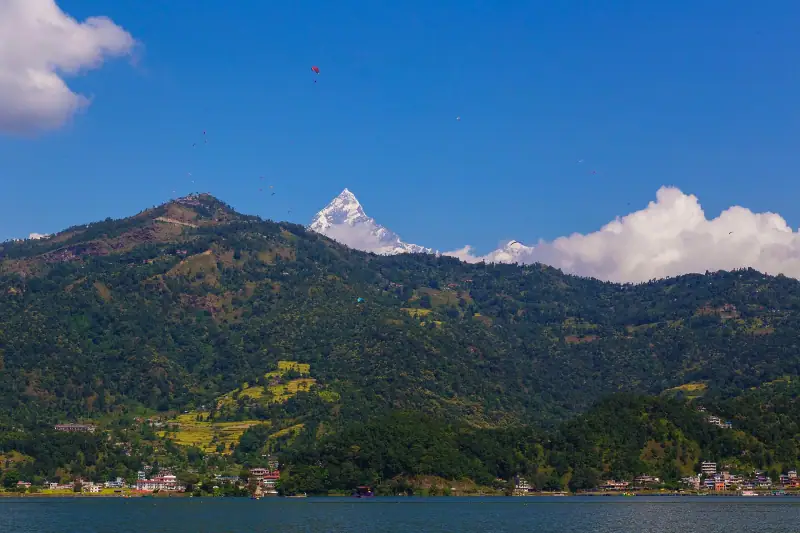
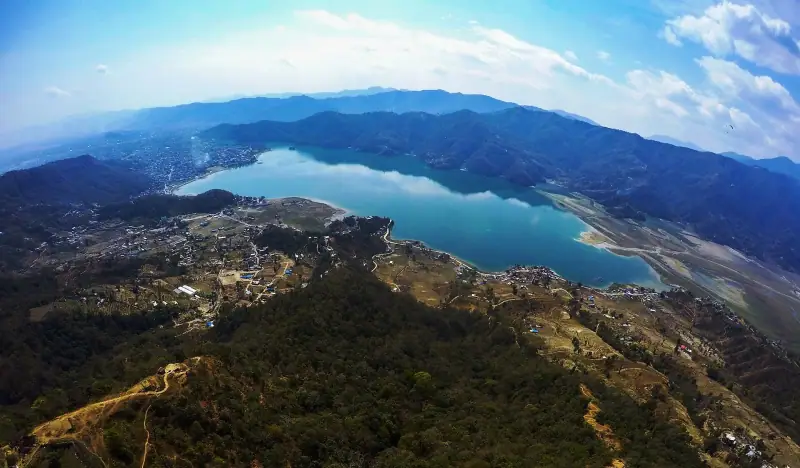
Phewa Lake is an ideal playground: a boat rented by the hour, swimming depending on the spots and conditions, a walk along the shore. Children love rowing, even clumsily. In the morning, when the air is clear, the Himalayan summits can appear on the horizon, and the reflection of the mountains on the water is one of the finest memories of the trip.
Bring life jackets suited to the children’s size: ask the boat renter for them, and decline the outing if they are not available.
Day 7: a viewpoint over the Himalaya
For a high-up walk without excessive difficulty, think of a viewpoint reachable by taxi or a short hike above the city, such as the World Peace Pagoda. The idea is to start early, walk little and enjoy the view with a snack. Our guide what to do in Pokhara details these options, as well as other activities: museums, caves, paragliding for older children depending on safety conditions and operators’ age limits.
Day 8: Bandipur, a village out of time
Bandipur is a hill village perched on a ridge, with a pedestrian main street lined with Newar houses. It is a stage families like: no traffic, short walks, sunsets and a peaceful atmosphere. Access is by road from the main route between Kathmandu and Pokhara; ask your accommodation to arrange a taxi.
Sleep in Pokhara or Bandipur
Compare family rooms with a view of the lake or the valley.
Days 9 to 11: Chitwan, the Terai jungle
Day 9: road to Chitwan
From Bandipur or Pokhara, the road to the Terai descends toward the plain and the heat increases. Allow half a day to a day of travel depending on conditions, with breaks. Arrive in the afternoon, settle in and let the children enjoy the pool or garden of the accommodation if it has one.
Day 10: safari and wildlife encounters
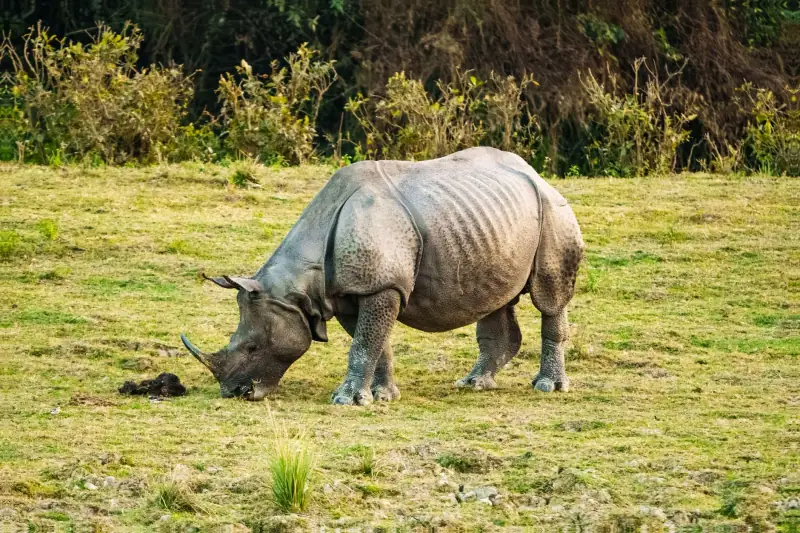
Chitwan National Park is one of the best places in Nepal to watch wildlife: one-horned rhinoceroses, deer, birds, crocodiles and, with luck, other more discreet animals. Jeep safaris and dugout canoe rides are the activities best suited to families. Listen carefully to the guide and follow the safety instructions: wild animals remain unpredictable.
Our Chitwan safari guide explains how to choose a package, the favorable periods and the rules to follow. Avoid activities that involve direct contact or dubious working conditions for the animals: favor operators that value observation from a distance.
Safaris and excursions in Chitwan
Jeep, dugout canoe, walk with a naturalist guide: compare the options and choose the one that suits your children.
Day 11: Tharu village and culture
Devote the morning to a cultural visit: the Tharu people have long lived in this region of the Terai, and some villages welcome visitors for dance, cooking or craft demonstrations. It gives children another image of Nepal, far from the mountains. Check that the activity is organized respectfully, with real participation from the residents.
Day 12: back to Kathmandu
The last day is devoted to the return. Depending on your international flight, plan a comfortable margin between arriving in Kathmandu and departing: road or flight delays are frequent. A domestic flight from Bharatpur, the town near Chitwan, remains an option to save time, subject to availability.
Variations by children’s age
With toddlers
Limit the stages to two or three places: Kathmandu, Pokhara and possibly Chitwan. Favor domestic flights, lodgings with a kitchen or a reliable restaurant, and bring a light stroller or baby carrier: sidewalks are often uneven, which makes strollers impractical.
With teenagers
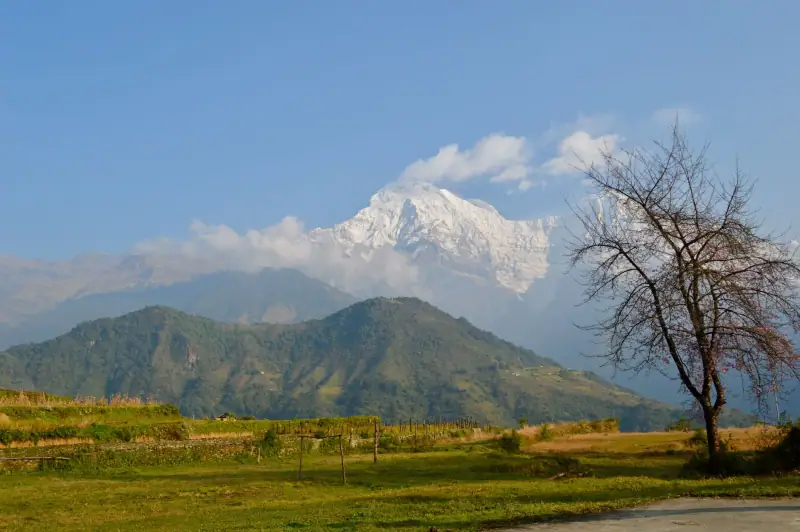
Add more athletic activities: a short trek of two to three days in the hills above Pokhara, rafting on a river of suitable level, or an introduction to paragliding depending on conditions and the operator’s age limit. Our article on the 10-day trek to Poon Hill can serve as inspiration for a sportier version of the trip, to adapt with a local guide.
If you have more time
With an extra week, add Lumbini, the Buddha’s birthplace according to tradition, visited on foot or by bike in a large, calm park, and leave a full rest day between each stage.
Practical tips for traveling with children
Transport
Roads are winding and journey times often longer than the map suggests. Allow generous time, start early and avoid driving at night. When hiring a car with a driver, ask for a vehicle with seat belts in the back seats: this is not always the case, and child seats are rare. Bring a booster or a suitable seat if you can.
Food and water
Use bottled or filtered water, including for brushing the youngest children’s teeth. Prefer hot dishes cooked to order, fruit you peel yourself and busy restaurants. For drinks, our article on traditional drinks of Nepal distinguishes what suits children (light milk tea, fresh juice pressed in front of you) from what is not for them.
Pace and fatigue
Plan just one big activity a day, a quiet time in the middle of the day and a margin for the unexpected: power cuts, delays, storms. Tired or sick children need a day off: better a flexible itinerary than non-changeable bookings.
Respecting customs
Explain a few simple rules to children: take off shoes at temple entrances, do not touch people’s heads, walk around stupas clockwise, ask before photographing. They often remember them better than adults, and it eases encounters.
Budget and booking
For a family, the main expense items are international flights, domestic flights, family lodgings and private transport. Book international flights and the first night in Kathmandu ahead, then keep flexibility for the rest, depending on mood and weather. In high season (October-November especially), the good places fill up quickly: better to book a few weeks ahead.
In summary
A family trip to Nepal is an accessible adventure, as long as you choose a gentle itinerary, limit altitude and leave rest time. Kathmandu for temples and crafts, Pokhara for the lake and hills, Bandipur for tranquility, Chitwan for wildlife: these four stages make a balanced trip, where everyone finds something to marvel at. To go further, reread our complete guide to Nepal before finalizing your plan.
Frequently asked questions
Is Nepal suitable for travel with young children?
Yes, as long as you choose an itinerary without excessive altitude and limit long road days. The stages of Kathmandu, Pokhara, Bandipur and Chitwan stay at low or medium altitude and offer varied activities.
What is the best time to go as a family?
Autumn (October-November) and spring (March-April) are generally the most comfortable: clearer skies, mild temperatures. The monsoon (June to September) brings rain and humidity, and summer in the Terai can be very hot. Our article on when to go to Nepal details the seasons.
What insurance do you need with children?
Travel insurance with good medical cover and repatriation is strongly advised, especially with children.
Are the roads tiring for children?
They can be: roads are winding and journeys longer than the map suggests. Plan short stages, regular breaks and domestic flights if a journey seems too tiring.
Can you trek with children?
Yes, walks of a few hours or short low-altitude routes suit many children. Avoid high-altitude treks with young children. A local guide makes things easier.
What about water and food with children?
Drink sealed bottled or filtered water, avoid ice and raw vegetables washed in tap water. Rice, soups, steamed momos and hot dishes cooked to order are generally safe choices.
How much time should you plan?
Twelve days is a good basis for a first family trip: it leaves rest time between stages. Ten days remain possible by dropping Bandipur, and a three-week version lets you add Lumbini or a gentle hike.
More Nepal guides
Keep reading
Nepal Travel Budget: Real Costs, 3 Profiles and Ways to Save
What budget for Nepal? Costs by item (lodging, transport, food, activities, permits), three budget profiles and tips to spend less.
Paragliding in Pokhara: Prices, Booking Ahead or on Site, Season and Requirements
Tandem paragliding in Pokhara: rough budget, booking the day before or online, best months, Sarangkot takeoff, age, weight and insurance to check.
Things to Do in Pokhara: Lake, Peace Pagoda and Himalayan Views
What to do in Pokhara? Phewa Lake, Peace Pagoda, Sarangkot, paragliding, caves and the Mountain Museum: ideas for 2 to 4 days.
Ready-made
Nepal itineraries
3 days
Kathmandu in 3 Days: Day-by-Day Itinerary, Temples, Newar Cities and Tips
A 3-day itinerary for Kathmandu and its valley: Durbar Square, Swayambhunath, Pashupatinath, Boudhanath, Patan and Bhaktapur, with transport and tips.
10 days
Nepal in 10 Days: Kathmandu, Pokhara and the Poon Hill Trek
A 10-day Nepal itinerary: Kathmandu temples, Pokhara's lake and a short 4-day Poon Hill trek, with tips, permits and a rough budget.
14 days
Nepal in 2 Weeks: Day-by-Day Itinerary from Kathmandu to Chitwan
KathmanduBandipurPokharaChitwan National Park