Itineraries
Kathmandu in 3 Days: Day-by-Day Itinerary, Temples, Newar Cities and Tips
We may earn a commission when you book through links on this page, at no extra cost to you. We don't visit or try the places we cover: we summarize published sources. How we work
Day by day
- Day 1Kathmandu Durbar Square, Thamel, Garden of Dreams
- Day 2Swayambhunath, Pashupatinath, Boudhanath
- Day 3Patan in the morning, Bhaktapur in the afternoon
In short
- Day 1 covers historic Kathmandu (Durbar Square, Thamel, Garden of Dreams), day 2 Swayambhunath, Pashupatinath and Boudhanath, day 3 Patan and Bhaktapur.
- Thamel is the most practical area to stay for a short visit: restaurants, agencies and taxis within walking distance.
- October-November and March-April are generally the most pleasant months; the monsoon (June to September) brings frequent rain.
- Take a taxi for distant sites and agree on the price before you leave. A site 8 km (5 mi) away can take over half an hour at peak times.
Kathmandu often feels dizzying: horns, incense smoke, narrow lanes, temples on every square. With three well-organized days, you can still grasp the essentials of the capital and its UNESCO World Heritage valley without rushing from one site to the next.
This itinerary is for people arriving in Nepal with little time, or who want to prepare the start of a longer trip. It follows a simple logic: historic Kathmandu on the first day, the major spiritual sites on the second, the Newar cities of Patan and Bhaktapur on the third. For an overview of what to see, our guide to what to do in Kathmandu is a good complement.
Before you go: organizing your three days
Where to stay
For a short stay, it is best to sleep in a single neighborhood and radiate out from there. Thamel concentrates accommodation of all categories, restaurants, gear shops and agencies: it is the most practical starting point. Our article on where to stay in Kathmandu compares the neighborhoods by traveler profile.
Book your accommodation in Kathmandu
Compare hotels and guesthouses in Kathmandu, from Thamel to Boudhanath, before fixing your three days.
When to come
October-November and March-April are generally the most pleasant months: clearer skies, mild temperatures, and sometimes a view of the Himalaya from the heights of the valley. The monsoon turns the streets into puddles and the sky often stays overcast. The details are in our article on when to go to Nepal.
Getting around
The valley is dense, but traffic slows everything down. A few principles:
- Group the sites by area to limit travel.
- Take a taxi for sites far from the center and agree on the price before leaving.
- Start early: the light is better, the crowds thinner, and the day stretches more easily.
- Walk in the historic center, where distances are short and the lanes are the real show.
Basic temple rules
Take off your shoes when asked, walk around stupas clockwise, avoid touching offerings and ask before photographing a ceremony. Entrance tickets to some sites are charged to foreigners: bring enough to pay, and check current prices there or with your accommodation rather than relying on an old figure.
Day 1: historic Kathmandu
Morning: Durbar Square and the nearby lanes
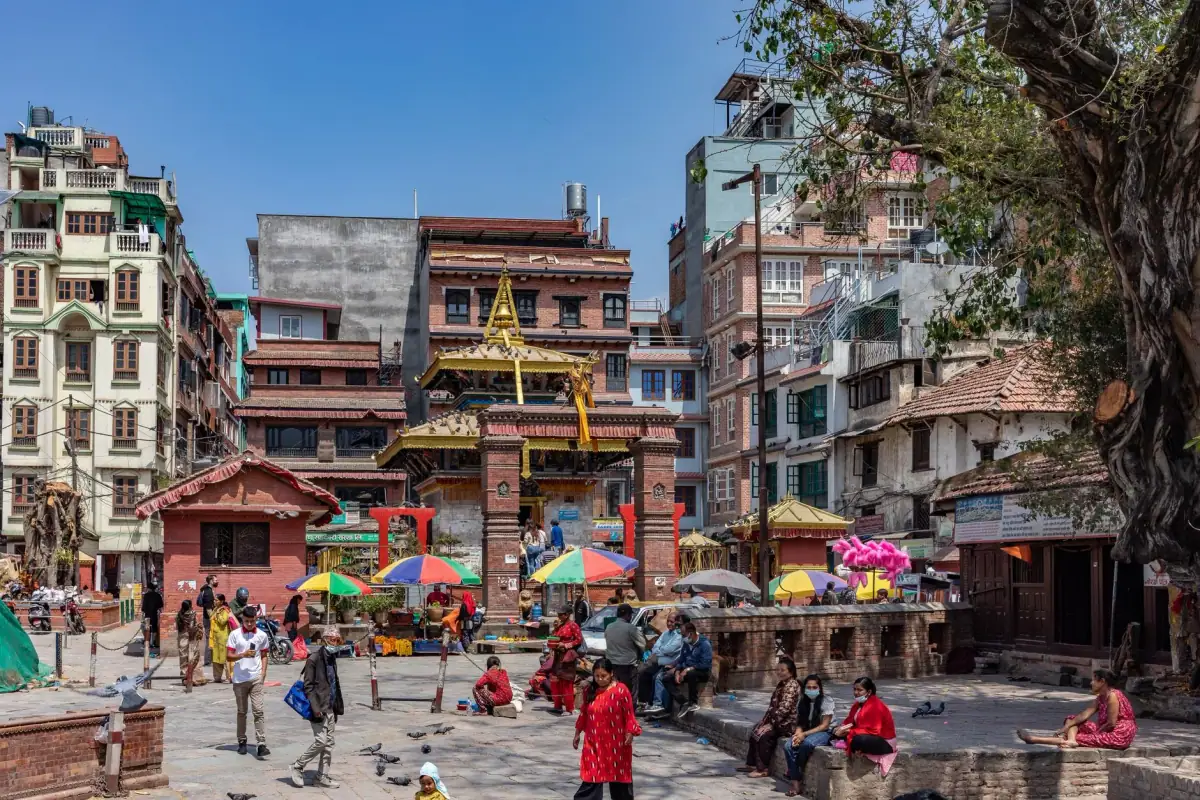
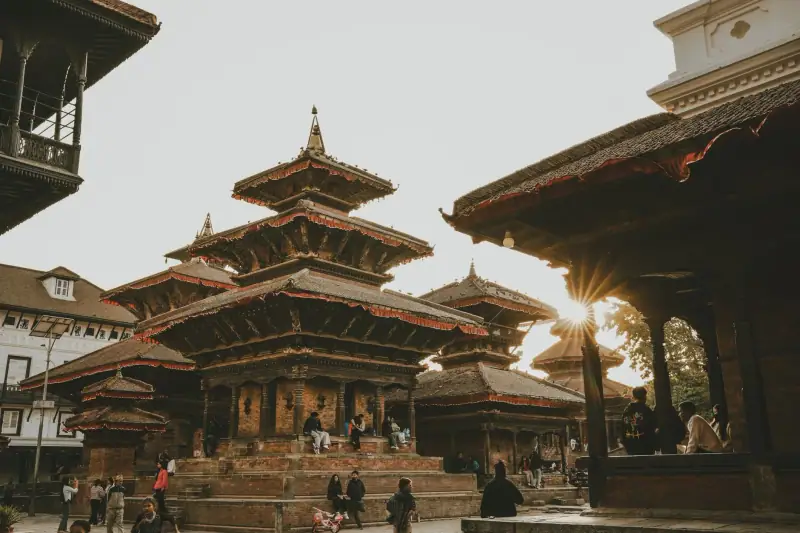
Start with Kathmandu Durbar Square, the former royal square. Its palaces, multi-roofed temples and courtyards tell the story of the Malla and then Shah kings. The 2015 earthquake damaged several monuments, and restoration work continues: some buildings may be surrounded by scaffolding, which is also part of the visit.
Points of interest:
- Hanuman Dhoka Palace, the former royal complex, whose facade and courtyards give the scale of the dynasty.
- The Kumari Ghar, the house of the living goddess, where tradition holds that a young girl is venerated as a divine incarnation. Photographing the Kumari herself is forbidden.
- The Kasthamandap temple and neighboring monuments, whose history is tied to the origin of the city’s name.
Take the time to sit on the steps of a temple and watch the square: vendors, pigeons, offerings and passersby make a picture worth any guidebook.
Midday: lunch in the lanes
Around the square, small eateries serve the national dish, dal bhat (rice, lentils, vegetables), or momos, the widespread steamed dumplings. To understand what you are eating, reread our article on Nepali cuisine and its specialties. Choose places frequented by locals that cook to order.
Afternoon: Thamel and the Garden of Dreams
In the afternoon, walk to Thamel, with its tea, spice, fabric and craft shops. This is the place to buy souvenirs, compare trek offers and have a coffee on a terrace. Nearby, the Garden of Dreams offers a calmer setting: a neoclassical enclave with lawns and pergolas, useful for catching your breath after the noise of the city.
Evening: tea and a quiet dinner
End the day in Thamel, at a restaurant of your choice, and try a chiya (milk tea) or another local drink. Our guide to traditional drinks of Nepal will help you choose. If you are jet-lagged, avoid excess and go to bed early: day 2 starts strong.
Day 2: Swayambhunath, Pashupatinath and Boudhanath
The second day is the most spiritual. It links three major Buddhist and Hindu sites, which show how closely the two traditions coexist in the valley.
Morning: Swayambhunath, the monkey temple
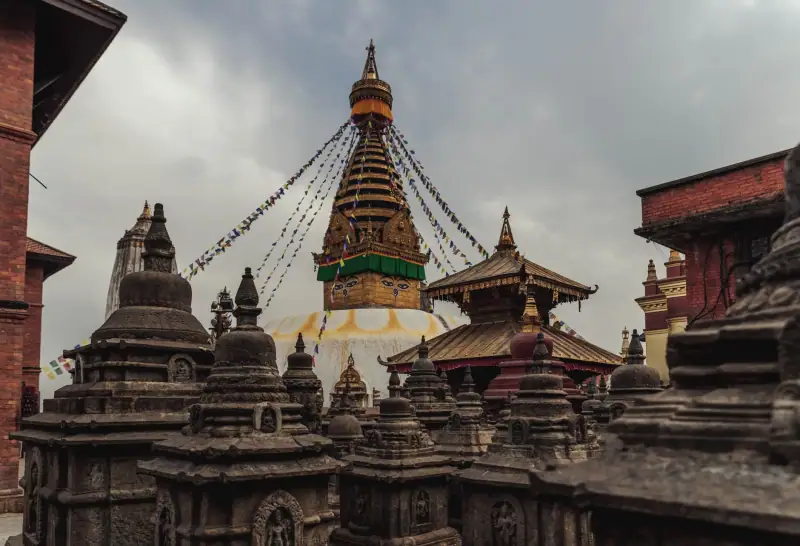
Perched on a hill west of the city, Swayambhunath is one of the oldest Buddhist sanctuaries in the valley. You reach it by a long staircase, and the white stupa crowned with a golden spire bears the famous painted eyes of the Buddha on its four faces. The many macaques living there earned it the nickname “monkey temple”.
A few tips:
- Arrive early to enjoy the morning light and a clear view over the city.
- Keep your belongings closed: the monkeys are skilled and opportunistic. Do not offer them food.
- Walk around the stupa and spin the prayer wheels, as pilgrims do.
Midday: Pashupatinath, the great Shaivite sanctuary
Next, head to Pashupatinath, on the banks of the Bagmati River, one of the most important Hindu sites in the country, dedicated to Shiva. The main temple is reserved for Hindus, but visitors can watch the whole site from the opposite bank, where terraces overlook the ghats.
The site is also a place of cremation. It can be surprising, even upsetting: respect the families’ contemplation, do not photograph intrusively and lower your voice. You will also meet sadhus, Hindu ascetics with painted faces, who sometimes pose for visitors in exchange for a small contribution. Decide in advance what you are willing to give, and politely decline if you prefer.
Afternoon: Boudhanath, the great Tibetan stupa
Finish with Boudhanath, one of the largest stupas in the world, the center of Tibetan Buddhist culture in Kathmandu. Pilgrims perform the kora, the ritual walk around the dome, among prayer flags, wheels and butter lamps. The atmosphere is calmer than in the center: monasteries, incense shops, rooftop cafes.
Go up to a terrace in the late afternoon: at dusk, the lamps are lit, chants rise and the golden light on the stupa justifies the day on its own. It is also an excellent place to have dinner if you want to change neighborhoods.
Visit with a local guide
Guided tours of Kathmandu and its temples: a guide helps you understand the rites and history of each site.
Why this order?
You start in the west (Swayambhunath), then move east (Pashupatinath, then Boudhanath), following the order that limits back-and-forth. If time or energy is short, drop one of the three sites rather than skimming everything: two thorough visits beat three rushed ones.
Day 3: Patan and Bhaktapur, the Newar cities
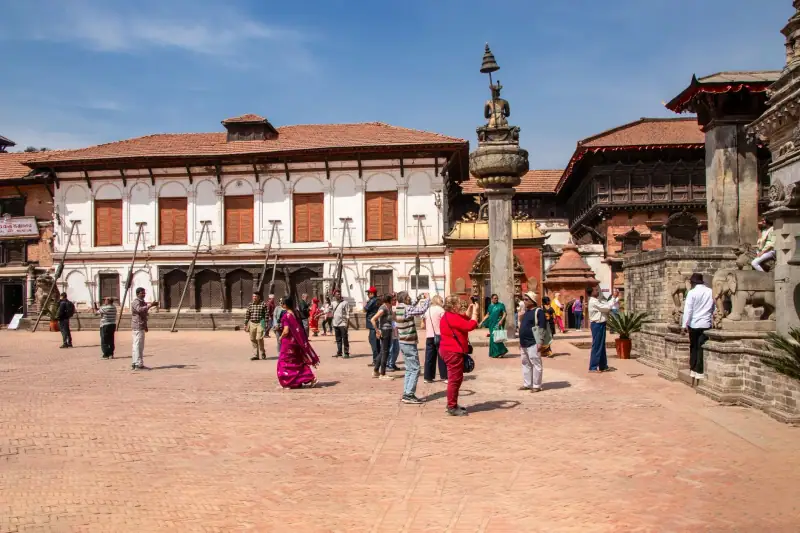
The third day leaves the center for two former city-kingdoms of the valley, with craft traditions and an architecture of brick and carved wood. We cover them in our guide Visiting Bhaktapur and Patan.
Morning: Patan, the city of artisans
Patan (Lalitpur) is close to Kathmandu, separated from it by the Bagmati River. Its Durbar Square is known for the finesse of its temples and palaces, and for its museum housed in a former palace, often cited among the finest in the country. Also explore the Golden Temple (Hiranya Varna Mahavihar), an ornate Buddhist monastery, and the lanes of artisans who work metal, stone and wood.
Patan is a good place to buy handicrafts: bowls, statuettes, metal pieces. Compare offers, ask where things come from and bargain with a smile.
Afternoon: Bhaktapur, the medieval town
Then take the road to Bhaktapur, east of Kathmandu, one of the best-preserved towns in the valley. Foreign visitors are generally charged an entrance fee to enter the historic center. Taumadhi Tole square, dominated by the multi-tiered Nyatapola temple, is one of the finest viewpoints. The potters’ square, where clay dries in the sun on the ground, offers a scene of everyday life not to be missed.
Try juju dhau, the “king of yogurts” made from curdled milk, a specialty of the town found in many shops. It is a cool, tasty break, welcome after a day of walking.
Evening: back to Kathmandu
Depending on traffic, expect a slow return at the end of the day. If you would rather not go back, some travelers sleep in Bhaktapur to enjoy the town in peace after the groups leave. In that case, book ahead in high season.
Excursion to Patan and Bhaktapur
A guided day in the valley's Newar cities, with transport included, to avoid taxi negotiations.
Itinerary variations
If you have one more day
A fourth day lets you leave the city: Nagarkot, a ridge village famous for its dawn panoramas when the sky is clear, or Changu Narayan, an ancient temple overlooking the valley near Bhaktapur. You can also simply slow down and stroll around Thamel or Boudhanath.
If you have only two days
Merge days 1 and 2, keeping Durbar Square, Swayambhunath and Boudhanath, then devote the second day to Patan or Bhaktapur, but not both. One site well seen beats two seen in a rush.
For travelers with children
The lanes are crowded and the traffic is heavy: keep your children close. Swayambhunath and its monkeys appeal to the youngest, while the ceremonies at Pashupatinath can be overwhelming: decide according to their age and sensitivity.
Fitting these three days into a longer trip
Kathmandu is the natural gateway to the country. After these three days, several continuations are possible: head on to Pokhara and the Annapurnas, set off on a trek, or go down to Chitwan National Park. Our two-week itinerary shows how to link these stages, and the 10-day itinerary with Poon Hill offers a shorter version with a first trek.
Practical tips for these three days
Money and payment
Keep cash in small bills for taxis, entrance fees and small purchases. ATMs are plentiful in Thamel, but withdrawal fees and limits vary: check with your bank. To estimate your spending, see our budget for a stay in Nepal.
Health and water
Drink sealed or purified bottled water, avoid ice of unknown origin and wash your hands regularly. Dust and urban pollution can irritate the throat: a light mask or scarf helps on very busy roads. Entry rules depend on your passport: check the official travel advice of your government before you book: travel.state.gov (US), GOV.UK (UK), travel.gc.ca (Canada), Smartraveller (Australia) (checked November 2026). More in our article on formalities for Nepal.
Travel insurance
Insurance covering medical costs and repatriation is strongly recommended, especially if you plan a trek afterwards.
Useful gear
A pair of comfortable shoes, a water bottle, a small zip bag, a light scarf, a headlamp for power cuts and a plug adapter: the essentials fit in a small bag. Our article on essential accessories for Nepal gives the full list.
Respect and behavior
- Greet with a “namaste”, hands joined.
- Do not point your feet at statues or people, and do not point them toward an altar.
- Avoid public displays of affection.
- Ask before photographing someone, and do not buy from begging children: look into reputable local charities instead.
Common mistakes to avoid
- Trying to see everything in two days: the city is dense and traffic is slow. Prioritize.
- Arriving late at the sites: the morning offers the best light and the fewest crowds.
- Neglecting travel times: a site 8 kilometers (5 mi) away can take more than half an hour at peak hours. Allow a margin.
- Forgetting to cover up in temples or to take off your shoes when asked.
- Bargaining without a reference: ask your accommodation for an indicative price for taxi rides.
Itinerary summary
| Day | Morning | Afternoon | Evening |
|---|---|---|---|
| 1 | Kathmandu Durbar Square | Thamel and Garden of Dreams | Dinner in Thamel |
| 2 | Swayambhunath | Pashupatinath, then Boudhanath | Sunset at Boudhanath |
| 3 | Patan | Bhaktapur | Back to Kathmandu |
These three days give a balanced view of the valley: city life, Buddhist and Hindu spirituality, Newar craft and architecture. They also set the stage for what follows, whether a trek or a quieter stay in the hills.
Frequently asked questions
Are three days enough to visit Kathmandu?
Yes, for a first look. Three days let you see the capital's major sites (Durbar Square, Swayambhunath, Pashupatinath, Boudhanath) and give one day to Patan and Bhaktapur. To go deeper or add a hike, plan four to five days.
Which neighborhood should you choose to stay in?
Thamel is the most practical for a short stay: restaurants, agencies, money exchange and taxi stands within walking distance. If you want more calm, the areas around Boudhanath or Patan are good alternatives, at the cost of longer trips to the center.
How do you get around between the sites?
The simplest option is a taxi, with a price agreed before you get in, or a ride-hailing app if it works on your phone. Local buses exist but are packed and hard for a visitor to read. For Patan and Bhaktapur, you can also hire a taxi for half a day or a full day.
Can you enter the Hindu temples at Pashupatinath?
The main sanctuary is reserved for Hindus. Foreign visitors can, however, watch the site, the ghats and the ceremonies from the terraces on the opposite bank of the Bagmati River, respecting the families' privacy during cremations.
What should you wear to visit the temples?
Clothes covering shoulders and knees are appreciated. Bring shoes that are easy to take off, since you remove them at the entrance of some sanctuaries, and a light scarf for cooler moments or to cover up.
What is the best time of year for this itinerary?
Autumn (October-November) and spring (March-April) generally offer clear skies and pleasant temperatures. The monsoon, from June to September, brings frequent rain that makes visiting harder without preventing it.
More Nepal guides
Keep reading
Nepal Travel Budget: Real Costs, 3 Profiles and Ways to Save
What budget for Nepal? Costs by item (lodging, transport, food, activities, permits), three budget profiles and tips to spend less.
Paragliding in Pokhara: Prices, Booking Ahead or on Site, Season and Requirements
Tandem paragliding in Pokhara: rough budget, booking the day before or online, best months, Sarangkot takeoff, age, weight and insurance to check.
Things to Do in Pokhara: Lake, Peace Pagoda and Himalayan Views
What to do in Pokhara? Phewa Lake, Peace Pagoda, Sarangkot, paragliding, caves and the Mountain Museum: ideas for 2 to 4 days.
Ready-made
Nepal itineraries
10 days
Nepal in 10 Days: Kathmandu, Pokhara and the Poon Hill Trek
A 10-day Nepal itinerary: Kathmandu temples, Pokhara's lake and a short 4-day Poon Hill trek, with tips, permits and a rough budget.
12 days
Nepal with Kids: A 12-Day Family Itinerary with Gentle Stages and Tips
KathmanduPokharaBandipurChitwan
14 days
Nepal in 2 Weeks: Day-by-Day Itinerary from Kathmandu to Chitwan
KathmanduBandipurPokharaChitwan National Park