Itineraries
Spain in 14 days: Madrid, Castile and Mallorca
We may earn a commission when you book through links on this page, at no extra cost to you. We don't visit or try the places we cover: we summarize published sources. How we work
Day by day
- Days 1-2Madrid: palace, plazas, Prado and Retiro Park
- Day 3Toledo: cathedral, Alcázar and El Greco
- Days 4-5Segovia: Roman aqueduct, Alcázar and cathedral
- Days 6-7Salamanca: university, Plaza Mayor, two cathedrals
- Days 8-11Fly to Palma: La Seu, Valldemossa and Sóller
- Days 12-14Alcúdia and Pollença, then Palma airport
Where to sleep
- Madrid2 nights
- Toledo1 night
- Segovia2 nights
- Salamanca2 nights
- Palma (Mallorca)4 nights
- Alcúdia or Pollença (northern Mallorca)2 nights
Weather through the year on this route
| Jan | Feb | Mar | Apr | May | Jun | Jul | Aug | Sep | Oct | Nov | Dec | |
|---|---|---|---|---|---|---|---|---|---|---|---|---|
| High °F (°C) | 489 | 5211 | 5815 | 6217 | 7122 | 8228 | 8932 | 8831 | 7826 | 6720 | 5613 | 499 |
| Low °F (°C) | 310 | 330 | 362 | 404 | 478 | 5412 | 6015 | 6015 | 5412 | 468 | 383 | 331 |
| Rain in (mm) | 1.540 | 1.230 | 1.435 | 1.745 | 1.845 | 1.025 | 0.410 | 0.515 | 1.025 | 2.255 | 1.950 | 1.745 |
Normals 1991–2020 at Toledo, Segovia and Salamanca: averages over 30 years, not a forecast. Source: NASA POWER (MERRA-2), grid of about 50 km. Figures computed by us in November 2026.
In short
- Eight days by car through Madrid, Toledo, Segovia and Salamanca, then a flight from Madrid to Palma and six days in Mallorca.
- The longest drives are Toledo to Segovia (2 h 00, 163 km) and Salamanca to Madrid airport (2 h 40, 224 km).
- Rent the car at Madrid-Barajas (MAD) and return it there before the flight: no one-way fee on the mainland.
- May-June and September-October suit both halves best: Castile is very hot in July and August, Mallorca is busiest then.
This trip suits travelers who want two very different sides of Spain in two weeks: the walled stone cities of central Castile, then the island of Mallorca with its old town, mountain villages and long beaches. It runs one way through Madrid, Toledo, Segovia and Salamanca, then flies to Palma and stays on the island until the flight home.
The driving is all in the first eight days, and it is moderate: no leg is longer than 2 h 40. In Mallorca, distances are short and you can choose between a rental car and the buses, train and tram. The route covers 13 nights in six bases, with Madrid and Palma as the two anchors.
The route at a glance
| Days | Base | Nights | Drive from previous base |
|---|---|---|---|
| 1-2 | Madrid | 2 | From Madrid-Barajas Airport (MAD): 20 min, 15 km (9 mi) |
| 3 | Toledo | 1 | 1 h 00, 73 km (46 mi) |
| 4-5 | Segovia | 2 | 2 h 00, 163 km (101 mi) |
| 6-7 | Salamanca | 2 | 2 h 05, 152 km (95 mi) |
| 8-11 | Palma (Mallorca) | 4 | Salamanca to MAD: 2 h 40, 224 km (139 mi), then a flight to Palma |
| 12-13 | Alcúdia or Pollença (northern Mallorca) | 2 | Inside Mallorca (see day 12) |
| 14 | Palma de Mallorca Airport (PMI) | - | Back from northern Mallorca |
Car rental in Spain
Book early for summer, and compare drop-off conditions if you return the car somewhere other than where you picked it up.
Day by day
Days 1-2: Madrid
From Madrid-Barajas Airport (MAD) the drive to the center is 20 min, 15 km (9 mi). Our Madrid guides point out that parking in central Madrid is complicated and that the city is done on foot and by metro, so you may prefer to pick up the car only when you leave for Toledo on day 3. The route is the same either way. Our guide to where to stay in Madrid compares the neighborhoods; Sol, Austrias and Huertas are the ones it suggests for a first stay of two or three nights.
With one afternoon and one full day, group your visits by area, as our 3-day Madrid itinerary does:
- Day 1, afternoon: the Puerta del Sol, the Plaza Mayor and the Royal Palace (allow about two hours inside). Morning is better for the Plaza Mayor, so if you land early, start there. Finish in La Latina for an aperitif.
- Day 2: the Prado Museum in the morning (two to three hours is a good compromise; €18, or ~$21, for adults, with free entry at the end of the day, Monday to Saturday 6 to 8 pm), then Retiro Park, its pond with rowboats and the Crystal Palace. If you still have energy, pick one of the Reina Sofía (Picasso’s Guernica) or the Thyssen-Bornemisza rather than all three.
Book the Prado and the Royal Palace ahead, and watch your belongings around the Puerta del Sol and in the metro. For more on the capital and the region, see what to see in Madrid and Castile. Madrid dinners start late, often after 9 pm; tapas bars serve at any hour.
Hotels in Madrid · Tours and activities in Madrid
Day 3: Toledo
Drive from Madrid: 1 h 00, 73 km (46 mi). Toledo sits on a hill almost surrounded by the Tagus, and its old town is a UNESCO World Heritage Site. It is called the city of three cultures because Christian, Jewish and Muslim communities lived there, and you can still see it in the synagogues, churches and Moorish remains.
The main sights are the Gothic cathedral, the Alcázar and the Church of Santo Tomé, where El Greco’s Burial of the Count of Orgaz hangs. The slopes are steep and the cobblestones uneven, so wear sturdy shoes. Groups fill the streets during the day; sleeping in town means almost empty lanes in the early evening and early morning, which is why this route gives Toledo a night.
Days 4-5: Segovia
Drive from Toledo: 2 h 00, 163 km (101 mi). This is the longest drive of the loop.
Segovia is known for its Roman aqueduct, a granite structure assembled without mortar that crosses the city on tall arches and earned the old town its UNESCO listing. Higher up, the Alcázar stands on a rocky spur between two rivers, with slate-capped towers. The Gothic cathedral on the Plaza Mayor is nicknamed “the lady of cathedrals”. Book the Alcázar ahead in high season. Segovia is also a good place to try Castilian cooking.
Use the first afternoon for the aqueduct and the old town, and the second day for the Alcázar and the cathedral without hurrying. Segovia sits at altitude and can be cold in winter. If you want a third outing, our Madrid and Castile guide pairs Segovia with El Escorial and the Sierra de Guadarrama as a culture and nature getaway, but it gives no drive time from Segovia, so check the route on a map first.
Days 6-7: Salamanca
Drive from Segovia: 2 h 05, 152 km (95 mi). Salamanca is one of the most beautiful cities in Castile and León, and its historic center is UNESCO-listed. The university, founded in the 13th century, is one of the oldest in Europe. The golden stone of its monuments warms at the end of the day.
The Baroque Plaza Mayor is often cited among the most harmonious in Spain, and you will see students, families and visitors there from morning until late. Look for the small carved frog on the university facade. The old and new cathedrals are joined and visited together. The city is lively in the evening thanks to its students, and its lanes are calmer than Madrid’s. Two nights let you see the sights on day 7 and spend the evenings in the squares.
Days 8-11: Palma, Valldemossa and Sóller
Day 8 is a transfer day. Drive from Salamanca to Madrid-Barajas Airport: 2 h 40, 224 km (139 mi). Return the car, then take the flight from Madrid to Palma. It is a flight, not a road, and our guides give no flight time, so check the schedule when you book. Leave a comfortable margin at the Madrid airport. From Palma airport, the city bus line A1 reaches the center in 20 to 30 minutes (8 km, or 5 mi) for a few euros.
Day 9: Palma on foot. Start with La Seu, the golden Gothic cathedral by the sea. Gaudí reworked part of the interior from 1904 to 1914, moving the choir and adding a suspended metal canopy. Adult entry is €9 (~$10); hours vary with the season, so check with the cathedral. The Palau de l’Almudaina is a short walk away (€7, or ~$8; plan 45 minutes to 1 hour). Then explore the Barri Gòtic, have lunch at the Mercat de l’Olivar, and spend the evening in Santa Catalina. Our guide to the top sights in Palma adds the Fundació Pilar i Joan Miró (€10, or ~$12), Es Baluard (€6, or ~$7) and Bellver Castle (€4, or ~$5). The July and August heat argues for monuments before noon and after 6 pm.
Day 10: Valldemossa and Sóller. Valldemossa is the village where Chopin and George Sand spent the winter of 1838-1839, in the cells of the Carthusian monastery. Go early to beat the tour coaches. You can reach it without a car on TIB bus line 203 from Palma’s intermodal station, about 30 to 45 minutes; check the last bus back on tib.org. Our guide to Valldemossa without a car has the details. From there the 7-day guide continues along the MA-10 to Deià and Sóller, the town of orange trees, with its century-old train to Palma (about 1 hour) and a tram to Port de Sóller (about 20 minutes). The Tramuntana is a UNESCO World Heritage cultural landscape.
Day 11: your choice. With a car, the Caves of Drach at Porto Cristo make an east-coast day: about an hour by road from Palma, guided visits at fixed times, and online booking advised in season (see our Caves of Drach guide). Without a car, spend a second day in the Tramuntana or walk part of the GR 221 (see hiking in Mallorca).
Car or no car in Mallorca. The 7-day guide calls a rental car essential for its island loop and recommends a small one for narrow village lanes. The 5-day car-free itinerary shows that Palma, the Tramuntana, Sóller and Alcúdia work by bus, train and tram, but the southeastern coves and Cap de Formentor in peak season do not. A good compromise is to rent for just a day or two.
Days 12-13: Alcúdia or Pollença
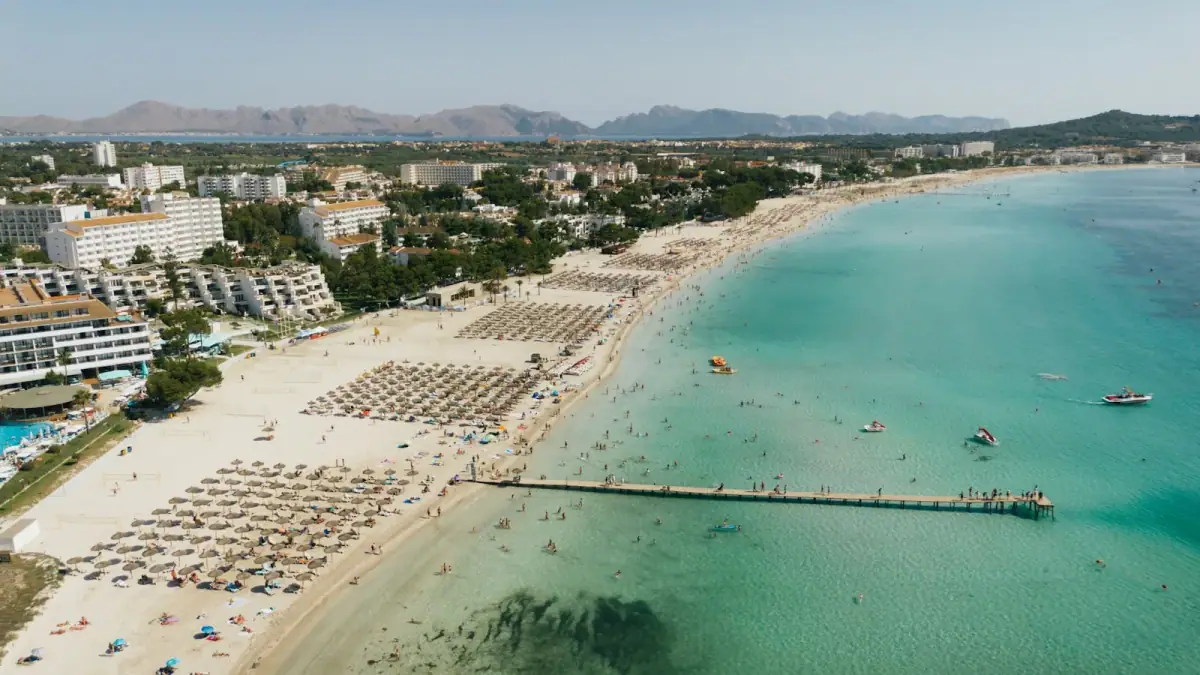
Day 12: move north. Alcúdia is 55 km (34 mi) from Palma. Our car-free guide gives about 1 h 15 by TIB bus; by car, check live traffic, as our guides give no car time. Alcúdia keeps medieval walls from the 14th century that form a walkable circuit of about 1.5 km (0.9 mi). Walk them, then visit the Sant Jaume church and the Pollentia Roman site and museum, a short walk from the walls. Alcúdia’s market runs on Tuesday and Sunday mornings; arrive before 9:30 am. The long, shallow, sandy beach is about 2 km (1.2 mi) from the old town. Our guide to visiting Alcúdia has the full day plan, and where to stay in Alcúdia compares the old town, the port and the beach.
Day 13: Pollença and the coast. Pollença is about 11 km (7 mi) northwest of Alcúdia. It is known for the Calvari, 365 steps up to a chapel, and for its Sunday morning market. If you prefer a base there, where to stay in Pollença says Port de Pollença is the easiest option without a car and the old town suits village atmosphere. The s’Albufera Natural Park, less than 5 km (3 mi) south of Port d’Alcúdia, is free and best at 7 to 10 am for birdwatching. For Cap de Formentor, note that in July and August the road is restricted for private cars; shuttles run from Port de Pollença for about €5 (~$6) round trip.
Day 14: back to Palma airport
Go back to Palma: 55 km (34 mi), about 1 h 15 by bus according to the car-free guide, which advises a 3-hour margin before the flight. If you drive, return the rental car at the airport. Our 7-day Mallorca itinerary suggests lunch in Santa Catalina if you have time before departure.
Getting there and away
You arrive at Madrid-Barajas Airport (MAD) and leave from Palma de Mallorca Airport (PMI). MAD is the main international airport of the country planner, together with Bilbao (BIO) and San Sebastián (EAS), which this route does not use. Our guides do not list flight routes or airlines from the US, UK, Canada or Australia, so search from your own airport, and check the entry rules, visa and driving licence requirements on the official government website of your country.
On the mainland, picking up and returning the car at Madrid-Barajas makes it a round trip with no one-way fee. If you pick up and drop off in different cities, rental companies usually charge a one-way (drop-off) fee, more if the drop-off is in another country, and it varies by company: check it when you compare offers. The Madrid to Palma leg is a flight and is booked separately. Palma airport is one of the busiest in Europe in summer, and the 7-day guide advises booking flights 2 to 4 months ahead for July and August.
When to go
For Madrid and the Castilian cities, our guide to when to go to Spain names April, May, June, September and October as the best months. In July and August Madrid afternoons often exceed 30 to 35 °C (86 to 95 °F), and winters are cool with sometimes cold mornings; Segovia, Ávila and Burgos sit higher and are colder. For Mallorca, our Alcúdia guide suggests May-June and September-October for a good sea temperature (about 19 °C, or 66 °F, in May; 26 to 27 °C, or 79 to 81 °F, in September) and moderate crowds.
May, June, September and early October therefore suit both halves of the trip. In July and August, expect heat in Castile and busy beaches, car parks and Formentor restrictions in Mallorca.
Budget
Figures come from two guides. For mainland Spain, our Spain budget guide gives per person per day, for two people sharing a room: about €55 to 65 (~$64-75) on a tight budget, €120 to 140 (~$140-165) mid-range and €250 and up (~$290+) upscale. It puts a small rental car at about €40 (~$46) a day, and €60 (~$70) or more upscale, plus fuel, tolls and parking. A midday menú del día averages about €14 (~$16), and costs a bit more in the Balearic Islands.
For Mallorca, the 7-day itinerary gives an indicative total of €880 to 1,500 (~$1,020-1,740) per person for the week, including a 3-star hotel (€50 to 80, or ~$58-93, a night), car rental, food, activities and fuel. In Alcúdia, the Alcúdia guide lists €90 to 250 a night (~$105-290) in the old town and €60 to 180 (~$70-210) at Port d’Alcúdia. These prices vary by season, so treat them as a basis for calculation.
Adapt it
For a shorter version, drop Salamanca and its two nights, or drop the northern Mallorca stay and finish in Palma. For a longer one, the other stops of our Spain planner fit the Castile loop: Ávila (about 110 km, or 68 mi, from Madrid), Burgos (about 240 km, or 149 mi) and Cuenca (about 170 km, or 106 mi), each described in our Madrid and Castile guide with no drive time from this route, so check the road before adding them. In Mallorca, our guides add Cabrera, Formentera and the east coast. On the Spain planner, San Sebastián, Bilbao and Getaria belong to a northern route that this itinerary does not cover.
Frequently asked questions
Do you need a car for the whole 14 days?
No. The car covers the mainland loop from Madrid to Salamanca (days 1 to 8). In Mallorca you can rent another one or follow the car-free advice of our guides, which use buses, the Sóller train and the tram.
Is there a one-way fee on this route?
Not if you pick up and return the car at Madrid-Barajas. If you drop it in a different city, rental companies usually charge a one-way fee that varies by company, so check it when you compare offers.
Which airports do you fly into and out of?
You arrive at Madrid-Barajas Airport (MAD) and leave from Palma de Mallorca Airport (PMI). The flight between Madrid and Palma is booked separately, and our guides give no flight time.
When is the best time for this trip?
May, June, September and October. Madrid afternoons often exceed 30 to 35 °C (86 to 95 °F) in July and August, and Mallorca's beaches and Formentor are busiest then.
How much should you budget?
Our Spain budget guide gives about €120 to 140 (~$140-165) per person per day for mid-range travel. For Mallorca, our 7-day guide gives €880 to 1,500 (~$1,020-1,740) per person for the week.
Ready-made
Spain itineraries
10 days
Spain in 10 days: Madrid, Castile and the Basque coast
MadridToledoSegoviaBurgosSan Sebastián
Can be adapted in the planner
14 days
Spain in 14 days: Castile and the Basque Country by car
MadridToledoSegoviaSalamancaBurgosBilbaoSan Sebastián
Can be adapted in the planner