What to see
West Fjords: what to see between Látrabjarg, Rauðasandur and Dynjandi
We may earn a commission when you book through links on this page, at no extra cost to you. We don't visit or try the places we cover: we summarize published sources. How we work
In short
- Allow at least three full days for Látrabjarg, Rauðasandur, Patreksfjörður and Dynjandi; four or five if you continue to Ísafjörður.
- Puffins are generally at Látrabjarg from late spring to July, some staying into August; aim for late May, June or July.
- Access roads include gravel and steep sections; fuel stations are rare and absent on the Látrabjarg and Rauðasandur roads, so fill up in Patreksfjörður.
- The cliff edge at Látrabjarg is crumbly with a very high drop: stay back from the edge, especially in wind, fog or wet ground.
When people talk about the West Fjords, they often think of Ísafjörður and Hornstrandir, in the north of the peninsula. Yet the southern half of this region offers some of the most spectacular landscapes in Iceland: cliffs where millions of birds nest, a pinkish beach stretching as far as the eye can see, a lace-like waterfall, and fishing villages at the end of roads that almost nobody drives.
This guide complements our article on visiting Ísafjörður by detailing what to see in the south and center of the West Fjords: Patreksfjörður as a starting point, the Látrabjarg cliff, Rauðasandur beach and the Dynjandi waterfall. To place the region in a broader trip, start from our complete guide to visiting Iceland.
The West Fjords: what to expect
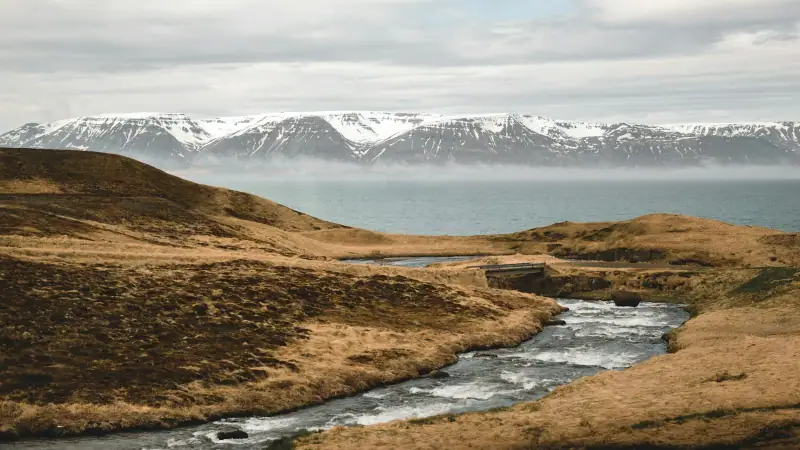
The West Fjords peninsula looks like a hand with cut-out fingers, hooked onto the northwest of Iceland. The fjords are deep, the mountains plunge straight into the sea and villages are few and far between. It is the least visited region of the country, and that is precisely its charm: you meet more sheep and birds than tourists, even in midsummer.
This tranquility has a price. Roads are long, distances between services are large and the weather often decides the plan. Some roads are gravel, passes are exposed to wind and, outside the season, some roads close. Gas stations and supermarkets are rare: it is best to fill up on fuel and supplies whenever the chance arises.
The official site of the regional tourist office, Visit Westfjords, presents the main sights and towns of the region, with up-to-date access information. Check it before you go, alongside this article.
How to get there
Several options exist depending on your budget and time:
- By car from Reykjavik: the most flexible solution, since the sights are spread out. Allow a long day of driving if you come straight from the capital, and a stop to catch your breath on the way.
- By the Baldur ferry: it links Stykkishólmur, on the Snæfellsnes Peninsula, to Brjánslækur, in the West Fjords, across Breiðafjörður. It is a pleasant alternative to break up the drive, and combines very well with our Snæfellsnes Peninsula itinerary. Book ahead in summer.
- By plane: domestic flights serve the region, notably Ísafjörður and Bíldudalur. A transfer then links Bíldudalur to Patreksfjörður. Flights depend on the weather.
Whatever the option, a car remains the best way to explore. Our article on driving in Iceland and renting a car details driving rules, gravel and wind.
Patreksfjörður: the ideal base for the south
Patreksfjörður is the main town in the south of the peninsula, set on the edge of a fjord framed by flat-topped mountains. It has only a few hundred inhabitants, but it concentrates most services: lodging, restaurants, a shop, a pool, a tourist information center and rental companies. For anyone who wants to explore Látrabjarg and Rauðasandur without long drives, it is the best base.
The town can be seen quickly, but it is worth an evening. It has an outdoor pool with a view of the fjord, with hot tubs and a sauna, perfect after a day of driving or walking. An exhibition devoted to French fishermen and life in the old days recalls that sailors from France long frequented these waters. Several natural hot springs are also within reasonable driving distance: to compare options across the country, read our article on hot springs in Iceland.
Lodging includes hotels, guesthouses and a campsite. It remains limited: in summer, book several weeks, even several months, ahead.
Staying in Patreksfjörður
Compare hotels, guesthouses and apartments in Patreksfjörður, an ideal starting point for Látrabjarg and Rauðasandur.
Látrabjarg: the cliffs of millions of birds
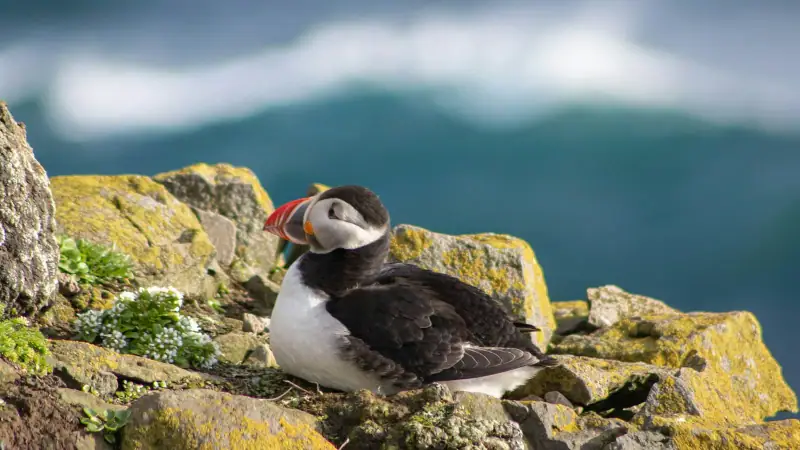
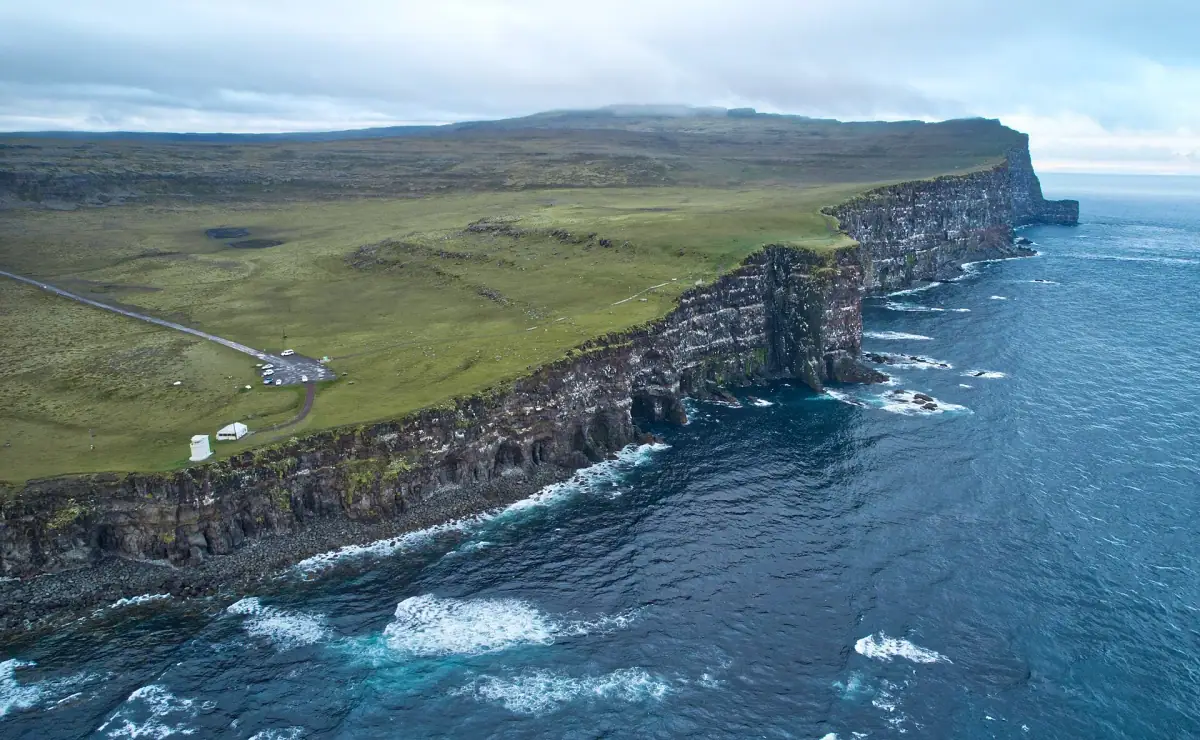
Látrabjarg is the great attraction of the southern West Fjords. This cliff stretches for about 15 km (9 mi) at the western tip of Iceland and rises to about 440 m (1,445 ft) above the Atlantic. During the nesting season, millions of seabirds settle here: guillemots, razorbills, fulmars and, above all, puffins.
The puffins are the star of the place. Unlike other colonies, they nest here in the grass, near the top of the cliff, and can often be observed up close, provided you stay calm and still. They are generally present from late spring to July, sometimes into August, but dates change from year to year. The best times are often morning and late afternoon, when the birds return from the sea.
How to get there
A road leads to the Bjargtangar lighthouse, the westernmost point of Iceland, where there is a parking area. The last stretch is gravel and its condition varies. This road is not cleared of snow in winter and can become impassable. There is no gas station or public transport to the site: come with a full tank, or book a guided excursion from Patreksfjörður.
Watching birds without taking risks
The cliff edge is crumbly, the ground is riddled with burrows and the drop is very high. A few simple rules:
- Keep a good distance from the drop and behind the barriers where they exist.
- Never lie down at the edge to take photos: whole sections can give way without warning.
- Be very careful in strong wind, fog or rain, as gusts can throw you off balance.
- Do not walk on the burrows and do not chase the birds.
- Keep your children and pets close to you.
A good pair of binoculars changes the experience: it lets you watch the birds from afar, without disturbing them and without going near the edge.
Rauðasandur: the beach with pink reflections
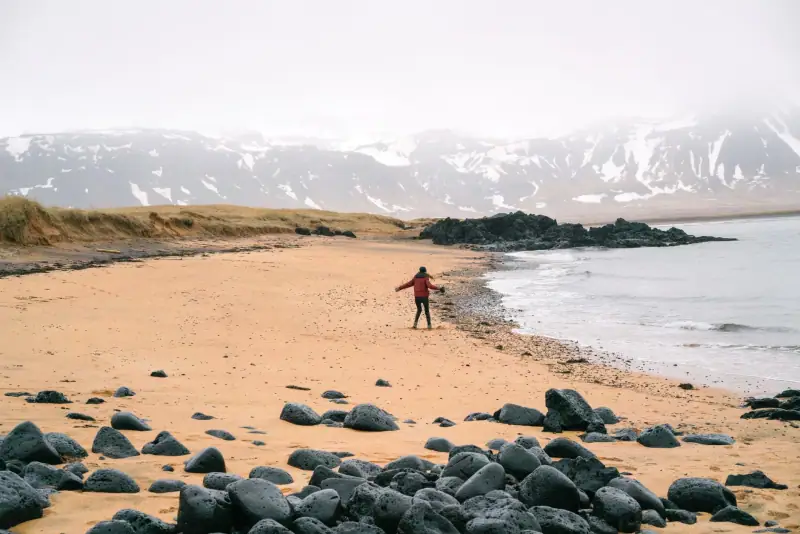
East of Látrabjarg, a detour along a gravel road leads to Rauðasandur, the “red sand.” This huge beach, about ten kilometers (6 mi) long, owes its pinkish hue to shell fragments mixed with the sand. Depending on the light and the tide, it goes from beige to pink and then orange, with shallow lagoons that reflect the sky when the sea recedes.
The access road enters a steep slope, with several hairpin bends and few guardrails. Drive slowly, keep to the right and yield at crossings. In return, the view from the top of the descent is one of the finest in the region. A small isolated wooden church stands near the beach and, with the mountains behind, makes a postcard landscape.
There, the mood is that of the end of the world: a rare silence, birds, sometimes a few sheep. Swimming is not advised, as the North Atlantic water is icy and the sea sometimes rough. Enjoy instead a long walk on the sand, photo stops at low tide and a picnic out of the wind if the weather allows.
A few tips for the visit:
- Allow time: the trip from the main road is slow, plan half a day with the beach.
- Fill up beforehand: there is no fuel nearby.
- Dress in layers: the wind can chill quickly, even in summer.
- Avoid the road after heavy rain or in dense fog.
Svuntufoss and the region’s small waterfalls
Between two major sights, the region is full of more discreet waterfalls that are worth a photo stop. Svuntufoss, near Patreksfjörður, is one of them and is easily visited in a day. As often in the West Fjords, there is no major infrastructure: a basic parking area, a simple trail, and often nobody else.
This is one of the pleasures of the region: driving slowly, stopping at the roadside when a landscape calls you, and accepting that the day will not go as planned. Always keep a margin in your schedule, because fog or a closed road may force you to change plans.
Dynjandi: the fan-shaped waterfall
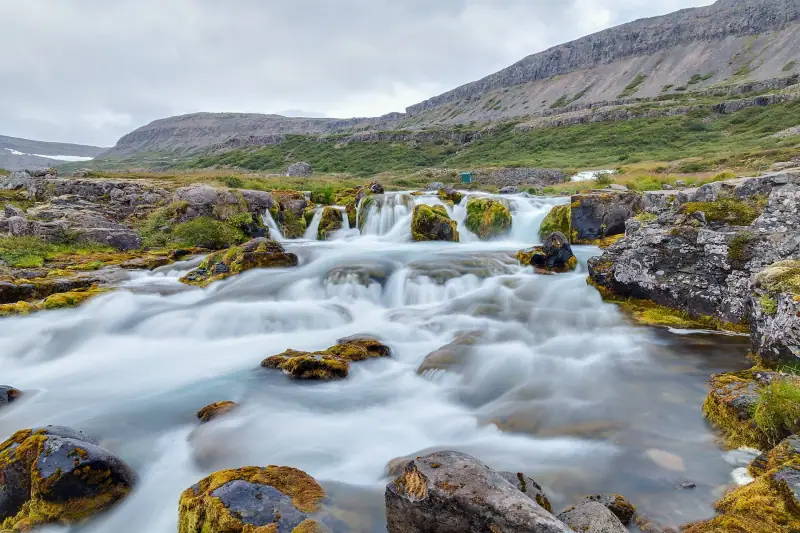
On the road linking the southern West Fjords to Ísafjörður, Dynjandi is one of the most photographed sights in the region. This waterfall drops about a hundred meters (330 ft) down the mountainside and widens into a fan as it descends. Dynjandi, also called Fjallfoss, is the main fall; it is followed downstream by five smaller falls, including Hundafoss, Strokkur, Göngumannafoss and Hrísvaðsfoss. Names vary a little depending on the source.
Access is simple. You park in the developed parking area, then walk up a trail of about fifteen minutes to the main waterfall. The lower part of the path is developed and accessible as far as Hrísvaðsfoss. A parking fee is charged at the site. Route 60 leads to Dynjandi; check its condition before you go outside the season.
When to go
Dynjandi can in principle be visited all year, but access depends on the condition of mountain roads. Summer offers the easiest conditions, with long days and a clear trail. Autumn and spring are quieter but less certain. In winter, the waterfall can be covered with ice, very beautiful but hard to reach.
Bring a waterproof layer: spray soaks you quickly, especially in windy weather. A breathable hiking jacket will serve you throughout the trip, and notably at Látrabjarg, where the wind is constant.
Excursions in the West Fjords
Compare guided outings: bird cliffs, hikes, boats and tours on the peninsula.
A three-to-four-day itinerary
Here is a realistic proposal, to adapt to your arrival point and the weather. It assumes you arrive by the Baldur ferry or by road from the south.
- Day 1: arrival and Patreksfjörður. Settle in, shop and fill up on fuel, then relax at the pool with a view of the fjord.
- Day 2: Látrabjarg. Leave early to enjoy the calm and the birds. Allow a long break at the Bjargtangar lighthouse and a walk along the cliff, with great care.
- Day 3: Rauðasandur. Devote the morning to the beach and the isolated church, then return the same way, leaving a margin for the climb back.
- Day 4: road to Dynjandi and Ísafjörður. Stop at the waterfall, then continue to Ísafjörður for one or two more nights.
Each day stays below what a car can do in distance, but roads are slow: do not expect to make up for lost time. If fog covers the cliff, simply swap two days rather than persisting.
Rent a car for the West Fjords
Compare rental companies to explore the peninsula at your own pace, with a vehicle suited to gravel roads.
When to go to the West Fjords
June to August is the simplest period: clear roads, very long days, open services, puffins present. It is also the only period when some sea links, such as crossings to the northern reserves, run fully. Book lodging early.
May and September offer more calm, with more variable weather. Check that the services you need are open.
From October to April, the region is very quiet. Days are short, and some roads, such as the one to Látrabjarg, are not maintained and may be closed. The northern lights are possible under a clear sky: our article on the northern lights in Iceland explains how to improve your chances. To compare all the seasons, see our guide to when to visit Iceland.
Eating in an isolated region
Local cuisine is that of Icelandic ports: fresh fish, soups, lamb dishes, pastries. Restaurants are few and often close early, especially outside the season. In summer, book for the evening in the villages. To understand what Icelanders eat day to day, read our article on Icelandic cuisine and its specialties.
Also think of building a picnic stock before leaving Patreksfjörður or the last major town: a lunch beside a waterfall is often the best memory of a day. Prices are high in Iceland, and even more so in remote areas. Our guide to the budget for Iceland gives useful pointers.
Practical tips before you go
- Fuel and supplies: fill the tank and the trunk whenever you can.
- Weather and roads: check the forecast and road conditions the same morning. Wind and fog change fast.
- Mountain safety: tell your host about your hiking plans, stay on the trails and turn back if in doubt.
- Respect for nature: do not disturb the birds, do not take stones or plants and do not take shells from the beach.
- Entry rules and insurance: entry rules depend on your passport. Check the official travel advice of your government before you book: travel.state.gov (US), GOV.UK (UK), travel.gc.ca (Canada), Smartraveller (Australia) (checked November 2026). Consider travel insurance covering medical costs and repatriation.
- Mobile network: check your carrier’s international plan or consider a travel eSIM before you go. Coverage remains patchy in the remote fjords: download your maps for offline use.
To stay in the north of the peninsula, also read our article on where to stay in Ísafjörður.
How long to stay?
- One day: if you are in a hurry, focus on Látrabjarg or Dynjandi, but you will spend most of your time on the road.
- Three days: the right compromise to see Látrabjarg, Rauðasandur and Dynjandi without stress.
- Five days or more: add Ísafjörður, boat excursions and a few hikes to enjoy the region at its own pace.
The West Fjords are not visited, they are lived slowly. Between the cries of birds on the cliff, the pinkish sand that changes color through the hours and the roar of the waterfall, you will quickly understand why those who come here rarely leave disappointed.
Sources
Frequently asked questions
How much time should you plan to visit the southern West Fjords?
Plan at least three full days for Látrabjarg, Rauðasandur, Patreksfjörður and Dynjandi without rushing, and four or five if you continue to Ísafjörður. Distances are modest on the map, but winding roads, partly gravel, slow you down a lot.
When is the best time to see puffins at Látrabjarg?
Puffins are generally present from late spring to July, some staying in August, but sightings are then less predictable. Exact dates vary from year to year: aim for late May, June or July to maximize your chances.
Do you need a 4x4 to go to Látrabjarg and Rauðasandur?
The access roads include a gravel section, with slopes and tight bends toward Rauðasandur. A careful regular vehicle often makes it in summer in good weather, but a higher vehicle is more comfortable. Check road conditions before you go and read the terms of your rental contract.
Can you swim at Rauðasandur?
The beach is huge and superb, but the North Atlantic water is very cold and the sea can be rough: it is not a typical swimming spot. To warm up, the municipal pool of Patreksfjörður, with its hot tubs, is a much better idea.
How do you get to the West Fjords without driving?
There are two options: domestic flights to Ísafjörður or Bíldudalur, or the Baldur ferry linking Stykkishólmur to Brjánslækur across Breiðafjörður. Check schedules and reservations with the operators, especially outside summer.
Is the Látrabjarg site dangerous?
The cliff edge is crumbly and the drop is very high. Stay away from the drop, do not lie down at the edge to take photos and be especially careful in strong wind, fog or soaked ground. The ground is weakened by bird burrows.
Are there gas stations in the area?
They are rare in the West Fjords and completely absent on the roads to Látrabjarg and Rauðasandur. Fill up in Patreksfjörður or in the last town before you commit to those roads.
More Iceland guides
Keep reading

What to see on the Snæfellsnes Peninsula: volcano, beaches, craters and villages
What to see in Snæfellsnes, Iceland: Snæfellsjökull glacier, Kirkjufell, Djúpalónssandur, Saxhóll, Gerðuberg, seals and fishing ports, site by site.
Visiting Höfn: what to see and do on Iceland's southeast coast
Langoustines, the Vatnajökull glacier, Stokksnes and the Jökulsárlón lagoon: a guide to visiting Höfn, planning your stop and choosing excursions.
Visiting Akureyri: what to see and do in North Iceland's capital
Church, botanical garden, Eyjafjörður fjord, baths, skiing, whales and excursions: a guide to visiting Akureyri and planning your stay.
Ready-made
Iceland itineraries
4 days
Iceland's south coast: a 4-day itinerary from Reykjavik to Jökulsárlón
A 4-day south coast Iceland itinerary: Seljalandsfoss, Skógafoss, Vík, Reynisfjara and Jökulsárlón lagoon, with distances, stops and practical tips.
3 days
North Iceland in 3 days: Goðafoss, Mývatn and Húsavík
Lake Mývatn areaHúsavík
2 days
Snæfellsnes Peninsula: a 2-day itinerary from Reykjavik
Visit Iceland's Snæfellsnes Peninsula: Kirkjufell, Arnarstapi, Djúpalónssandur, Búðir and Stykkishólmur. A 2-day itinerary with drive times and tips.