Itineraries
Dubrovnik loop in 14 days: Bosnia and Herzegovina and Montenegro by car
We may earn a commission when you book through links on this page, at no extra cost to you. We don't visit or try the places we cover: we summarize published sources. How we work
Day by day
- Days 1-2Dubrovnik: city walls, Stradun, cable car
- Day 3Cross into Bosnia, Trebinje
- Days 4-5Mostar, Blagaj, Počitelj and Kravice
- Days 6-8Sarajevo, Tunnel of Hope, a day trip
- Days 9-10Žabljak, Black Lake, Tara canyon
- Days 11-13Kotor, Bay of Kotor, Cetinje
- Day 14Border back to Croatia, fly from Dubrovnik
Where to sleep
- Dubrovnik2 nights
- Trebinje1 night
- Mostar2 nights
- Sarajevo3 nights
- Žabljak2 nights
- Kotor3 nights
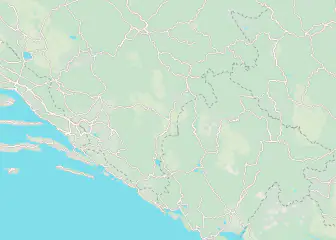
Opens the trip planner with these stops and nights already filled in. Add a stop, drop one or change the nights.
In short
- A 14-day loop from and back to Dubrovnik Airport (DBV): Dubrovnik, Trebinje, Mostar, Sarajevo, Žabljak and Kotor. Three countries, three borders, no one-way fee.
- Longest drives: Sarajevo to Žabljak (3 h 55, 206 km / 128 mi) and Žabljak to Kotor (3 h 35, 164 km / 102 mi).
- Tell the rental company every country in advance and ask for a Green Card that lists Bosnia and Herzegovina and Montenegro.
- Cross the last border, Montenegro to Croatia, early in the morning and avoid summer weekends: queues are the main risk on day 14.
This loop suits travelers who want three countries in two weeks without changing cars: Croatia’s best-known walled city, the Ottoman and Habsburg layers of Bosnia and Herzegovina, and Montenegro’s mountains and fjord-like bay. You land and leave at Dubrovnik Airport (DBV), so the car goes back where it started and you pay no international one-way fee.
The shape is a clockwise circle with six bases and 13 nights. Most legs are two to two and a half hours. Two are longer: Sarajevo to Žabljak takes 3 h 55 and Žabljak to Kotor 3 h 35. Add a border crossing and some mountain roads on those days and plan them as driving days with a few stops, not sightseeing days.
The route at a glance
| Days | Base | Nights | Drive from previous base |
|---|---|---|---|
| 1-2 | Dubrovnik (Croatia) | 2 | From Dubrovnik Airport (DBV): 25 min, 21 km (13 mi) |
| 3 | Trebinje (Bosnia and Herzegovina) | 1 | 35 min, 33 km (21 mi) |
| 4-5 | Mostar (Bosnia and Herzegovina) | 2 | 2 h 25, 117 km (73 mi) |
| 6-8 | Sarajevo (Bosnia and Herzegovina) | 3 | 2 h 10, 125 km (78 mi) |
| 9-10 | Žabljak (Montenegro) | 2 | 3 h 55, 206 km (128 mi) |
| 11-13 | Kotor (Montenegro) | 3 | 3 h 35, 164 km (102 mi) |
| 14 | Dubrovnik Airport (DBV) | - | 1 h 45, 71 km (44 mi) |
Compare rental companies in Dubrovnik
When you compare, tick or ask for the cross-border option and list every country you will drive into: Croatia, Bosnia and Herzegovina and Montenegro.
Day by day
Days 1-2: Dubrovnik
Pick up the car at the airport, 25 minutes and 21 km (13 mi) from the city. Our guide to Dubrovnik’s top sights recommends two days.
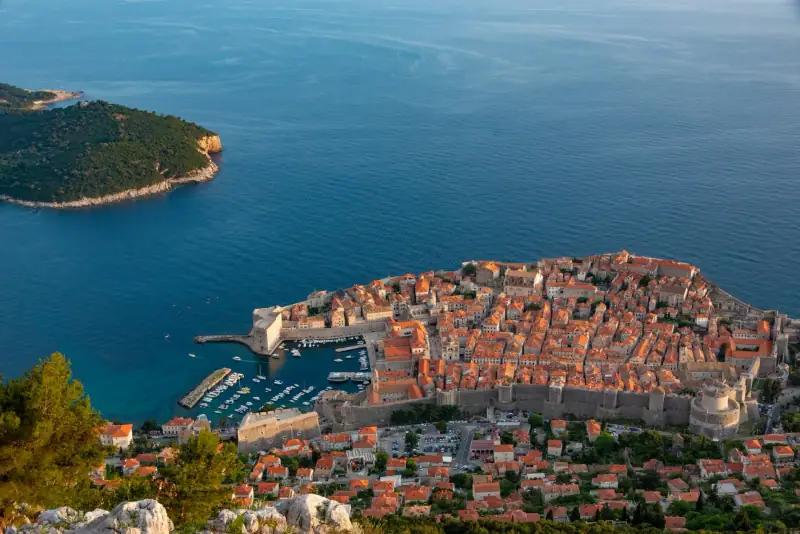
Spend day 1 on the 2 km (1.2 mi) city walls, which open at 8 am: go at opening, because cruise groups take over by 10 am. The ticket costs €35 (~$40) in high season and €25 (~$29) off season, and includes Fort Lovrijenac. Then walk the Stradun, the 300 m (985 ft) marble main street, and visit the Franciscan monastery with its pharmacy founded in 1317. On day 2, ride the cable car up Mount Srđ (about €27 to 30, ~$31 to 35, round trip; late afternoon for the light) and take the 10-minute boat to Lokrum Island. The old town is at its best after 6 pm, once the cruise buses have left.
The Old Town is pedestrian and cobbled, so expect to carry your luggage. See our guide on where to stay in Dubrovnik, then compare options: Hotels in Dubrovnik. For the wider country, our Croatia road trip covers the coast north of here.
Day 3: Dubrovnik to Trebinje
Today you leave the EU. Drive 35 minutes, 33 km (21 mi), to Trebinje and cross from Croatia into Bosnia and Herzegovina on the way (see the border section below). Our Bosnia road-trip guide describes Trebinje as a town of Republika Srpska in eastern Herzegovina with medieval architecture, vineyards and a Mediterranean feel. It places it about 1 h 30 to 1 h 50 from Mostar. The guide gives no sight list, so treat it as a short, easy first night in the country: a walk, a meal, and an early start.
Remember the currency change: Bosnia and Herzegovina uses the convertible mark (KM), not the euro. Keep some cash, as small places do not always take cards. Trebinje is in Republika Srpska and Mostar in the Federation; our Bosnia guide notes there is no checkpoint between the two entities.
Days 4-5: Mostar, Blagaj, Počitelj and Kravice
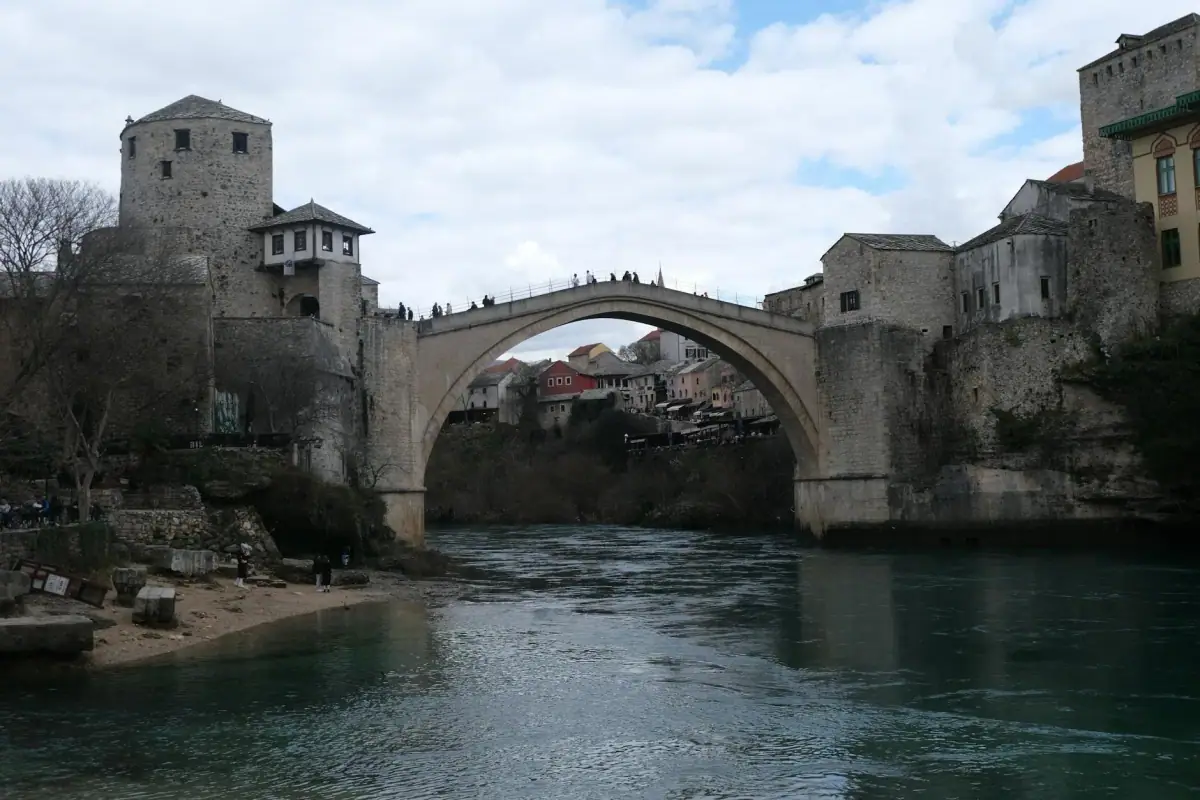
Drive 2 h 25, 117 km (73 mi), to Mostar. Our Mostar guide puts the Stari Most first: a UNESCO-listed limestone arch about 21 m (69 ft) above the Neretva, rebuilt and reopened in 2004 after its destruction in 1993. Add the Kujundžiluk bazaar, the Koski Mehmed Pasha Mosque (the minaret climb is about 80 steps) and the Bulevar, the former front line between the Bosniak east bank and the Croat west bank. The guide recommends two nights so you can see the bridge at dusk and again at sunrise. See where to stay in Mostar.
Use day 5 for the classic Herzegovina circuit. Leave about 8:30 am for Blagaj, 12 km (7.5 mi) away, where a 16th-century dervish tekke stands at the Buna spring. Continue to Počitelj, an Ottoman fortress village about 30 km (19 mi) south of Mostar, where the climb to the tower takes 15 to 20 minutes. End at the Kravice waterfalls, about 40 km (25 mi) from Mostar, a curve of falls 25 m (82 ft) high and 120 m (394 ft) wide that you can swim below in summer. In July and August go in the morning, because the site can be packed.
Days 6-8: Sarajevo
Drive 2 h 10, 125 km (78 mi), to Sarajevo. Our Bosnia road-trip guide suggests three days here: Baščaršija, the war-history sites and the Austro-Hungarian districts, plus an excursion to Bjelašnica. Day 6 is for the old town on foot.
On day 7, visit the Tunnel of Hope, the hand-dug shaft used between 1993 and 1996. It is open about 8:30 am to 5 pm from April to October and 9 am to 4 pm from November to March. The adult ticket is about 20 KM (about €10, $12), paid in cash only. Allow 45 minutes to 1 h 30 on site; with the trip it takes half a day.
For day 8, you have two day trips from our guides. The Višegrad bridge is about 130 km (81 mi) and a little over 2 hours by car: an eleven-arch Ottoman bridge, 179.5 m (589 ft) long, free to cross. For hikers, Lukomir is a stone hamlet at 1,495 m (4,905 ft), about 90 minutes from the city, with the last 10 km (6 mi) on gravel; the guide says the road is open from June to September. The hike from Umoljani is about 8 km (5 mi) each way.
Days 9-10: Žabljak and Durmitor
This is the second border day. Drive 3 h 55, 206 km (128 mi), from Sarajevo to Žabljak, leaving Bosnia and Herzegovina for Montenegro. Start early: the border time comes on top of the driving time.
At 1,456 m (4,777 ft), Žabljak is the gateway to Durmitor National Park. Our Žabljak guide lists a park fee of €5 (~$6) per person per day, checked at the start of the Black Lake trail. Even in summer nights can fall to 5 to 8 °C (41 to 46 °F), so bring a jacket.
Use the rest of day 9 for Black Lake, a 3.5 km (2.2 mi) loop in about 1 h 30 that is best before 9 am. On day 10 choose by fitness: Bobotov Kuk (2,523 m / 8,278 ft) is a hard 7 to 8 hour hike for experienced walkers, the glacial lakes loop is moderate, and the Đurđevića Tara Bridge, 365 m (1,198 ft) long and 172 m (564 ft) high, is a short drive. Rafting on the Tara runs a standard day trip for €60 to 90 (~$70 to 104). Guesthouse doubles are €25 to 50 (~$29 to 58) and chalets €60 to 120 (~$70 to 139). Browse activities in Zabljak and book ahead in July and August.
Days 11-13: Kotor and the bay
Drive 3 h 35, 164 km (102 mi), down to the coast. The Montenegro road-trip guide covers the rest of the country if you extend the trip.
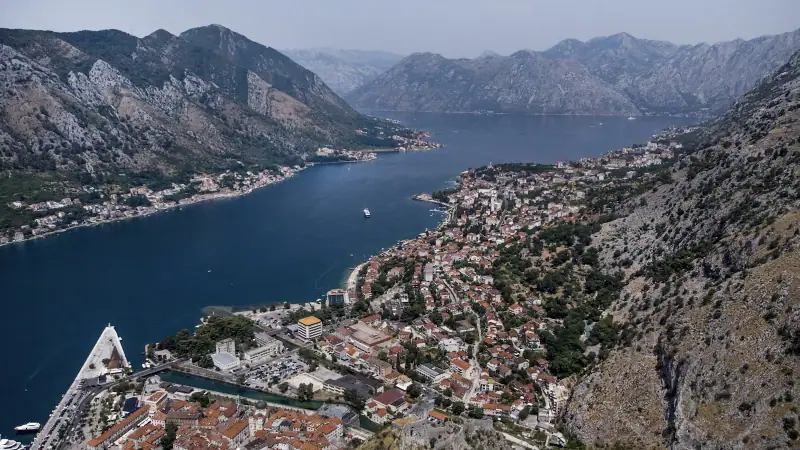
Spend the first afternoon in the old town: the Sea Gate, Arms Square and St. Tryphon Cathedral. Climb the ramparts to San Giovanni Fortress early or late in the day: it is about 1,200 to 1,355 steps, 45 minutes to 1 h 30, at about €8 (~$9) in season. Our Kotor guide and 3 days in the Bay of Kotor agree on the second day: Dobrota, Prčanj, Perast with the boat to Our Lady of the Rocks, and Risan’s Roman mosaics. A guided kayak tour costs €25 to 40 (~$29 to 46) per person for three hours.
On day 13, Cetinje, the old royal capital, is 37 km (23 mi) away by the Lovćen switchback road, 1 h to 1 h 20 each way. Cars cannot enter Kotor’s old town, so choose lodging with parking or Dobrota (about €50 to 120, ~$58 to 139); old-town hotels run about €60 to 150 (~$70 to 174) in high season. Our guide to where to stay in Kotor explains the areas, and you can search hotels in Kotor.
Day 14: Kotor to Dubrovnik Airport
Drive 1 h 45, 71 km (44 mi), to DBV. This figure does not include the border wait. Leave Kotor early and add a generous margin before your flight.
Crossing the borders
This loop crosses three borders. Details and fees for the whole region are in the tour page’s section on crossing borders with a rental car. Before you book, declare every country to the rental company (cross-border option). Some companies require a written permit from the branch for Montenegro and charge a fee per day or per country. Driving into a country that was not authorized voids the rental protections (Sixt published terms, 2026). Fees vary, so compare. Entry rules, visas and driving licence or IDP requirements depend on your passport: check your own government’s advice (travel.state.gov for the US, gov.uk/foreign-travel-advice for the UK, travel.gc.ca/destinations for Canada, smartraveller.gov.au for Australia). ETIAS was not in operation as of November 2026; see travel-europe.europa.eu/etias_en before you go.
Day 3, Croatia to Bosnia and Herzegovina (near Trebinje). This is an external Schengen border with passport checks. The EU Entry/Exit System has been fully deployed at external borders since April 10, 2026: non-EU travelers register fingerprints and a photo at their first crossing, which takes longer, and you may be asked to step out of the car (eu-LISA, 2026). Bosnia and Herzegovina requires foreign-registered cars to carry a paper Green Card (electronic not accepted) unless the plate’s country is recognized under the Multilateral Agreement; otherwise border insurance is sold at the crossing, not online (Green Card Bureau of Bosnia and Herzegovina, 2026). Ask the rental company for a Green Card covering Bosnia, Montenegro and Albania, and check that it lists every country of your route. Albania is not on this loop.
Day 9, Bosnia and Herzegovina to Montenegro (on the way to Žabljak). Border insurance for Montenegro is also sold at the crossing when the car’s Green Card does not cover it (insurer and bureau information, 2026). Confirm the Green Card before you leave Dubrovnik. Montenegro has no vignette; there are small tolls on the Smokovac-Mateševo motorway and the Sozina tunnel, which your route may or may not use. Bosnia has no vignette either.
Day 14, Montenegro to Croatia. This is again an external Schengen border, and in summer it is the one to plan around. The Croatian auto club HAK reported waits of up to 12 hours at the Croatia-Montenegro border on a peak August day in 2026, and weekends are the worst. Cross early in the morning, avoid summer weekends, and check HAK’s live border information at hak.hr. EES registration also applies here.
One-way rentals: a drop-off in another country is often refused or charged a high international one-way fee, with no published figure for these countries. This loop returns to Dubrovnik, so none applies; a one-way inside Croatia is much cheaper than one across borders. Croatia has no vignette and uses distance-based toll booths on motorways (a change of toll system is planned for 2027), but this route barely uses them. Currency: the euro in Croatia and Montenegro, the convertible mark (KM) in Bosnia and Herzegovina.
Getting there and away
From the US, UK, Canada and Australia, the usual gateways in the region are the larger airports: Zagreb (ZAG), Split (SPU) and Dubrovnik (DBV) in Croatia, plus Sarajevo (SJJ), Tivat (TIV) and Podgorica (TGD). For this loop, fly into and out of Dubrovnik Airport (DBV), which gives you the pick-up and drop-off in one place. Our guides do not list routes or airlines, so check what serves DBV from your home airport.
If you prefer an open-jaw ticket, a one-way rental to another country is usually refused or expensive. A one-way inside Croatia, such as Zagreb to Dubrovnik, is much cheaper, but it would change this route. Compare before you fix the dates.
When to go
Late May, June and September work in all three countries. Our Bosnia guide calls May and June the recommended period for a first trip and says September may be the best month; our Montenegro guide rates June and September highly, with a sea at 22 to 24 °C (72 to 75 °F) in June and 24 to 26 °C (75 to 79 °F) in September. Croatia’s guide calls June the best month on the coast.
July and August bring 35 to 40 °C (95 to 104 °F) in Mostar and on the Montenegrin coast, cruise crowds in Dubrovnik and Kotor, and the longest border queues. Durmitor stays cool (15 to 22 °C / 59 to 72 °F) and its trails are best from mid-June to the end of September. The Lukomir road is passable from June to September. From mid-October some Montenegrin lodging and restaurants close, and Durmitor turns toward ski season.
Budget
Figures come from each country’s own guides and are indicative.
- Croatia: the Croatia budget guide lists 3-star hotels in Dubrovnik at €150 to 250 (~$175 to 290) a night in high season. A seaside fish dinner is €25 to 45 (~$29 to 52) per person.
- Bosnia and Herzegovina: the comfort budget is €50 to 80 (~$58 to 93) a day excluding the car. A guesthouse in Mostar is 30 to 60 KM (€15 to 30, ~$17 to 35) a night; a 3-star hotel in the old town 100 to 160 KM (€50 to 80, ~$58 to 93). A restaurant meal there is 15 to 30 KM (€8 to 15).
- Montenegro: the Kotor and Žabljak guides give the lodging prices above; a standard Tara rafting day is €60 to 90.
- Car, fuel and tolls: the Bosnia guide gives fuel around €1.70 to 1.80 per liter (~$2.00 to 2.10) and the Montenegro guide €1.55 to 1.70 for gasoline. Rental, insurance and cross-border fees depend on the company.
Adapt it
For a shorter trip, drop Trebinje and drive Dubrovnik to Mostar directly, or skip Sarajevo and go from Mostar to the coast. To add days, extend the Kotor base with Cetinje, Budva or Virpazar on Lake Skadar, or add Jajce from the Bosnian interior. North of Dubrovnik, Makarska and Split lie on the Croatian coast. Anything that enters Albania (Shkodër, Theth, Tirana, Berat, Gjirokastër, Sarandë) needs its own check with the rental company, since Albania is the country most often restricted. Sutjeska National Park sits on the Bosnia-Montenegro border, about 100 km (62 mi) from Sarajevo by the Bosnia guide; the drive times above do not include it.
Frequently asked questions
Can you drive a Croatian rental car into Bosnia and Montenegro?
Only if you declare every country to the rental company when you book. Some companies require a written cross-border permit from the branch for Montenegro and charge a fee per day or per country. Driving into a country that was not authorized voids the rental protections (Sixt published terms, 2026).
Do you need a Green Card for this loop?
Bosnia and Herzegovina requires foreign-registered cars to carry a paper Green Card unless the plate's country is recognized under the Multilateral Agreement; otherwise border insurance is sold at the crossing. Ask the rental company for a Green Card that lists Bosnia and Herzegovina and Montenegro (Green Card Bureau of Bosnia and Herzegovina, 2026).
Is there a one-way fee on this route?
No international one-way fee applies, because you return the car to Dubrovnik, where you picked it up. A drop-off in another country is often refused or charged a high fee, which is why this route is a loop.
Which currency do you need?
Croatia and Montenegro use the euro. Bosnia and Herzegovina uses the convertible mark (KM), and some sights take cash only, such as the Tunnel of Hope in Sarajevo.
When is the best time for this loop?
Late May, June and September suit all three countries: mild to warm weather and fewer crowds. July and August bring heat above 35 °C (95 °F) and the longest border queues.
Ready-made
Balkans road trip itineraries
14 days
The Balkans in 14 days: Slovenia, Croatia and Mostar, from Ljubljana to Dubrovnik
BledLjubljanaPlitvice LakesZadarSplitMostarDubrovnik
Can be adapted in the planner
20 days
The Balkans in 20 days: a loop from Dubrovnik through Mostar, Albania and Montenegro
DubrovnikMostarShkodërBeratGjirokastërSarandëTiranaBudvaKotor
Can be adapted in the planner