What to see
Visit Počitelj: The Ottoman Medieval Town of Herzegovina
We may earn a commission when you book through links on this page, at no extra cost to you. We don't visit or try the places we cover: we summarize published sources. How we work
In short
- Two to three hours cover the whole site: the climb to the kula tower (15 to 20 minutes), the Šišman Ibrahim Pasha Mosque, the caravanserai and the lanes.
- Počitelj is about 30 km (19 mi) south of Mostar on the M17, about 30 minutes by car. The village itself is free to enter.
- A car is the most practical way, and lets you combine Blagaj, Počitelj and the Kravice waterfalls in one day (25 to 40 km / 15 to 25 mi apart).
- The mosque is open to non-Muslim visitors outside prayer times; modest dress is required. Spring and fall are best; summer is hot (35 to 40 °C / 95 to 104 °F).
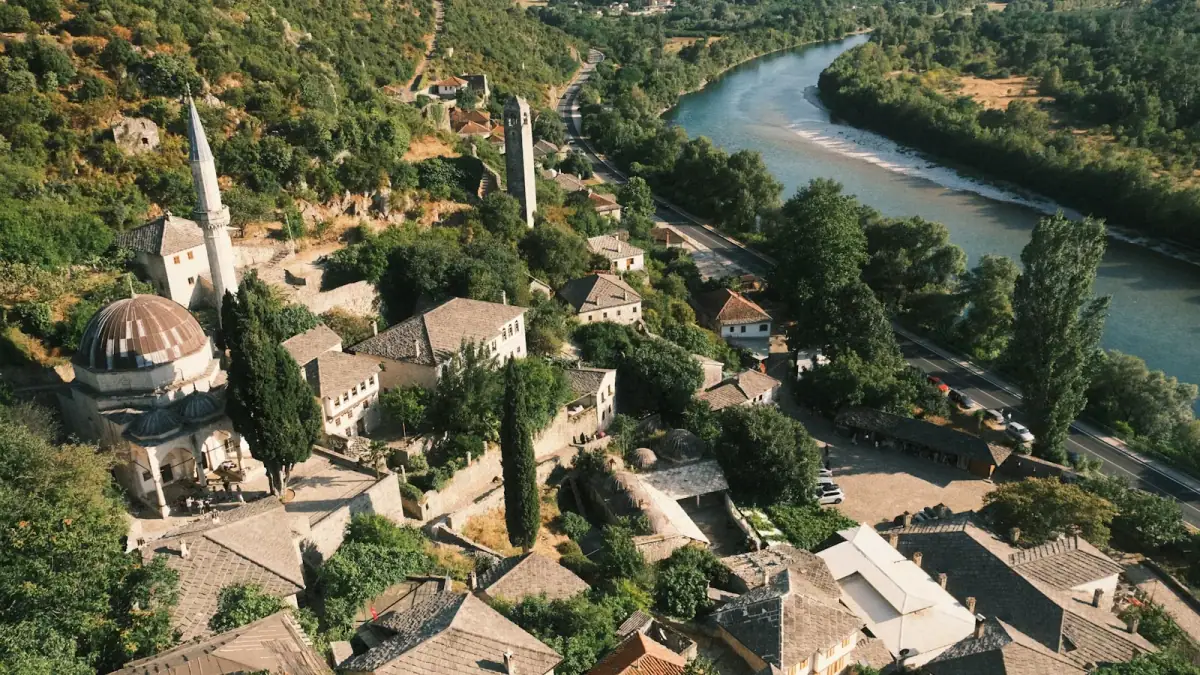
There are places where time seems to have stopped in the 16th century. Počitelj is one of them. Clinging to a cliff above the green waters of the Neretva, about 30 kilometers (19 mi) south of Mostar, this Ottoman medieval town is one of the most beautiful and least visited in Herzegovina. Its lanes paved with white pebbles, its mosque with a slender minaret, its fortified tower overlooking the river and its old golden-stone houses make a picture of rare architectural coherence, a film set that nonetheless belongs to no fiction. This guide gives you everything you need to enjoy it fully.
History of Počitelj: from medieval times to the Ottomans
Počitelj (pronounced “Po-chi-tel”) is one of the best-preserved historic sites in the Balkans. Its history goes back to medieval Bosnia: fortifications are recorded from the 14th century, when the town was an outpost of the Kingdom of Bosnia against Ottoman incursions from the south.
After the Ottoman conquest of Herzegovina, Počitelj had its period of greatest prominence. The town acquired its most remarkable monuments from the 16th century on: the great mosque, built in 1562-63 by Hadži Alija, is the centerpiece of the site. In the 17th century, under the governorship of Šišman Ibrahim Pasha, who renovated the mosque and gave it his name, the complex was enriched with a hammam (public bath), a caravanserai for merchants and travelers, a Quranic school (mekteb) and several notables’ residences. The site’s present architectural look dates from that time.
Revival after the war
The Bosnian war (1992-1995) left deep marks on Počitelj. In 1993, during fighting between the HVO (Croatian Defence Council) and the Army of Bosnia and Herzegovina, the town suffered massive destruction: the Šišman Ibrahim Pasha Mosque was partly destroyed, its minaret brought down, and part of the Ottoman houses burned. The toll was heavy for a site then in the process of being considered for UNESCO listing.
Since the end of the conflict, gradual restoration has been carried out, notably thanks to international funds and the support of local communities. The minaret has been rebuilt, the mosque renovated, and many houses have recovered their pre-war look. Počitelj is today on UNESCO’s tentative World Heritage list, a deserved recognition of this exceptional record of Ottoman architecture in the Balkans.
The Kula: the fortified tower that dominates everything
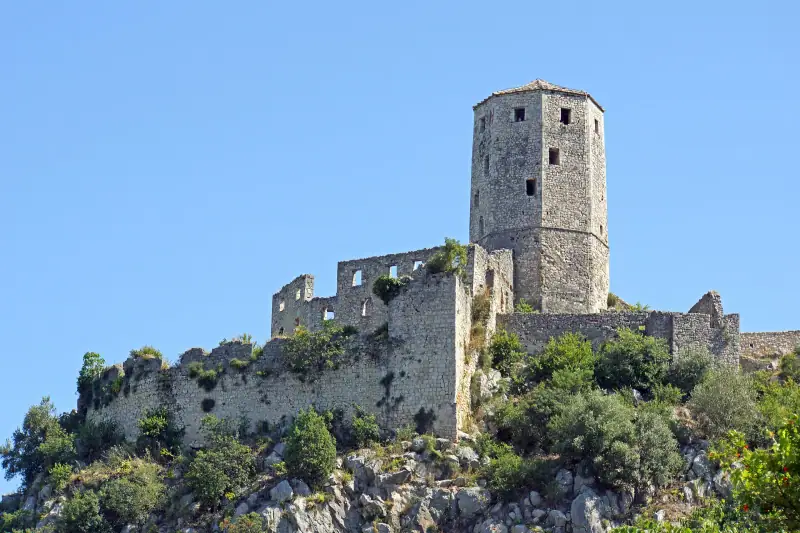
The most immediately recognizable symbol of Počitelj is its medieval cylindrical tower, the kula (tower in Bosnian), which stands at the top of the limestone cliff above the village. Built in medieval Bosnian times and reinforced under the Ottomans, it was part of a larger defensive system including ramparts and several bastions.
The climb and the view
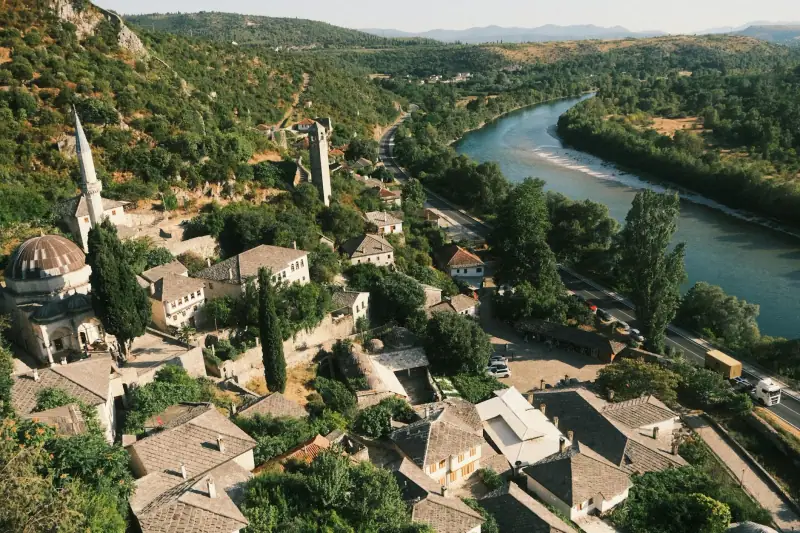
The kula is reached by a paved path climbing from the village center through the lanes and the old ramparts. The climb is steep, 15 to 20 minutes at a relaxed pace, but each turn offers a wider panorama of the village below and the bend of the Neretva.
From the top of the tower, in clear weather, the view extends for several kilometers: the jade-green waters of the river winding through their karst valley, the arid hills of Herzegovina dotted with olive bushes and wild fig trees, and below, the ocher and gray mosaic of Počitelj’s tiled roofs. It is one of the most photographed panoramas in all of Bosnia and Herzegovina, and for good reason.
Tip: Climbing in late afternoon, against the light, is visually beautiful but hard to photograph. Prefer the morning for front light on the roofs and the mosque. In summer, leave before 9 am to enjoy the cool and the low light before the groups arrive.
Herzegovina tours from Mostar
Discover Počitelj, Blagaj and the Kravice waterfalls with a local guide who knows every corner of Herzegovina.
The Šišman Ibrahim Pasha Mosque
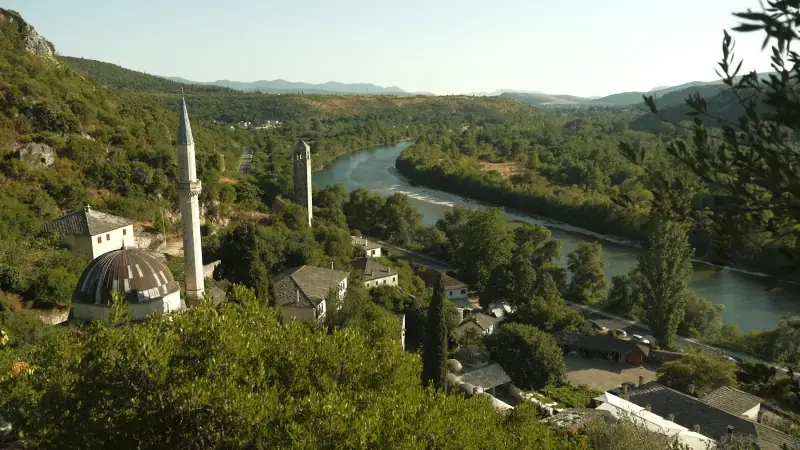
In the center of the village, the Šišman Ibrahim Pasha Mosque is the most imposing and architecturally most accomplished monument in Počitelj. Built in 1562-63 (970 AH) by Hadži Alija, son of Musa, and restored in the 17th century by Šišman Ibrahim Pasha, hence its name, it is an accomplished example of classical Ottoman architecture adapted to the Balkan context.
Architecture and decoration
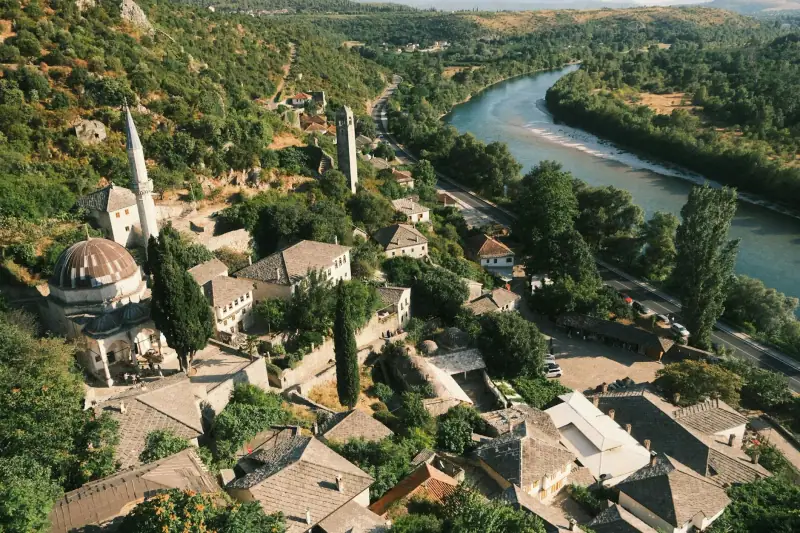
The mosque has the typical plan of the great Ottoman provincial mosques: a square prayer space topped by a central dome, preceded by a columned porch (trijemovi). The minaret, brought down in 1993 and faithfully rebuilt since, rises generously above the roof, visible from afar from the M17 road at the foot of the cliff.
The interior, sober as befits classical Islamic architecture, is remarkable for the quality of its carved woodwork (the mimbar, pulpit, and the hünkâr mahfili, gallery) and for the subdued light filtering through the pointed-arch windows. Quranic inscriptions in Arabic calligraphy decorate the whitewashed walls.
Dress: Modest dress is required for men and women. Scarves are provided at the entrance for women. Avoid short shorts. The mosque is closed to tourist visits during prayer times.
The caravanserai and the mekteb
Počitelj was not only a fortress; it was also a trading crossroads on the Neretva route. The Ottoman caravanserai (han) beside the mosque bears witness to the town’s economic role: merchants and their caravans stopped there for the night, with animals housed on the ground floor and men upstairs.
The Počitelj caravanserai is one of the few examples of this type of building still standing in Herzegovina. Its large vaulted hall, arcades and thick walls of local cut stone have been partly restored. The building now sometimes hosts cultural events or temporary exhibitions; ask there if anything is scheduled during your visit.
The mekteb and Ottoman education
Next to the mosque stands the mekteb (Quranic school), a small building with a wooden portico that was used to teach the community’s children. It is a rare type of building in its present state of preservation. The simple, almost modest architecture contrasts with the grandeur of the neighboring mosque and recalls that the Ottoman town was designed as a coherent set of complementary functions: prayer, trade, travel and education.
The Ottoman hammam
The ruins of the hammam (Ottoman public bath) are not far from the mosque. It is the type of building that systematically completes the great Ottoman foundations (külliye): ritual purity was ensured there before prayer, but the hammam also served as a place of socializing, meeting and body care in a society where hygiene was raised to a religious duty.
The Počitelj hammam is partly ruined, but well enough preserved to appreciate the traditional layout: the soğukluk (cold room), ılıklık (warm room) and sıcaklık (hot room), with individual cabins around a centered plan. Remains of the hot water piping are still visible in the walls.
Hotels in Mostar: an ideal base for exploring Herzegovina
Mostar is the natural starting point for Počitelj, Blagaj and the Kravice waterfalls. Book your hotel to organize your excursion days.
Strolling the village: the Ottoman houses
Beyond the main monuments, Počitelj’s great richness is its almost intact Ottoman urban fabric. Lanes paved with white pebbles wind between houses with overhanging upper floors in local limestone, with inner gardens shaded by fig and pomegranate trees.
These houses, known as stara bosanska kuća (traditional Bosnian houses), mostly date from the 17th to the 19th century. Many were restored after the 1993 destruction, but some are still waiting for rehabilitation: blackened facades and collapsed roofs recall, by contrast, the scale of the damage. It is an open-air history lesson, as eloquent as the restored monuments.
The artists and the art colony
Before the war, Počitelj was an art colony known throughout the former Yugoslavia. Painters, sculptors and photographers came to work there, drawn by the beauty of the site and the quality of the Herzegovinian light, that white, raw light that draws sharp shadows on the limestone. A few workshops and galleries have reopened since the end of the conflict, and the artistic tradition is slowly taking its place again in village life. If you come across an open workshop on your walk, do not hesitate to go in.
Food in Počitelj
The village has a few terraces and small places to eat, tucked into the lanes or facing the Neretva. Without claiming to rival Mostar’s food offer, the local kitchens serve the Herzegovinian specialties you will find across the region.
What you eat here
- Ćevapi: Small Bosnian grilled sausages, served with puffed lepinja bread, raw onions and kajmak (lightly fermented cream). The staple of every Bosnian table.
- Pita: Flaky pastry (filo) with cheese (sirnica), meat (mesnica) or spinach (zeljanica). Ideal as a snack before or after the climb to the kula.
- Neretva grills: The river is rich in fish and local restaurants offer fresh trout or grilled carp in season, a nice way to end the visit.
- Bosnian coffee: The essential ritual. A copper džezva with its rahat lokum sugar, drunk slowly on a shaded terrace.
Meal budget: A light meal (ćevapi and a drink) costs 10-18 BAM (€5-9 / $6-10). A full meal with fish is around 25-35 BAM (€12-18 / $14-21).
Počitelj in your itinerary
The classic Herzegovina circuit in one day
Počitelj fits naturally into the Herzegovina day circuit from Mostar, the favorite itinerary of travelers with a car. The most logical sequence: Blagaj in the morning (leave 8:30 am, tekke, Buna spring and trout lunch), Počitelj in early afternoon (2 to 3 hours of visiting), then the Kravice waterfalls in mid-afternoon before returning to Mostar. Distances between these three sites are short: Blagaj to Počitelj about 24 km (15 mi), Počitelj to Kravice about 18 km (11 mi).
Weekend from Mostar
If you have two days based in Mostar, spend the first day in the center of Mostar (Stari Most bridge, the Ottoman Kujundžiluk bazaar, Koski Mehmed Pasha Mosque, the War Museum). On the second day, leave early for Blagaj, Počitelj and Kravice, a perfect day in Herzegovina. See our Mostar weekend guide for detailed planning.
As part of a Bosnia road trip
As part of a Bosnia road trip of 7 days or more, Počitelj is visited on the way between Mostar and the Croatian coast or on a day devoted to southern Herzegovina. It is also a natural stop if you arrive or leave via Dubrovnik (about 100 km / 62 mi to the southwest via Čapljina and Metković).
Car rental in Bosnia and Herzegovina
A car is essential to explore Herzegovina at your own pace. Compare the best rental deals from Mostar or Sarajevo airport.
When to visit Počitelj
Spring (April-May): The best season. Almond and fig trees in bloom dot the site with touches of fresh green, temperatures are mild (15-22 °C / 59-72 °F) and crowds stay moderate. Spring light is ideal for architectural photography.
Summer (June-August): High season. In July-August, Počitelj receives a rush of tourists from Mostar and tour groups from the Croatian Dalmatian coast. Come early (before 9:30 am) or late afternoon (after 5 pm) to avoid the coach rush hour. Summer heat in Herzegovina is intense (35-40 °C / 95-104 °F): bring water, sunscreen and a hat.
Fall (September-October): An excellent compromise. Temperatures drop to 20-28 °C (68-82 °F), crowds fall sharply from mid-September, and the autumn light gilds Počitelj’s limestone beautifully. Fig trees bear fruit and the gardens of the old houses smell of warm honey.
Winter (November-March): Počitelj is almost empty in winter, which gives it a very particular contemplative atmosphere. The site is accessible but some shops close. Morning mist over the Neretva and the cold colors of the stone are an invitation for photographers.
Practical information
Access and parking
Počitelj lies right on the M17 road, about 30 km (19 mi) south of Mostar. A large parking lot is at the roadside at the foot of the site (free as far as is known, check locally). From there you walk up to the village entrance (a few minutes on a fairly steep paved path).
By car from Mostar: About 30 minutes via the M17 toward Čapljina. By bus: Mostar-Čapljina buses run along this route; ask to get off at the Počitelj junction (stop Počitelj raskrižje). Frequency is limited, so check times at Mostar bus station.
Indicative budget
| Item | Indicative price |
|---|---|
| Village access | Free |
| Kula climb | ~2-3 BAM (€1-1.50 / $1.15-1.75), check locally |
| Light meal (ćevapi) | 10-18 BAM (€5-9 / $6-10) |
| Full meal (fish) | 25-35 BAM (€12-18 / $14-21) |
| Bosnian coffee | 2-3 BAM |
For an overall budget for Bosnia and Herzegovina, see our Bosnia budget guide.
Accommodation in Počitelj
Počitelj has few places to stay, and most visitors see the site on a day trip from Mostar. A few small family guesthouses offer rooms in restored Ottoman houses, an extraordinary experience, but book ahead in high season. For more choice and infrastructure, Mostar remains the natural logistics base for Herzegovina.
Flights to Bosnia and Herzegovina
Mostar airport is the closest to Počitelj. Sarajevo airport is also an option, with better international connections.
Visiting tips
- Wear suitable shoes: Počitelj’s lanes are paved with round, smooth pebbles, often slippery. Trekking sandals or walking shoes are better than flat sandals or flip-flops.
- Bring water: There are few water points on the site itself. Fill your bottle before climbing, especially in summer.
- Respect the place of worship: The mosque is an active place of worship. Do not enter during prayer times (five times a day according to the adhan) and keep away from worshippers.
- Protect yourself from the sun: The limestone cliff reflects heat and light intensely. High-protection sunscreen, a hat and covering clothes are essential in summer.
- Go beyond the main path: Hurried tourists settle for the kula-mosque-kula route. Take the time to get lost in the side lanes; that is where the best-preserved houses and the finest architectural details hide.
Final thoughts
Počitelj is one of those sites that belong to great history but that few travelers take the time to really visit. Halfway on the road between Mostar and the Croatian border, it is too often a photo taken from the car and a twenty-minute stop at the parking lot. Yet behind the facade of white pebbles and ocher stone hides an Ottoman town of rare architectural coherence, scarred by war and revived by a remarkable collective will. Climb to the kula, take the time to sit in front of the mosque, look for the artists in their discreet workshops. Počitelj deserves the two to three hours of attention it asks for, and often gives you much more in return.
Frequently asked questions
How long does it take to visit Počitelj?
Two to three hours are enough to cover the whole site: climbing to the kula (fortified tower), visiting the Šišman Ibrahim Pasha Mosque, strolling the cobbled lanes and stopping at the caravanserai. If you love Ottoman architecture or photography, allow a full half day.
How do you get to Počitelj from Mostar?
Počitelj is about 30 km (19 mi) south of Mostar on the M17 road along the Neretva. By car, allow about 30 minutes depending on traffic. Some long-distance Mostar-Čapljina buses stop at the Počitelj junction, but the site itself is on foot from the roadside. A car is the most convenient solution, and lets you combine Počitelj with Blagaj and the Kravice waterfalls on the same day.
Is there an entry fee for Počitelj?
Access to the village and the Ottoman lanes is free. Climbing the kula tower generally involves a small contribution (check the rate and conditions locally), but the exact arrangements may vary. The Šišman Ibrahim Pasha Mosque is open to non-Muslim visitors outside prayer times, with modest dress required.
Was Počitelj damaged during the war?
Yes. In 1993, during the conflict between Croat and Bosniak forces, Počitelj suffered major damage: the mosque was partly destroyed, the minaret brought down and many Ottoman houses burned. Since then, considerable restoration work has recovered much of the pre-war look, notably the rebuilding of the Šišman Ibrahim Pasha Mosque minaret.
Can you visit Počitelj in winter?
Yes, Počitelj is accessible all year. In winter the site is almost deserted, which makes for a very intimate visit. The mosque may have reduced hours and some shops close off-season. Morning mist over the Neretva and low winter light make the site especially photogenic outside summer.
How do you combine Počitelj with other Herzegovina sights?
Počitelj fits perfectly into a Herzegovina day circuit from Mostar: Blagaj in the morning (tekke, Buna spring), Počitelj in early afternoon, and the Kravice waterfalls in mid-afternoon before returning to Mostar. The three sites are linked by road and 25 to 40 km (15 to 25 mi) apart.
More Bosnia and Herzegovina guides
Keep reading
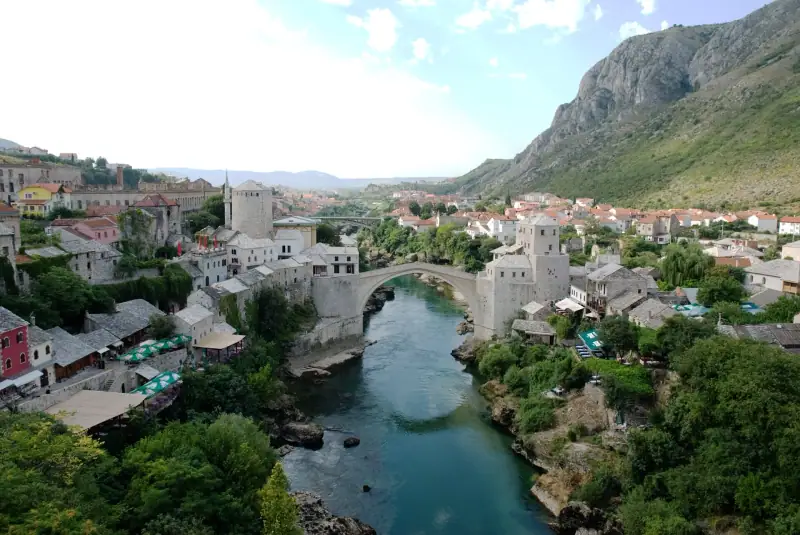
Visit Mostar: Complete Guide to the Pearl of Herzegovina
Everything to visit Mostar: Stari Most, Ottoman old town, day trips to Blagaj and Kravice, where to stay, budget and practical tips. 2026 guide.
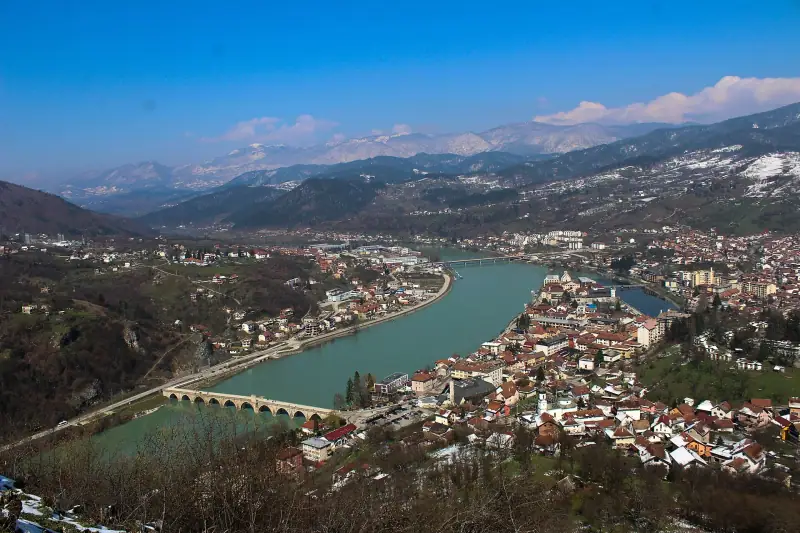
Višegrad: Visiting the Bridge on the Drina from Sarajevo, With or Without a Car
Mehmed Paša Sokolović Bridge in Višegrad: getting there from Sarajevo by car, bus or tour, visit length, free entry, Andrićgrad and practical tips.
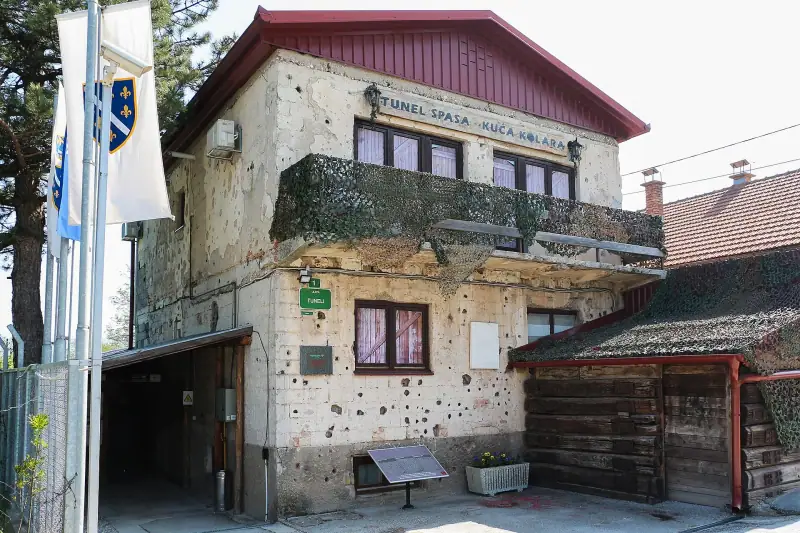
Sarajevo Tunnel of Hope: Hours, Prices and Getting There Without a Car
Visiting the Tunnel of Hope in Sarajevo: summer and winter hours, cash entry price, tram and bus from the center, visit length and tips.
Ready-made
Bosnia and Herzegovina itineraries
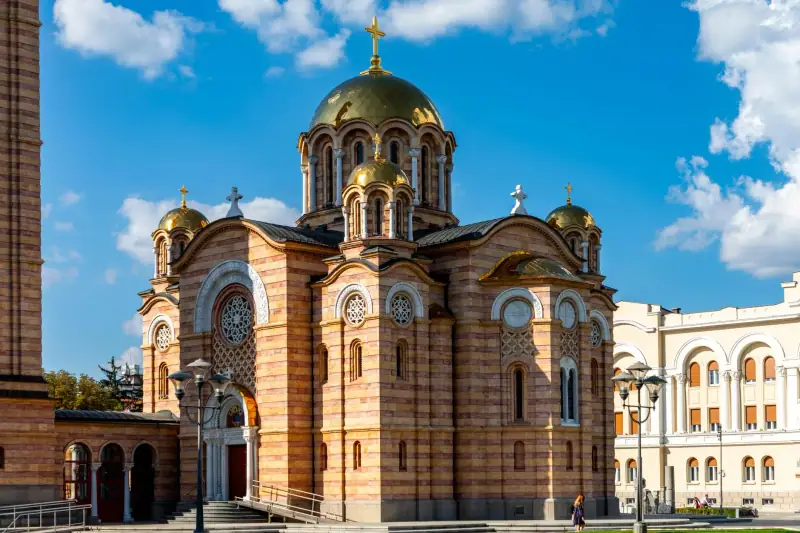
3 days
Northwest Bosnia: Banja Luka, Jajce and Una National Park
JajceBanja Luka
5 days
14 days
Bosnia and Herzegovina Road Trip: A 10 to 14 Day Itinerary by Car
Road trip through Bosnia and Herzegovina in 10 to 14 days: Sarajevo, Mostar, the Una, Sutjeska and Trebinje. The full itinerary to see it all.