Itineraries
3 Days in the Bay of Kotor: A Complete Itinerary
We may earn a commission when you book through links on this page, at no extra cost to you. We don't visit or try the places we cover: we summarize published sources. How we work
Day by day
- Day 1Kotor Old Town, cathedral, ramparts to San Giovanni Fortress
- Day 2Dobrota, Prčanj, Perast, Our Lady of the Rocks, Risan, ferry
- Day 3Herceg Novi fortresses and the Luštica peninsula
Weather through the year on this route
| Jan | Feb | Mar | Apr | May | Jun | Jul | Aug | Sep | Oct | Nov | Dec | |
|---|---|---|---|---|---|---|---|---|---|---|---|---|
| High °F (°C) | 489 | 5010 | 5513 | 6317 | 7021 | 7926 | 8630 | 8831 | 7725 | 6820 | 5915 | 5010 |
| Low °F (°C) | 394 | 394 | 457 | 5010 | 5915 | 6619 | 7021 | 7222 | 6418 | 5513 | 489 | 415 |
| Rain in (mm) | 4.5115 | 4.5115 | 4.3110 | 3.9100 | 3.075 | 2.050 | 1.435 | 1.435 | 4.1105 | 4.7120 | 6.3160 | 6.1155 |
Normals 1991–2020 at Virpazar: averages over 30 years, not a forecast. Source: NASA POWER (MERRA-2), grid of about 50 km. Figures computed by us in November 2026.
In short
- Three days cover Kotor and its ramparts (day 1), the bay circuit with Perast, Our Lady of the Rocks and Risan (day 2), and Herceg Novi with the Luštica peninsula (day 3).
- A car is strongly recommended for the full circuit; the Kamenari-Lepetane ferry crosses the bay in a few minutes, with departures about every 20 minutes in the daytime.
- The climb to San Giovanni Fortress takes 45 minutes to 1 h 30; go before 9 am or after 5 pm to avoid heat and crowds.
- Indicative budget for 3 days: about €400 to 500 (about $464 to 580) on a budget, €700 to 1,000 (about $812 to 1,160) in comfort, per person.
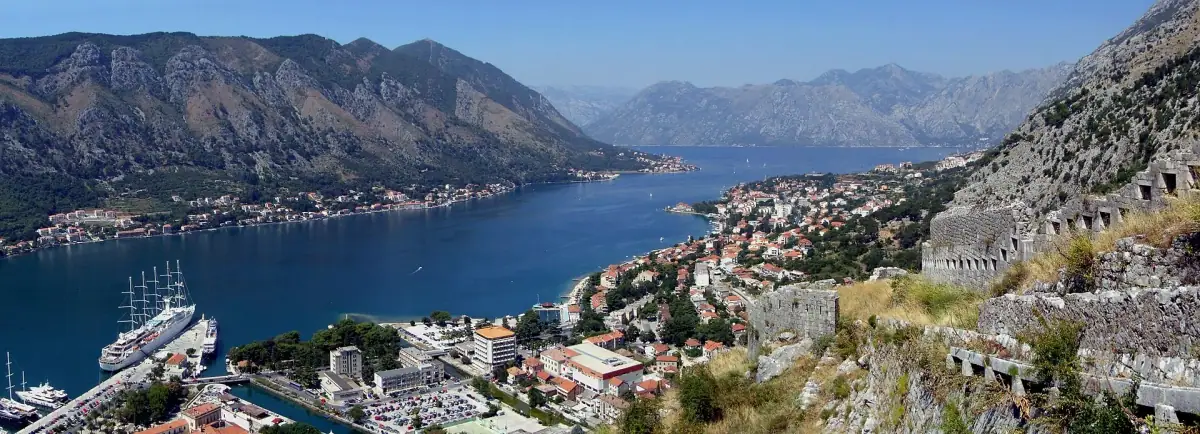
The Bay of Kotor is unlike any other Mediterranean destination. This network of bays tucked between 1,000-meter (3,280 ft) limestone cliffs, often compared to a fjord (though technically it is a ria), holds sleepy Venetian villages, a medieval old town on the UNESCO World Heritage list and deep blue waters in which the mountains are reflected. In three days you can grasp the essentials of this unique corner of the Balkans, as long as you do not rush.
Day 1: Kotor, the medieval city
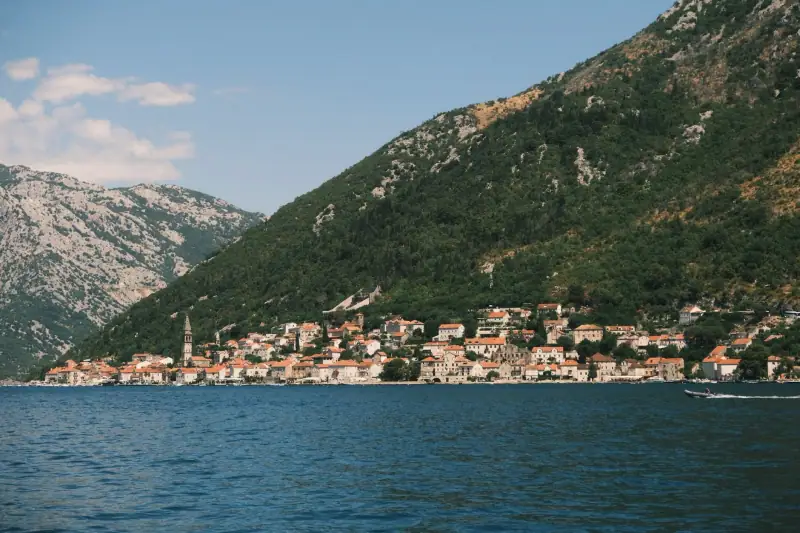
Start your stay with Kotor, the pearl of the bay. Arrive in the morning if possible: the lanes are still cool and the cruise passengers (many in high season) often don’t come ashore until late morning.
Kotor’s Old Town
Pass through the Sea Gate (Vrata od Mora), the main entrance on the harbor side, and dive into a labyrinth of cobbled lanes, squares and churches. St. Tryphon Cathedral (Sveti Tripun), dedicated to the town’s patron saint, is one of the finest examples of Romanesque architecture on the eastern Adriatic, and its two asymmetrical bell towers have become the symbol of Kotor. Inside, the saint’s relics and a treasury of medieval jewelry deserve a stop.
Arms Square (Trg od Oružja), in the center of town, is Kotor’s beating heart. The Clock Tower, built in the 17th century, still stands proudly there. Around it, cafés, restaurants and craft stalls liven up the square.
Don’t forget to glance at the small St. Luke’s Church (Sveti Luka), built in the 12th century, which has the particularity of having served as both a Catholic and an Orthodox place of worship at different periods.
Climbing the ramparts
Kotor’s must-do experience remains the climb up the medieval ramparts, which stretch about 4.5 km (2.8 mi) along the mountainside. The marked path starts at the Stairs Gate (Gurdić Gate), on the south side of the old town, and climbs to San Giovanni Fortress (Tvrđava Svetog Jovana), perched at about 280 meters (920 ft).
The climb takes 45 minutes to 1 h 30 depending on pace. It is physical, especially in summer: set out early in the morning (before 9 am) or late in the afternoon (after 5 pm) to avoid the heat and the crowds. The reward is worth it: a dizzying panorama of the inner bay, the mountains and the tiled roofs of the old town.
Guided tours of Kotor
Discover Kotor and its surroundings with a local guide: ramparts, history, hidden places.
Afternoon: the cats and the hidden corners
Kotor is known worldwide for its cats: hundreds of felines have lived freely in the old town for centuries (Venetian sailors brought them aboard to hunt rats). A small cat museum, in a lane near the cathedral, delights cat lovers (check that it is open).
In the late afternoon, head down to the harbor to watch cruise ships and yachts dock or leave. The quay hums with pleasant café life at sunset, the ideal time for a glass of Vranac (the local red wine) while watching the bay light up.
Lodging: Inside Kotor’s walls or in the Dobrota district, 3 km (1.9 mi) to the north, calmer and with a fine view of the bay. See our guide to where to stay in Kotor.
Day 2: Around the bay: Perast, the island and Risan
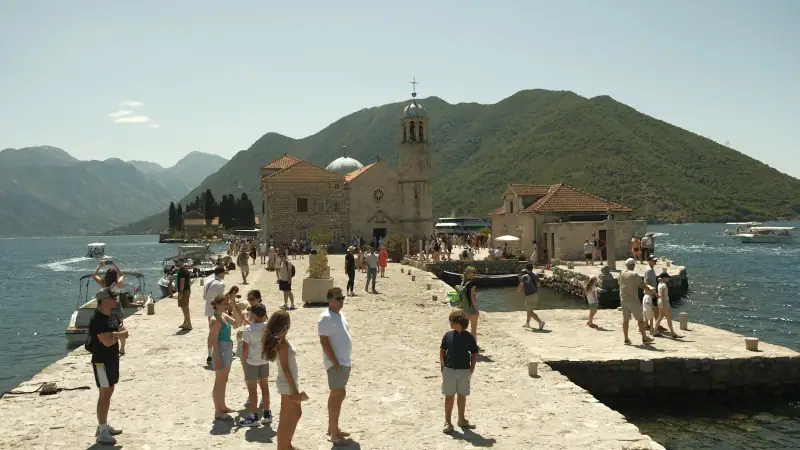
The second day is devoted to exploring the bay by the northern coastal road, which runs along turquoise waters through sleepy villages where time seems to have stopped in the Venetian era.
Dobrota and Prčanj
Leave Kotor heading north. The village of Dobrota stretches for 4 km (2.5 mi) along the shore: 17th- and 18th-century baroque palaces, built by sea captains enriched in the service of Venice, line the coastal road directly. Many are now private homes or small boutique hotels; their gardens run down to the water.
A little farther on, Prčanj has a fine parish church of the Nativity of the Virgin, whose construction stretched over more than a century. The small village square, with its stone landing stage and centuries-old plane trees, invites a pause.
Perast: the baroque village and Our Lady of the Rocks island
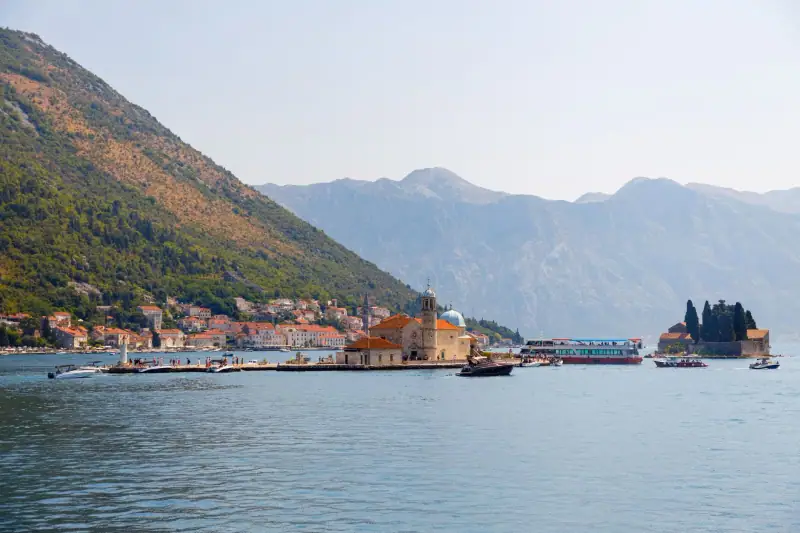
Perast is probably the most photographed village in Montenegro, and for good reason. Its Venetian palaces, its two bell towers standing against the mountain backdrop and the two islets floating just opposite make a picture of rare beauty.
The island of Our Lady of the Rocks (Gospa od Škrpjela) is the more famous of the two. Artificial, built stone by stone by Perast sailors who added a rock on each return from a voyage, it holds a baroque church with walls covered in votive paintings and a collection of 2,500 medals offered by grateful sailors. Water taxis bring visitors there from Perast’s landing stage in a few minutes (a very short crossing).
The other islet, St. George (Sveti Đorđe), holds a Benedictine monastery and a small cemetery; it cannot be visited.
Boat trips on the Bay of Kotor
Private cruises, island tours, sunset boat trips: book ahead in high season.
Risan and the Roman mosaics
Continuing west, you reach Risan, the oldest town on the Bay of Kotor, where the Romans founded a colony in the 2nd century BC. Under a modest but well-kept shelter, Roman mosaics from the 2nd century AD depicting Hypnos (the god of sleep) and mythological scenes were uncovered in archaeological digs. A site little known to travelers outside Montenegro, and well worth the detour.
Risan is also the starting point for a few hikes to the heights above the bay; paths lead to plunging views over the whole Bay of Kotor.
Return by the Kamenari ferry
So as not to repeat exactly the same road, take the ferry between Kamenari and Lepetane (a few minutes’ crossing, departures about every 20 minutes during the day; check the timetable with the operator Morsko Dobro). This mini-crossing takes you from one shore to the other at the narrowest point of the bay and gives a unique viewpoint over both shores at once. A treat for photographers.
In the late afternoon, return to Kotor or head to Herceg Novi for the night (see the next day’s stage). If you stay in Kotor, enjoy the local food in one of the old town restaurants: fresh seafood, grilled fish, goat cheese and homemade bread.
Day 3: Herceg Novi and the Luštica peninsula
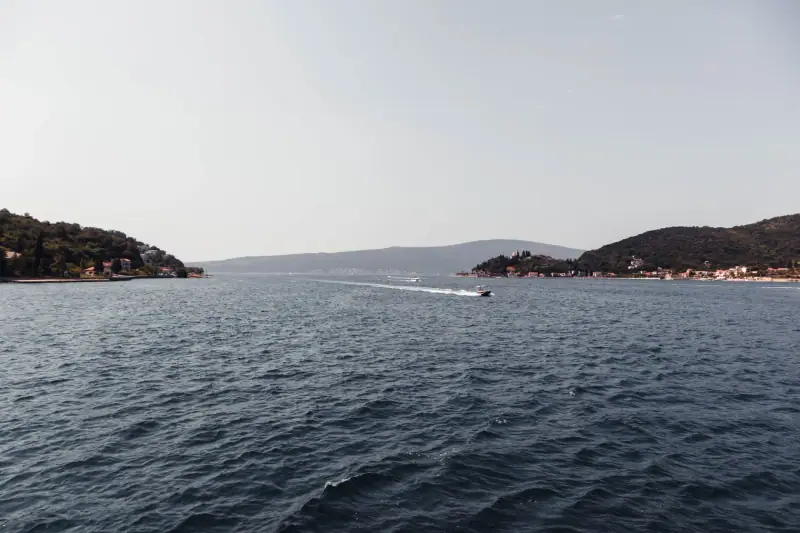
The third day takes you to the entrance of the Bay of Kotor, where the fjord opens onto the Adriatic: Herceg Novi, nicknamed the “city of flowers” for its lush gardens and its mimosa blooming in winter.
Herceg Novi: old town and fortresses
Herceg Novi is a town of several historical layers: occupied in turn by the Ottomans, the Venetians, the Austro-Hungarians and the French, each period has left traces in the architecture and culture. The old town is organized around the Stara Čaršija (the Ottoman bazaar), a tangle of lively lanes with shops, cafés and craftspeople, running down to the seafront promenade.
The Kanli Kula fortress (“the bloody tower”), built by the Ottomans in the 16th century, dominates the town center and offers a splendid view of the bay, the town and, in clear weather, the Croatian coast near Dubrovnik. An open-air theater is set up in the ruins.
The Španjola fort (Spanish fortress), higher still on the hill, is reached on foot from the center. The climb is steep but the view from the ramparts is breathtaking.
Stays in Herceg Novi
Hotels, apartments and guesthouses facing the bay for a quiet stay.
The Luštica peninsula
About thirty minutes southeast of Herceg Novi, the Luštica peninsula is still wilder than Kotor or Budva, even though the Luštica Bay tourism project has developed the area. It is a big surprise after the bustle of Kotor or Budva. Secluded coves, sometimes reachable only by hiking trails or by boat, offer swimming in crystal-clear water.
The village of Rose (Ružica), at the tip of the peninsula, is particularly picturesque: a few fishermen’s houses, a tiny harbor and an end-of-the-world atmosphere. The hike on the coastal path along the peninsula can be done independently and offers panoramas over the open bay.
Checking your budget
If you are planning this 3-day stay on a tight budget, see our article on the budget in Montenegro, which gives you realistic ranges for lodging, meals and transport in the Bay of Kotor region.
Option: kayaking in the Bay of Kotor
If you come back early from Herceg Novi or want to add a sporting activity to your stay, an outing by kayak in the Bay of Kotor is an unforgettable experience. Guided outings (half day or full day) let you explore coves otherwise inaccessible, approach the Venetian palaces from the water and observe local wildlife; dolphins sometimes come up into the bay.
Car rental to explore the bay
Compare rates and book ahead: cars go fast in July and August.
Practical tips for planning your stay
When to go
Spring (April-May) and fall (September-October) are the best times for the Bay of Kotor: pleasant temperatures (20 to 28 °C / 68 to 82 °F), lighter crowds than in July-August, beautiful light on the bay. In summer, the region is overrun with tourists and cruise passengers: arrive early at the main sights (before 9 am) to enjoy them in peace. For details on seasonality, see our article on the best time to visit Montenegro.
Getting around the Bay of Kotor
- Rental car: recommended for doing the full circuit of the bay at your own pace. Tivat Airport (about 10 km / 6 mi from Kotor) is handy for pickup.
- Taxis and ride-hailing: available from Kotor for one-off excursions; more expensive than a rental car over 3 days.
- Kamenari-Lepetane ferry: essential for cutting the road short and crossing the bay (a few minutes, frequent departures during the day; check the timetable with Morsko Dobro).
- On foot: Kotor inside the walls can be explored entirely on foot. For the other villages, a car is necessary.
Lodging
Kotor is the most practical base for exploring the whole bay. Lodging in the old town has a unique atmosphere but can be noisy in the evening. Dobrota and Prčanj offer calmer alternatives with fine views of the bay. Herceg Novi is practical if you arrive from Dubrovnik.
See our complete guide to where to stay in Kotor and our Herceg Novi guide for recommendations by price range.
Estimated budget for 3 days
| Item | Budget | Comfort |
|---|---|---|
| Lodging (per night) | €40-70 (~$46-81) | €80-150 (~$93-174) |
| Meals (per day) | €25-35 (~$29-41) | €50-80 (~$58-93) |
| Transport (car or taxis) | €40-60 (~$46-70) | €60-100 (~$70-116) |
| Entry fees and activities | €20-40 (~$23-46) | €50-100 (~$58-116) |
| Total 3 days | ~€400-500 (~$464-580) | ~€700-1,000 (~$812-1,160) |
Indicative ranges per person; prices vary by season and type of lodging.
Ideas for extending your stay
If you have more time, the Bay of Kotor fits perfectly into a Montenegro road trip or a 7-day trip that lets you add Budva, Cetinje and Lake Skadar. The Montenegrin coast is easy to travel and the distances stay modest, a rare asset in Europe.
Key takeaways
Three days in the Bay of Kotor is enough to fall in love with the place, and not enough to see all of it. This bay with its unique geography has the rare ability to satisfy history and architecture lovers, hikers, swimmers and food lovers alike. Don’t try to do everything: choose your pace, stop in the villages that speak to you, and let the changing light on the water do the rest.
Early morning in Kotor, before the cruise passengers arrive, or the sunset from the ramparts of Herceg Novi over a bay lit up in orange and pink: these are images you keep for a long time.
Frequently asked questions
Are 3 days enough to see the Bay of Kotor?
Yes, 3 days cover the main sights: Kotor, its ramparts, Perast, the island of Our Lady of the Rocks, Risan and Herceg Novi. To go further (Luštica peninsula, hikes), allow 4 to 5 days.
Do you need a car to visit the Bay of Kotor?
A car is strongly recommended to do the full circuit of the bay and reach places like Risan or Herceg Novi at your own pace. Water taxis and transfers exist but are less flexible. Rental is easy at Tivat Airport (10 min from Kotor).
What is the best base for visiting the Bay of Kotor?
Kotor is the ideal base: old town on foot, active harbor, many places to stay. Dobrota (the village immediately north of Kotor, on the bay) is calmer. Herceg Novi is practical if you arrive from Dubrovnik.
Can you swim in the Bay of Kotor?
Yes, the water is clear and clean in many coves, notably at Dobrota, Prčanj and around the Luštica peninsula. The inner bay is calmer than the open sea, ideal for children. Ask locally about authorized swimming areas.
How do you climb Kotor's ramparts?
The entrance is through the Stairs Gate (Gurdić gate), on the south side of the old town. The climb to San Giovanni Fortress takes about 45 minutes to 1 hour depending on your pace. An entry fee is charged (the rate changes: check there). Go early in the morning to avoid the heat and crowds.
Are there regular boats between villages on the Bay of Kotor?
A ferry crosses the bay regularly between Kamenari and Lepetane (a few minutes' crossing, departures about every 20 minutes during the day; check the timetable with the operator Morsko Dobro). Water taxis reach Our Lady of the Rocks island from Perast. For the other villages, it is better to have a vehicle.
More Montenegro guides
Keep reading
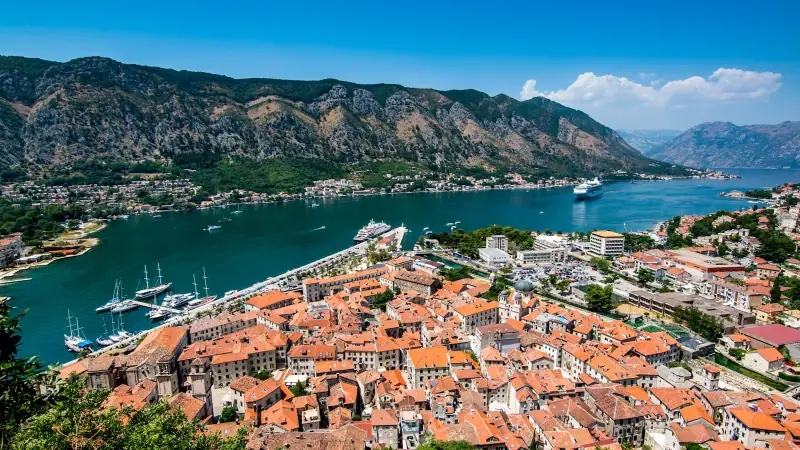
Visit Kotor: A Complete Guide to the UNESCO-Listed Old Town
Kotor, medieval jewel of the Bay of Kotor: ramparts, cathedral, legendary cats and the Montenegrin fjord. Everything you need to plan your visit.
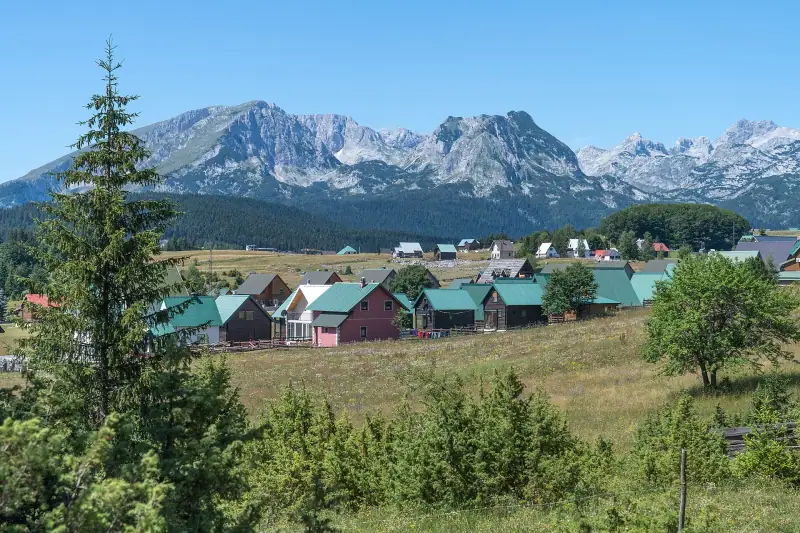
Visit Žabljak: A Complete Guide to the Capital of Durmitor
Žabljak, gateway to Durmitor: Black Lake, hiking, Tara canyon, skiing and wild nature. A complete guide for your stay in the Montenegrin mountains.
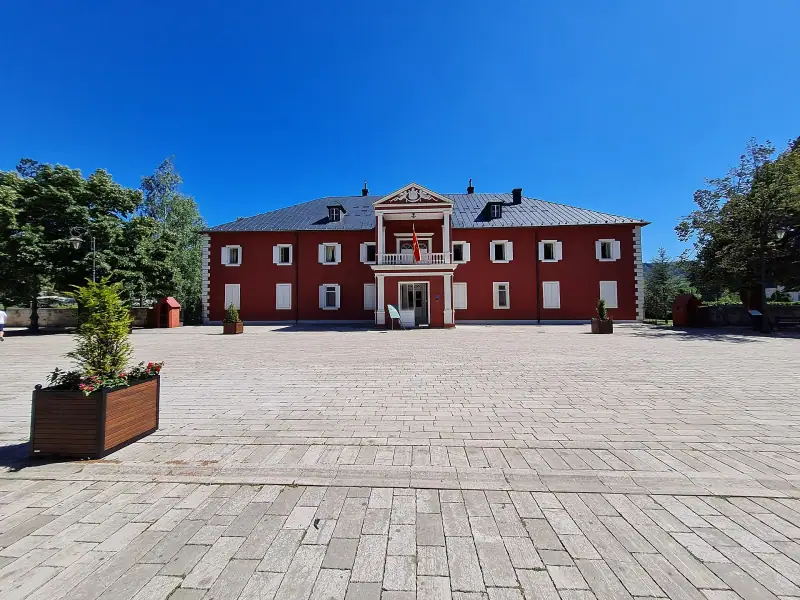
Visit Cetinje: A Complete Guide to Montenegro's Old Royal Capital
Cetinje, former royal capital of Montenegro: monastery, royal palaces, museums and the switchback road from Kotor. A practical guide for a day trip.
Ready-made
Montenegro itineraries
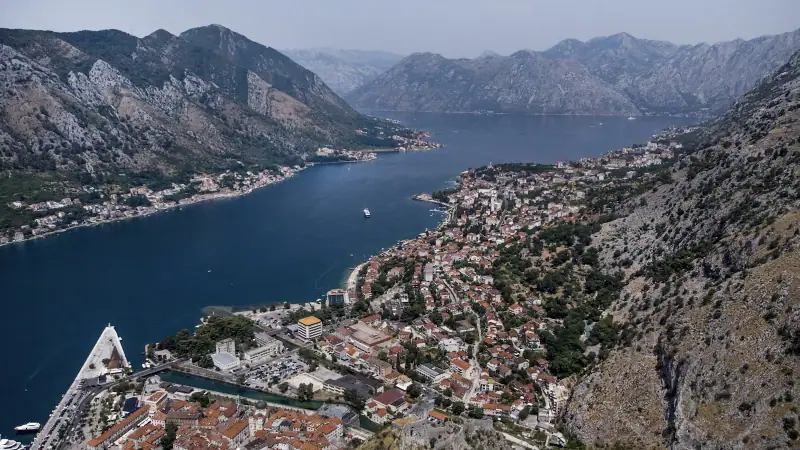
5 days
Montenegro in 5 Days Without a Car: A Realistic Itinerary
KotorBudvaKotor
14 days
Montenegro Road Trip: A Complete 10 to 14 Day Itinerary
Plan your Montenegro road trip with this complete itinerary. Coast, mountains, lakes and medieval towns in 10 to 14 days of freedom.