What to see
Visit Mostar: Complete Guide to the Pearl of Herzegovina
We may earn a commission when you book through links on this page, at no extra cost to you. We don't visit or try the places we cover: we summarize published sources. How we work
In short
- One full day covers the Stari Most, Kujundžiluk, Koski Mehmed Pasha Mosque and the Croat quarter; two days add Blagaj and Počitelj, three add the Kravice waterfalls.
- Sarajevo to Mostar is about 130 km (81 mi): about 2 h 30 by bus for 14 to 20 BAM, about 2 h by car, or the scenic train (1 or 2 departures a day).
- Spring and fall are ideal (20 to 28 °C / 68 to 82 °F). July and August often reach 35 to 40 °C (95 to 104 °F) and are the busiest.
- Day trips: Blagaj (12 km / 7.5 mi), Počitelj (about 30 km / 19 mi) and the Kravice waterfalls (40 km / 25 mi).
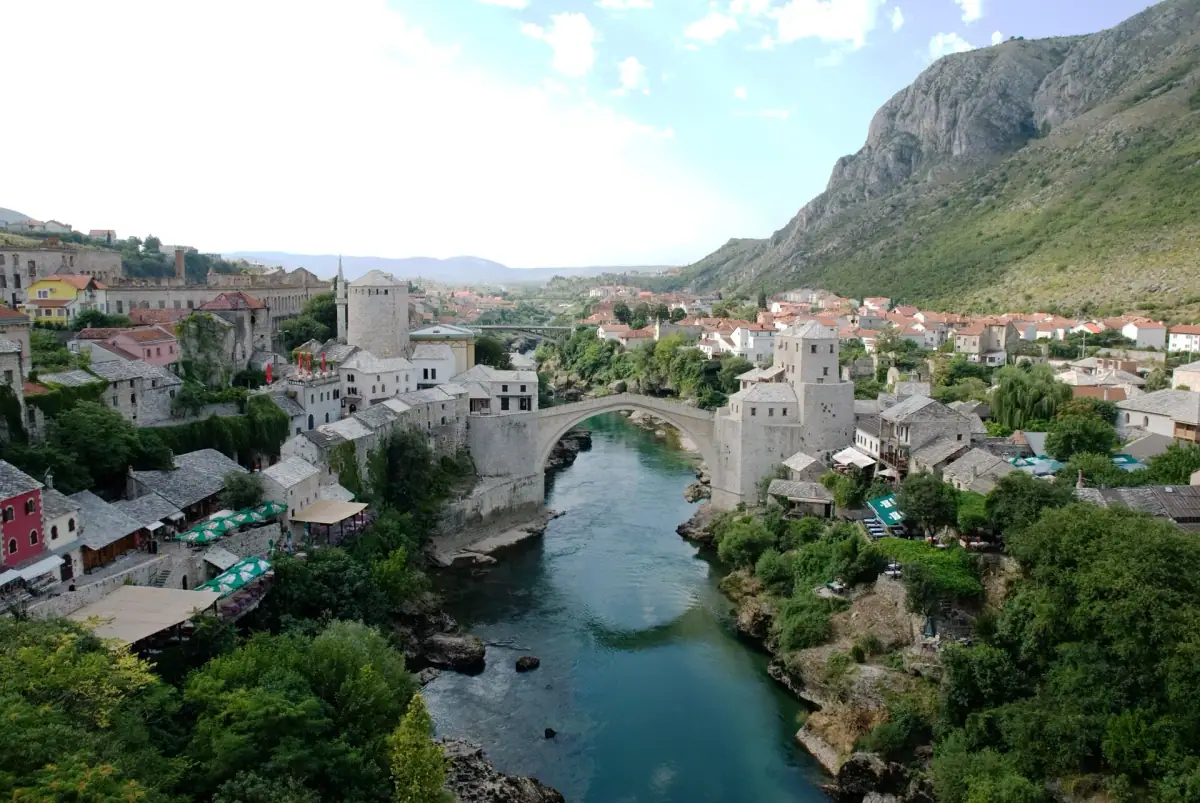
Mostar is arguably the most photographed city in Bosnia and Herzegovina. Its silhouette, the white stone bridge arching over the emerald waters of the Neretva, framed by minarets and tiled roofs, has become one of the emblematic images of the Balkans. But Mostar is much more than a postcard: it is a city marked by history, divided between two communities, and it embodies the whole complexity of Bosnia. Here is a complete guide to grasp its richness.
The Stari Most: much more than a bridge
The Stari Most (literally “old bridge”) is the soul of Mostar. A UNESCO World Heritage Site since 2005, this white limestone arch bridge (local nummulitic limestone called tenelija) spans the Neretva at a height of about 21 meters (69 ft) above the river.
A history of destruction and rebirth
Built under Ottoman rule in 1566 by the architect Mimar Hayruddin, the Stari Most came through more than four centuries of history before being deliberately destroyed by Croat shells on November 9, 1993, during the siege of Mostar. Its destruction was felt as a symbolic act of particular violence: bringing down a bridge breaks a link between two banks and two peoples.
The reconstruction, financed by the international community and carried out with the same craft techniques and the same limestone from the Tenelija quarry, ended with the inauguration of the rebuilt bridge on July 23, 2004, a symbol of reconciliation between the two communities, ten years after its destruction. Today the bridge is again the physical and symbolic link between the east bank (majority Bosniak) and the west bank (majority Croat).
The diving tradition
For centuries, young men of Mostar have thrown themselves from the top of the Stari Most into the Neretva, from about 21 meters (69 ft). This tradition, codified over time, is now run by the Mostar Divers Club (Mostarski ronilački klub), which holds official competitions each summer. The jump is formidable: the Neretva is cold (about 10-12 °C / 50-54 °F even in summer at this spot) and the impact demands precise technique.
Outside competitions, you can often watch divers launch from the parapet, especially after collecting donations from the tourists gathered. For more on the history and architecture of the bridge, see our complete guide to the Stari Most.
Guided visits of Mostar
Discover Mostar with a local guide: the history of the bridge, life between communities, hidden gems of the old town.
Kujundžiluk: the old Ottoman bazaar
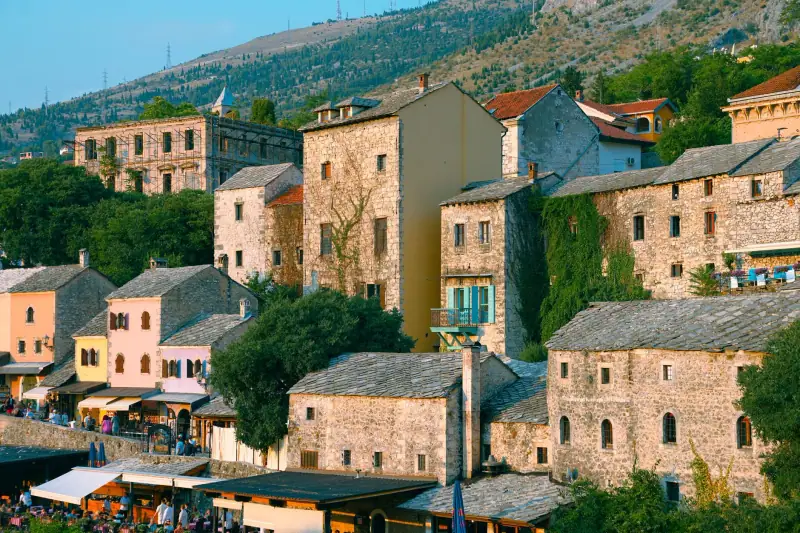
Kujundžiluk street, which runs on either side of the Stari Most on the east bank, is the beating heart of Mostar’s Ottoman old town. Its name comes from the kujundžije, the goldsmiths and coppersmiths who worked there in Ottoman times.
Today the street is lined with small workshops and shops selling filigree jewelry, engraved copper, kilim rugs, traditional embroidery and carved wooden objects. The atmosphere is that of the old čaršija (covered markets) of Ottoman towns: craftspeople work in view, the sound of hammers on copper mingles with the murmur of the river and the calls to prayer from the surrounding minarets.
What to know for shopping
- Prices are negotiable, especially outside tourist peak hours
- Copper pieces and handmade embroidery are typical of Mostar and make good souvenirs
- Beware of mass-produced items imitating local crafts; look for workshops where you can see the craftsperson at work
The side lanes
Beyond Kujundžiluk, several lanes climb toward the heights of the east bank. They lead to mosques, Ottoman houses converted into cafés and terraces with superb views of the bridge. In these quieter streets you will find the most authentic cafés: hookah, strong Bosnian coffee (bosanska kafa) and welcome silence.
Koski Mehmed Pasha Mosque
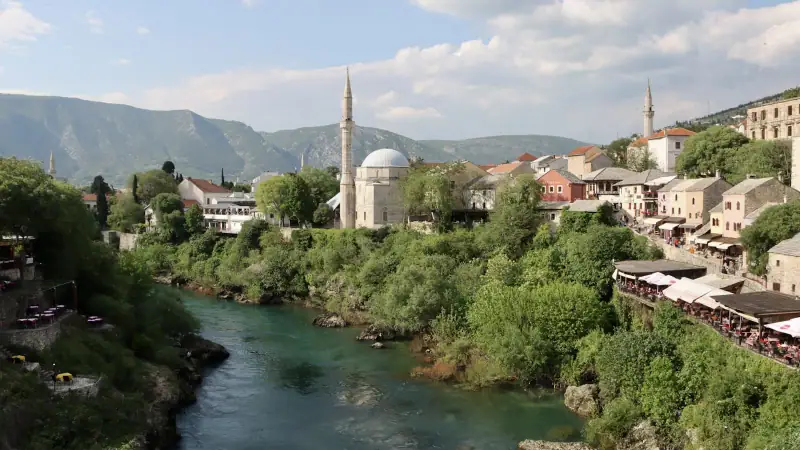
Built in 1617-1618 by the Ottoman dignitary Koski Mehmed Pasha, this mosque is one of the most beautiful and best-preserved in Mostar. It is open to non-Muslims for a modest entry fee (generally a few BAM).
The interior is simple and bright: red carpets, Quranic calligraphy painted on white walls, and light filtered through pointed-arch windows. It is a space of peace in the middle of the tourist bustle.
The minaret can be climbed for an extra fee. The ascent (about 80 narrow steps) rewards you with a unique panorama of the Stari Most, the Neretva and the rooftops of the old town. It is one of the best viewpoints in Mostar for photographing the bridge from above. Plan to climb in late afternoon for the golden light.
Accommodation in Mostar
Charming hotels, guesthouses by the Neretva and apartments in the old town.
The Bulevar: the war’s front line
A few hundred meters from the Stari Most, the wide avenue known as the Bulevar still forms an invisible border between the two parts of the city today. During the 1992-1995 war, and especially in the Bosnian-Croat conflict of 1993-1994, this avenue was the front line: on one side, Bosniaks defended the east bank; on the other, HVO Croat forces held the west bank.
Some buildings along the Bulevar still bear the scars of the fighting, with facades pocked by bullet and shell impacts, recognizable even after partial renovation work. The Moja Bosna tower (formerly Robna kuća Razvitak), a badly damaged commercial building, remains one of the most striking images of this recent past.
Mostar war museums
Several small museums and memorial spaces in the old town document the 1992-1995 war. They help you understand the siege of Mostar, the destruction of the bridge and the suffering of the civilian population. These places are essential for putting in context what you see in town: the reconstruction, the community tensions still perceptible, and the remarkable resilience of the residents.
Must-do day trips from Mostar
Mostar’s geographic position makes it an ideal base for exploring Herzegovina. Several major sights are reachable in under an hour.
Blagaj: the tekke at the Buna spring (12 km / 7.5 mi)
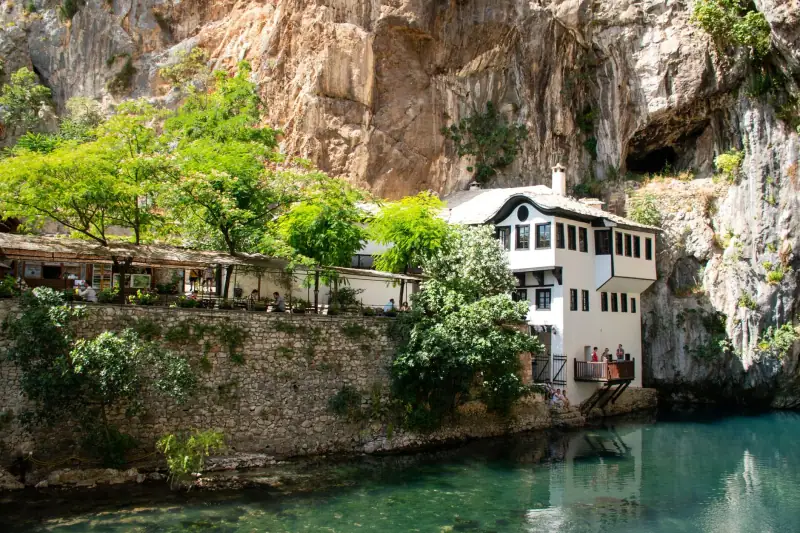
About 12 km (7.5 mi) southeast of Mostar, the village of Blagaj hides one of the most spellbinding sites in Bosnia: a 16th-century dervish monastery (tekke), perched at the foot of a sheer limestone cliff, right at the source of the Buna river. The water wells up from a karst cave at an impressive flow, crystal clear and permanently cool.
The tekke is still lived in by dervishes and open to visitors. The interior, with its mats, calligraphy and reflective atmosphere, offers a moment of serenity. The terrace of the restaurants along the Buna opposite the tekke is an idyllic place for lunch. Discover the whole site in our guide to Blagaj.
Počitelj: the medieval fortress (about 30 km / 19 mi)
About 25 km (15 mi) south of Mostar on the road to the Adriatic coast, Počitelj is one of the best-preserved medieval towns in the Balkans. Perched on a rocky promontory above the Neretva, this Ottoman fortress village holds a 16th-century mosque, a watchtower, stone houses and a remarkably preserved kasaba (market town).
The climb to the upper ramparts is steep but rewarded with a spectacular view of the Neretva valley, the village below and the arid hills of Herzegovina. See our guide to Počitelj to prepare your visit.
The Kravice waterfalls (40 km / 25 mi)
About 40 km (25 mi) south of Mostar, the Kravice waterfalls are a natural wonder of Herzegovina. A semicircular fall about 25 meters (82 ft) high and 120 meters (394 ft) wide plunges into a turquoise pool surrounded by lush vegetation. In summer, swimming there is possible and popular.
The site can be packed in July-August; prefer a morning visit or May-June. Read our guide to the Kravice waterfalls for all the practical details.
Car rental in Herzegovina
Explore Blagaj, Počitelj and Kravice freely with a rental vehicle from Mostar.
Food in Mostar
Mostar’s cooking is deeply marked by its Ottoman heritage and the Mediterranean influence of nearby Herzegovina. Sunnier than Sarajevo, Herzegovina produces tasty vegetables, a well-regarded wine and cooking slightly different from the rest of the country.
Dishes to try
Ćevapi: A Bosnian staple, Mostar’s ćevapi differ slightly from Sarajevo’s, often smaller and served with a slightly different somun bread. Enjoy them in the old town’s ćevabdžinica (specialist restaurants).
Burek: The flaky savory pastry filled with minced meat (or white cheese for sirnica) is the quintessential Bosnian breakfast and snack. Crisp, generous and delicious, found in bakeries (pekara) from early morning.
Grills on the Neretva: Restaurants along the river offer mixed grill plates (meats, vegetables) to enjoy facing the Stari Most. The setting is incomparable; reserve a riverside table for sunset.
Herzegovina wines: The area around Mostar is one of the only wine-growing regions in Bosnia and Herzegovina. The žilavka grape (dry, fruity white) and blatina (tannic red) are produced locally and appear on most restaurant lists. Ask for a local Herzegovina wine; it is an experience in itself.
Bosnian coffee: Bosanska kafa (coffee served in a copper džezva with a sugar cube to bite separately) is the social ritual of Mostar as of all Bosnia. Take the time to have one in an old town café, preferably on a terrace facing the bridge.
The two banks of Mostar: understanding the divided city
Visiting Mostar without understanding its community geography would mean missing the essential. The city is still deeply marked by the war and remains divided in practice between a Bosniak (Muslim) east bank and a Croat (Catholic) west bank, separated by the Bulevar.
East bank (Bosnjačka strana): The Ottoman old town, the Stari Most, Kujundžiluk, mosques and traditional Bosniak cafés. This is the part most tourists visit.
West bank (Hrvatska strana): A more modern district, dominated by the Franciscan Church of Saints Peter and Paul with its 107-meter (351 ft) bell tower (the tallest in Bosnia and Herzegovina and in the Balkans). This bank is less visited by tourists, but it offers a striking contrast and helps in understanding Mostar’s social complexity.
Crossing the Stari Most from one bank to the other also means symbolically crossing this legacy. The official city does not yet have a new unified administrative status, a symbol of the difficulty of moving beyond the fractures of the war.
When to visit Mostar
Spring (April-May): The ideal period. Temperatures of 18-25 °C (64-77 °F), few crowds, green vegetation in the Neretva gorges, flowers in the old town lanes. The Kravice waterfalls are at their finest level.
Summer (June-August): Very touristy (Mostar receives hundreds of thousands of visitors in summer) and very hot: 35-40 °C (95-104 °F) is common in July-August. The old town is packed in the middle of the day. Solution: arrive early in the morning (before 9 am) and stay into the evening, when the crowd disperses and the light is beautiful.
Fall (September-October): An excellent compromise. Temperatures of 20-28 °C (68-82 °F), a significant drop in tourism, golden autumn light on the bridge’s white stones. The grape harvest is in full swing in Herzegovina’s vineyards.
Winter (November-March): Mild compared with the rest of Bosnia (rarely below 5 °C / 41 °F), few tourists, an intimate atmosphere in the cafés. Mostar in winter is an authentic experience, but some sights and restaurants reduce their hours.
How to get to Mostar
From Sarajevo (130 km / 81 mi): The most frequent connection. Several daily buses from Sarajevo bus station; about 2 h 30 for around 14-20 BAM (€7-10 / $8-12). By car via the A1 then the M17.3 (2 h), with spectacular scenery in the Neretva gorges.
From Split (Croatia, 160 km / 99 mi): Regular buses (3 h 30 to 4 h 30 depending on the company and the border, about €12-35 / $14-41). Mostar is easily reached from the Dalmatian coast, making it a day trip for travelers based in Split or Dubrovnik.
From Dubrovnik (111 km / 69 mi): International bus or private minibuses (about 2 h 30). Mostar is often included in tours from Dubrovnik.
Sarajevo-Mostar train: A rail line links the two cities (about 2 h 30), with spectacular views of the Neretva gorges and impressive viaducts. Timetables are limited (one or two departures a day) and may change during works or incidents on the track: check with the Railways of the Federation of Bosnia and Herzegovina (ŽFBH) before leaving.
Airport: Mostar has a small airport (OMO) with a few regular connections, mainly to Belgrade, Istanbul and Germany (Stuttgart, Düsseldorf), some of them seasonal: check the airlines before booking. Most travelers arrive via Sarajevo (SJJ) or Split (SPU).
Budget in Mostar
Mostar is slightly more expensive than other Bosnian towns for accommodation, due to strong tourist demand. Here are a few benchmarks:
| Item | Indicative price |
|---|---|
| Guesthouse / hostel | 30-60 BAM (€15-30 / $17-35) a night |
| 3-star hotel, old town | 100-160 BAM (€50-80 / $58-93) a night |
| Restaurant meal | 15-30 BAM (€8-15 / $9-17) per person |
| Bosnian coffee | 1.50-2 BAM (€0.80-1 / ~$1) |
| Koski mosque entry | 10-15 BAM (€5-8 / $6-9), minaret included depending on the ticket |
| Sarajevo-Mostar bus | 14-20 BAM (€7-10 / $8-12) |
| Guided tour of Mostar | 30-60 BAM (€15-30 / $17-35) per person, to be confirmed with the operator |
For a detailed budget for your whole trip, see our Bosnia budget guide.
Flights to Bosnia and Herzegovina
Compare flights to Sarajevo, Split or Dubrovnik to reach Mostar at the best price.
Fitting Mostar into your itinerary
Mostar suits several trip configurations:
Sarajevo to Mostar (2-3 nights in Mostar): The classic Bosnia pairing. Spend 2-3 days in Sarajevo, then go down to Mostar by bus or car. From Mostar, explore Blagaj, Počitelj and Kravice.
Herzegovina loop: Mostar as a base, with trips to Blagaj (half a day), Počitelj (half a day), Kravice (a day) and possibly Sutjeska National Park via eastern Bosnia.
Via the Dalmatian coast: Arrive from Split or Dubrovnik for a Balkan immersion, then head up to Sarajevo. This direction lets you discover the interior gradually from the coast.
For a complete day-by-day program, see our 7-day Bosnia itinerary and our Bosnia road trip.
Final thoughts
Mostar fascinates and moves. It first seduces with its obvious beauty: the arched white bridge, the turquoise river, the minarets and tiled roofs. But it moves you even more once you understand its recent history: the destruction, the reconstruction, the lingering division and life resuming all the same. Mostar is a city to live slowly, to explore on both sides of the bridge, talking with residents and taking time for a Bosnian coffee facing the Neretva. A destination that does not leave you indifferent.
Frequently asked questions
How long does it take to visit Mostar?
A full day lets you see the essentials: the Stari Most, Kujundžiluk, the Koski Mehmed Pasha Mosque and the Croat quarter. Two days allow a trip to Blagaj and Počitelj. Three days give time to add the Kravice waterfalls and enjoy the city without rushing.
Is Mostar dangerous for tourists?
No, Mostar is a safe city for tourists. Tensions between Bosniaks and Bosnian Croats exist in local politics but do not affect travelers at all. The old town is busy and lively, including in the evening.
When is the best time to visit Mostar?
Spring (April-May) and fall (September-October) are ideal: pleasant temperatures (20-28 °C / 68-82 °F) and fewer crowds than in summer. July-August are the hottest months (often 35-40 °C / 95-104 °F) and the most touristy, so avoid them if you are sensitive to heat. Winter (December-February) is mild but rainy.
How do you get from Sarajevo to Mostar?
By bus from Sarajevo's central bus station, the trip takes about 2 h 30 for 14-20 BAM (about €7-10 / $8-12). Several departures a day. By car via the A1 and M17.3, allow about 2 hours for 130 km (81 mi). The drive crosses splendid scenery in the Neretva gorges.
Can you watch the Stari Most diving?
Yes, traditional divers jump from the bridge (a height of about 21 meters / 69 ft) regularly in summer, often after collecting donations from spectators. The Mostar Divers Club also organizes official competitions. It is not a fixed show at a set time, so you sometimes have to wait a little.
Can you swim in the Neretva at Mostar?
The Neretva at Mostar is cold (fed by karst springs) and the current can be strong. Swimming directly in town is not recommended. Several natural spots nearby do allow safe swimming: ask your accommodation.
More Bosnia and Herzegovina guides
Keep reading
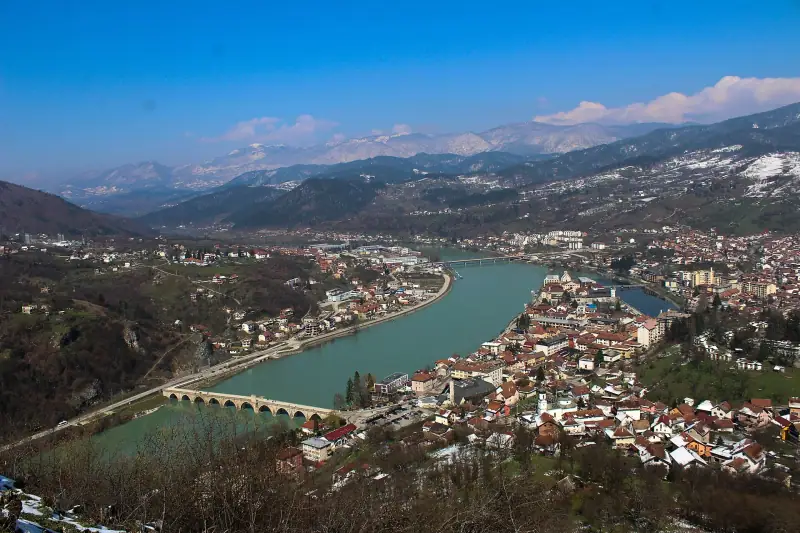
Višegrad: Visiting the Bridge on the Drina from Sarajevo, With or Without a Car
Mehmed Paša Sokolović Bridge in Višegrad: getting there from Sarajevo by car, bus or tour, visit length, free entry, Andrićgrad and practical tips.
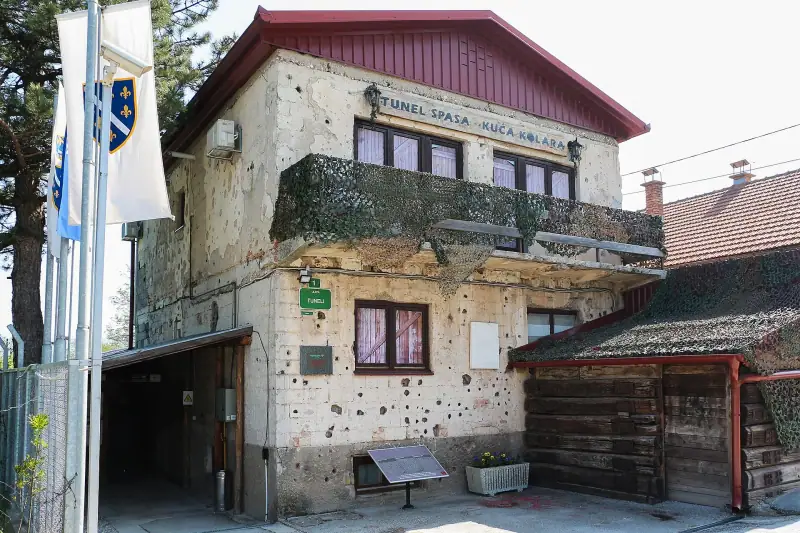
Sarajevo Tunnel of Hope: Hours, Prices and Getting There Without a Car
Visiting the Tunnel of Hope in Sarajevo: summer and winter hours, cash entry price, tram and bus from the center, visit length and tips.
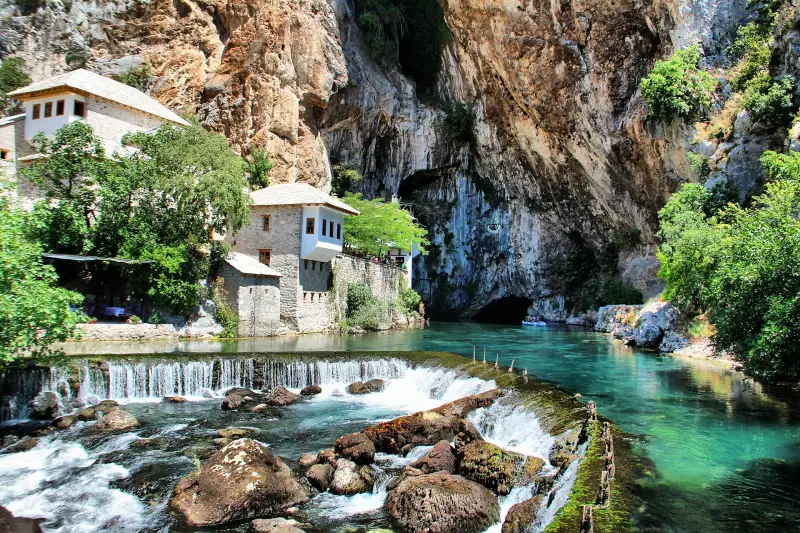
Visit Blagaj: The Dervish Tekke and the Source of the Buna
Complete guide to visiting Blagaj in Bosnia: Ottoman tekke, Buna river spring, medieval fortress, old village and practical tips for 2026.
Ready-made
Bosnia and Herzegovina itineraries
3 days
Northwest Bosnia: Banja Luka, Jajce and Una National Park
JajceBanja Luka
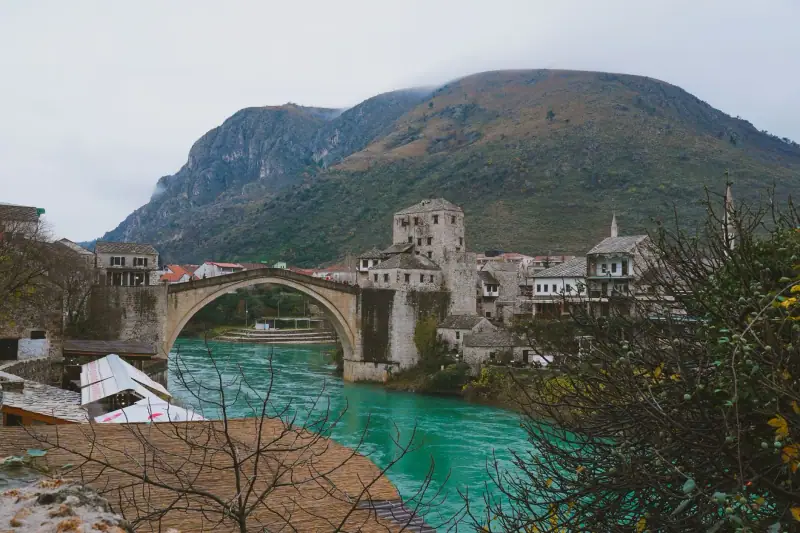
5 days
14 days
Bosnia and Herzegovina Road Trip: A 10 to 14 Day Itinerary by Car
Road trip through Bosnia and Herzegovina in 10 to 14 days: Sarajevo, Mostar, the Una, Sutjeska and Trebinje. The full itinerary to see it all.