What to see
Complete Guide to Visiting Morocco: Cities, Regions, Budget and Tips
We may earn a commission when you book through links on this page, at no extra cost to you. We don't visit or try the places we cover: we summarize published sources. How we work
In short
- Think by region rather than by city: Marrakech and the High Atlas, the imperial cities (Fes, Meknes, Rabat), the North (Chefchaouen), the Atlantic coast (Essaouira) and the South and desert.
- Distances are large: Marrakech to Fes is about 500 km (311 mi), and Marrakech to Merzouga about 550 km (342 mi). Choose three or four stops and give them time.
- Spring and fall are the most balanced seasons for a circuit; summer is very hot inland, and Ramadan dates change every year and affect hours and daytime dining.
- Between cities, comfortable trains and buses (ONCF, CTM, Supratours) are enough; a car helps in the Atlas and the South, and many travelers prefer a guided excursion for the desert.
Morocco can feel like another world within a single trip. You can get lost in the Fes medina, drink mint tea on a Marrakech terrace, walk the ramparts of Essaouira facing the Atlantic, cross the kasbahs of the South and end at the foot of the Merzouga dunes. This diversity is also what makes preparation hard: where to start, how long to plan, which season to choose, how to get around?
This complete guide is a starting point. It presents the country, its main regions, the cities and sites not to miss, then the practical questions: when to go, how to get there, how to get around, where to stay and what budget to plan. At each step, links lead you to the detailed articles on the site so you can go deeper into what interests you.
Morocco in brief: what to know before you go
Morocco is a North African kingdom open to both the Atlantic and the Mediterranean. Its geography is surprisingly varied: farming plains, coasts of sand and cliffs, the Rif, Middle Atlas and High Atlas ranges, then palm-grove valleys and desert expanses in the southeast. Toubkal, in the High Atlas, is considered the highest peak in North Africa, at about 4,100 meters (13,500 ft).
A few useful pointers for travelers:
- Languages: Arabic and Tamazight (Berber) are the official languages, and Moroccan Arabic dialect, darija, is the language of daily life. French is widely used in tourism, shops and administration, and English is common in tourist areas, which makes travel much easier.
- Currency: the Moroccan dirham. It is best to check the exchange rate before leaving, as it fluctuates slightly.
- Religion and customs: the country is majority Muslim. Relaxed but covering dress is appreciated outside the seaside resorts, and you should ask before photographing people.
- Time difference: Morocco’s legal time can change during the year, notably during Ramadan. Check before you leave.
- Entry rules: entry rules depend on your passport and can change. Check the official travel advice of your government before you book: travel.state.gov (US), GOV.UK (UK), travel.gc.ca (Canada), Smartraveller (Australia) (checked November 2026). We go into this in our article on entry requirements for Morocco.
The country is organized around a few major tourist hubs, each with its own character. This division structures the rest of this guide.
Morocco’s main regions
To build a coherent trip, it is better to think by region rather than by isolated cities. Distances are large: linking Marrakech to Fes is about 500 kilometers (311 mi) and several hours by road or train, which forces choices.
Marrakech and the High Atlas
This is the most popular gateway. Marrakech concentrates a medina, souks, palaces, gardens and lively nightlife, with the best-served airport in the country. Nearby, the Atlas valleys, such as Ourika, and the village of Imlil, starting point for many hikes, offer an immediate contrast with the city’s bustle. A few days are enough to combine city and mountain.
The imperial cities
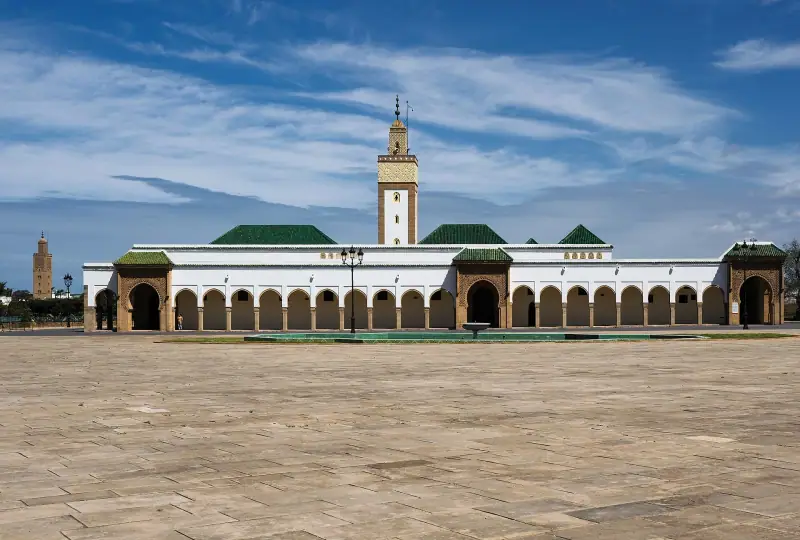
Fes, Meknes and Rabat make up the historic heart of the country. Fes holds the largest car-free medina in Morocco, a living maze of artisans, madrasas and alleys. Rabat, the administrative capital, is calmer and airier, with its gardens, its Kasbah of the Udayas and its seafront. Meknes, more discreet, charms with its monumental gates and less touristy mood.
The North
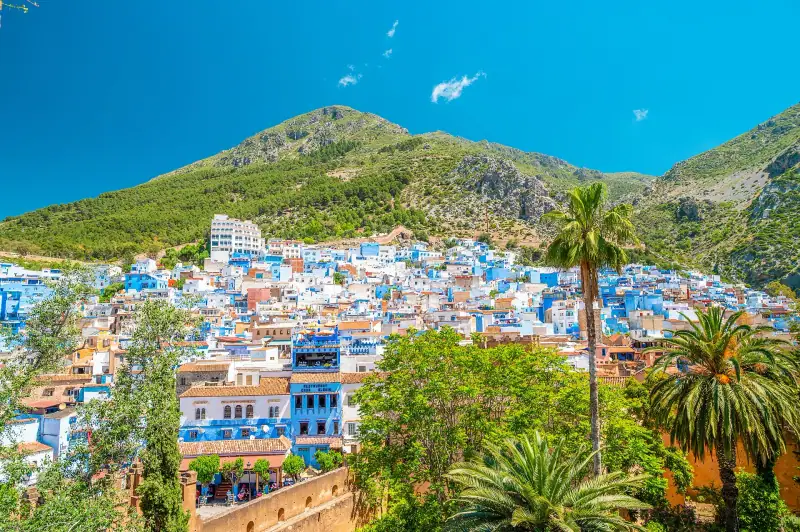
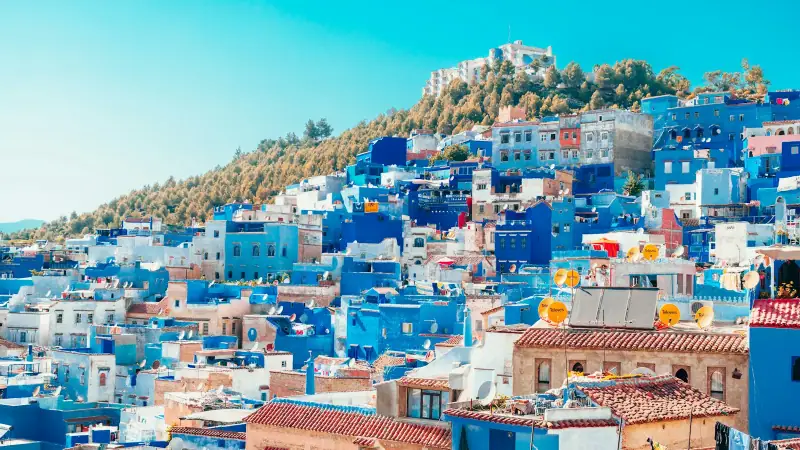
Chefchaouen, the famous blue city of the Rif, attracts with its alleys of walls painted in every shade of azure and its quiet rhythm. Farther north, Tangier and Tetouan tell the story of a Morocco turned toward the Mediterranean and Andalusia. This region is ideal for a two- or three-day escape.
The Atlantic coast
Essaouira, with its ramparts, fishing port and steady winds, offers a welcome pause after the intensity of Marrakech. Farther south, Agadir and Taghazout attract beach and surf lovers, with a mild climate for much of the year.
The South and the desert
Beyond the Tizi n’Tichka pass, the road descends to Ouarzazate, its film studios and the region’s kasbahs. Farther on, the Drâa Valley and palm groves lead to Merzouga and Erg Chebbi, where the golden dunes are visited by camel or 4x4. This is the region of big landscapes, but also of long distances.
Marrakech: the energy of the ochre city
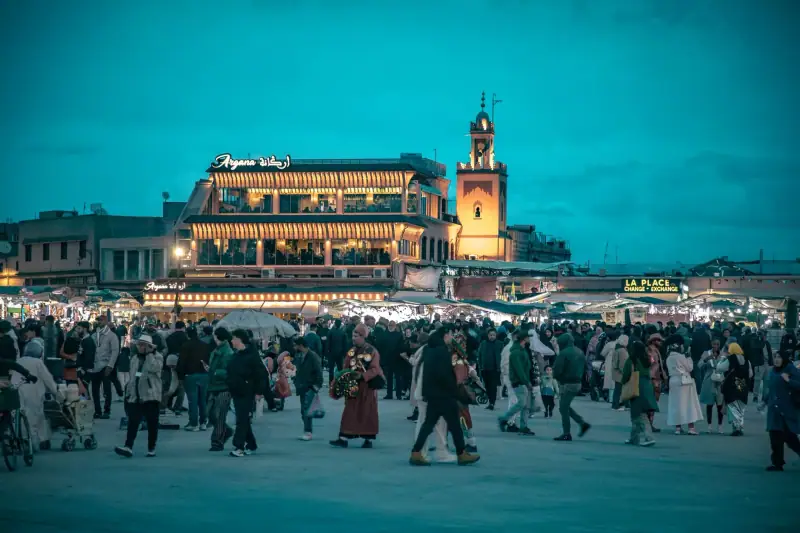
Marrakech is the city most travelers discover first, and for good reasons. Its medina, surrounded by ochre-colored ramparts, groups souks, mosques, palaces and lively squares. Jemaa el-Fna square, the center of the city, changes character throughout the day: calm and orange in the morning, then filled with stalls, musicians and food stands in the evening.
The simplest approach is to give the city two or three days: one day for the medina and its souks, another for gardens, palaces and museums, and half a day to stroll or take a break in a hammam. Our guide to visiting Marrakech in 3 days details a realistic program, with addresses and tips to avoid the crowd.
For lodging, the riad is the emblematic experience: a traditional house organized around a patio, often very calm despite the tumult outside. The choice of neighborhood matters a lot, between the bustle of the medina, the quieter surroundings and the New Town hotels. We discuss this in our article on where to stay in Marrakech.
Riads and hotels in Marrakech
Compare medina riads, New Town hotels and guesthouses for your dates and budget.
Fes: the medieval medina
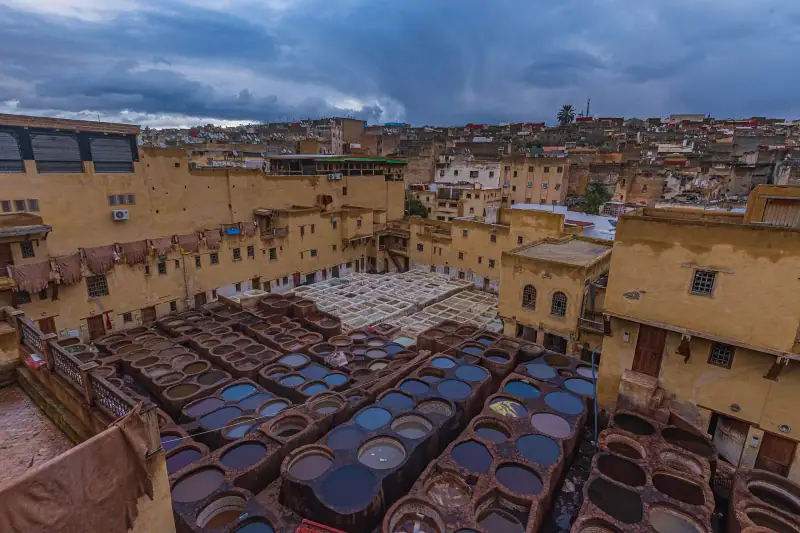
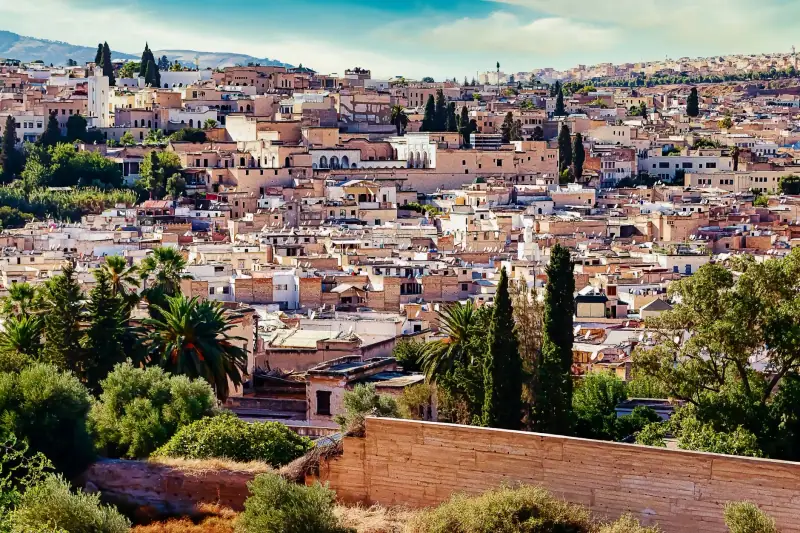
Fes is the oldest and most disorienting imperial city. Its medina, Fes el-Bali, UNESCO-listed, is a tangle of alleys where you meet artisans, porters and donkeys loaded with goods, far from any traffic. You visit madrasas adorned with zellige and stucco, discover the souks by guild and watch the traditional tanneries from the terraces of leather shops.
Fes takes a bit more effort than Marrakech: the medina is vast, easy to get lost in and grittier in atmosphere. In return, it seems less staged for tourists. Allow two full days for the essentials. Our article on visiting Fes explains how to get oriented, what to see first and how to avoid fake guides.
Chefchaouen: the blue city of the Rif
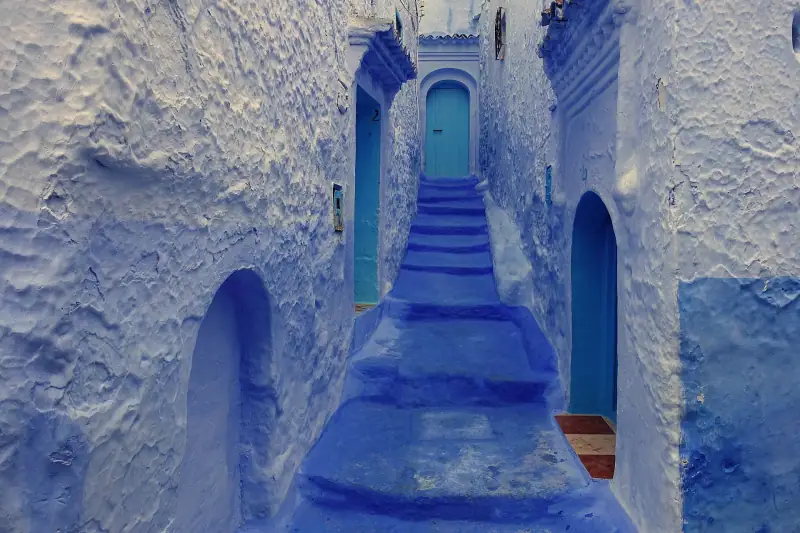
Nestled in the Rif mountains, Chefchaouen has become one of the most recognizable images of the country. Its alleys, stairs and facades bathed in blue make it a paradise for photography, but also a restful stop after the big medinas. The town can be covered in a few hours, and people gladly stay a night to enjoy the evening calm and the morning light.
It is also a base for short hikes in the surrounding hills. For hours, the neighborhoods worth seeing and organizing tips, head to our guide to visiting Chefchaouen. From Fes, the road is about 200 kilometers (124 mi): an easy stop to fit into a circuit between the center and the north of the country.
Essaouira: the Atlantic, the ramparts and the wind
About 175 kilometers (109 mi) from Marrakech, Essaouira is the ideal seaside parenthesis. Its fortified, World Heritage-listed medina, its ramparts beaten by the ocean and its small blue fishing port create a relaxed atmosphere, very different from the big inland cities. The trade winds that often blow on the coast also make it a popular destination for kitesurfing and windsurfing.
Allow a full day on an excursion from Marrakech, or better, one to two nights to enjoy the streets in the evening and the grilled fish dishes. Everything there is to do is detailed in our article on things to do in Essaouira.
Excursions and guided tours in Morocco
Desert, Atlas, medinas or Atlantic coast: compare guided excursions and book with flexible cancellation.
Ouarzazate, Aït Ben Haddou and the kasbah road
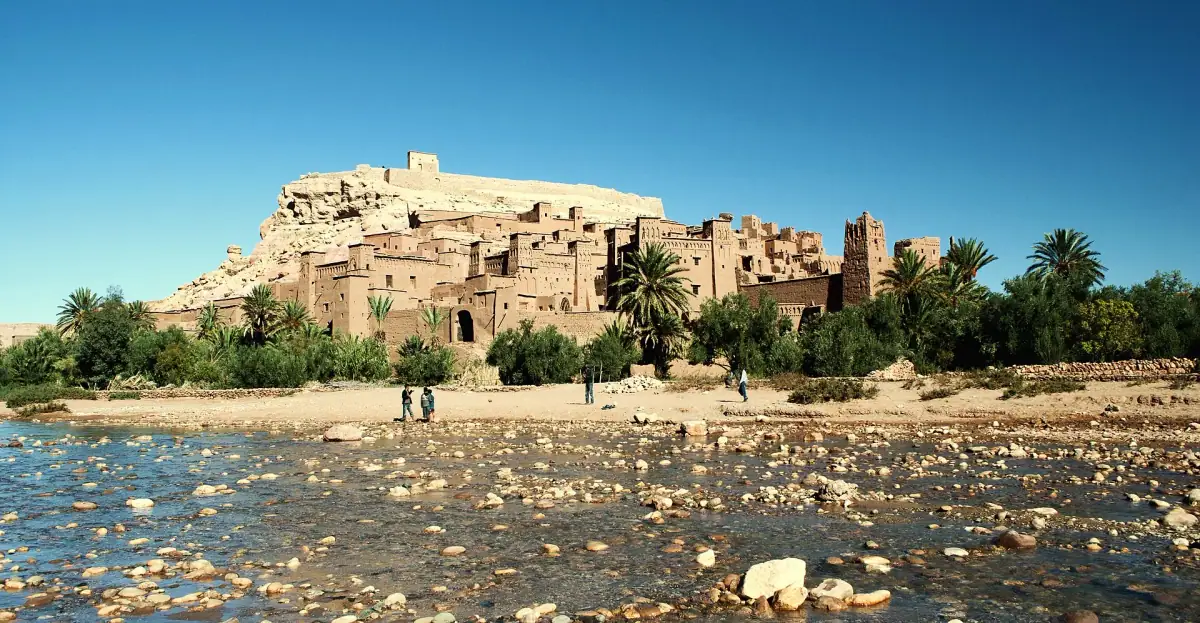
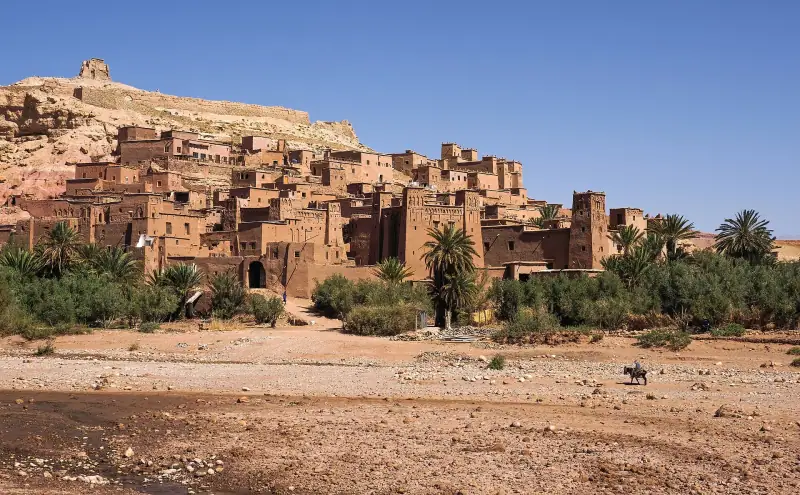
Between Marrakech and the desert, Ouarzazate serves as a major stop. The town is known for its film studios, but the real treasure lies nearby: Aït Ben Haddou, a fortified earthen ksar listed by UNESCO, which has served as a set for many films. The road leading there crosses the High Atlas by the Tizi n’Tichka pass, spectacular but winding.
This region is a chance to discover adobe architecture, palm groves and deep valleys. Our article on Ouarzazate and Aït Ben Haddou helps you organize the visit and choose between an overnight stop or a simple pass-through.
The Merzouga desert: the dunes of Erg Chebbi
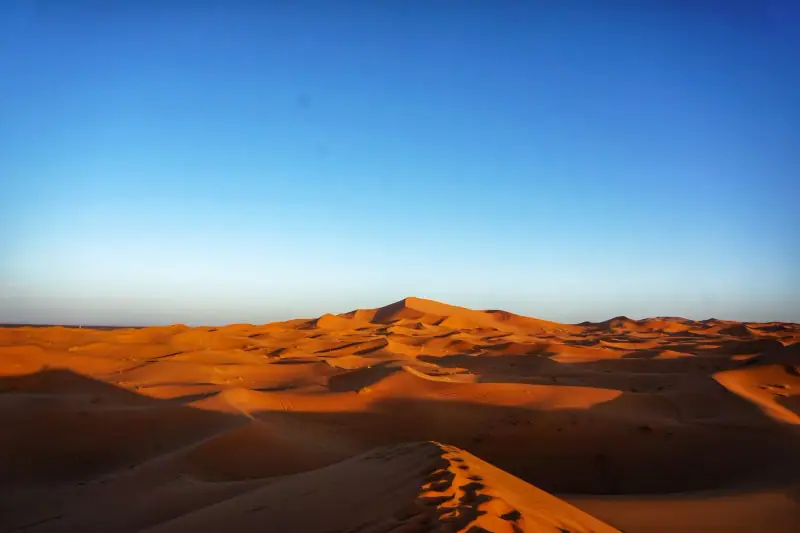
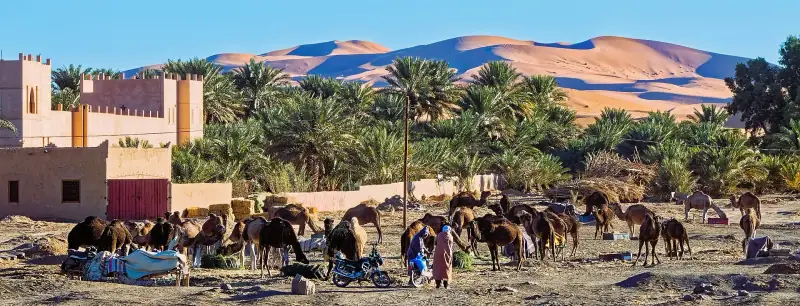
Merzouga is the dream stop for many travelers: big golden sand dunes, a sunset over Erg Chebbi, a night in a camp and a sunrise by camel. The experience is unforgettable, as long as you prepare it well. The distance from Marrakech is significant, on the order of 550 kilometers (342 mi), which explains why most circuits give it at least two days, with stops along the way.
It is better to avoid an excursion that is too short: the more time you allow, the more you enjoy the desert and the less you suffer from road fatigue. For the choice of camp, the season, what to bring and the options available, see our guide to preparing your Merzouga desert excursion.
Morocco’s highlights at a glance
If you had to keep only a few stops, here is the most frequent list of highlights, with the traveler profile they suit:
- The Marrakech medina: for immediate immersion, the souks, palaces and the bustle of Jemaa el-Fna square.
- The Fes medina: for historic, craft-based, authentic Morocco.
- Chefchaouen: for a photogenic and quiet break in the Rif.
- Essaouira: for the ocean, the wind and a more relaxed atmosphere.
- Aït Ben Haddou and the kasbah road: for earth architecture and the big landscapes of the South.
- The Merzouga dunes: for a night in the desert.
- The High Atlas: for hiking, Berber villages and fresh air, in particular around Imlil.
- Rabat: for a calmer capital, between gardens, kasbah and waterfront.
Seeing everything at once is rarely reasonable. It is better to select three or four stops and give them time. That is the principle of the 10-day Morocco itinerary we offer, which links Marrakech, the desert, Fes and Chefchaouen without chaining unnecessary kilometers.
When to go to Morocco
The question of season depends above all on the region visited. Morocco has very contrasting climates: the Atlantic coast is temperate, the interior has big temperature swings, the South is arid and the Atlas can be snowy in winter.
- Spring (March to May): a much-loved period, with pleasant temperatures in the cities, green landscapes in the mountains and favorable conditions for a full circuit.
- Summer (June to August): very hot in Marrakech, Fes and the desert, with temperatures that can become punishing during the day. It is, however, the right season for the Atlantic coast and the heights of the Atlas.
- Fall (September to November): the heat gradually falls, which makes fall particularly pleasant for circuits in the South and the imperial cities.
- Winter (December to February): mild, sunny days in the South and Marrakech, but cool nights, notably in the desert, and the possibility of cold and rain in the North and the Middle Atlas.
On top of this comes Ramadan, whose dates change every year: the country remains open to travelers, but hours, atmosphere and daytime dining options change. Many travelers choose to avoid it, others precisely enjoy the atmosphere of the evenings. For a region-by-region comparison, see our article on when to go to Morocco.
How to get to Morocco
Morocco is served by several airports, including Marrakech, Casablanca, Agadir, Fes, Tangier and Rabat.
A few tips for choosing your ticket:
- Marrakech is generally the most practical gateway if you want to see the Atlas, the South and the desert.
- Fes suits better if you start with the imperial cities and the North.
- Casablanca is mostly interesting for its central position on the rail network, a good starting point by train to Rabat, Marrakech or Tangier.
- Open-jaw itineraries (arriving in one city, returning from another) avoid pointless back-and-forth on a circuit: arrive in Marrakech and leave from Fes, for example.
Compare airlines, schedules and baggage policy, especially on low-cost flights where a checked bag is often charged separately. It is also useful to check entry conditions before booking, as they can change.
Flights to Morocco
Compare flights to Marrakech, Casablanca, Fes or Agadir, and find the best dates.
Getting around Morocco
Once there, several options are available, and the best choice depends on your itinerary.
Train
The ONCF rail network serves the major axes of the northwest: Casablanca, Rabat, Fes, Meknes, Marrakech, Tangier. It is a comfortable, reliable and inexpensive way to link the big cities. A high-speed line links Tangier to Casablanca. Remember to book trips ahead in busy periods.
Buses
Long-distance bus companies such as CTM and Supratours serve towns the train does not reach, notably Essaouira, Chefchaouen or Ouarzazate. Buses are air-conditioned, with clear timetables and booking possible in advance.
Taxis
In cities, petit taxis are handy for short trips: insist on the meter, or agree on the price before getting in. Grands taxis, shared, link nearby towns: it is cheap, but less comfortable.
Rental car
Renting a vehicle gives real freedom to explore the Atlas, the southern valleys and the kasbahs. Main roads are generally in good condition, but driving can be demanding: mountain passes, dense traffic in cities, unpredictable pedestrians and two-wheelers. Avoid driving at night off the main roads and plan realistic stages, preferably under 200 to 250 kilometers (124 to 155 mi) a day on mountain roads. Compare rental companies and insurance conditions before booking.
Excursions and organized tours
For the desert and some areas of the Atlas, a guided circuit can simplify logistics: transport, camp lodging, meals and a guide. It suits those who do not want to drive in the mountains, or who have little time.
Where to stay in Morocco
The lodging offer is broad and fits all budgets:
- Riads and guesthouses: the emblematic choice in a medina. A riad is a traditional house around a patio, often with breakfast included and a very personal welcome. In medinas, cars do not always reach the doors: find out about access before booking.
- Hotels: more conventional, often located in the New Town or on the outskirts, with a pool, parking and services. Practical if you travel by car or as a family.
- Kasbah hotels and inns of the South: earth buildings converted into lodgings, sometimes with a view of the palm grove or the valley. An authentic way to sleep in the South.
- Desert camps: from a simple tent to a more comfortable setup, with meals and musical entertainment. Compare the options and read recent reviews.
- Homestays and mountain lodges: a good option in the Atlas, notably for hikers.
For Marrakech, the starting address for many travelers, our article on where to stay in Marrakech explains how to choose between the medina, Guéliz and the surroundings. In general, book ahead for school holiday periods, the end-of-year holidays and spring, and read recent reviews.
Budget: how much does a trip to Morocco cost?
The budget varies enormously with the travel style: a stay in hostels and small addresses has nothing to do with a circuit in charming riads with a driver. The main expense items are:
- Flight: variable with the season and the airline, to be compared well ahead for school holidays.
- Lodging: highly variable, from simple hostels and guesthouses to luxury riads and hotels.
- Meals: you can eat very decently in small local restaurants for little, whereas tourist restaurants, especially in Marrakech, cost much more.
- Transport: train and bus remain affordable, while car rental or a private driver noticeably raise the spending.
- Excursions: the desert, hot-air balloons, mountain activities and guided tours are often the biggest item after lodging.
A few tips to optimize your budget: travel outside school holidays, alternate charming riads and simpler lodgings, eat local, and negotiate prices in the souks with good humor. For a detailed estimate across several profiles, see our guide to the budget in Morocco.
Eating in Morocco: specialties not to miss
Food is fully part of the trip. Slow-cooked tagines, Friday couscous, sweet-and-savory pastilla, harira to break the fast, grilled skewers and breads baked in the neighborhood oven: dishes are generous, fragrant and often very affordable. Mint tea, served generously, accompanies every break.
You can also get an introduction to local cuisine at a cooking class or a food tour, a way to understand spices, markets and cooking techniques. For an overview of the essential dishes, see our article on Moroccan cuisine and its 10 dishes to taste.
Cooking classes and food tours
Learn to prepare a tagine or taste street food with a local guide: a tasty and cultural experience.
Practical tips for a successful trip
A few simple habits make the trip smoother:
- Negotiate with a smile: in the souks, the posted price is only a starting point. Stay polite, compare, and know how to say no without justifying yourself.
- Beware of fake guides: in medinas, some young people offer to accompany you “for free” before asking for payment. A firm, courteous refusal is generally enough.
- Dress respectfully: no need to cover entirely, but covered shoulders and knees are appreciated, particularly outside tourist areas.
- Drink bottled water: as a precaution, prefer sealed water and avoid ice in unreliable places.
- Carry cash: ATMs are plentiful in cities, but not in villages and desert areas.
- Ask before photographing: people, artisans and merchants do not always like being photographed without permission.
- Take out travel insurance: useful for medical costs, luggage and cancellations, especially if you plan mountain or desert activities.
- Find out about restrictions: some areas, notably near borders, call for particular caution. Check the official travel advice of your government before you leave: travel.state.gov (US), GOV.UK (UK), travel.gc.ca (Canada), Smartraveller (Australia) (checked November 2026).
What length and itinerary to choose?
The biggest trap in Morocco is wanting to see everything in a week. Distances are long and mountain roads slow your progress. Here are a few realistic formats:
- 4 to 5 days: Marrakech and its surroundings (Ourika Valley, Imlil, Essaouira), for a first discovery.
- 7 days: Marrakech, Aït Ben Haddou and a night in the Agafay or Merzouga desert depending on the time available, or Fes and Chefchaouen for a heritage-focused trip.
- 10 days: the classic circuit, which links Marrakech, the South, the desert, Fes and Chefchaouen. It is detailed in our 10-day Morocco itinerary.
- 2 weeks or more: you can add Essaouira, the Atlantic coast, Rabat or a longer hike in the Atlas, and take time to slow down.
A good principle: sleep no more than two nights in a row in three different cities per week, and alternate urban stops and nature stops to avoid fatigue.
All our guides to prepare your trip
To go from idea to organization, here are all the articles on the site, grouped by theme:
Discovering cities and sites
- Visiting Marrakech: what to see and do in 3 days
- Visiting Fes: medina, madrasas and tanneries
- Visiting Chefchaouen: guide to the blue city of the Rif
- Ouarzazate and Aït Ben Haddou: kasbahs, ksar and film sets
Organizing your itinerary and activities
- Morocco in 10 days: Marrakech, the Merzouga desert, Fes and Chefchaouen
- Merzouga desert: how to plan your Erg Chebbi excursion
- Things to do in Essaouira: medina, ramparts, port and beaches
Preparing the practical aspects
- When to go to Morocco: seasons, climate and best time by region
- Morocco budget: how much does a trip cost?
- Entry requirements for Morocco: passport, visa, health and customs
Where to stay and what to eat
- Where to stay in Marrakech: riads, neighborhoods and tips
- Moroccan cuisine: 10 dishes you must taste
Final word
Morocco suits all types of travelers: lovers of culture, landscapes, hiking, food or simply a change of scene. Its main challenge is choosing your stops well and giving each one time. Start by defining the season, the number of days and the region that attracts you most, then let the itinerary take shape around three or four strong stops. The rest, the mint tea, the unexpected alleys and the encounters, will come on its own.
Frequently asked questions
How long do you need to visit Morocco?
A week lets you discover Marrakech and its surroundings, or combine two regions without rushing. To link Marrakech, the desert, Fes and Chefchaouen without haste, allow ten days to two weeks.
What is the best time to go to Morocco?
Spring and fall are the most balanced seasons for a circuit. Summer is very hot inland, especially in the South, while winter is mild by day but cool at night, with snow on the Atlas summits.
Do you need a visa to go to Morocco?
Entry rules depend on your passport. Check the official travel advice of your government before you book: travel.state.gov (US), GOV.UK (UK), travel.gc.ca (Canada), Smartraveller (Australia) (checked November 2026).
Is Morocco expensive?
Morocco is generally affordable, especially for meals, local transport and mid-range lodging. Excursions, private circuits and charming riads push the bill up. The details are in our budget guide.
Should you rent a car or take an organized tour?
Between cities, comfortable trains and buses are more than enough. A car is useful for the Atlas and the South if you like autonomy, but mountain roads call for caution. For the desert, many travelers prefer a guided excursion.
Is Morocco suitable for a first trip to North Africa?
Yes, it is well equipped for tourism. You just need to accept the bustle of the medinas, bargain in the souks and get used to vendors' solicitations.
What currency should you use there?
The currency is the Moroccan dirham. Bank cards are accepted in hotels, larger restaurants and modern shops, but souks, small cafés and taxis mostly work in cash. Withdraw cash from bank ATMs rather than street exchange offices.
More Morocco guides
Keep reading
Visiting Chefchaouen: Guide to the Blue City of the Rif
Visiting Chefchaouen: blue medina, Outa el Hammam square, kasbah, the Ras el Maa spring and hikes to Akchour. Tips to organize your stay.
Ouarzazate and Aït Ben Haddou: Kasbahs, Ksar and Film Sets
Visiting Ouarzazate and Aït Ben Haddou: UNESCO-listed ksar, Taourirt Kasbah, film studios, the road from Marrakech and tips to plan your stop.
Visiting Fes: Medina, Madrasas and Tanneries, a Guide to Finding Your Way
Visiting Fes in 2 or 3 days: Fes el-Bali medina, madrasas, Chouara tanneries, Fes el-Jdid and excursions. Tips to get oriented and avoid pitfalls.
Ready-made
Morocco itineraries
10 days
Morocco in 10 Days: Marrakech, the Merzouga Desert, Fes and Chefchaouen
A 10-day Morocco itinerary, day by day: Marrakech, the Atlas, Aït Ben Haddou, Todgha Gorges, Merzouga desert, Fes and Chefchaouen, with drive times.
8 days
Morocco in 8 Days Without a Car: A Realistic Train and Bus Itinerary
Morocco in 8 days without a car: Marrakech, Essaouira, Rabat, Fes and Chefchaouen by train and CTM bus, with distances, travel times and pitfalls to avoid.
5 days
Morocco's Imperial Cities: Rabat, Meknes, Volubilis and Fes in 5 Days
RabatMeknesFes
Can be adapted in the planner