Itineraries
Morocco in 10 Days: Marrakech, the Merzouga Desert, Fes and Chefchaouen
We may earn a commission when you book through links on this page, at no extra cost to you. We don't visit or try the places we cover: we summarize published sources. How we work
Day by day
- Days 1-2Marrakech: Jemaa el-Fna, souks, madrasas, gardens, museums
- Day 3High Atlas by the Tizi n'Tichka pass to Aït Ben Haddou
- Day 4Ouarzazate to Tinghir, Todgha Gorges
- Day 5Tinghir to Merzouga, camel ride, night in the desert
- Day 6Merzouga: dunes, villages, rest
- Day 7Long drive from Merzouga to Fes
- Day 8Fes el-Bali medina
- Day 9Fes to Chefchaouen, blue medina
- Day 10Chefchaouen and departure
Weather through the year on this route
| Jan | Feb | Mar | Apr | May | Jun | Jul | Aug | Sep | Oct | Nov | Dec | |
|---|---|---|---|---|---|---|---|---|---|---|---|---|
| High °F (°C) | 6418 | 6519 | 6921 | 7222 | 7625 | 8228 | 8731 | 8831 | 8228 | 7826 | 7122 | 6519 |
| Low °F (°C) | 5010 | 5111 | 5412 | 5513 | 5915 | 6418 | 6820 | 6921 | 6619 | 6317 | 5614 | 5312 |
| Rain in (mm) | 2.155 | 1.950 | 2.155 | 1.540 | 0.925 | 0.310 | 0.00 | 0.15 | 0.720 | 1.745 | 2.770 | 2.565 |
Normals 1991–2020 at Essaouira and Meknes: averages over 30 years, not a forecast. Source: NASA POWER (MERRA-2), grid of about 50 km. Figures computed by us in November 2026.
In short
- The route runs Marrakech (2 days), the High Atlas to Aït Ben Haddou, the Todgha Gorges, a night in the Merzouga desert, Fes, then Chefchaouen.
- Merzouga to Fes is the longest day: over 450 km (280 mi) and 8 hours. Split it with a night in Midelt or near Ifrane if you can.
- Spring and fall are the most comfortable seasons; summer is very hot in the South and winter can be cold at altitude and in the desert.
- Plan on more than 1,500 km (930 mi) overall, and avoid driving at night on mountain roads.
Morocco is bigger than you might think: between Marrakech and Fes, it takes a full day on the road, and the desert is farther still to the southeast. A good 10-day itinerary is therefore a compromise: pick few stops, but give each one time. Here is an open-loop circuit from Marrakech to Chefchaouen that links medinas, Atlas passes, kasbahs, dunes and imperial cities. Distances are approximate: they vary with the route you choose, traffic and stops.
Overview: the circuit at a glance
Here is the thread of the trip, with approximate distances:
- Days 1 and 2: Marrakech
- Day 3: Atlas road to Aït Ben Haddou (about 180 km / 112 mi)
- Day 4: Ouarzazate and the Todgha Gorges (about 200 km / 124 mi)
- Day 5: road to Merzouga, night in the desert (about 200 km / 124 mi)
- Day 6: Merzouga dunes, a relaxed day
- Day 7: long drive to Fes (more than 450 km / 280 mi, split it if you can)
- Day 8: Fes
- Day 9: road to Chefchaouen (about 200 km / 124 mi)
- Day 10: Chefchaouen and departure
This plan suits travelers who like to alternate cities and landscapes. If you only have a week, drop the loop to Merzouga and add an excursion to Essaouira instead; if you have twelve days, keep a real overnight stop between the desert and Fes.
Days 1 and 2: Marrakech, the medina and its squares
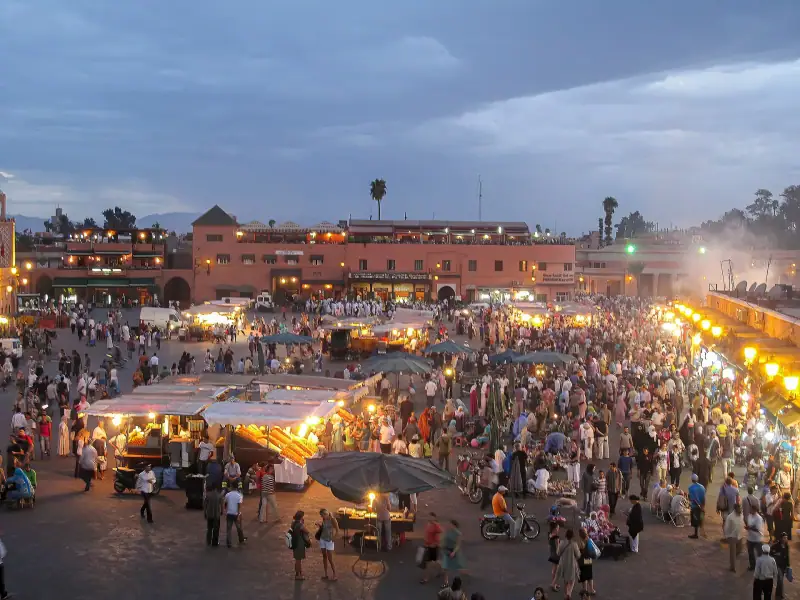
Marrakech is an ideal starting point: it is well served by air, and it lets you ease into the trip before you hit the road. Spend the first day on Jemaa el-Fna square, the neighboring souks and the medina’s big madrasas. Keep sunset for the square, which changes completely when the food stalls set up.
The second day can be quieter: gardens, museums, the tanneries area or a hammam. If you want to leave the city, the Ourika Valley and the Berber villages of the High Atlas can be visited in a day, but they fit poorly into an already busy schedule.
For lodging, a riad in the medina gives you a change of scene, but you have to be willing to walk with your luggage through narrow alleys. Our guide to where to stay in Marrakech compares the neighborhoods and options.
Riads and hotels in Marrakech
Compare riads and hotels for your dates before you start the circuit.
Day 3: from Marrakech to Aït Ben Haddou through the High Atlas
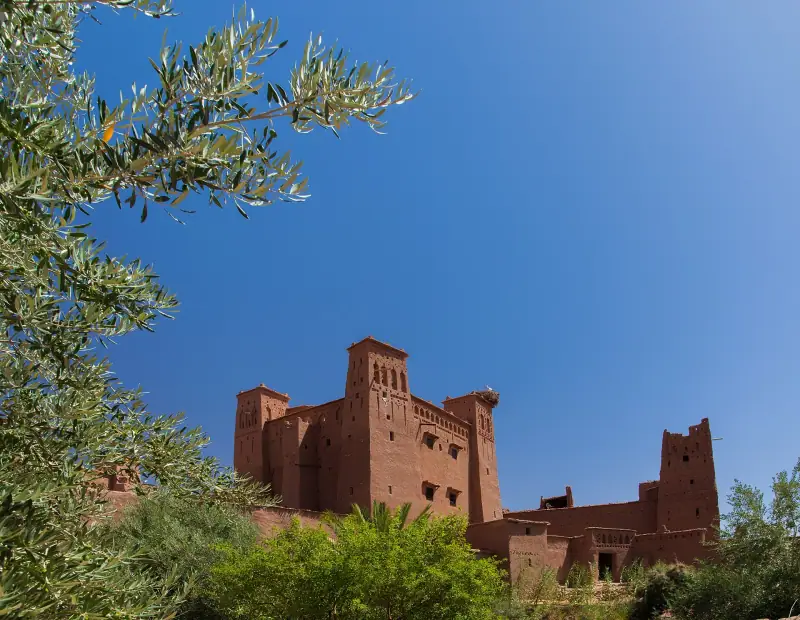
The third day is the big change of scenery. The road crosses the High Atlas by the Tizi n’Tichka pass, one of the most used in the country. There are many bends, and the landscape shifts from red plains to mountains and then to arid valleys. The full drive to Aït Ben Haddou usually takes four to five hours, stops not included. Leave early in the morning to enjoy the light and avoid driving in the mountains after dark.
The ksar of Aït Ben Haddou, a fortified earthen village on the UNESCO World Heritage list, is the highlight of the day. It has served as a set for many films, and you climb on foot between the adobe houses to reach the top, where the view opens over the valley. Sleeping there or nearby lets you see it early in the morning or late in the afternoon, when the groups have left.
Our article on Ouarzazate and Aït Ben Haddou details the visit to the ksar and the surroundings.
Day 4: Ouarzazate and the Todgha Gorges
The fourth day heads east, from Ouarzazate toward Tinghir. The road follows the Dadès Valley and the palm groves, with adobe kasbahs here and there. The stage is about 200 km (124 mi), but the mountain road and the stops make it a full day.
The Todgha Gorges, near Tinghir, are among the most spectacular landscapes on the route: narrow, very high rock walls that you walk through on foot for a few hundred meters from the entrance. The mood is calmer early in the morning or late in the afternoon. The Tinghir palm grove is also good for a relaxed walk.
Plan one night in Tinghir or in the Todgha Valley, in a guesthouse or small hotel. There is less choice than in Marrakech, but the welcome is generally warm.
Day 5: heading to Merzouga and a night in the desert
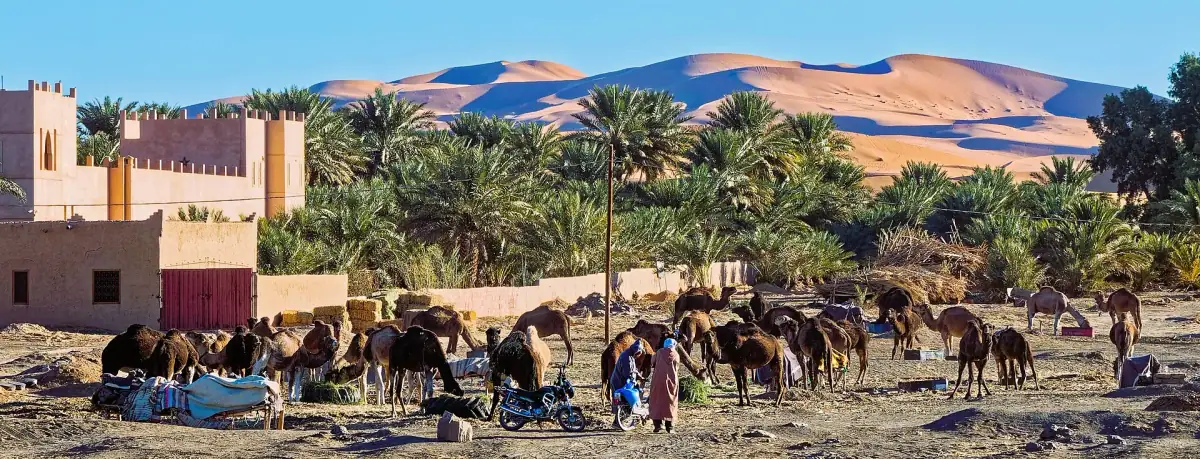
The fifth day brings you closer to the desert. The road from Tinghir to Merzouga is about 200 km (124 mi) and crosses increasingly mineral landscapes before reaching Erfoud or Rissani, then the first dunes of Erg Chebbi. Once there, the tradition is to ride a camel to a camp in the late afternoon and watch the sunset from the dunes.
Choose a camp with recent reviews that clearly states what is included: meals, breakfast, tents with or without bathrooms. Also check the season: nights are cool for much of the year, and days in midsummer are very hot.
Excursions in the Merzouga desert
Camel ride, night in a desert camp, quad or 4x4: compare the options and read travelers' reviews.
Day 6: Merzouga, dunes and nomad life
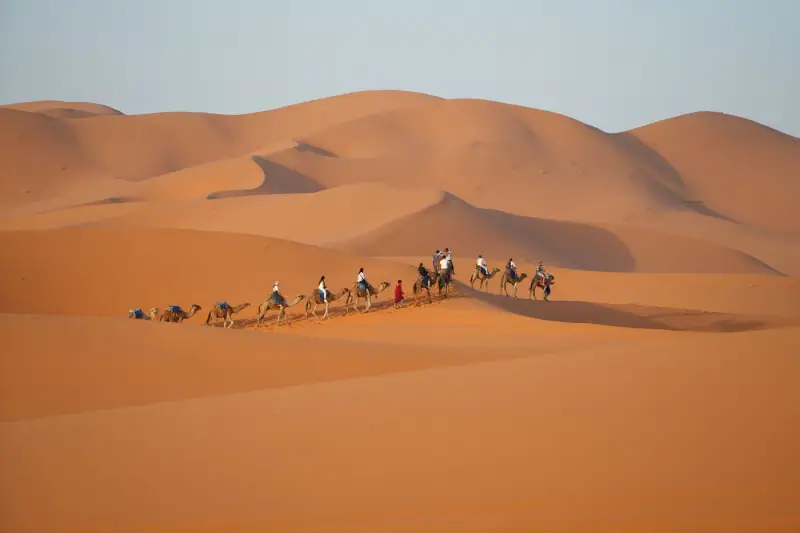
The sixth day is a breather. After sunrise over the dunes, head back to Merzouga for an unhurried breakfast, then enjoy a day at your own pace: a walk through the villages, meeting nomad families, a visit to a fossil workshop or simply resting in the shade. If you are short on energy after the night in a tent, feel free to plan nothing.
Our guide to a Merzouga desert excursion details the options (camel, 4x4, overnight camp), the seasons and practical tips for preparing this stage.
Day 7: the long road from Merzouga to Fes
This is the most demanding day of the circuit. Between Merzouga and Fes, expect more than 450 km (280 mi) and more than eight hours on the road, not including breaks, through the Ziz Valley, Midelt and the Middle Atlas. The scenery varies: palm groves, arid high plateaus, cedar forests depending on the stretch. If your schedule allows, split the drive in two with a night in Midelt or around Ifrane: you will reach Fes fresher, and you will be safer on the mountain roads.
Travelers who prefer not to drive can choose a private transfer or an organized tour that includes this leg. In every case, avoid driving at night and carry water and snacks.
Flights to Morocco
Compare flights, ideally arriving in Marrakech and leaving from Fes or Tangier if possible.
Day 8: Fes, the oldest of the imperial cities
Fes takes planning and a little patience. Spend the day in Fes el-Bali, its UNESCO-listed medina: souks, madrasas, fountains and the Chouara tanneries. Start early, keep an offline map and take an official guide if you want to learn the history of the places without getting lost.
A single day is short for Fes, but that is the compromise of this circuit. Our article on visiting Fes offers a detailed route if you can add a night.
Day 9: from Fes to Chefchaouen, the road to the Rif mountains
The road from Fes to Chefchaouen is about 200 km (124 mi), usually three to four hours of driving, through farmland hills and then the first foothills of the Rif. If you take a bus or a transfer, the principle is the same; there is no rail link to Chefchaouen. For the stage by car, our guide to where to stay in Chefchaouen explains how to handle parking and luggage.
Arriving in early afternoon, you have time to wander in the medina’s blue alleys, climb to Outa el-Hammam square and have tea on a terrace with a view of the mountains. In the evening, the town is calm and very pleasant.
Day 10: Chefchaouen and the return
On the last day, take time for a morning stroll before the visitors arrive. Trails around the town lead to viewpoints, and the Akchour waterfalls attract walkers on day trips. Our guide to visiting Chefchaouen details the walks and good addresses.
For departure, allow plenty of time: Tangier, Fes and Tetouan are the nearest hubs, with transfer times of several hours. Avoid booking an early-morning flight on the last day, and keep a margin for the unexpected.
Adapting the itinerary to your length of stay and season
This circuit works particularly well in spring and fall, when temperatures are pleasant in the South. In summer, the desert and the inland roads are very hot; in winter, nights can be cold and the Atlas pass is sometimes snowy. See our guide on when to go to Morocco to choose the right period.
A few variations depending on your time:
- 7 days: Marrakech, Aït Ben Haddou, Fes (by plane or transfer), Chefchaouen. You give up the desert.
- 12 days: add a night in Midelt or Ifrane between Merzouga and Fes, and an extra day in Fes.
- With the coast: add two nights in Essaouira at the start, about three hours by road from Marrakech (see our article on things to do in Essaouira).
Practical tips for a successful circuit
- Book the key stops ahead: charming riads, the desert camp and lodging in the valleys fill up in high season.
- Carry cash: ATMs are rare in the villages of the South.
- Drive in daylight: mountain roads and animals on the road make night driving inadvisable.
- Stay flexible: a closed pass, a sandstorm or accumulated fatigue can justify dropping a stop.
- Travel insurance: check that it covers activities in the desert and repatriation.
If you rent a car, check the included mileage, the deductible and the condition of the vehicle: on a circuit of more than 1,500 km (930 mi), these details matter.
At a reasonable pace, this ten-day circuit gives a good overview of Morocco’s diversity. It is better enjoyed unhurried than skimmed: choose your stops, keep a margin, and leave room for the unexpected.
Frequently asked questions
Is 10 days enough to see Morocco?
Ten days cover a big arc of the country, from Marrakech to Chefchaouen via the desert and Fes. You have to accept time on the road, though. For a calmer pace, it is better to drop a stop than to try to do everything.
Do you need to rent a car for this circuit?
It is not essential. You can combine an organized tour in the South, trains between the big cities and private transfers. A car does give you freedom in the Atlas and on the road to the desert, as long as you are comfortable on mountain roads.
Which direction should you follow the itinerary?
Marrakech to Chefchaouen works well if you arrive in Marrakech and leave from the north, for example Tangier or Fes. If flights are cheaper the other way round, simply reverse the stops.
What is the best time of year for this circuit?
Spring and fall are the most comfortable, because summer is very hot in the South and winter can be cold at altitude and in the desert. Our guide to the best time to visit Morocco covers the seasons in detail.
How much time do you spend on the road?
Several stages take more than three or four hours, and the day between Merzouga and Fes is the longest, at more than eight hours. Plan breaks, or split that leg in two with an overnight stop.
More Morocco guides
Keep reading
Morocco Budget: How Much Does a Trip Cost? Real Prices and 3 Costed Profiles
Budget for a trip to Morocco: real costs by item (riad, transport, meals, activities), three daily profiles with figures and tips to spend less.
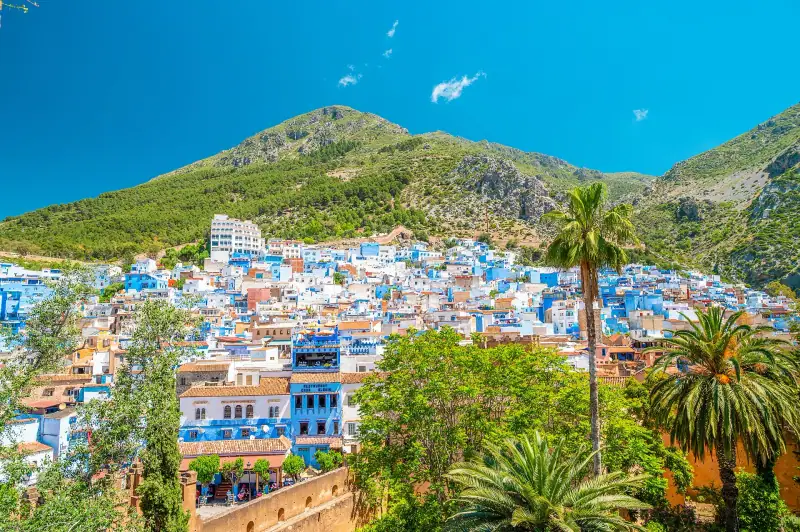
Visiting Chefchaouen: Guide to the Blue City of the Rif
Visiting Chefchaouen: blue medina, Outa el Hammam square, kasbah, the Ras el Maa spring and hikes to Akchour. Tips to organize your stay.
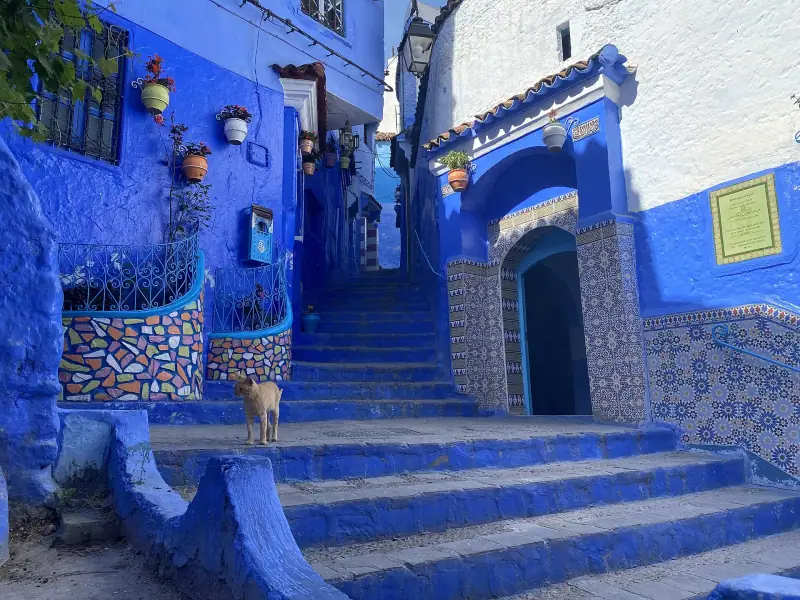
Where to Stay in Chefchaouen by Car: Medina, Parking and Which Area to Pick
Driving to Chefchaouen: stay in the car-free medina, near Bab el Ain, or at a hotel with parking? Criteria to choose without struggling with luggage.
Ready-made
Morocco itineraries
8 days
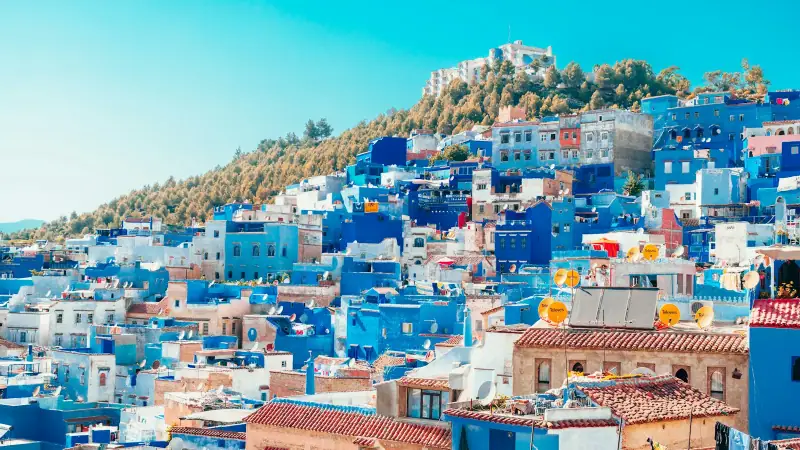
Morocco in 8 Days Without a Car: A Realistic Train and Bus Itinerary
Morocco in 8 days without a car: Marrakech, Essaouira, Rabat, Fes and Chefchaouen by train and CTM bus, with distances, travel times and pitfalls to avoid.
5 days
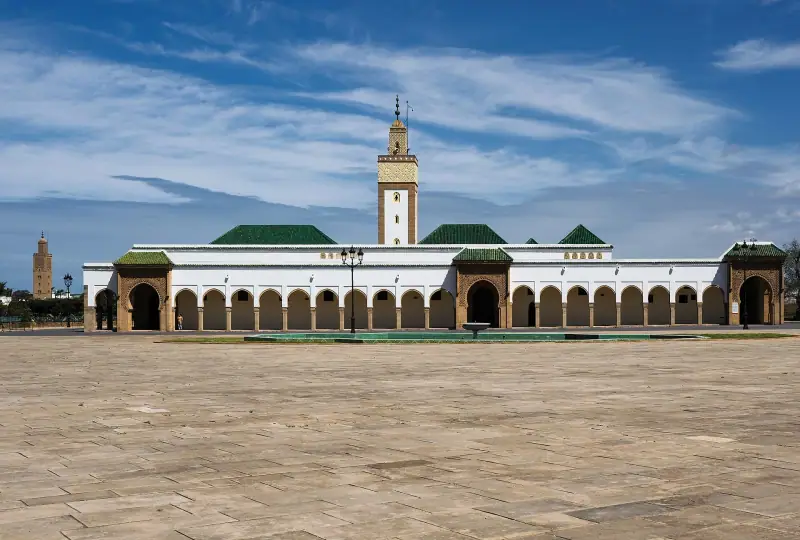
Morocco's Imperial Cities: Rabat, Meknes, Volubilis and Fes in 5 Days
RabatMeknesFes
Can be adapted in the planner