What to see
What to see in the Alpilles: Les Baux, Saint-Rémy and villages worth a stop
We may earn a commission when you book through links on this page, at no extra cost to you. We don't visit or try the places we cover: we summarize published sources. How we work
In short
- Two days cover the essentials: Les Baux-de-Provence, Saint-Rémy and Glanum. A third day adds Fontvieille, Eygalières and a walk in the range.
- Avignon and Arles are each less than 30 km (19 mi) from the center of the range; Saint-Rémy and Les Baux are only about 10 km (6 mi) apart.
- There is no train station in the range. A car is the most flexible option; without one, base yourself in Saint-Rémy.
- Spring and early fall are the most pleasant. In summer, access to wooded areas can be restricted because of fire risk.
They only rise to about 500 meters (1,640 ft), but the Alpilles have everything a big range has: white cliffs piercing the scrubland, olive groves as far as the eye can see, villages of golden stone and a light that dazzled Van Gogh. This small limestone range, wedged between Avignon, Arles and the Durance, packs the most photogenic side of Provence into a few dozen kilometers.
Here is what you need to decide what to see in the Alpilles, how to spread your visits over two or three days and which villages to choose depending on what you like. Opening hours, prices and access conditions change: check with tourist offices and official sites before you go.
The Alpilles at a glance
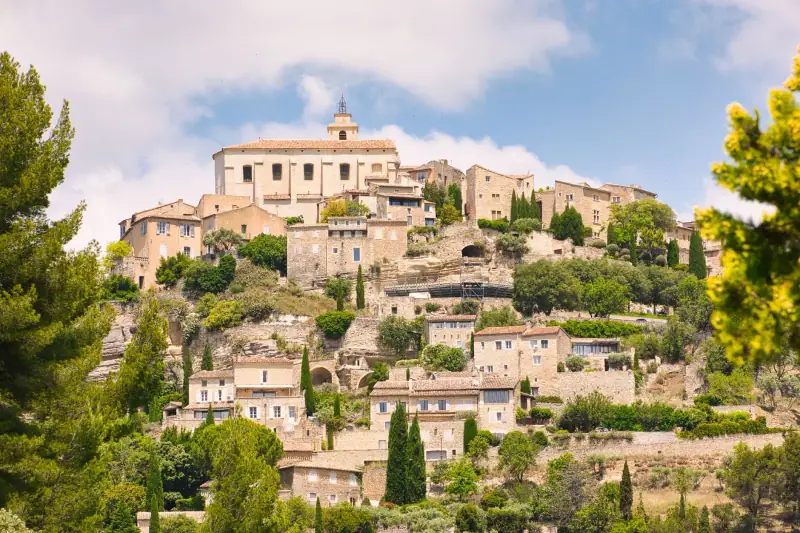
The range forms an east-west rocky barrier, which you go around on small winding roads lined with plane trees, vines and olive trees. The Alpilles Regional Natural Park protects much of the territory, which explains the quality of the landscapes: few modern buildings, dry-stone walls and isolated farmhouses (mas).
To find your way around, you can split the region into four poles:
- Saint-Rémy-de-Provence, in the north, a lively, historic town and a practical base;
- Les Baux-de-Provence, in the south, a spectacular village and its surroundings;
- The west side (Maussane-les-Alpilles, Le Paradou, Fontvieille, Mouriès), facing the olive trees and Arles;
- The east side (Eygalières, Orgon, Lamanon), more discreet.
Distances are short: only about ten kilometers (6 mi) separate Saint-Rémy from Les Baux, and both Avignon and Arles are less than 30 kilometers (19 mi) from the center of the range. That makes the Alpilles ideal for a single base with day trips.
Les Baux-de-Provence, the village on its rock
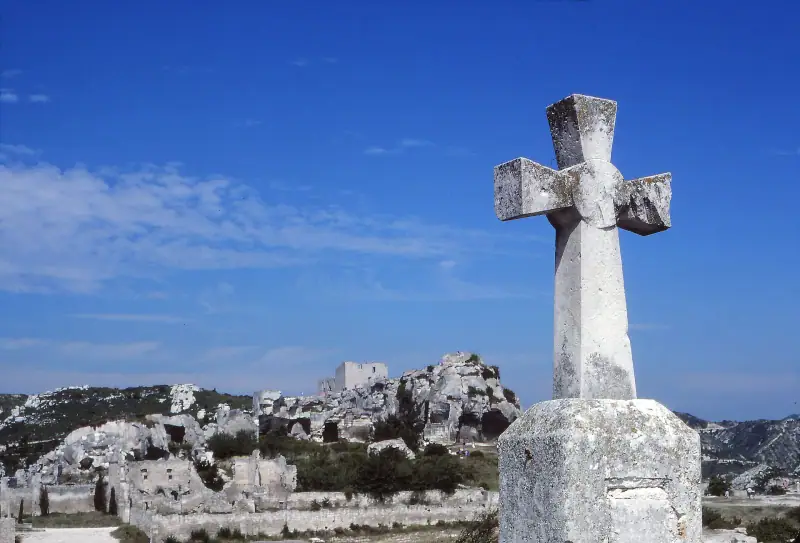
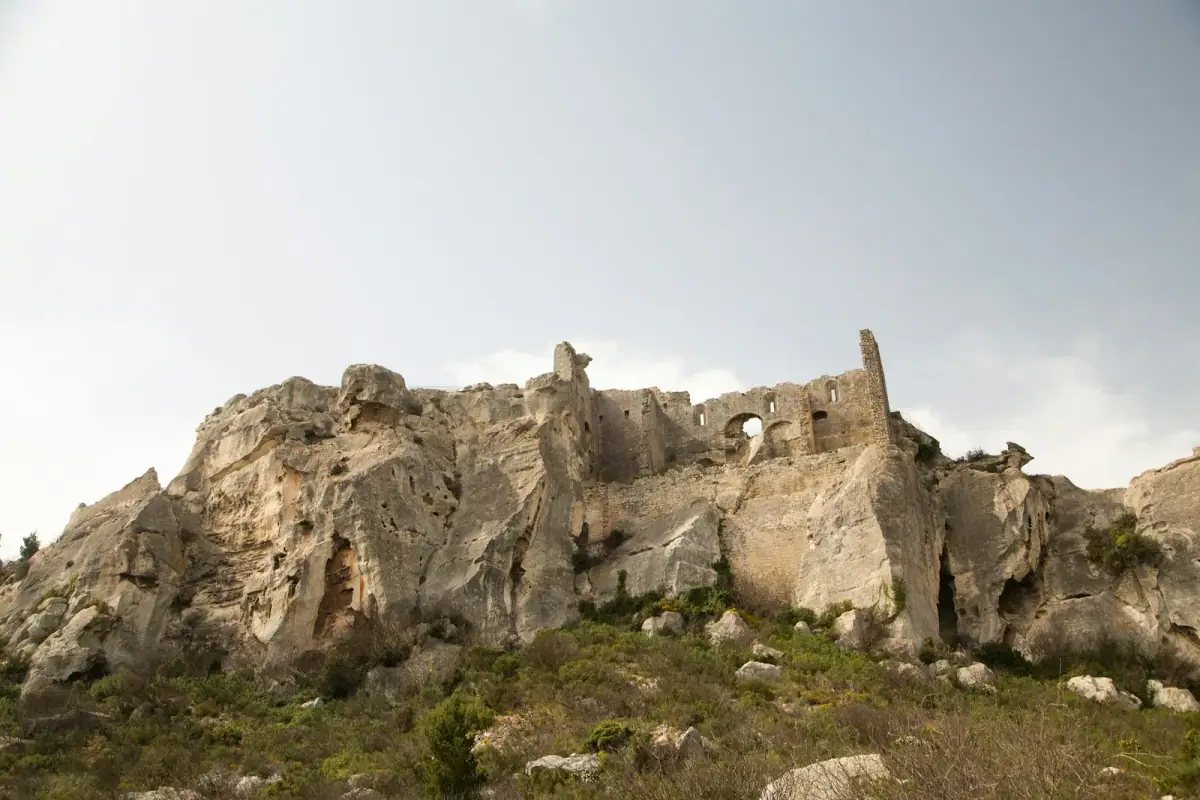
This is the stop almost everyone aims for, and rightly so. Les Baux-de-Provence clings to a limestone spur, overlooked by the remains of a medieval castle that belonged to a powerful lordship. The stone village, with its narrow lanes, carved doorways and small chapels, can be walked in an hour or two; a visit to the ruins and the plateau easily stretches to half a day.
From the plateau, the view extends over the olive groves, the plain and, on a clear day, as far as the Camargue. The ruins also host medieval demonstrations in season: check the program before you come.
A few practical tips:
- Avoid the middle of the day in summer: the village is packed and the stone radiates heat.
- Park in the lots below and walk up, since traffic around the village is limited.
- Wear comfortable shoes: the cobblestones are uneven and slippery.
The Val d’Enfer and the quarries
Just below the village, the Val d’Enfer is a rocky valley of strange shapes, which according to local tradition inspired Dante. The old stone quarries nearby host an immersive show of images projected on the walls, whose theme changes regularly. Check the program and prices before your visit, and bring a light jacket: the temperature stays cool all year.
Stay in the Alpilles
Charming farmhouses, B&Bs and hotels among the olive trees: compare accommodation and book early for high season.
Saint-Rémy-de-Provence, Glanum and Van Gogh
If Les Baux is the spectacle, Saint-Rémy-de-Provence is everyday life: plane trees, fountains, shops and terraces, all in a circular old center that is easy to cover on foot. The town brings together three major reasons to visit.
- Glanum, a vast archaeological site at the town’s gates, showing the layers of a Celtic-Ligurian, then Greek, then Roman city;
- Les Antiques, an almost intact Roman mausoleum and arch, facing the entrance to Glanum;
- Saint-Paul-de-Mausole, the former monastery where Vincent van Gogh was treated in 1889 and where he painted several of his most famous canvases.
The Wednesday morning market is the chance to stock up on local products. To plan your visit in detail, see our dedicated guide: visiting Saint-Rémy-de-Provence. And if you are unsure which area to sleep in, see where to stay in Saint-Rémy-de-Provence.
Maussane, Le Paradou and Mouriès: olive country
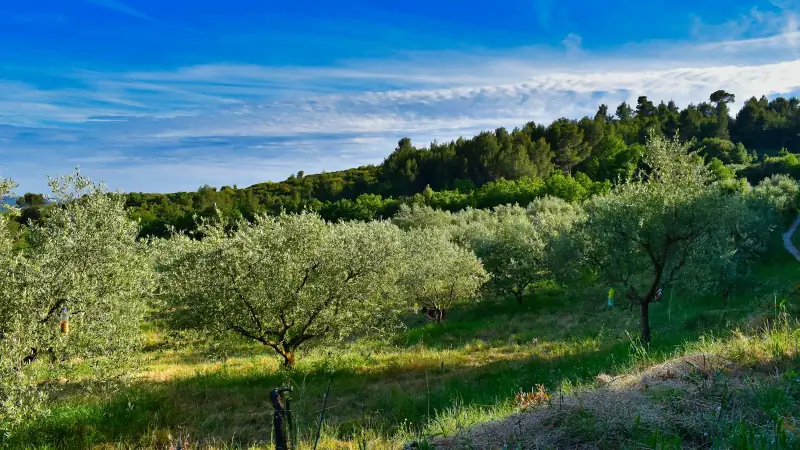
On the west side of the range, the Vallée des Baux-de-Provence is the main olive-growing region of the Alpilles. Maussane-les-Alpilles, a human-scale village organized around a square lined with terraces, is its informal capital. It has oil mills that welcome visitors, shops selling local products and wine estates.
The valley is known for its olive oil, protected by an appellation of origin, as well as for the wines of the Les Baux-de-Provence appellation, produced on limestone soil bathed in sun and mistral. Estates often offer tastings, but the welcome varies by season: make an appointment if possible.
Mouriès, a little further south, is also associated with the olive and has some of the most extensive olive groves in the region. Le Paradou, between the two, spreads out at the foot of the Les Baux hill and is a pleasant waypoint on the road.
Even if you don’t plan to buy, a mill visit is worth the detour: you see how olives are sorted, pressed and processed, and tasting the pure oil lets you compare green, more peppery fruitiness with black, milder fruitiness. To go further into regional products, see our article on Provence markets and the one on Provence wines.
Tastings and excursions in the Alpilles
Mill visits, olive oil and wine tastings, excursions from Avignon or Arles: compare the available activities.
Fontvieille, Daudet’s mill and Roman heritage
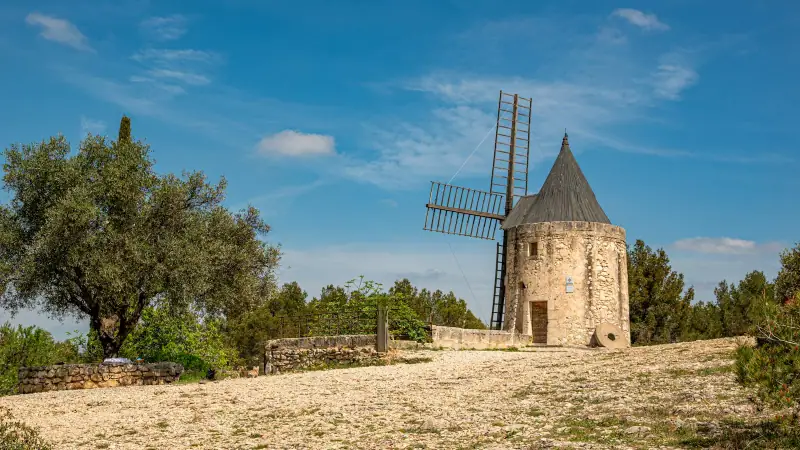
To the west, Fontvieille is a peaceful village, famous for its mill associated with Alphonse Daudet and his Lettres de mon moulin (Letters from My Mill). The building can be visited and houses a small space devoted to the writer; Daudet’s link with this particular mill is mostly a matter of local tradition, but the literary atmosphere is very real.
The area also lets you go back further in time. The remains of the aqueduct and the Roman mills of Barbegal are a reminder that the region was already a place of production and engineering nearly two thousand years ago. The surrounding stone quarries also supplied the materials for many of Arles’s monuments. As for Montmajour Abbey, very close by, it is visited together with Arles: see our guide to visiting Arles.
Eygalières, the quiet village
On the northeast side, Eygalières offers a welcome contrast to the crowds at Les Baux. The village, perched around a chapel and a tower, unfolds calm lanes, shaded squares and a few terraces where you can lunch without rushing. Its surroundings have several Romanesque chapels you can reach on foot or by bike, in a setting of scrubland and old stone walls.
It is an excellent option if you want peaceful accommodation, or an afternoon with no monuments to tick off, just a stroll and a coffee break. Eygalières is best discovered outside peak hours, late morning or early afternoon in the off-season.
Hiking and cycling in the range
The Alpilles are a pleasant playground for walking and cycling, with moderate elevation gains and open landscapes. Several marked trails start from Saint-Rémy, Les Baux or Maussane, with viewpoints over the Crau plain and the Camargue. The Regional Natural Park publishes maps and advice on routes.
A few rules to follow:
- Check access to the range before you leave: in summer, access can be restricted or banned depending on fire risk;
- Start early and carry plenty of water, since shade is rare;
- Stay on the trails to protect the scrubland;
- Do not smoke in the range and do not light any fire.
For cycling, the small roads around the range suit fit cyclists; electric-assist bikes, available to rent in several villages, make it easy to link Saint-Rémy, Maussane and Les Baux. Bring a helmet and water, and check the weather: the mistral can make some stretches tiring.
What to taste in the Alpilles
Local cooking relies on regional produce: olive oil, olives, tapenade, sun-grown vegetables, lamb, goat cheese and local wines. Village markets are the place to put together a picnic, while farmhouses (mas) and country inns serve meals built around seasonal Provençal cooking.
Rather than following a single address, look for the terraces frequented by locals and read recent reviews. In season, book for lunch in the busiest villages, notably Les Baux and Saint-Rémy. For products to bring home, choose those bought directly from the producer or at the mill: you support small farms and you are sure of the origin.
How to get there and get around
There is no train station in the range. The most practical rail access points are Avignon and Arles, from where you continue by bus or car. The trip to Saint-Rémy takes about twenty minutes by car from Avignon and a little more from Arles, outside heavy traffic.
Without a car, the simplest solution is to stay in Saint-Rémy-de-Provence and add organized excursions. With a car, the Alpilles can be done as a loop in one full day. Our guide to getting around Provence details the train, bus and car options.
Rent a car to explore the Alpilles
The villages are scattered: compare rental companies to move freely between Les Baux, Saint-Rémy and Eygalières.
Suggested itinerary for 2 to 3 days
Day 1: Saint-Rémy-de-Provence. Morning at Glanum and Les Antiques, lunch in the center, afternoon at Saint-Paul-de-Mausole and a stroll through the lanes. If it is Wednesday, start with the market.
Day 2: Les Baux and the olive valley. Arrive early at Les Baux-de-Provence for the village and the castle, then head down to Maussane-les-Alpilles for lunch and a visit to an oil mill. Late afternoon in an olive grove or at a wine estate.
Day 3 (optional): Fontvieille and Eygalières. Morning in Fontvieille and at Daudet’s mill, then drive to Eygalières for a quiet end of the day. If you have energy, a short walk in the range ends the stay.
To combine the Alpilles with a wider trip, our 5-day Provence itinerary already includes the region. You can also make the Alpilles a day trip from Avignon.
When to go
Spring is the ideal season: the hills are green, almond and fruit trees blossom and temperatures allow comfortable walking. Fall offers beautiful light and thinner crowds, at the time of the olive harvests in the fields. Summer is hot, dry and very busy; if you come then, concentrate your visits early in the morning or late in the day. Winter stays mild but several businesses slow down or even close.
The mistral can blow for several days in a row: it clears the sky but cools the air noticeably. Bring a windbreaker in the shoulder seasons. To compare seasons across the whole region, see when to go to Provence.
Key takeaways
For a successful stay, combine the three pillars of the range: Saint-Rémy and Glanum for history and Van Gogh, Les Baux for the spectacle, and the olive villages or Eygalières for a quiet pace. Start early, check access to the range in summer, taste olive oil at the producer and keep some flexibility in your plans: it is in the small detours that the Alpilles reveal their charm.
Frequently asked questions
Where are the Alpilles?
The Alpilles are a small limestone range in the Bouches-du-Rhône department, between Avignon to the north, Arles to the west and the Durance to the east. The range stretches about thirty kilometers and its landmarks include Saint-Rémy-de-Provence, Les Baux-de-Provence, Maussane-les-Alpilles, Eygalières and Fontvieille.
How long should you allow to visit the Alpilles?
Two days let you see the essentials: Les Baux-de-Provence, Saint-Rémy and Glanum. With three days, you add a quieter village such as Eygalières or Fontvieille, a walk in the range and an olive oil or wine tasting.
What is the most famous village in the Alpilles?
Les Baux-de-Provence, perched on a rocky spur and overlooked by the ruins of a castle. It is one of the most visited villages in Provence: arrive early in the morning or late in the day for a calmer atmosphere.
Do you need a car to visit the Alpilles?
It is the most flexible way, because the villages are scattered and public transport is limited. Without a car, you can base yourself in Saint-Rémy-de-Provence, reach the area by bus from Avignon or Arles, or book an organized excursion. Check bus timetables before you go.
Can you hike in the Alpilles in summer?
Access to Provence's wooded massifs can be restricted on some summer days because of fire risk. Check the information from the prefecture or the Regional Natural Park before each outing, start early in the morning and carry plenty of water.
What is the best time to visit the Alpilles?
Spring and early fall are the most pleasant: soft light, mild temperatures and thinner crowds. Summer is hot and very busy, winter is quiet with some businesses closed.
What should you taste in the Alpilles?
Olive oil from the Vallée des Baux-de-Provence, olives, Les Baux-de-Provence wine, seasonal market produce and Provençal specialties such as tapenade. Mills and estates often offer visits and tastings, to be checked by season.
More Provence guides
Keep reading
What to see around Mont Ventoux: the climb, Nesque gorges, Dentelles and villages
What to see around Mont Ventoux: the summit, Nesque gorges, Dentelles de Montmirail, Sault, Bédoin and Vaison-la-Romaine. A guide to plan your visit.
What to see on the Valensole plateau: villages, lavender and gorges to explore
What to see on the Valensole plateau: Riez, Valensole, Puimoisson, Gréoux, Quinson and Les Mées, villages, heritage and landscapes beyond the lavender.
Visiting Cassis: what to see and do in 1 to 2 days
Harbor, Cap Canaille, Route des Crêtes, calanques from Port-Miou to En-Vau, local white wines: a guide to visiting Cassis and planning your stay.
Ready-made
Provence itineraries
3 days
Lavender route in Provence in 3 days: Valensole, Sault and the Luberon, stops and distances
Moustiers-Sainte-MarieSault
3 days
3 days between Marseille, Cassis and Aix-en-Provence: a detailed itinerary
3-day Provence itinerary: Marseille and the Vieux-Port, Cassis calanques, Aix-en-Provence and its fountains. Day by day, distances and tips.
5 days
5-day Provence itinerary: Avignon, Luberon, Alpilles and Camargue
A day-by-day 5-day Provence itinerary: Avignon, Luberon, Alpilles, Arles, Camargue, Aix and Cassis, with realistic distances and practical tips.
Can be adapted in the planner