Things to do
Hiking in the Cyclades: the best trails, island by island

We may earn a commission when you book through links on this page, at no extra cost to you. We don't visit or try the places we cover: we summarize published sources. How we work
In short
- The Santorini caldera path from Fira to Oia is about 9 to 10 km (6 mi) and 3 to 5 hours, with almost no shade or water.
- Paros's Byzantine road from Lefkes to Prodromos is short, paved and easy: about 3 to 3.5 km (2 mi), 1 h 30 to 3 hours round trip.
- Mount Zas on Naxos, about 1,000 m (3,300 ft), is the archipelago's highest summit and its emblematic climb.
- The best seasons are April-May and late September-October; in July and August start at dawn and carry plenty of water.
The Cyclades have the reputation of an archipelago of beaches and parties, but they hide a network of trails that deserves the detour. Paved mule paths between two villages, ridges overlooking the sea, perched monasteries, coves reachable only on foot: walking means discovering the archipelago at the pace at which it lived before ferries and asphalt roads. This guide presents the most interesting hikes, island by island, with benchmarks for duration and difficulty, then practical advice for walking without bad surprises.
One clarification up front: the durations and distances given here are orders of magnitude, drawn from hiking guidebooks and hiking sites. They vary with your pace, the weather and photo stops. Always check the exact route before leaving, and allow a margin.
Santorini: the caldera path between Fira and Oia
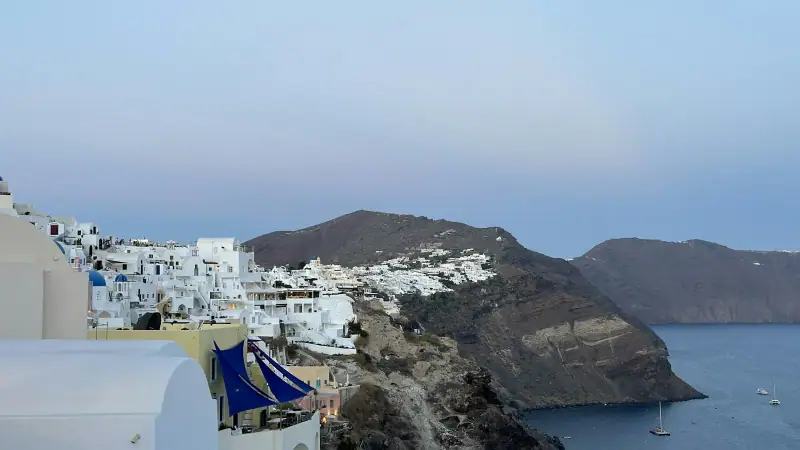
This is the archipelago’s most famous hike, and one of the easiest to reach. The path follows the edge of the caldera, first from Fira to Firostefani, then Imerovigli, and finally to Oia. Depending on the source, allow about 9 to 10 kilometers (6 mi) and 3 to 5 hours, with a cumulative elevation gain of several hundred meters: the walk is not technical, but it has regular ups and downs.
The appeal is obvious: the view over the caldera, the dark cliffs, the blue domes and, in the distance, the volcano. The drawback is just as obvious: there is almost no shade or water point along the route. In summer, set off very early in the morning to avoid the heat and reach Oia before the crowd. The return is easy by bus, with a stop in Oia. If you prefer not to walk alone, guided hikes exist.
Guided hike in Santorini
Walk with a guide on the caldera path or combine a hike and the volcano, with no navigation stress.
For a broader view of the island, see our 3-day Santorini itinerary, which includes a stretch of this path.
Paros: the Byzantine road between Lefkes and Prodromos
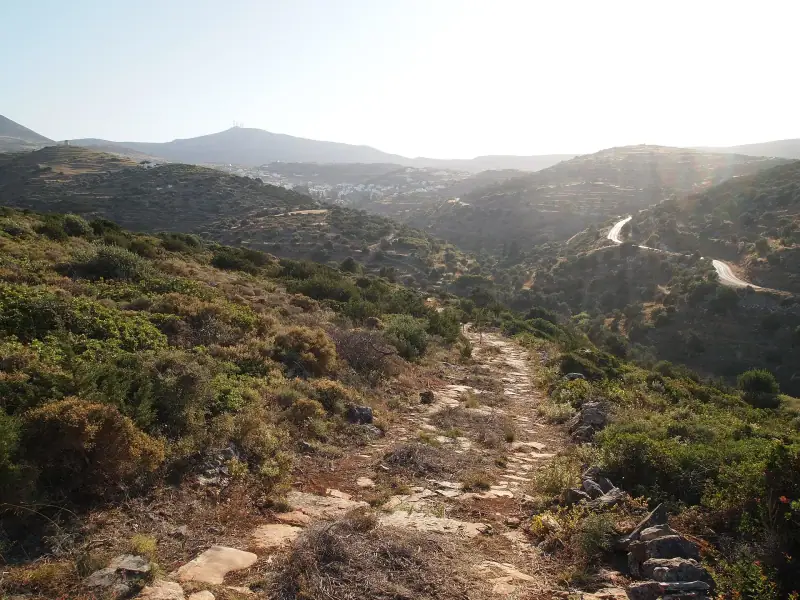
Paros offers a short, paved and very pleasant hike: the Byzantine road. It links the village of Lefkes to that of Prodromos, on an old paved path of about 3 to 3.5 kilometers (2 mi), which takes 45 minutes to 1 h 30 one way, or 1 h 30 to 3 hours round trip depending on your pace. The path crosses terraces, olive groves and scrubland, with the sea as a backdrop.
It is an excellent first hike: little elevation, a stable surface, and villages at each end for a coffee or lunch. Lefkes, a white village of the interior, is worth the visit on its own. To compare the island with its neighbor, read Naxos or Paros: which island to choose.
Naxos: interior trails and Mount Zas
Naxos is the largest island in the Cyclades, and the most mountainous. Its central massif peaks at Mount Zas (or Zeus), the highest summit in the archipelago, at about 1,000 meters (3,300 ft). Climbing it is the island’s emblematic hike: it requires decent fitness, good shoes and water, but it rewards with a panorama over many neighboring islands in clear weather.
Naxos also keeps paths linking its interior villages, among terraces, chapels, towers and cultivated valleys. These are quieter walks, often a few hours long, that let you discover the island away from the coast. Accommodation on Naxos, in a village or by the sea, makes a good base.
Sleep in peace near the trails
Compare accommodation in Naxos, Paros or Folegandros: rooms in private homes, small hotels, apartments.
Folegandros: from Chora to the beaches on foot
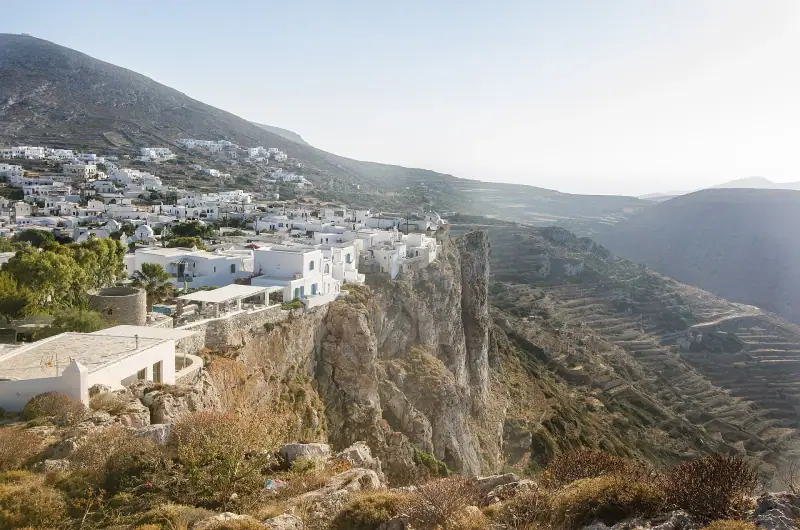
On Folegandros, walking is the natural way to get around. Trails start from Chora, perched on the cliff edge, toward the beaches and toward Ano Meria, the farming hamlet in the west of the island. Distances are modest, but the paths are sometimes stony and exposed to the sun.
It is a great island for walking a few hours a day without a car, then finishing with a swim in a cove reachable on foot. Our Folegandros guide details the beaches, villages and practical organization, as well as the most pleasant hikes.
Amorgos, Sifnos, Tinos: the hiker’s islands
If you are an experienced walker, three islands deserve a place on your list.
- Amorgos is known for its mule paths along the balcony above the sea, its thyme-scented valleys and its monastery clinging to the cliff (hours, dress code and steps in our guide to the Hozoviotissa monastery). It is one of the most beautiful islands for hiking, wilder than Paros or Naxos.
- Sifnos is famous for its many trails linking villages, chapels and beaches, among olive groves and cultivated terraces. The island is also known for its cooking.
- Tinos offers a heritage of stone villages, dovecotes and country paths, far from mass tourism.
These islands call for a bit more organization: less frequent ferries and more limited accommodation than on Santorini or Mykonos. See our ferry guide to prepare your crossings, and allow a margin in case of strikes or wind.
Milos: walking and sailing
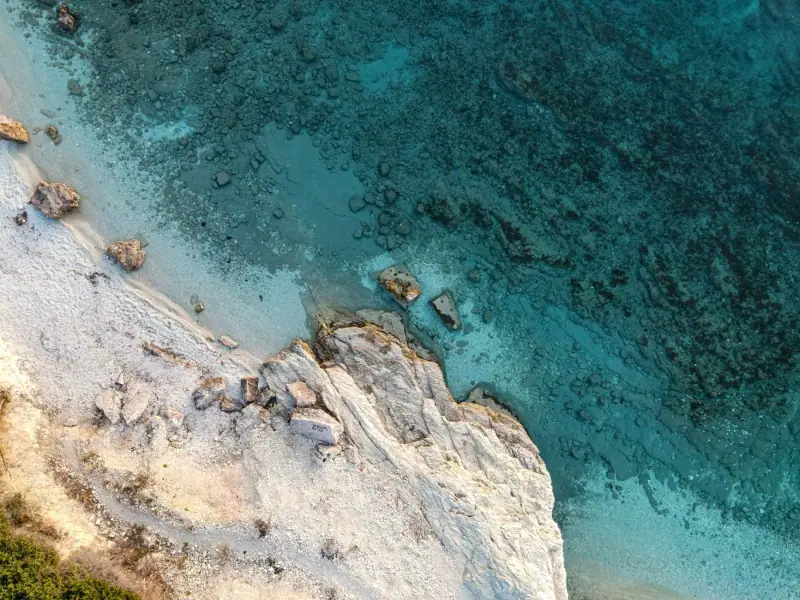
Milos is best known for its coves and rock formations, but you can walk along the coast, between viewpoints, old mining areas and small beaches. A good option is to combine a morning walk and an afternoon boat trip to see the cliffs from the sea. See also our article on the beaches and coves of Milos.
Hiking and boating in Milos
Combine a coastal walk with a boat tour around the coves, depending on the day's weather.
Choosing your level and pace
The Cyclades are not a high-mountain destination, and that is what makes them accessible: most routes take half a day, with no technical equipment. The trap lies less in difficulty than in conditions. A two-hour trail becomes long under a strong sun, without shade or water, and a ridge seems short until the wind picks up. To choose, ask yourself three questions.
What is your level? If you walk little, favor the paved paths between villages (Paros), the caldera path in Santorini starting early, or short walks to a beach on Folegandros. If you walk regularly, the climb of Mount Zas on Naxos or the trails of Amorgos and Sifnos offer more elevation and solitude.
What is your time budget? A half-day hike leaves the afternoon for the beach and lunch in a village. A full day takes organization: water, snacks, a planned return. Do not combine a big walk with a ferry trip on the same day: timetables, wind and delays can make you miss the crossing.
What do you want to see? The trails of the Cyclades tell the story of the archipelago: isolated white chapels, dry-stone terraces, dovecotes, windmills, old mule paths that linked villages before roads arrived. Walking helps you understand how these islands were organized, where each village had its path to the sea and to the fields. Take the time to stop, close the gates of the enclosures you pass and stay on the trail: the terraces are fragile and flocks are often nearby.
When to hike in the Cyclades
The ideal period generally runs from April to May, then from late September to October. In spring, vegetation is greener and in flower; in fall, the sea is still warm, so you can finish the walk with a swim. In July and August, days are very hot, the meltem wind can be strong and trails without shade become punishing: walk from dawn and rest during the hot hours. Winter is calm, with reduced services on the small islands and less frequent ferries, but some islands are well suited to walking. Find the detail in our article when to go to the Cyclades.
Gear and safety
A few simple rules reduce most of the risks:
- Water: carry at least 1.5 to 2 liters (50 to 68 oz) per person for a walk of several hours, more in summer. Water points are rare.
- Shoes: hiking shoes with a grippy sole, as the paths are often stony and slippery on polished slabs.
- Sun protection: hat, sunglasses, sunscreen. There is little shade on most trails.
- Navigation: download the GPS track offline, the mobile network is not always available, and waymarking is uneven.
- Timing: tell your host the planned route, set off early and keep a margin before nightfall.
- Return: check bus or taxi timetables, they are limited on many islands.
For equipment, our list of essential accessories details what really matters in a bag for the archipelago. Travel insurance covering hiking activities can also be useful.
Organizing a hiking trip
It is hard to see everything in a single week. Here are a few realistic combinations:
- Beginner, 1 week: Santorini (caldera path), then Paros (Byzantine road), with a swim every day.
- Regular walker, 10 days: Paros, Naxos (interior and Mount Zas), then Amorgos or Folegandros.
- Quiet stay: a single island, two or three hikes per walking day, and the rest of the time relaxing.
Between the islands, most travel is by ferry, sometimes with a connection. Allow margins, especially if you have a return flight. The meltem can also delay or cancel crossings. See our 10-day itinerary in the Cyclades for a sequence of islands.
Flights to the Cyclades
Compare flights to Santorini, Mykonos or Athens, with a ferry or plane connection.
In short
The Cyclades lend themselves very well to hiking, provided you choose the right season and the right island. Santorini and Paros suit beginners, Naxos more seasoned walkers, and Amorgos, Sifnos or Folegandros lovers of nature and calm. Prepare water, sun protection and the route, and you will discover an archipelago very different from its postcard. For an overview, see our complete guide to the Cyclades.
Frequently asked questions
Can you hike in the Cyclades in summer?
It is possible but demanding: little shade, strong heat and wind. Set off at dawn, carry plenty of water and avoid the ridges at the hottest hours. Spring and early fall are much more pleasant.
What is the best time for walking?
Generally April-May and late September-October: mild temperatures, greener nature in spring and less crowded trails. See our article on the best time to go to the Cyclades.
Are the trails well marked?
It depends on the island. Some routes (Paros, Naxos, Sifnos, Amorgos) are well known and partly waymarked, others are simple goat tracks. Download an offline GPS track and do not rely on the mobile network.
Which island should you choose for a first hike?
Paros and its Byzantine road between Lefkes and Prodromos are a good introduction: short, paved and accessible. Santorini also offers an easy walk along the edge of the caldera, but without shade.
Do you need a guide?
Not for short, well-known trails. A local guide is useful for climbing a mountain, for routes with little signage or to learn the history of the places.
What should you put in your bag?
Hiking shoes with a grippy sole, a hat, sunscreen, at least 1.5 to 2 liters (50 to 68 oz) of water per person, a light windbreaker and a power bank. Our accessories list details these choices.
More Cyclades guides
Keep reading
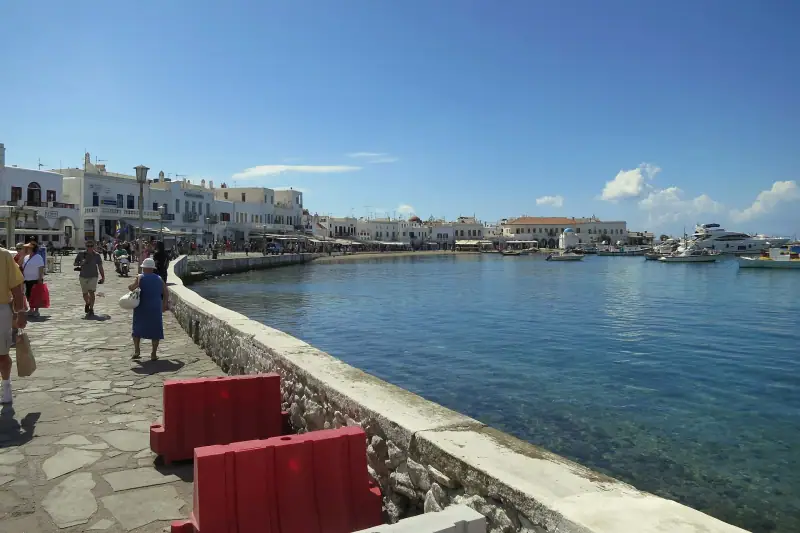
Delos excursion from Mykonos: book ahead or on site?
Delos from Mykonos: should you book the boat ahead or on site? Prices, timetables, entry ticket, wind and season to choose the right option.

Water sports in the Cyclades: kitesurfing, windsurfing, diving and kayaking island by island
Kitesurfing in Paros and Naxos, windsurfing, diving and kayaking in Milos: where to do water sports in the Cyclades, by wind, season and level.
Cyclades budget: what a trip costs, item by item (3 profiles)
Cyclades budget: costs for accommodation, ferries, meals and activities, three priced profiles (smart, standard, comfort) and tips to spend less.
Ready-made
Cyclades itineraries
7 days
Naxos and Paros in 7 days: a detailed itinerary for two
Naxos ChoraParos
10 days
10 days in the Cyclades: Paros, Naxos and Santorini, island by island
ParosNaxosSantorini
3 days
Santorini in 3 days: a complete itinerary through the caldera, ancient sites and beaches
What to do in Santorini in 3 days? Day-by-day itinerary: Fira, Oia, Akrotiri, the volcano, black beaches and vineyards, with transport and planning tips.