What to see
What to see in Florida: Miami, the Everglades, the Keys, Orlando and the historic coast

We may earn a commission when you book through links on this page, at no extra cost to you. We don't visit or try the places we cover: we summarize published sources. How we work
In short
- Everything is far apart in Florida: Miami to Orlando is about 235 miles (380 km), roughly four hours by car; Miami to Key West about 160 miles (260 km).
- Four main hubs: the southeast (Miami, Everglades), the Keys, the center (Orlando) and the coasts (space and historic on the east, Gulf beaches on the west).
- November to April is drier and milder; the hurricane season officially runs from June to November, so choose flexible bookings.
- A car is practical as soon as you leave Miami or Orlando; the Everglades and the Keys are best visited at the wheel.
When people think of Florida, they first imagine Disney, Miami’s palm trees and beaches. All of that really exists, but the state offers much more: a huge wetland designated as a national park, a chain of islands linked to the mainland by spectacular bridges, a rocket launch base, the oldest city of European origin in the country still inhabited and white sand beaches on the Gulf of Mexico. It is a destination that forces you to choose, because everything is far from everything.
This guide helps you decide what to see in the Florida region, understand the geography and build a coherent route. To go deeper into a stop, it points to dedicated guides: the 3-day Miami itinerary, the guide to visiting Orlando or the one to visiting Key West.
Understanding Florida’s geography before choosing
Florida is a long peninsula stretching from north to south, bordered by the Atlantic Ocean to the east and the Gulf of Mexico to the west. This shape explains most of the constraints: you do not cross the state in an hour, and trips between two stops can easily take half a day.
A few useful benchmarks, to check on your navigation app depending on traffic:
- Miami to Orlando: about 235 miles (380 km), roughly four hours by car.
- Miami to Key West: about 160 miles (260 km) along the Keys road, generally between three and a half and four hours, more in case of traffic.
- Orlando to Cape Canaveral: about one hour by car.
- Orlando to St. Augustine: about two hours by car.
- Orlando to Tampa: about an hour and a quarter to an hour and a half.
There are roughly four main hubs: the southeast (Miami, Fort Lauderdale, Everglades), the Keys (from Key Largo to Key West), the center (Orlando and its parks) and the coasts (Space Coast and historic coast on the east, Gulf beaches on the west). To compare seasons, see the guide to when to go to the East Coast.
Miami and South Beach: Art Deco, beaches and colorful neighborhoods

The first image of Florida for many travelers is Miami. The city is a mix of beaches, glass skyscrapers, Latin American neighborhoods and street art. The South Beach district, at the tip of Miami Beach island, is famous for its pastel-colored Art Deco buildings, mostly built in the 1930s and 1940s. Ocean Drive, with its facades and outdoor cafés, is the showcase, but a walk a bit farther back, in the quieter streets, lets you appreciate the architecture better.
Beyond the beach, several neighborhoods are worth a detour. Wynwood is a set of walls covered with murals, along with galleries and breweries. Little Havana, around Calle Ocho, recalls the importance of the Cuban community: cafés, hand-rolled cigars, dominoes games in the parks. Coral Gables, more residential, charms with its wide tree-lined avenues and Mediterranean architecture. Finally, the Vizcaya villa, a mansion built in the early 20th century on the bay, will delight lovers of gardens and Italian-style settings.
Plan two to three days for Miami. The 3-day Miami itinerary organizes these stops, and the guide to where to stay in Miami compares South Beach, Brickell, Wynwood and the other areas.
Where to sleep in Miami
Compare hotels in South Beach, Brickell or Coral Gables: rates vary strongly with the season and events.
Everglades: the great wetland south of Miami

Less than an hour’s drive from Miami, Everglades National Park protects a vast subtropical wetland, one of the largest in the United States, covering more than 2,300 square miles (6,000 square kilometers). It is not a swamp in the classic sense: the water advances slowly in a wide sheet, the “river of grass”, between tree islands, mangroves and sawgrass prairies. The landscape is flat, but the wildlife is exceptional: alligators, many wading birds, turtles and, with luck, manatees in some coastal areas.
The park is visited through several entrances. On the southeast side, the Homestead entrance gives access to boardwalk trails, such as Anhinga Trail, where you can watch alligators and birds up close without leaving the marked path. On the north side, the Shark Valley area offers a loop you can ride by bike or on a narrated tram, with an observation tower halfway. On the Gulf side, the Everglades City access opens to the Ten Thousand Islands and kayak outings.
Airboat rides are very popular, but they often take place on private land on the edge of the park, not inside the national park. If the noisy atmosphere does not appeal to you, prefer a walk, bike ride or kayak trip, quieter and better for observation. To know whether to book and how much to plan, read the guide airboat rides in the Everglades: book ahead or on the spot.
A few practical tips: the dry season (about November to April) is the most pleasant, because animals gather around water points and mosquitoes are fewer. In summer, heat, humidity and insects make the visit harder. Bring water, a hat, sun protection and an effective repellent. Do not feed any animal and keep your distance from alligators.
The Keys and Key West: the road over the water
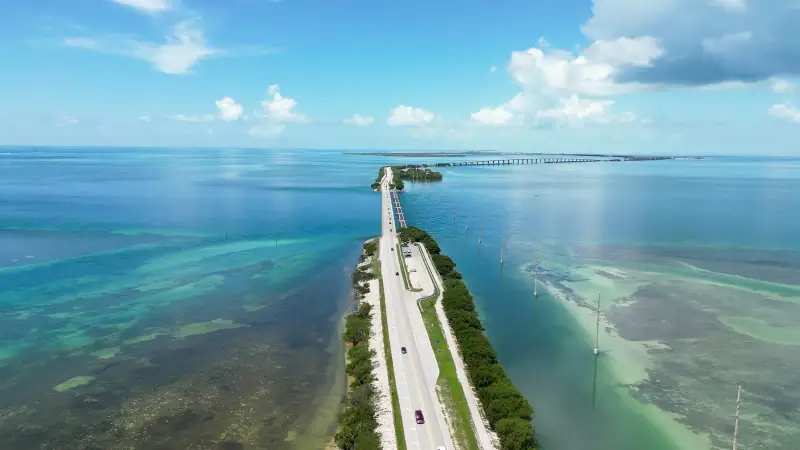
At the southern tip of the mainland, the Florida Keys form an archipelago of small islands linked by the Overseas Highway, a road that spans the water over many bridges. The trip itself is part of the attraction: on either side, the turquoise of the Gulf and the Atlantic, with the famous Seven Mile Bridge as the high point. This road ends at Key West, about 160 miles (260 km) from Miami.
The stops along the way are worth making. Key Largo, the first island, is known for diving and snorkeling around protected coral reefs. Islamorada and Marathon offer fishing, quiet beaches and sea turtle care centers. The trip can be done in a day, but one or two nights on the way make much better memories.
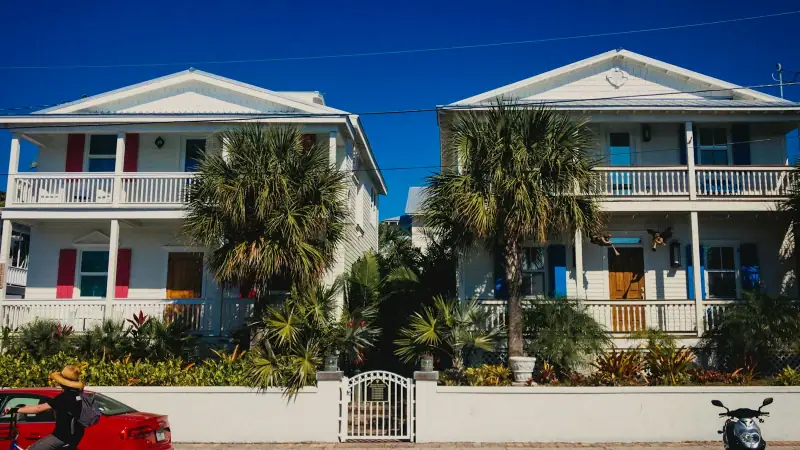
Key West is a small town with character, with its colorful wooden houses, streets lined with bougainvillea, galleries and well-attended sunsets at the harbor. The house where the writer Ernest Hemingway lived, now a museum, is among the classic visits, as is the Southernmost Point buoy, which marks the southern end of the continental United States. The guide to visiting Key West details the town, and the comparison where to stay in Key West helps you choose your neighborhood.
From Key West, a ferry or seaplane excursion leads to Dry Tortugas National Park, about 70 miles (110 km) to the west. There you discover Fort Jefferson, an immense 19th-century brick fort built on a tiny island, and waters ideal for snorkeling. It is a full day, to book ahead in high season.
Excursions in the Keys and the Everglades
Snorkeling, kayak outings, boat trips or guided Everglades visits: compare activities from Miami and Key West.
Orlando: much more than theme parks
In the center of the state, Orlando is the theme park capital of the world: Walt Disney World, Universal Orlando and SeaWorld attract millions of visitors each year. For a family, these parks justify the trip by themselves, and you should allow several days to enjoy them without rushing. Book tickets ahead, avoid American school holidays if possible and plan a substantial budget for admission, food and transport.
But Orlando is not limited to the parks. The city has a pleasant center around Lake Eola, botanical gardens, small neighborhoods like Winter Park, with its lakes, museums and boat rides, as well as clear-water springs and nature reserves about an hour away. The guide to visiting Orlando beyond the theme parks develops these options, while the comparison where to stay in Orlando helps you choose between park hotels and independent lodging.
If you travel without children, Orlando can be reduced to a two-day stop, an ideal base to branch out to the Space Coast to the east or Tampa to the west.
The Space Coast: Cape Canaveral and the Kennedy Space Center

About an hour east of Orlando, the Kennedy Space Center is the site from which the Apollo missions and the space shuttles departed. The visitor center presents launch vehicles, capsules, simulators and, depending on the date, a space shuttle on display. Space buffs will gladly spend a whole day there. If a launch is scheduled during your stay, it is sometimes possible to watch it from the surroundings: check the center’s official calendar and that of the operators before planning your trip, because dates often change.
The neighboring coast also deserves a stop. Cocoa Beach, about an hour from Orlando, is a seaside resort known for surfing and its relaxed atmosphere. It is an excellent option to combine beach and space visit in two days, without going back to sleep in Orlando.
St. Augustine: the oldest city of European origin in the United States
For a completely different atmosphere, head up the Atlantic coast to St. Augustine, about two hours from Orlando. Founded by the Spanish in 1565, it is the oldest city of European origin in the country to have remained continuously inhabited. Its historic center is a tangle of narrow lanes, colonial houses and shaded squares, dominated by the Castillo de San Marcos, a Spanish fort of coquina stone that guards the entrance to the bay.
The city is visited on foot, in a day or an overnight stay. You stroll along the pedestrian St. George Street, discover its small museums and, in the evening, the lighting of the facades gives it a particular charm. For travelers used to American metropolises, it is a historical detour that recalls that Florida experienced Spanish colonization well before the United States. The neighboring light-sand beaches complete the stay.
Tampa, St. Petersburg and the Gulf coast
On the west coast, the Gulf of Mexico offers a calmer Florida. Tampa, a large port city, has a historic district, Ybor City, a former cigar-making center. St. Petersburg, across the bay, mixes museums, waterfront and well-known beaches, including those of Clearwater, with a family atmosphere. Sunsets over the water are among the main attractions there.
Farther south, Sanibel and Naples are popular destinations for shell collecting, fine-sand beaches and tranquility. They are aimed at travelers who want a week of rest after a more active circuit. After storms pass, the state of infrastructure can vary by area: find out about local conditions before booking.
Which itinerary to choose depending on the length of your stay?
Not all stops fit into a single trip. Here are realistic combinations.
One week, South Florida. Three days in Miami, one day in the Everglades, then two days in the Keys as far as Key West. This is the best-balanced formula between city, nature and beach.
One week, center and coast. Four days in Orlando and its parks, one day at the Kennedy Space Center and Cocoa Beach, then one night in St. Augustine. It suits families well.
Ten to fourteen days, big loop. Start with Miami, head down to Key West, come back up through the Everglades, cross to Orlando, continue along the Space Coast and finish with St. Augustine or the Gulf coast. Allow several hours of driving between each hub: do not overfill your days.
On a small budget. Concentrate on Miami and the Everglades, two stops reachable with little travel. The East Coast budget guide gives benchmarks on everyday spending.
Combining New York and Florida. If you extend a stay in the Northeast, a domestic flight to Miami or Orlando saves two days of driving. Compare offers on the usual flight sites before booking.
Getting around Florida
The car is the most practical means of transport to combine several hubs. Highways are wide and well marked, but electronic tolls are frequent: ask the rental company how the transponder works. Parking in Miami Beach and Key West is paid and sometimes expensive. For a one-way trip, for example Miami to Orlando, check the drop-off fees at a different branch.
Rent a car in Florida
For the Keys, the Everglades and the road to Orlando, compare rental companies and check the return conditions.
Public transportation is useful within cities: a light rail and bus system in Miami, buses in Orlando. Between cities, long-distance trains and buses exist, but they are less practical than the car for the Everglades and the Keys. Domestic flights between Miami and Orlando are rarely necessary, because the road is direct.
Finally, think about electrical equipment: American outlets are type A/B, so check that your chargers fit or bring an adapter to recharge your devices.
When to go to Florida and what to expect from the weather
Florida has a subtropical climate, with two main seasons. From November to April, the weather is drier, cooler and bright: it is the best period for the Everglades, beaches and outdoor visits. Prices are higher, however, especially around Christmas and during spring break.
From May to October, heat and humidity set in, with frequent late-afternoon thunderstorms. It is the low season in many properties, with lower rates, but also mosquito season. The hurricane season officially runs from June to November, with a higher risk in August and September. The risk of a specific event is low for a given stay, but it justifies choosing flexible bookings and following local alerts.
Preparing your trip: formalities, insurance and connectivity
Entry rules depend on your passport. Check the official travel advice of your government before you book: travel.state.gov (US), GOV.UK (UK), travel.gc.ca (Canada), Smartraveller (Australia) (checked November 2026). See also the guide to East Coast formalities.
Because medical costs are very high in the United States, travel insurance covering medical care and cancellation is strongly recommended, especially during hurricane season.
To stay connected there, check your carrier’s international plan or consider a travel eSIM: Saily offers plans in more than 150 countries, so check the offer for the United States before you leave. The article on SIM cards and eSIMs on the East Coast compares the options.
One last habit: sun protection. The sun is intense all year, even on hazy days. Sunscreen, a hat and sunglasses are essential, and the reusable water bottle quickly becomes your best ally, especially in the Everglades and on the beaches.
Frequently asked questions
How much time should you plan to visit Florida?
Plan ten days to two weeks for a full loop: Miami, Everglades, Keys, then Orlando and the Atlantic coast. With one week, concentrate on two hubs, for example Miami and the Keys, or Orlando and the Space Coast.
Do you need to rent a car in Florida?
In practice, yes, as soon as you leave Miami or Orlando. Distances are long, the Everglades and the Keys are better visited at the wheel, and public transportation stays limited between the major stops.
What is the best time to go to Florida?
From November to April, the climate is drier and milder, which suits the Everglades and the beach well. Summer is hot, humid and stormy, and the hurricane season officially runs from June to November: plan travel insurance and flexible bookings.
Can you see Miami and Orlando in the same trip?
Yes, the two cities are about 235 miles (380 km) apart, roughly four hours by car depending on traffic. Many travelers start in Miami, head up to Orlando and then return the vehicle in one of the two cities.
Are the Everglades dangerous to visit?
No, if you follow the park's rules: stay on trails and boardwalks, do not feed any animal and keep your distance from alligators. Mosquitoes, however, are very present in the hot season, so a repellent is recommended.
What is there to see in Florida besides theme parks?
The Art Deco district of South Beach, the Everglades, the Keys road to Key West, the Kennedy Space Center, the old town of St. Augustine and the beaches of the Gulf of Mexico offer very varied landscapes and history.
Do you need an eSIM or an adapter for Florida?
American outlets are type A/B: check that your chargers fit or bring an adapter. For internet, check your carrier's international plan or consider a travel eSIM.
More US East Coast guides
Keep reading

What to see in Washington and the Mid-Atlantic: Baltimore, Annapolis, Philadelphia
What to see around Washington and the Mid-Atlantic: Alexandria, Mount Vernon, Baltimore, Annapolis, Gettysburg and Philadelphia. Sights, trips and tips.

Visiting Chicago: what to see and do in the Windy City
What to see and do in Chicago: Millennium Park, architecture, the Art Institute, Riverwalk, Lake Michigan, deep dish and neighborhoods. Plan your stay.
Visiting Key West: what to see and do at the end of the Keys
What to see and do in Key West: Duval Street, Hemingway House, sunset, the Dry Tortugas, beaches and food. Plan your Florida stay.
Ready-made
US East Coast itineraries

4 days
New England fall road trip: 4 days from Boston to the White Mountains and Vermont
LincolnWoodstock
Can be adapted in the planner

3 days
Miami in 3 days: an itinerary through South Beach, Wynwood and the Everglades
What to see in Miami in 3 days: South Beach Art Deco, Wynwood, Little Havana, Coral Gables, Vizcaya and the Everglades. Day-by-day plan and tips.

2 days
Philadelphia in 2 days: an itinerary through American history and good food
What to see in Philadelphia in 2 days: Independence Hall, Liberty Bell, Old City, Reading Terminal Market, the art museum and neighborhoods. Plan and tips.