Things to do
Wildlife Watching in New Caledonia: Whales, Turtles, Kagu and Dugongs
We may earn a commission when you book through links on this page, at no extra cost to you. We don't visit or try the places we cover: we summarize published sources. How we work
In short
- Humpback whale watching is concentrated from July to September, on boat trips with a professional operator; no encounter is guaranteed.
- The kagu, a flightless bird found only on Grande Terre, is most reliably seen at Rivière Bleue Provincial Park and the Nouméa zoological and forest park.
- The local code of conduct sets an approach distance of around 100 m (330 ft) for boats and forbids approaching a whale with its calf.
- Green turtles are watched while snorkeling around islets near Nouméa and the Isle of Pines; never touch, chase or feed them.
New Caledonia is not only a postcard of turquoise lagoon. Isolated for a very long time in the South Pacific, the archipelago shelters wildlife and plants with many species found nowhere else, starting with the kagu, the country’s emblem bird. At sea, New Caledonian waters also host humpback whales each austral winter to breed, and the lagoon, a UNESCO World Heritage site, shelters sea turtles and dugongs.
This guide helps you know what to watch, where, in which season, and above all how to do it without disturbing the animals. No encounter is guaranteed: wild animals remain unpredictable, and that is what makes the good moments so precious. We give no precise prices or schedules, which change with the seasons and operators.
Watching humpback whales: an austral winter season
Every year, humpback whales leave the cold waters of Antarctica for the warm waters of the South Pacific, where they breed and give birth. New Caledonia is one of their breeding areas. For travelers, the most reliable window is July to September, a period you will also find in our guide when to go to New Caledonia. Sightings are reported later in the year depending on the season, but do not build a whole trip around a late sighting.
The Grand Sud and the waters of the southern lagoon are where boat watching is most developed. Trips generally last half a day and leave from the Nouméa area or the Grand Sud, depending on the operator. Compare departure points, duration and boat size before booking.
What to know before you go:
- The animals are wild: some trips are spectacular, others calmer. A trip without a whale is possible, and a good operator will never promise otherwise.
- Seasickness is not rare offshore: if you are prone to it, ask your doctor or a travel clinic.
- A windbreaker is useful: the austral winter is cool at sea, especially at dawn.
- Bring binoculars and a camera with a good zoom, since you will stay at a distance.
Rules to follow around whales
The South Province has set up a code of conduct to regulate cetacean watching. It aims to limit disturbance to the animals, in particular mothers accompanied by their calf. Among the main rules you generally find:
- a minimum approach distance of about 100 m (330 ft) for boats;
- no approaching a whale with its calf in the immediate vicinity;
- a reduced speed and an approach from the side, never head-on or from behind;
- a limited number of boats at once around the same group;
- a limited watching time for each group.
For divers and swimmers, the rules are even stricter, with a greater distance. Environmental rangers check compliance at sea. The simplest: choose a professional operator that clearly states its respect for the code, and speak up if you see behavior that disturbs the animals. Rules change; always ask the operator to remind you of them when boarding.
Boat trips and whale watching
Compare boat excursions in New Caledonia and book according to the season and your dates.
The kagu, the emblem bird that does not fly
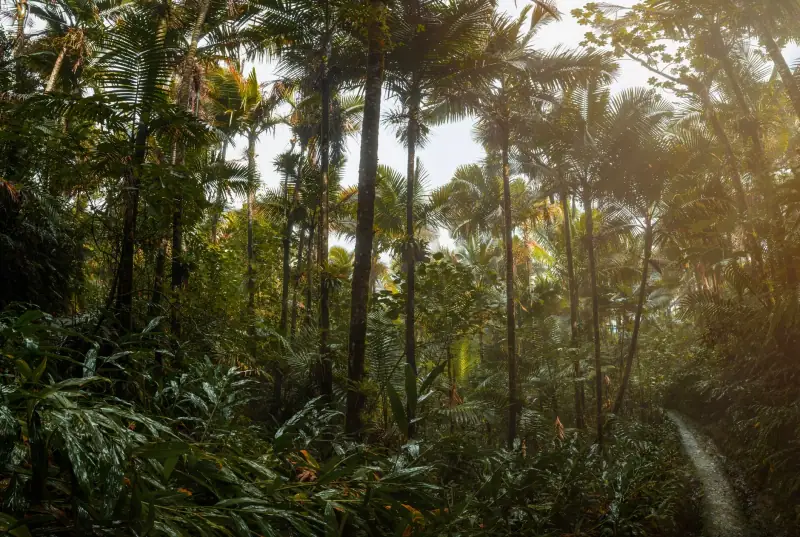
The kagu (Rhynochetos jubatus) is the symbol of New Caledonia. This light gray bird with a white crest moves only on the ground: it does not fly, which makes it very vulnerable to introduced predators such as dogs, cats, pigs or rats, as well as to fires and forest fragmentation. It is endemic: it is found only on Grande Terre.
The two places where you have the best chance of seeing it are:
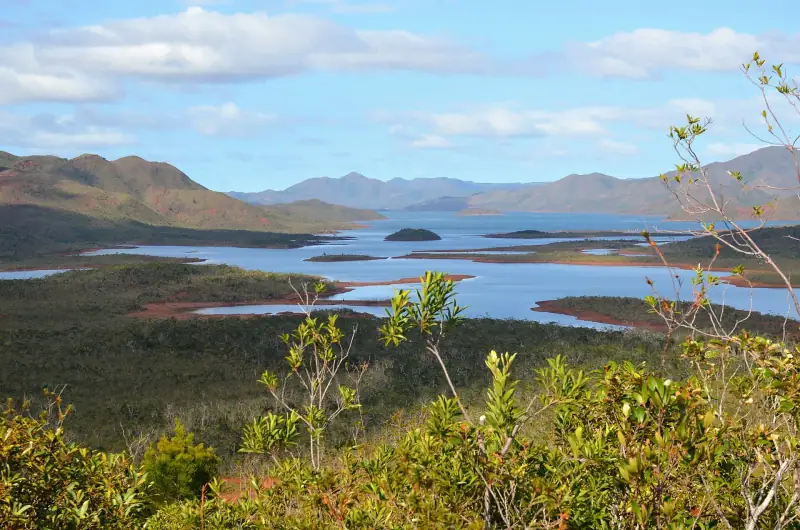
- Rivière Bleue Provincial Park, in the Grand Sud, where captive-bred kagus were reintroduced after the population had collapsed there in the last century;
- the Nouméa zoological and forest park, where sightings are reliable in a landscaped setting.
In the wild, the kagu stays shy, even when you try to imitate its call. A few tips: walk slowly, speak little, arrive early in the morning and stay on the marked trails. Do not try to attract it with food. To prepare for your visit to the Grand Sud, read our guide to Rivière Bleue Park and its hikes.
Sea turtles: watch without touching
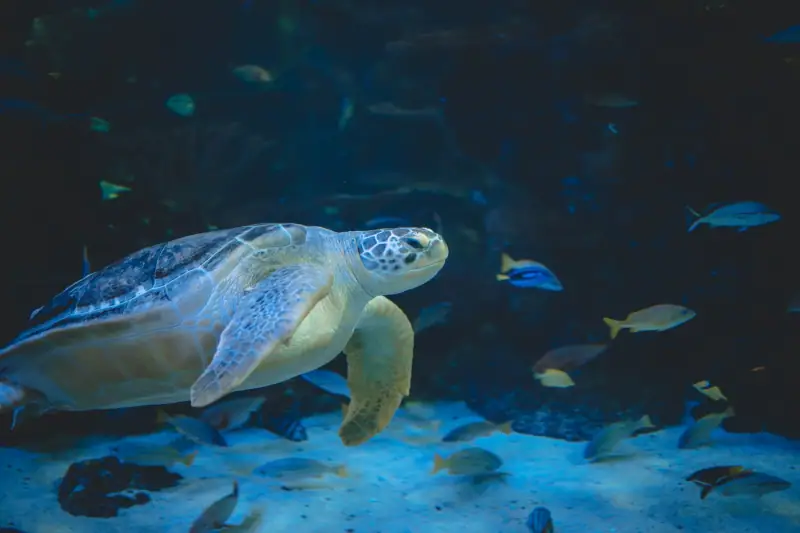
Several species of sea turtles visit the Caledonian lagoon. The green turtle is the one most often cited, and other species such as the loggerhead or the hawksbill are also present. They are protected.
In practice, they are watched mostly while snorkeling, sometimes from a boat, at sites where seagrass beds and the reef give them food. The islets near Nouméa and the waters of the Isle of Pines are among the places where you have a good chance of meeting one, with no guarantee. We detail the swimming spots in our article on diving and snorkeling in New Caledonia.
The right gestures:
- keep your distance and let the animal come to you, never the reverse;
- do not touch the turtle, do not chase it, do not hold on to it;
- do not feed it and do not trap it between you and the reef;
- avoid flashes and photo poles that are too close;
- leave no plastic waste in the water: a turtle can mistake it for a jellyfish.
The dugong, the lagoon’s discreet resident
The dugong is a herbivorous marine mammal, a cousin of the manatee. Aerial surveys carried out in the lagoon have shown that a large share of the individuals is on the West Coast of Grande Terre, with mother-calf pairs showing that the lagoon is important for its reproduction.
It is a very discreet animal, sensitive to disturbance. It is not the subject of standard excursions, and that is a good thing: if you spot a dugong from a boat or a beach, keep your distance, reduce speed, do not try to follow it. Collisions with boats and nets are one of the threats to the species. It is a good reminder that speed in the lagoon, for tourism as for pleasure boating, is not trivial.
Reef fish, rays and sharks
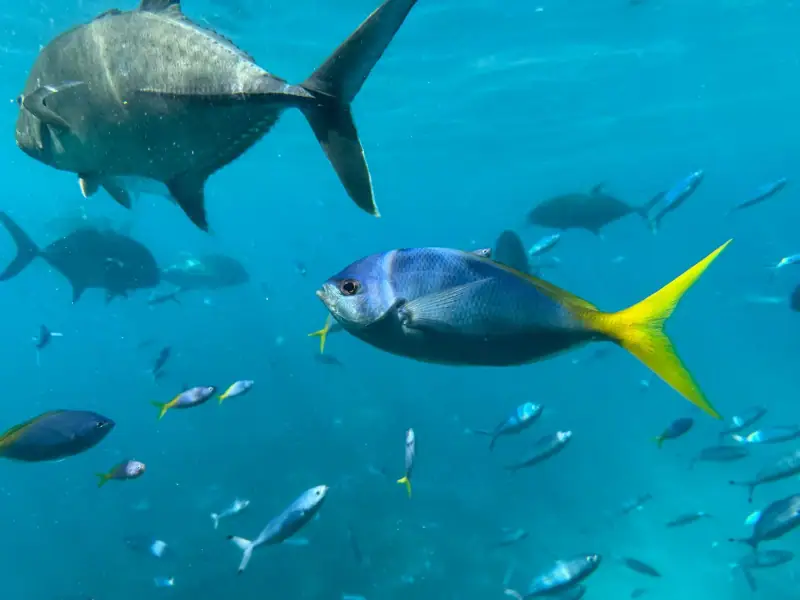
Snorkeling remains the best way to discover teeming marine life. Butterflyfish, parrotfish, clownfish, rays, reef sharks and corals make up a very varied picture, which changes from one site to another with visibility and weather.
A few common-sense points:
- The reef sharks you meet while snorkeling are generally not interested in humans, but you should stay calm and not chase them.
- Some animals are venomous or stinging (stonefish, cone shells, certain jellyfish, sea urchins): look without touching and wear reef shoes.
- Ask your lodging or a club for advice on the day’s currents and swimming areas.
Birds and forest: land biodiversity
Grande Terre also shelters rainforests, mining scrub and dry forests where the flora is exceptional, with a very high proportion of endemic species. As for birds, beyond the kagu, enthusiasts can look for species unique to the archipelago: some imposing pigeons, parakeets or honeyeaters. To identify them, a local guide or a birding app is a big plus.
A few tips for successful watching:
- Start early: birds are more active at dawn and in the late day.
- Stay on the trails: the soils of the Grand Sud are fragile, and some areas are protected.
- Disinfect your shoes if the park requires it: diseases and invasive plants travel easily.
- Never open a bottle or food bag near animals: they get used to humans quickly.
- Follow the rangers’ instructions and information signs.
In the Grand Sud, some sites can be visited in a day from Nouméa. Remember to bring water, mosquito repellent and rain gear: the weather can change quickly.
Sleeping in Nouméa to reach nature
Compare lodging in Nouméa, a practical base for the lagoon, parks and the Grand Sud.
Wildlife tied to Kanak culture
For many Kanak clans, animals are not only species to protect: they have a place in stories, totems and customs. Turtles, sharks, birds and fish can be associated with families, places or prohibitions. This dimension explains why some sites, beaches or fishing practices are subject to customary rules.
In practice, this means you must ask permission before entering customary land or accessing certain beaches, and follow your host’s instructions. To better understand these markers, read our article on Kanak culture.
Organizing a nature stay: days, seasons, logistics
A stay dedicated to wildlife takes a bit more organization than a simple beach stay.
- For whales: aim for July to September and allow some spare days, as weather can cancel a trip. Avoid placing your only trip on the last day.
- For the kagu: combine the Rivière Bleue with a night in the Grand Sud or an early departure from Nouméa. Check the park’s access conditions before you go.
- For turtles: half a day by boat to an islet or a snorkeling session on the Isle of Pines; see our guide what to do on the Isle of Pines.
- For a practical base: Nouméa concentrates flights, rental companies and excursions; see what to do in Nouméa.
For gear, binoculars, reef shoes, UV clothing and a small first-aid kit will serve you several times: our list of accessories for New Caledonia details the essentials.
To reach the Grand Sud parks or the departure points of boat trips, a rental vehicle is the most flexible. Book it early in high season and check the terms for unpaved tracks.
Flights to New Caledonia
Compare flights to Nouméa and choose your dates according to the whale season.
Watching wildlife responsibly: the summary
The same principles apply to all species:
- Distance: the farther you are, the more natural the animal stays. Use the zoom, not your legs.
- Silence: engines off or idling, low voices, no shouting or whistling.
- Zero contact, zero food: do not touch or feed any wild animal.
- Zero trace: take your trash, stay on the trails, pick nothing.
- Reputable operators: registered professionals, boats in good condition, clear safety instructions.
- Local guidance: customary and provincial rules prevail. When in doubt, ask.
A stay in New Caledonia combines nature and culture well: after a few days in the lagoon and the Grand Sud, you can complete your itinerary with our 10-day route, which leaves room for nature outings.
Finally, think about health and repatriation cover before an active stay at sea or in the forest: travel insurance is a useful habit, and ask your doctor or a travel clinic about health precautions.
Frequently asked questions
When can you see humpback whales in New Caledonia?
Humpback whales come to breed and give birth in New Caledonian waters during the austral winter. Watching trips are concentrated mostly from July to September, and the official season can extend later depending on the year. Ask an approved operator for the dates of the year.
Can you swim with whales?
No, not freely. The local code of conduct sets approach distances (around 100 m / 330 ft for boats and more for divers) and forbids approaching a whale with its calf. Choose an operator that respects these rules and expect no promise of contact.
Where can you see the kagu, the country's emblem bird?
The kagu cannot fly and lives only in New Caledonia. The two most reliable places to see it are Rivière Bleue Provincial Park, in the Grand Sud, and the Nouméa zoological and forest park. In the wild, it stays shy: be patient, quiet and keep your distance.
Where can you see sea turtles in the lagoon?
Several species visit the lagoon, including the green turtle. They are watched while snorkeling at various sites, such as around the islets near Nouméa. No encounter is guaranteed: do not touch, chase or feed them.
Are dugongs easy to see?
No. The dugong is discreet and lives mostly in the lagoons of Grande Terre's West Coast. It is not the subject of standard excursions: if you come across one, keep your distance, cut the engine if you are on a boat and do not try to follow it.
Do you need a guide to watch wildlife?
For whales, a boat trip with a professional operator is the only reasonable option. For birds and forest, a local guide greatly increases your chances and helps you understand what you see, but the marked trails of the provincial parks can also be done alone.
More New Caledonia guides
Keep reading
Diving and Snorkeling in New Caledonia: Where to Get in the Water
Snorkeling at Canard Islet, turtles at Amédée Islet, Oro's natural pool, the Loyalty Islands: tips for exploring the New Caledonian lagoon.
Rivière Bleue Park: Hiking, Kauri Trees and Kagus in the Grand Sud
Rivière Bleue Park: getting there from Nouméa, trails, the giant kauri, kagus, swimming and tips for a nature day in New Caledonia's Grand Sud.
Is Hienghène Worth the Detour? Poule Couveuse, Lindéralique and Tao Falls
Is Hienghène worth the detour? Poule couveuse, Lindéralique, Tao Falls, Ouaïème ferry, getting there from Nouméa, where to sleep and how long to stay.
Ready-made
New Caledonia itineraries
10 days
New Caledonia in 10 Days: An Itinerary Through Nouméa, the Bush and the Islands
A 10-day New Caledonia itinerary: Nouméa, Grand Sud, West Coast, Hienghène, then the Isle of Pines or Lifou, with pacing and budget tips.
7 days
New Caledonia in 7 Days Without a Car: A Realistic Itinerary
NouméaIsle of Pines
3 days
New Caledonia's Grand Sud in 3 Days: Yaté, Rivière Bleue and Port-Boisé
3-day Grand Sud itinerary from Nouméa: Rivière Bleue, Yaté Lake, Madeleine Falls, Port-Boisé, with practical tips.