What to see
What to see in the Jura's Revermont: villages, reculées and vineyards
We may earn a commission when you book through links on this page, at no extra cost to you. We don't visit or try the places we cover: we summarize published sources. How we work
In short
- The Revermont is the western edge of the Jura range, facing the Bresse plain, from Salins-les-Bains and Arbois in the north to south of Lons-le-Saunier.
- Two days cover the essentials: Poligny, Arbois and the vineyards one day; Château-Chalon, Baume-les-Messieurs and Lons-le-Saunier the next. A third day adds Arlay and walks.
- Château-Chalon is a hilltop village of about 150 residents; its AOC covers about 50 hectares (125 acres) and is reserved for vin jaune.
- A car is the simplest way to link the villages; public transport is limited outside the main towns. Call ahead before visiting a cellar.
When you arrive in the Jura from the west, the first thing you see is a long line of wooded slopes overlooking the Bresse plain. This is the Revermont: the western edge of the range, the first step before the plateaus and the mountains. Yet this narrow fringe concentrates much of what makes the department charming: vines clinging to the slopes, stone villages nestled at the foot of cliffs, spectacular reculées and cellars where wheels of Comté ripen.
This guide helps you understand the area, pick the stops that matter and link them without rushing. It complements our guide to the Jura wine route, focused on tasting, and the one on the lake district, on the other side of the department.
What exactly is the Revermont?
The name “Revermont” refers to the rim of the Jura that looks toward the Bresse. Geologically, it is a succession of limestone folds and faults forming a line of relief whose crest is often around 550 m (1,805 ft) above sea level on the Bresse side. The Revermont also continues beyond the Jura, into the neighboring Ain department, where it is one of the emblematic landscapes.
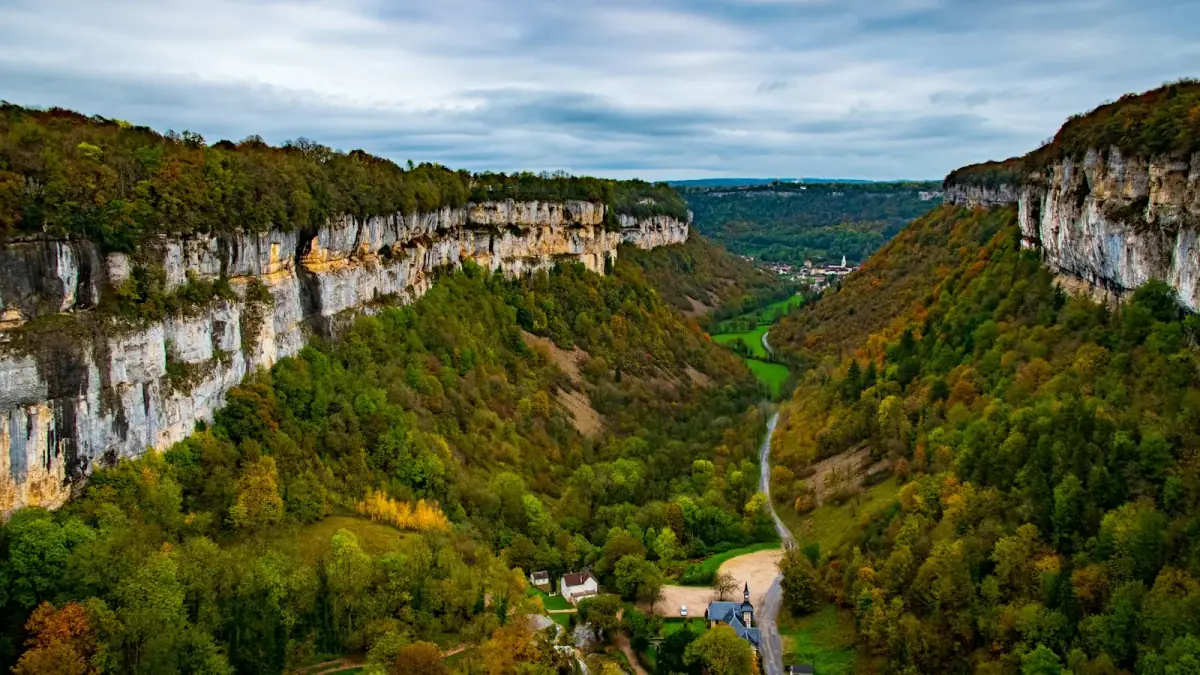
On the Jura side, it is linked to the broad ribbon running from Salins-les-Bains and Arbois in the north to south of Lons-le-Saunier, then toward Saint-Amour. It is also the home of the Jura vineyards, whose figurehead is vin jaune. The relief is cut by reculées, the dead-end valleys closed by cliffs that are typical of the Jura: they offer dramatic landscapes and hold waterfalls, caves and villages.
Why visit?
- Varied landscapes over short distances: vines, forests, cliffs, villages, the plain below.
- A rich historical heritage: abbeys, collegiate churches, castles, winegrowers’ houses.
- A standout cuisine: wines, Comté, local specialties.
- An ideal setting for slow travelers, who prefer wandering from village to village rather than ticking off big sights.
Poligny, the capital of Comté
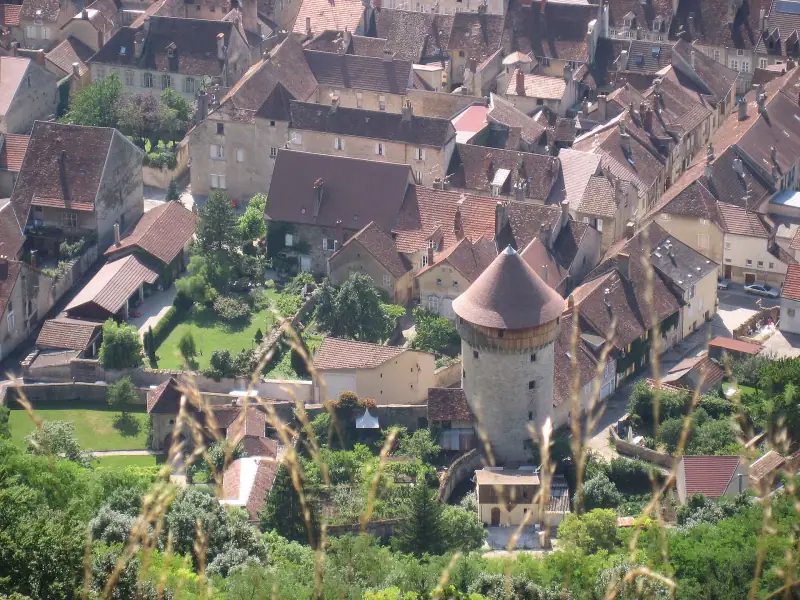
Poligny is the first major stop in the Revermont if you come from the north. This small town, about ten kilometers (6 mi) from Arbois and about twenty kilometers (12 mi) as the crow flies from Lons-le-Saunier, likes to present itself as the capital of Comté. It is home to many aging cellars holding about 200,000 wheels, as well as a national dairy industry school.
What to see in Poligny
The town has about fifteen buildings protected as historic monuments. Among the essentials:
- The Saint-Hippolyte collegiate church, which overlooks the old center and is worth a visit for its Gothic architecture.
- The remains of the Château de Grimont, a former fortress of which the Sergenterie tower and the Saint-Laurent keep survive.
- The Charcigny winegrowers’ quarter, with quiet lanes, bordered by the first vines.
- The Maison du Comté, an interpretive center that explains how the cheese is made, from milking to aging, and offers tastings.
To go deeper into the food side, our guide to the gastronomic specialties of the Jura details Comté, Morbier, Morteau sausage and the other local products to taste.
Where to stay in the Revermont
Compare hotels, guesthouses and gîtes in Poligny and the neighboring villages.
Arbois and Salins-les-Bains: the north of the Revermont
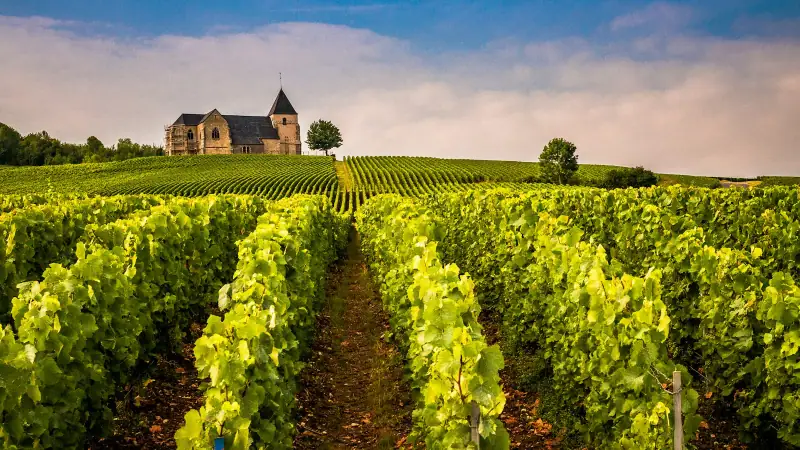
North of Poligny, two towns complete the picture. Arbois is the historic capital of Jura wine, crossed by the Cuisance, with its bulbous bell tower, old houses and cellars. It is a practical base for day trips: our guide to visiting Arbois details the museums, tasting addresses and walks to do on foot.
Salins-les-Bains, a little further north-east, is a town tied to salt, whose industrial history has marked its landscape and heritage. To plan your stop, see our article on visiting Salins-les-Bains.
These two towns form, with Poligny, a very accessible triangle: in a few minutes of driving, you go from one world to another, from wine to salt to cheese. It is ideal for a first day in the Revermont.
Château-Chalon, the hilltop village of vin jaune

If you could see only one village in the Revermont, it would undoubtedly be Château-Chalon. Perched on a promontory overlooking the Baume-les-Messieurs reculée, it is listed among the Most Beautiful Villages of France and also holds the “Cité de Caractère” label of Bourgogne-Franche-Comté. Its municipality spans pronounced relief, from about 250 m (820 ft) to over 560 m (1,835 ft), and has only about 150 residents: calm is guaranteed out of season.
An abbey at the origin of the village
The village grew up around an abbey founded in the medieval period, first Benedictine, then occupied by canonesses. Remains survive, as does the Saint-Pierre church, a Romanesque building listed as a historic monument. Of the fortified castle that gave the village its name, only a few pieces of ramparts and keep remain.
Viewpoints and museum
The village is lined with viewpoints that offer panoramas over the reculée and the vineyards. The Saint-Jean viewpoint looks onto the remains of the abbey at the cliff edge. The Rochette viewpoint houses the Musée de l’École d’Autrefois (old-time school museum), a pleasant visit with kids. Allow one to two hours to wander the lanes, pause at the viewpoints and, if you feel like it, push open a winemaker’s door.
The Château-Chalon appellation
The Château-Chalon AOC is reserved exclusively for vin jaune, made from the savagnin grape alone. It covers about 50 hectares (125 acres) spread across four municipalities: Château-Chalon, Domblans, Menétru-le-Vignoble and Nevy-sur-Seille. It is one of the smallest appellations in France, which adds to its rarity. To learn everything about this wine and its Jura cousins, see our article on the wine route.
Baume-les-Messieurs, the reculée and the abbey
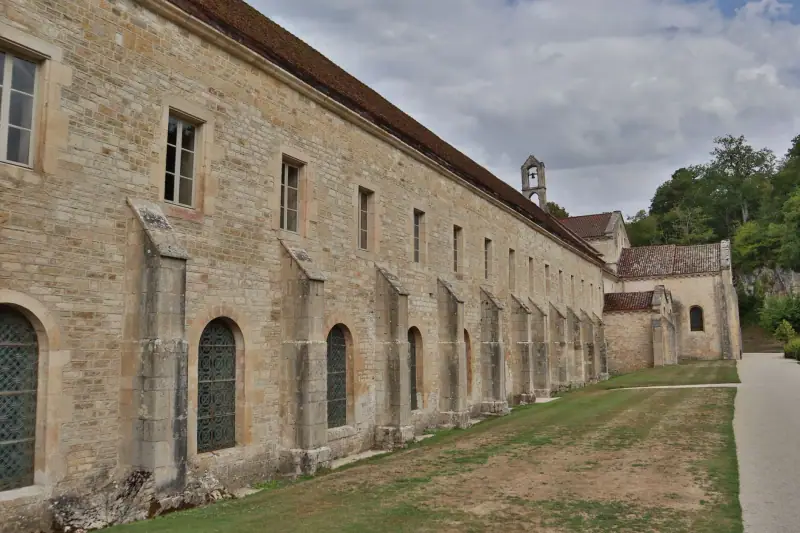
About twenty minutes by road from Château-Chalon, Baume-les-Messieurs is the other major site of the Revermont. The village lies at the bottom of a reculée, a cirque surrounded by cliffs about a hundred meters (330 ft) high. The reculée divides into three valleys: those of the Dard and the Seille, and the Mardasson vale. The site is part of a Natura 2000 zone devoted to the reculées of the Haute Seille.
Saint-Pierre Abbey
The abbey, of medieval origin (11th century), has been partly listed as a historic monument since 1862. Tradition says Bernon left Baume in 910 to found Cluny Abbey, which makes Baume a Cluniac site. The village itself carries the Most Beautiful Villages of France label. It takes a slight detour to visit, but it leaves a lasting memory.
Tufa waterfall and cave
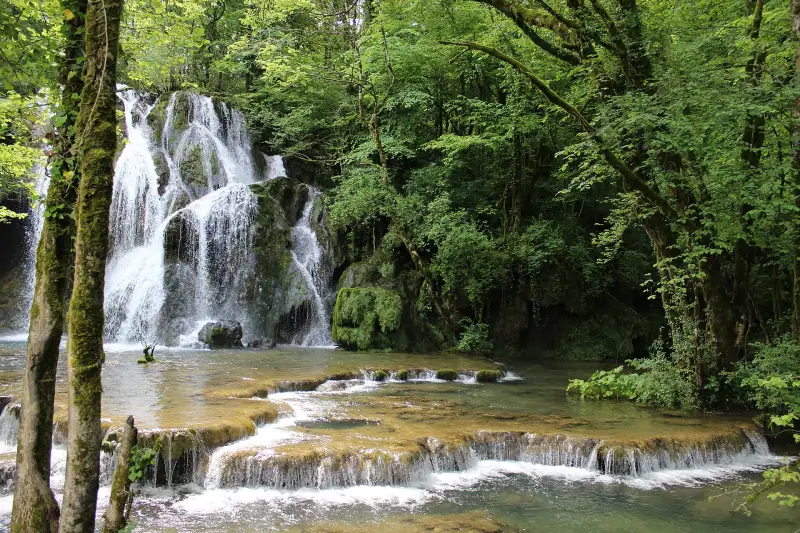
The Dard waterfall, also called the tufa waterfall, owes its particular shape to the precipitation of limestone, in which plants also play a part. The landscape of moss, water and stone is one of the most photogenic in the Jura. A cave that can be visited also opens in the cliff and has several chambers. Check hours and the opening period on the tourist office website before you come, as they vary by season.
If you like walking, the reculée viewpoints offer fine views, and our article on hikes, waterfalls and lakes in the Jura will give you more outing ideas.
Rent a car for the Revermont
The hilltop villages are scattered: compare rental companies to get around at your own pace.
Lons-le-Saunier and the south of the Revermont
Lons-le-Saunier, the prefecture of the Jura, is the southern gateway to the Revermont. A quiet spa town, it is a practical base for day trips to Château-Chalon and Baume-les-Messieurs. Our guide to visiting Lons-le-Saunier details its arcades, museums and addresses.
Further south, the Revermont continues toward Saint-Amour, then into the Ain. The upper Suran area, the Suran valley, is the wildest and least visited face of the Jura’s Revermont. Reculées such as those of Gizia or Montagna-le-Reconduit punctuate the line of relief. Travelers who have already seen the best-known sites will find a rural, peaceful landscape there, far from the crowds.
Château d’Arlay, a medieval detour
Located on the edge of the Jura part of the Bresse, the Château d’Arlay is a medieval castle that can be visited. It is an interesting stop if you like old stones and estates with a long history. Since visiting conditions (periods, prices, guided or self-guided visits) vary from year to year, check the castle’s official website or the tourist office before you go.
This detour fits easily between Lons-le-Saunier and Poligny: it adds a historical dimension to a route mostly centered on wine, landscape and cheese.
Recommended itineraries in the Revermont
In 1 day: the essentials
Start in Poligny in the morning (old center, collegiate church, Maison du Comté), then go to Arbois for lunch and a tasting. In the afternoon, you can head up to Château-Chalon for the viewpoints before sunset. It is a brisk pace, but distances remain short.
In 2 days: the most balanced
On the first day, focus on the north: Salins-les-Bains or Arbois, then Poligny. On the second day, go to Château-Chalon, drop down to Baume-les-Messieurs, then finish in Lons-le-Saunier. This split avoids backtracking and leaves time for breaks. For a longer stay mixing several areas, see our 3-day itinerary in the Jura.
In 3 days: without rushing
Add Arlay, a walk through the vines around Passenans or Pupillin, a longer cellar visit or a day of walking in a reculée. You can also slip in a day in the upper Suran for a more rural approach.
Tastings and guided visits
Discover the activities and excursions offered in the Jura, to book in advance.
When to visit the Revermont
The Revermont can be visited all year, but each season has its own face. In spring, the vines turn green again and the Baume-les-Messieurs waterfalls are generally well fed. Summer is the liveliest period, with open terraces and long days. Autumn, with the grape harvest and colorful foliage, is a choice season for landscapes, even though winemakers are very busy then. Winter is quieter and remains good for cellars and tastings. To refine your choice, see our article on when to go to the Jura.
Getting around and where to stay in the Revermont
A car is the simplest way to link the villages, especially as public transport is limited outside the main towns. If you travel without a vehicle, use Arbois, Poligny or Lons-le-Saunier as bases and plan on a bike for short trips. Our article on how to get around the Jura details the options.
For accommodation, Poligny, Arbois and Lons-le-Saunier offer the most choice. Villages like Château-Chalon mostly have guesthouses and gîtes, often full in high season: book early. To compare areas, see our guide where to stay in the Jura.
Practical tips
- Call before visiting a cellar: many winemakers receive visitors by appointment.
- Check opening hours of museums, caves and castles, which vary by season.
- Bring suitable shoes for the viewpoints and reculée trails.
- Do not drive after a tasting: appoint a driver or alternate visits.
- Bring a small cooler to take cheeses and bottles home in good condition.
What to bring back from the Revermont
The Revermont is excellent ground for food shopping. Think of a piece of Comté bought at a fruitière or aging cellar, a bottle of vin jaune or poulsard, a Jura crémant or some macvin. Small producers often sell directly at the property, which lets you talk with the people who make the product. Ask for advice on pairings: a winemaker will know how to steer you to the bottle that goes best with your cheese.
Summary
The Revermont is the most accessible and richest face of the Jura: in two or three days, you go from the cellars of Poligny to the viewpoints of Château-Chalon, from the Baume-les-Messieurs reculée to the streets of Arbois or Lons-le-Saunier. Rent a car, book your tastings, keep time to wander, and the Revermont will repay you generously.
Frequently asked questions
Where is the Revermont in the Jura?
The Revermont is the western edge of the Jura range, facing the Bresse plain. In the Jura department it runs from the Salins-les-Bains and Arbois area in the north to south of Lons-le-Saunier, passing through Poligny, then continues toward Saint-Amour and the Ain.
How long do you need to visit the Revermont?
Two days let you see the essentials: one day for Poligny, Arbois and the vineyards, another for Château-Chalon, Baume-les-Messieurs and Lons-le-Saunier. With a third day, you add Arlay and a few walks.
What should you see first in the Revermont?
Château-Chalon (a village listed among the Most Beautiful Villages of France), Baume-les-Messieurs and its reculée, Poligny and its Comté aging cellars, Arbois for wine, and the Château d'Arlay for a medieval detour.
Can you visit the Revermont without a car?
It is possible but restrictive. The main towns (Arbois, Poligny, Lons-le-Saunier) are anchor points, but hilltop villages like Château-Chalon or Baume-les-Messieurs are much easier to visit by car or bike. Check train and bus timetables before you go.
What is the best time to visit the Revermont?
Spring and early autumn are ideal: vines in leaf or in autumn colors, mild temperatures and moderate crowds. Summer is lively but pleasant, while winter is quiet and good for cellar tastings.
Is the Revermont suitable for families?
Yes. Short walks to viewpoints, the tufa waterfall at Baume-les-Messieurs, a visit to a cave or a castle and discovering Comté in Poligny suit children. Bring closed-toe shoes for the reculée trails, which can be damp.
More Jura guides
Keep reading
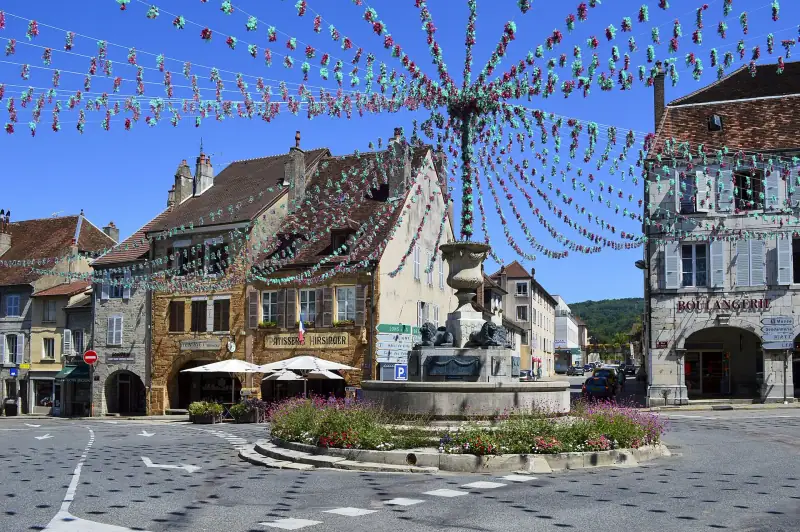
Visiting Arbois: what to do in the capital of Jura wine country
What to see and do in Arbois: Pasteur's house, vineyards, vin jaune, the Planches reculée and Pupillin. A guide to planning your visit in the Jura.
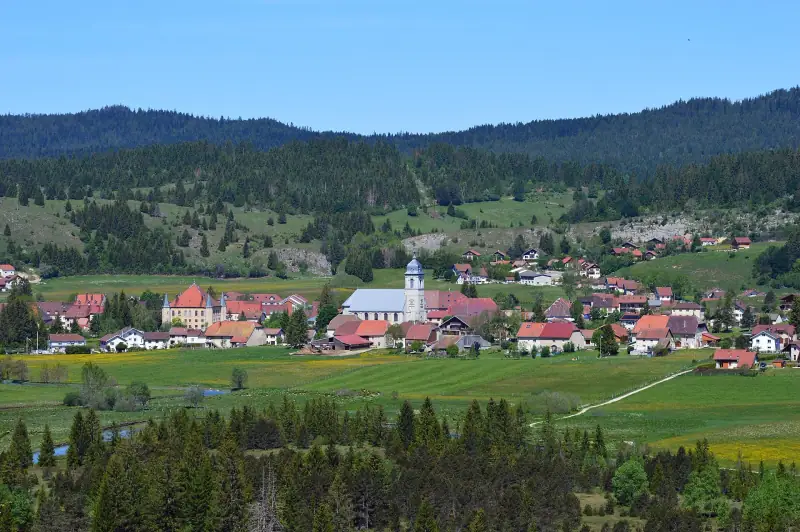
What to see in the Doubs next to the Jura: Pontarlier, Mouthe and the Haut-Doubs
What to see in the Doubs next to the Jura: Pontarlier, Fort de Joux, the source of the Doubs at Mouthe, Lake Saint-Point and Métabief.
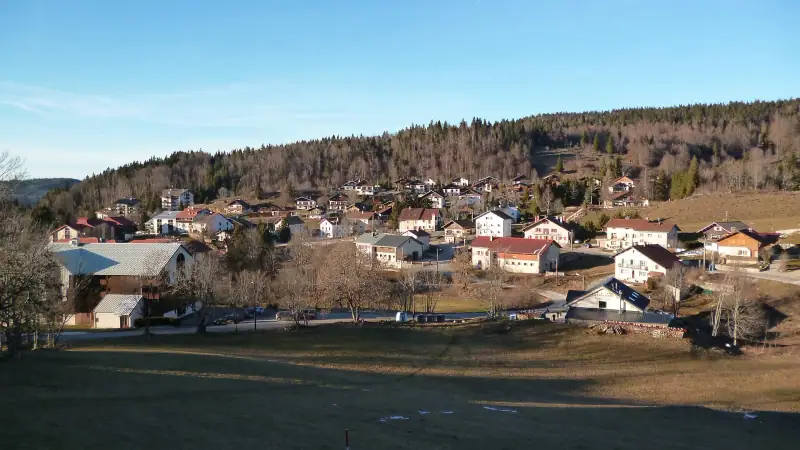
Visiting Les Rousses: what to see and do in the High Jura
What to see and do in Les Rousses: fort, lake, La Dôle, Espace des Mondes polaires, Comté and cross-country skiing. A guide to the High Jura resort.
Ready-made
Jura itineraries
3 days
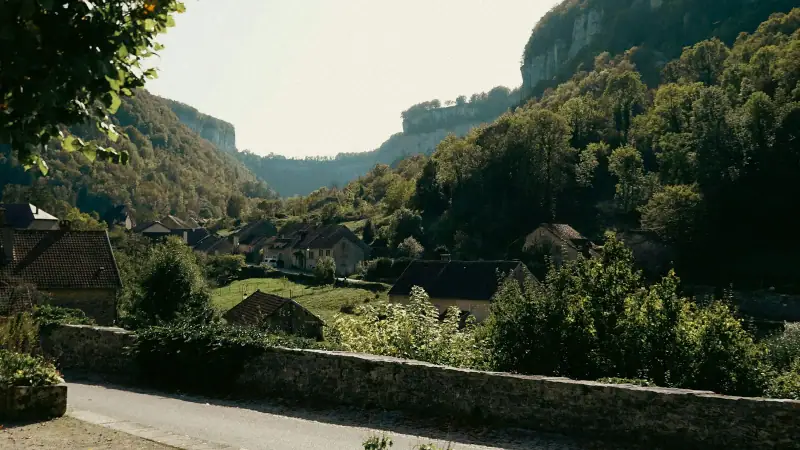
The Jura in 3 days without a car: a realistic itinerary by train, on foot and by bike
Visiting the Jura in 3 days without a car: a base in Arbois, trains from Mouchard, Salins-les-Bains, Lons-le-Saunier. Stages, distances, times and limits.
3 days
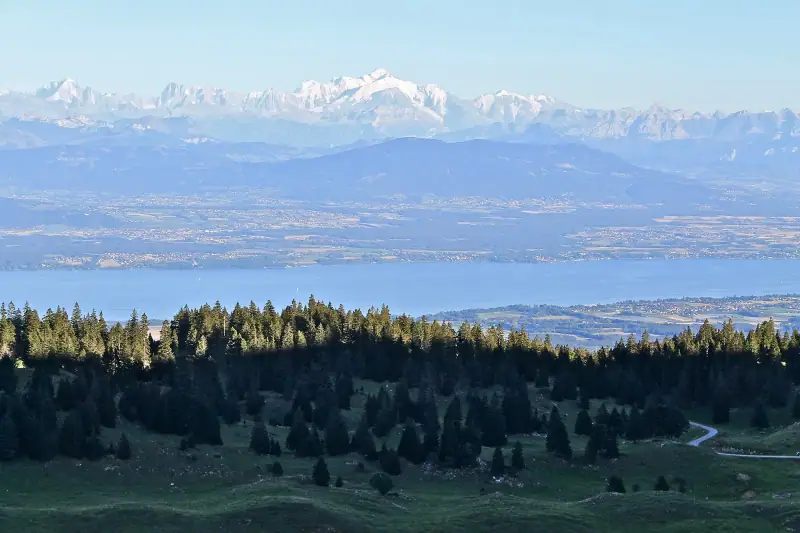
3 days in the Jura: a day-by-day itinerary through vineyards, waterfalls and the High Jura
A 3-day Jura itinerary by car: Arbois and the vineyards, Baume reculée, Hérisson waterfalls, lakes and the High Jura. Detailed plan and tips.
4 days
The Jura with kids: a 4-day family itinerary through waterfalls, lakes and caves
A 4-day Jura itinerary with children: Hérisson waterfalls, lake swimming, Baume reculée and the High Jura. Pace, tips and practical advice.