What to see
What to see in the Jura lake district: lakes, waterfalls and villages
We may earn a commission when you book through links on this page, at no extra cost to you. We don't visit or try the places we cover: we summarize published sources. How we work
In short
- The lake district covers the Jura plateaus east of Lons-le-Saunier and north of Saint-Claude; Lake Vouglans on the Ain marks its southern edge.
- Two days cover the essentials: one for the Hérisson valley and its waterfalls (about thirty), one for the lakes and beaches. Three or four days add Vouglans and viewpoints.
- Lake Chalain is the largest natural lake in the department; Vouglans stretches about 35 km (22 mi). Most viewpoints are a 20 to 45 minute walk.
- A car is the most practical way to get around; sites are scattered and public transport is limited. Book early for July and August.
When people talk about the Jura, they think first of vin jaune, Comté and fir trees. They often forget that the range holds one of the finest concentrations of lakes in France. Between the wooded plateaus and the first ridges of the High Jura, a series of glacial lakes, rivers and waterfalls draws a landscape of water and forest that changes at every bend. This is what is called the lake district.
This guide answers the question every traveler asks: what is there to see in the Jura lake district? We review the big lakes, the valley of waterfalls, the villages, the viewpoints and the best places for a break, then suggest ways to combine these sites depending on the length of your stay. For walking in detail, our guide to hikes, waterfalls and lakes in the Jura is a useful companion to this article.
Understanding the lake district before you go
The lake district is not an area with strict administrative borders, but a tourist name for the part of the range where bodies of water multiply. It stretches east of Lons-le-Saunier and north of Saint-Claude, over stepped plateaus where forests, grazing meadows and small villages alternate.
A landscape shaped by glaciers
The Jura lakes owe their existence to the glaciers of the Quaternary. As they retreated, they left depressions, moraines and natural dams that held back water. That is why the lakes of the area are often framed by small wooded hills and gently sloping shores, which are good for swimming.
The main groups of sites to see
To find your way, you can sort the points of interest into four groups:
- The big swimming lakes: Chalain and Clairvaux-les-Lacs, with beaches and leisure centers.
- The big artificial lake: Vouglans, on the Ain, with turquoise water and indented shores.
- The Hérisson valley: a river and its waterfalls, in the heart of a fir and beech forest.
- Small lakes and viewpoints: quieter bodies of water, views over the plateaus and villages with character.
Each group has a different feel. Combining them over a stay of two to four days gives a true picture of the Jura of the waters.
Lake Chalain: the largest natural lake in the Jura
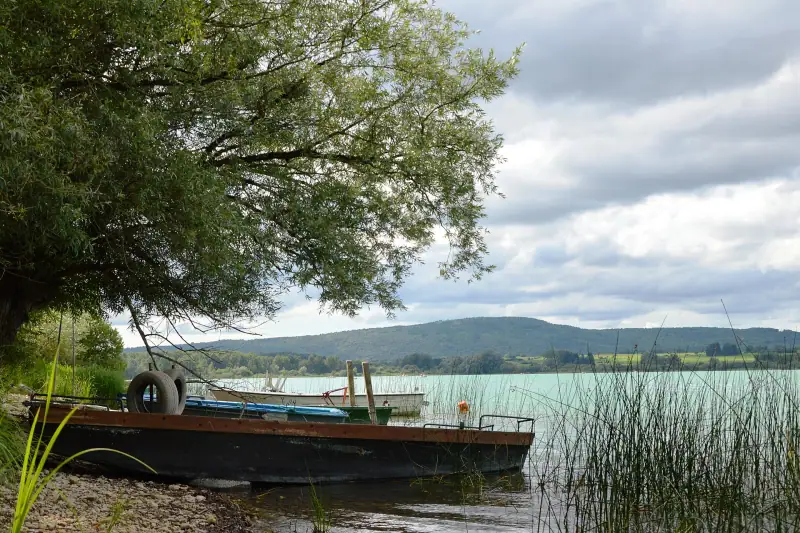
If you could see only one lake, it would probably be this one. According to the Jura tourist office, Lake Chalain is the largest natural lake in the department. It is set in a ring of wooded hills near Doucier, and offers sand and pebble beaches, swimming areas and marked trails along its shores.
Why go
Chalain has everything you expect from a mountain lake: deep blue water, a family atmosphere in summer and an almost silent mood out of season. Boats with combustion engines are banned, which preserves the calm and the quality of the site. You can swim, paddleboard, canoe or pedal boat depending on the rental companies present in season.
Visiting tips
- Arrive early in July and August: the car parks fill quickly and the beaches get crowded by late morning.
- Check the water temperature before jumping in: even in summer, the water stays cooler than that of a lowland lake.
- Walk around it: a path runs along part of the shore and lets you enjoy the viewpoints without crowds.
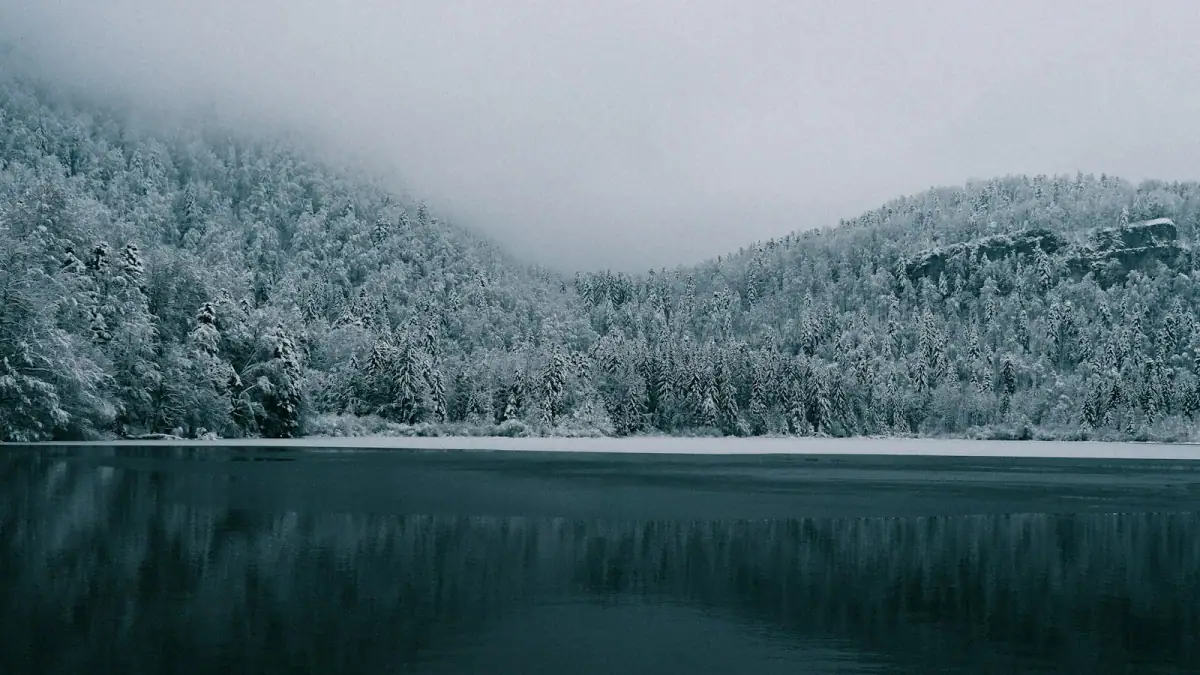
- Out of season, favor a morning walk: mist over the water creates very photogenic scenes.
To sleep nearby, see our guide where to stay in the Jura, which details the areas and types of accommodation.
Where to stay near the Jura lakes
Compare hotels, gîtes and guesthouses in the Jura and unpack your bags by the water.
Clairvaux-les-Lacs: a lakeside resort
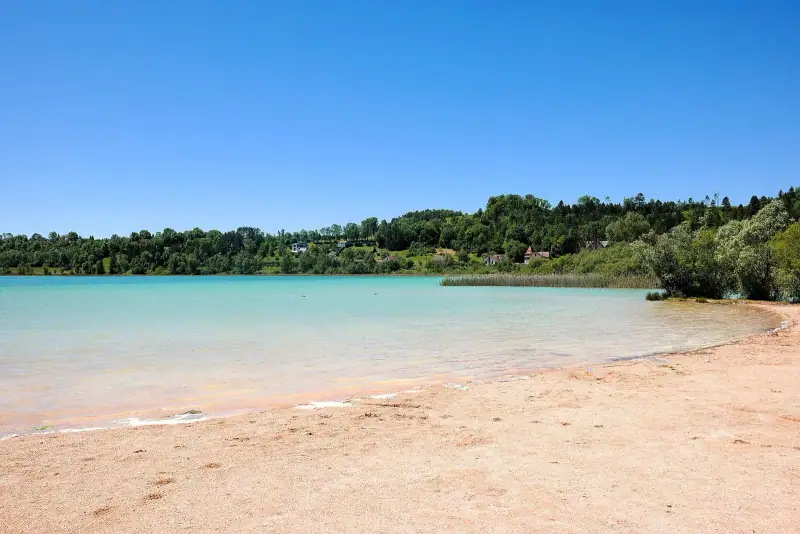
A short distance from Chalain, Clairvaux-les-Lacs is the most practical village for a lake-focused stay without constantly needing a car. It sits between two bodies of water, including the Grand Lac, which local sources describe as shallow and pleasant for swimming, with water that warms up quickly in summer. The village beach has been awarded the Blue Flag label.
What to do in Clairvaux
- Swim and laze on the developed beach, with the feel of a small family resort.
- Walk or cycle around the lake: the easy loops take one to two hours.
- Climb to the Scie viewpoint, which gives an overview of the lake and the village rooftops. Hiking and mountain biking routes lead there.
- Stroll through the village, which concentrates shops, restaurants and services, a rare asset in the area.
Clairvaux also serves as a base for the Hérisson valley or Lons-le-Saunier, covered in detail in our article on visiting Lons-le-Saunier.
The Hérisson valley and its waterfalls
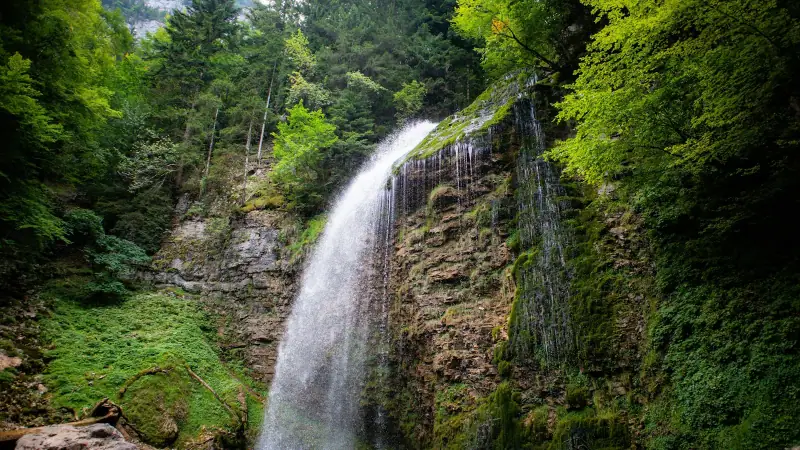
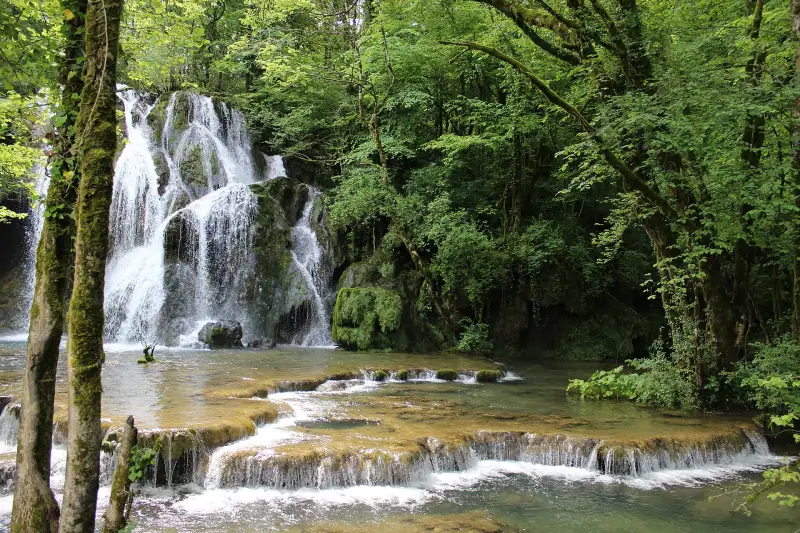
This is the most visited natural site in the area, and for good reason. The Hérisson river tumbles down a forested valley through a succession of falls. There are about thirty waterfalls in all, from small discreet falls to the largest, such as the Grand Saut, often cited among the most impressive.
A trail for every level
The main trail follows the river and links stairs, footbridges and viewpoints. The first waterfalls can be reached quickly from the car parks, which allows a short visit. More experienced walkers extend the route upstream to see more falls and enjoy more quiet.
Visiting tips
- Shoes with good grip: wet rocks and steps are slippery all year.
- Spring and snowmelt: the flow is at its maximum and the sight is more powerful.
- Summer: the coolness of the forest is welcome, but the site is busy during the day.
- Winter: some parts may be frozen, slippery or closed for safety. Check before you go.
The waterfalls combine easily with a lake on the same day: the valley in the morning, a swim or a walk along the shore in the afternoon. Route details are in our guide to Jura hikes.
Lake Vouglans: the big turquoise lake
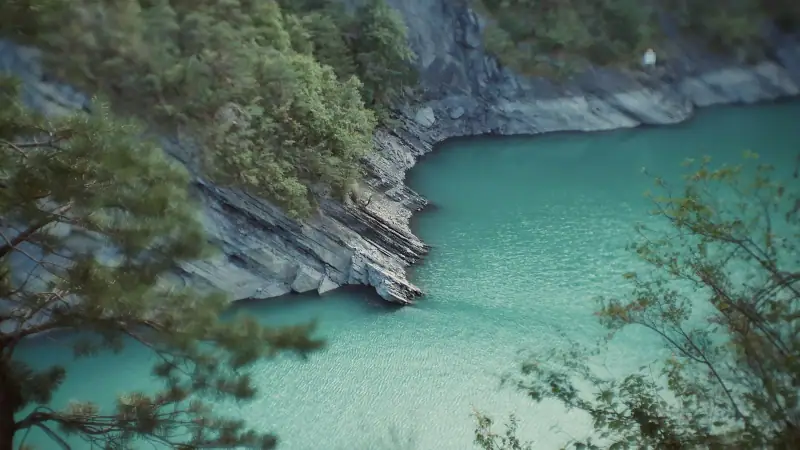
Further south, Lake Vouglans is on a completely different scale. It is a reservoir on the Ain, created by the construction of a dam completed in the late 1960s. It stretches for about 35 kilometers (22 mi) and is among the largest artificial lakes in France, often ranked third.
What makes it special
Its intense blue-green water, its shores cut into bays and its forest cover give it the look of a discreet fjord. Building the dam submerged several villages and a former monastic site, which adds a historical dimension to the landscape.
What to do at Vouglans
- Swim at the developed beaches in summer.
- Try water sports: paddleboarding, canoeing, boating depending on seasonal rental companies.
- Reach a viewpoint: the Lect viewpoint, in the Haut-Jura Regional Natural Park, looks over the lake and the dam.
- Walk the trails: a long route circles the lake, but it is easily split into half-day sections.
Visiting Vouglans means winding roads, especially if you combine it with the other sites. To compare ways of getting around, read our guide to getting around the Jura.
Rent a car to travel between the lakes
The sites are scattered: compare rental companies to link lakes and waterfalls at your own pace.
Small lakes and quiet corners
Beyond the big names, the area has a string of small bodies of water, often surrounded by forests or meadows. Some are discovered around a bend in the road, others at the end of a short trail. You find calm fishing spots, tree reflections in still water and very few people, even in summer.
How to choose them
Do not try to see everything. Pick one or two small lakes near your accommodation, check access and rules (swimming, dogs, parking) at the tourist office, then enjoy a break with no program. These lakes are perfect for a picnic or reading by the water.
Respecting the places
Many of these sites are fragile environments. Stay on the paths, take your trash with you, avoid noise and keep dogs on a leash. Rules vary from site to site: if in doubt, ask locally.
Villages and heritage not to miss
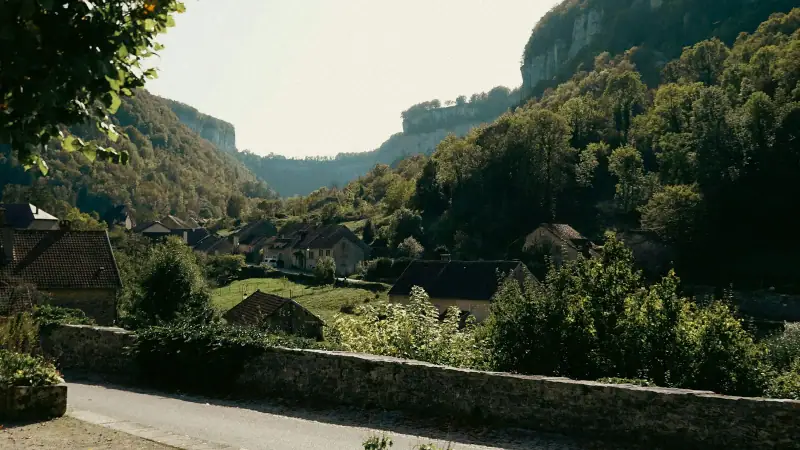
The lake district is not only about water. The villages, often built around a church, a fruitière and stone houses, tell the story of rural life in the range.
Comté culture
Fruitières, traditional dairy cooperatives, dot the roads of the area. Several sell Comté and local products, sometimes with visits or tastings. It is a chance to taste a cheese aged in a cellar and understand the link between meadows, cows and landscape. Our article on the gastronomic specialties of the Jura details what to taste.
Stopover towns
To round out your stay, two nearby towns offer an urban counterpoint: Lons-le-Saunier, to the west, and Saint-Claude, to the south-east, the historic capital of pipes and diamonds. Each can be visited in half a day to a day.
Viewpoints: seeing the area from above
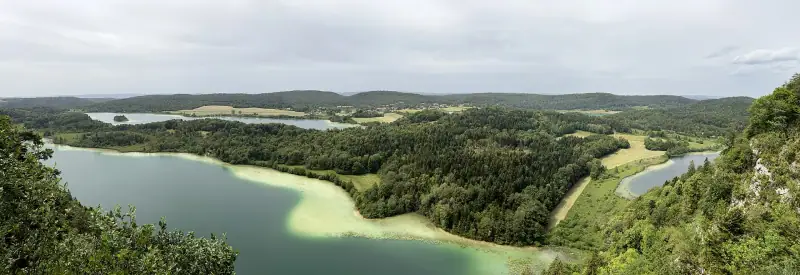
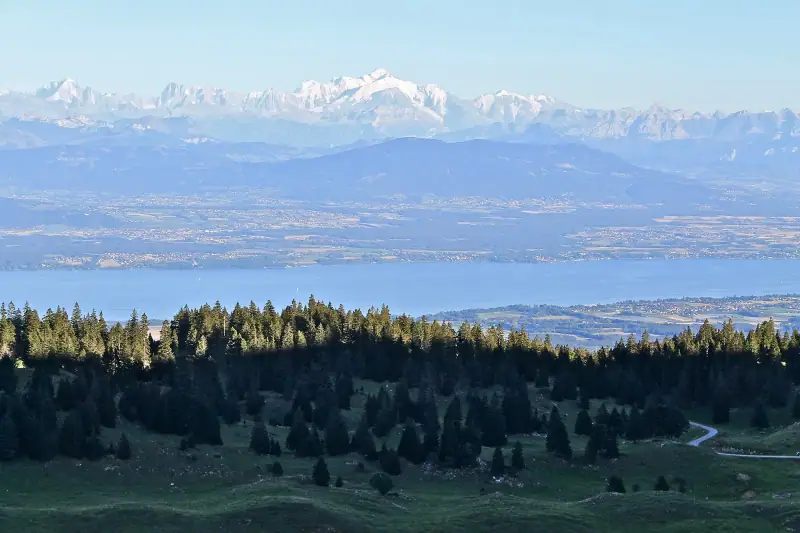
To understand the geography of the lakes, nothing beats a viewpoint. Several let you take in the landscape: the Scie viewpoint above Clairvaux, those overlooking Vouglans, and others on the edges of the plateaus.
When to go
- Early morning: soft light, fewer people, sometimes mist in the hollows.
- Late afternoon: warm light on the forests, ideal for photos.
- After rain: the air is clear and the colors more intense.
Most viewpoints are reached in 20 to 45 minutes of walking, making them accessible to almost everyone. Bring water and a jacket, as the weather can change quickly.
What activities to do in the lake district
The lake district is a varied playground, whether you want calm or energy.
- Swimming: the summer activity par excellence, at the developed beaches of Chalain, Clairvaux or Vouglans.
- Hiking: from easy walks around the lakes to longer forest routes.
- Cycling and mountain biking: quiet roads and forest tracks, with rolling terrain.
- Water sports: paddleboarding, canoeing, pedal boats depending on the sites and seasons.
- Fishing: several lakes and rivers are suitable for fishing, subject to a permit and compliance with regulations.
- Winter: snowshoeing and cross-country skiing on the plateaus, with calm landscapes under the snow.
To round out your program with guided visits or excursions, you can compare activities to book in advance.
Excursions and activities in the Jura
Guided visits, tastings and nature outings to book in advance.
When to visit the lake district
The right time depends on what you are looking for. Our article on when to go to the Jura details the seasons, but here is the essential for the lakes.
- June to September: swimming, water activities and long evenings. It is also the busiest period, especially in July and August.
- May and October: green or colorful landscapes, mild temperatures, quiet sites. The water is too cold for most swimmers, but the walks are superb.
- Spring: waterfalls at their peak thanks to the snowmelt.
- Winter: hushed atmosphere, snowshoeing and cross-country skiing. Some seasonal facilities are closed.
How to organize your stay: three itinerary ideas
A two-day weekend
- Day 1: the Hérisson valley in the morning, then a lake in the afternoon (Chalain or Clairvaux) for swimming or the shore.
- Day 2: Clairvaux-les-Lacs and the Scie viewpoint, then a fruitière to taste Comté before leaving.
A four-day stay
- Day 1: arrival, settling in and a walk around the shore of a first lake.
- Day 2: Hérisson valley, with a picnic lunch.
- Day 3: Lake Vouglans and a viewpoint, swimming or a water sport.
- Day 4: a stopover town, Lons-le-Saunier or Saint-Claude, depending on your route back.
With kids
Favor gently sloping beaches, the short trails of the Hérisson valley and accommodation near a lake. See also our four-day family itinerary for a complete program.
Getting to the lake district
A car remains the simplest option. The sites are scattered, the car parks are right next to the lakes and trailheads, and public transport is limited outside the main towns. Expect short but winding drives between sites: generally allow 20 to 45 minutes from one lake to the next. Check your routes before leaving, as mountain roads can be slower than expected, especially in high season and in winter.
Without a car, it is possible to stay in a village like Clairvaux-les-Lacs and explore on foot or by bike. Our itinerary the Jura in 3 days without a car offers ideas for doing so.
Budget and practical tips
The lake district remains affordable. Access to the lakes and trails is generally free, although some beaches or leisure centers may charge in season. The main expenses are accommodation, the car and meals. For figures, our article budget for the Jura gives you an idea of the ranges.
- Book early in July and August, as accommodation near the lakes fills up quickly.
- Keep a swimsuit and towel in the car: a chance to swim often comes up unexpectedly.
- Check the weather: it changes quickly in the mid-mountains.
- Carry cash or a card for small shops and car parks.
- Respect nature: no fires, no litter, stay on the paths.
Summary
The Jura lake district appeals through its variety: a large natural lake at Chalain, a family resort at Clairvaux-les-Lacs, the turquoise Lake Vouglans, the Hérisson valley and its waterfalls, not to mention the villages, fruitières and viewpoints. Two days are enough for a first look, four to savor it. Choose the season to suit your wishes, take a car if possible, and give yourself time to wander by the water.
Frequently asked questions
Where is the lake district in the Jura?
It covers the first and second plateaus of the Jura, east of Lons-le-Saunier and north of Saint-Claude. Clairvaux-les-Lacs, Doucier, Le Frasnois and the shores of Lake Chalain are the best-known landmarks. Lake Vouglans, on the Ain, marks its southern edge.
How long do you need to see the lake district?
Two days let you see the essentials: one day for the Hérisson valley and its waterfalls, another for the lakes and their beaches. With three or four days, you add Vouglans, the viewpoints and the villages without rushing.
Can you swim in the Jura lakes?
Yes, several lakes are set up for swimming in summer, notably Chalain, Clairvaux-les-Lacs and Vouglans. The water stays cool early in the season. Check with the tourist office for supervised areas and water quality before swimming.
Do you need a car to visit the lake district?
It is the most practical way. The sites are scattered, trailheads are often isolated and public transport is limited. Without a car, you need to focus on a single village and explore on foot or by bike.
What is the best time to visit the lake district?
June to September for swimming and water activities, May and October for calmer landscapes. In spring, the snowmelt makes the waterfalls powerful. Winter suits snowshoeing and cross-country skiing, with some slippery trails.
Is the lake district suitable for families?
Very much so. Gently sloping beaches, short trails, leisure centers and campsites make it a family destination. Bring suitable shoes for the waterfalls, where some of the stairs are steep and slippery.
Are water activities possible?
Yes, depending on the lake: swimming, paddleboarding, canoeing or pedal boats in season. On Chalain, boats with combustion engines are banned. Ask there about rental companies and opening periods.
More Jura guides
Keep reading
Visiting Arbois: what to do in the capital of Jura wine country
What to see and do in Arbois: Pasteur's house, vineyards, vin jaune, the Planches reculée and Pupillin. A guide to planning your visit in the Jura.
What to see in the Doubs next to the Jura: Pontarlier, Mouthe and the Haut-Doubs
What to see in the Doubs next to the Jura: Pontarlier, Fort de Joux, the source of the Doubs at Mouthe, Lake Saint-Point and Métabief.
Visiting Les Rousses: what to see and do in the High Jura
What to see and do in Les Rousses: fort, lake, La Dôle, Espace des Mondes polaires, Comté and cross-country skiing. A guide to the High Jura resort.
Ready-made
Jura itineraries
3 days
The Jura in 3 days without a car: a realistic itinerary by train, on foot and by bike
Visiting the Jura in 3 days without a car: a base in Arbois, trains from Mouchard, Salins-les-Bains, Lons-le-Saunier. Stages, distances, times and limits.
3 days
3 days in the Jura: a day-by-day itinerary through vineyards, waterfalls and the High Jura
A 3-day Jura itinerary by car: Arbois and the vineyards, Baume reculée, Hérisson waterfalls, lakes and the High Jura. Detailed plan and tips.
4 days
The Jura with kids: a 4-day family itinerary through waterfalls, lakes and caves
A 4-day Jura itinerary with children: Hérisson waterfalls, lake swimming, Baume reculée and the High Jura. Pace, tips and practical advice.