Itineraries
Tokyo, Hakone and Mount Fuji in 5 days: a detailed itinerary
We may earn a commission when you book through links on this page, at no extra cost to you. We don't visit or try the places we cover: we summarize published sources. How we work
Day by day
- Day 1Arrive in Tokyo: Asakusa, Senso-ji, izakaya dinner
- Day 2Meiji Shrine, Harajuku, Shibuya, Shinjuku viewpoint
- Day 3Train to Hakone, mountain train, Owakudani, Lake Ashi, ryokan
- Day 4Hakone morning, then Lake Kawaguchiko and Fuji viewpoints
- Day 5Morning around the lakes, express bus back to Tokyo
In short
- Five days: two days in Tokyo, a day and a night in Hakone (loop of mountain train, ropeway and lake boat), then a day around the Fuji lakes.
- Getting from Hakone to Lake Kawaguchiko takes several hours with changes. Allow half a day, or return to Tokyo and take an express bus (about 2 hours).
- Fuji is often hidden by clouds: stay flexible, check the forecast the day before and be ready to swap two days.
- A national rail pass is generally not worth it here; trips are short. A local pass (Hakone Free Pass) can be compared with single tickets.
Tokyo, Hakone and Mount Fuji make up one of the very first circuits you build for a trip to Japan. In under a week, you go from the world’s largest metropolis to mountain hot springs, then to the lakes facing the country’s most famous volcano. Distances are short, transport is efficient and the variety of landscapes is remarkable.
This five-day itinerary is for people discovering Japan, with limited time, or who want to add a “Kanto and Fuji” module to a longer stay, for example our two-week itinerary for Japan. Travel times are approximate: always check the day’s timetables in a navigation app, as connections vary with season and traffic.
Overview: the plan at a glance
Here is the structure used, which you can adapt to your pace:
- Day 1: arrival in Tokyo, first contact with the city (Asakusa, then a bright neighborhood in the evening).
- Day 2: Tokyo: Meiji Shrine, Shibuya, Shinjuku and a panoramic view of the city.
- Day 3: train to Hakone, Lake Ashi, ropeway and a night in an onsen.
- Day 4: Hakone in the morning, then on to the Lake Kawaguchiko area and its views of Fuji.
- Day 5: morning around the lakes, return to Tokyo and departure or an extra night.
This order puts the two days in Tokyo first, to absorb jet lag in a setting where everything is easy (hotels, restaurants, late-opening pharmacies), before moving on to nature. If your return flight leaves Tokyo early, plan to be back the evening before.
Before you go: arriving, getting around, sleeping
Arriving in Tokyo
Tokyo is served by two international airports, Haneda, closer to the center, and Narita, farther away to the east. From Haneda, expect around thirty minutes by train or subway to the center; from Narita, more like an hour on express trains. A rechargeable IC transport card (Suica, Pasmo) simplifies all trips by subway, train and many buses: it also exists on smartphones.
Find your flight to Tokyo
Compare airlines and schedules to Tokyo (Haneda or Narita), the usual gateway for this circuit.
Getting between Tokyo, Hakone and Fuji
For Hakone, the classic solution starts from Shinjuku station: an Odakyu express train links the station to the Hakone-Yumoto area in a little over an hour and a half, with more comfortable reserved-seat services. An alternative combines the Shinkansen and local lines via Odawara, a little faster but not always cheaper. In Hakone, a local transport pass (the Hakone Free Pass, sold by Odakyu) covers the mountain train, ropeway, boat and buses in the area; it is easy to compare with the price of single tickets depending on your program.
For Fuji, direct express buses link Shinjuku and Tokyo Station to the Lake Kawaguchiko area in about two hours. From Hakone, you generally have to go back through Odawara or Gotemba to find a bus connection: allow half a day of transport, hence the value of leaving early. Our article on getting around, the Shinkansen and the JR Pass details the options.
Where to sleep
For the first two nights, choose a neighborhood well served by train lines: Shinjuku, Ueno or Asakusa are good starting points for this circuit. Our guide where to stay in Tokyo compares neighborhoods by budget. In Hakone, a night in a ryokan with private or shared baths is the highlight of the stay; book early in fall.
Book your ryokan in Hakone
Ryokan with onsen, mountain hotels and lakeside lodging: check availability for your dates.
Day 1: arrival in Tokyo and a first walk
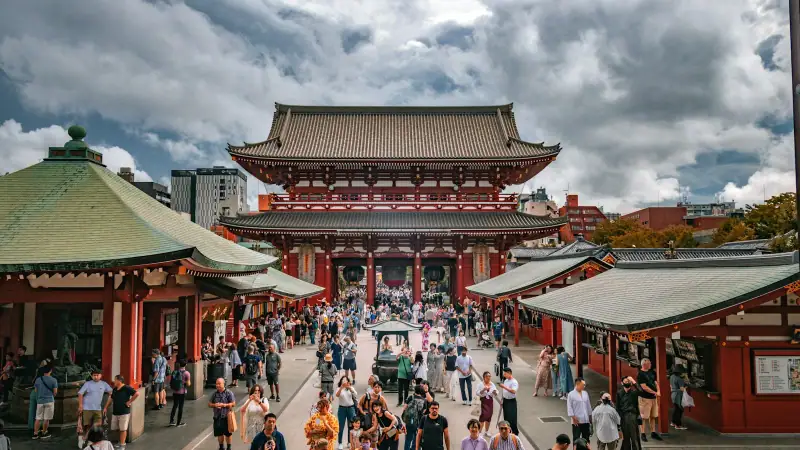
Depending on arrival time, the first day will be short. The goal is to drop the bags, eat something and soak up the atmosphere of the city without forcing a busy program on yourself. Jet lag catches up quickly, and the first night is more restorative than any visit.
Asakusa and Senso-ji temple
The Asakusa district is a good introduction: it is one of the oldest areas of the city, with Senso-ji, Tokyo’s oldest temple, and its big red gate hung with a giant lantern. The shopping street leading to it, lined with souvenir and snack shops, is very busy during the day: come in the late afternoon for soft light and fewer people. The temple is free to enter and remains pleasant at nightfall.
A first dinner in an izakaya
For dinner, choose an izakaya, a Japanese tavern where you share several small dishes: skewers, tempura, grilled fish, with a drink. Our article on Japanese drinks, from sake to tea and the izakaya will help you find your way around the menu.
Day 2: Meiji, Shibuya, Shinjuku
The second day is dense but compact: all the sights are linked by the Yamanote loop line, which circles central Tokyo. To go further, see our guide what to do in Tokyo.
Meiji Shrine and Yoyogi Park
Start early at Meiji Shrine, dedicated to Emperor Meiji, inside a large forest planted in the middle of the city. You reach it along a long path under tall wooden gates: the mood is calm, far from the bustle next door. Traditional weddings are frequent on weekends, offering chances to observe (from a distance, without intruding) ceremonial dress. Yoyogi Park, right next door, is a relaxing spot popular with locals.
Shibuya and Harajuku
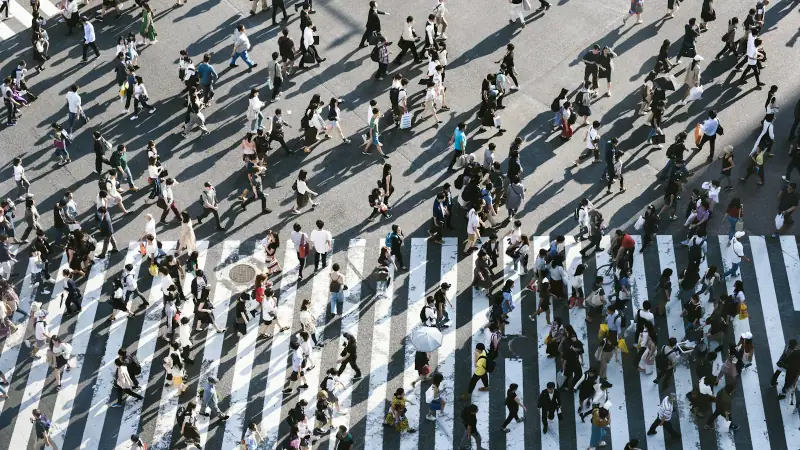
A few minutes’ walk away, Takeshita Street in Harajuku is the center of young, eccentric fashion. Farther south, the Shibuya crossing is a show in itself: at each green light, hundreds of people cross in every direction. Watch it from a high vantage point rather than drowning in the crowd, especially at dusk.
Shinjuku and the view over the city
In the afternoon, head to Shinjuku, a business and entertainment district. The free or paid observatories of the big buildings give a wide view of the city, and, in clear weather, of Mount Fuji in the background: it is a good way to check visibility before deciding the order of the following days. In the evening, the narrow lanes lined with small bars and eateries have a lot of charm, but prices and rules at some establishments vary: read the menus posted at the entrance.
Day 3: from Tokyo to Hakone, Lake Ashi and the onsen
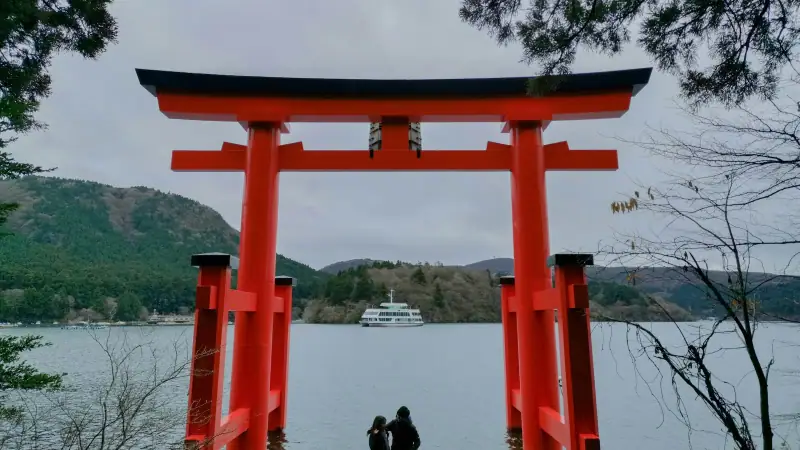
Leave in the morning from Shinjuku on an express train to Hakone. There, the classic loop combines several means of transport, which is the whole appeal of the region: a small mountain train, a ropeway, a boat on the lake and buses.
The Hakone loop
The little mountain train climbs through the forest, with tight bends and bridges over green valleys (very beautiful in June with hydrangeas and in fall with maples). It leads to the Gora area, where you can switch to a funicular and a ropeway that rise toward Owakudani, a volcanic valley with sulfurous fumaroles. A local specialty is sold there: eggs cooked in volcanic hot water, whose shells turn black as they cook. The valley can be temporarily closed in case of gas emissions: check the status of the ropeway before leaving.
The ropeway then descends to Lake Ashi, where galleon-style boats cross the water. In good weather, Fuji appears in the distance above the water and cedars: it is the region’s classic image. A red gate standing in the lake, belonging to Hakone Shrine, is one of its most photographed motifs.
Guided excursion to Hakone and Mount Fuji
If you would rather not manage the connections, day excursions from Tokyo exist.
A night in a ryokan with onsen
In the evening, go to your ryokan: you are welcomed in slippers, often served a multi-course meal (kaiseki) and you sleep on a futon laid on tatami mats. Onsen, baths of natural hot water, are one of the region’s great pleasures. Before diving in, take time to read our guide to onsen etiquette in Japan: washing before the bath, not taking a towel into the water and checking the rules on tattoos are essential points.
Day 4: Hakone, then the five lakes of Mount Fuji
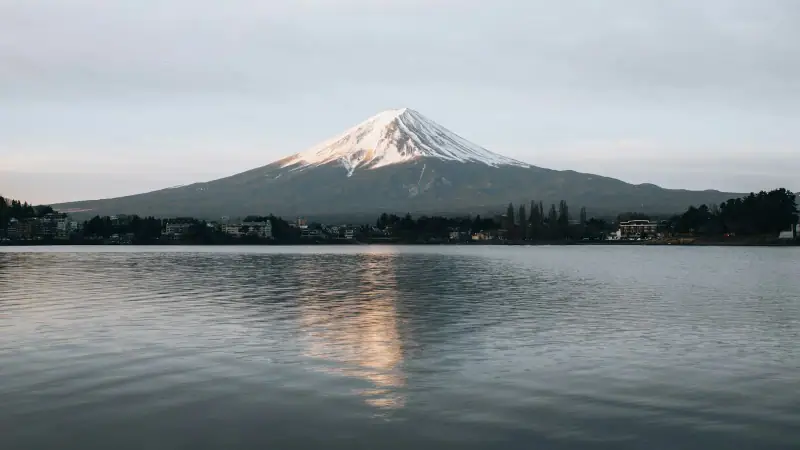
Enjoy the morning in Hakone for a last bath, a traditional breakfast or a cultural visit: the region has several art museums, including a large open-air sculpture museum, which suit families and art lovers well. Then head toward the Fuji region.
The journey to Kawaguchiko
There is no simple direct link between Hakone and Lake Kawaguchiko: the most practical solution is to go through Gotemba or Odawara by bus or train, then reach Fujiyoshida and the lake by local train. Allow several hours in total, with connections. If you see that this could spoil your day, another option is to return to Tokyo at the end of the morning and set off again by express bus to the lake: it takes no longer and is often more predictable.
The five lakes and the viewpoints
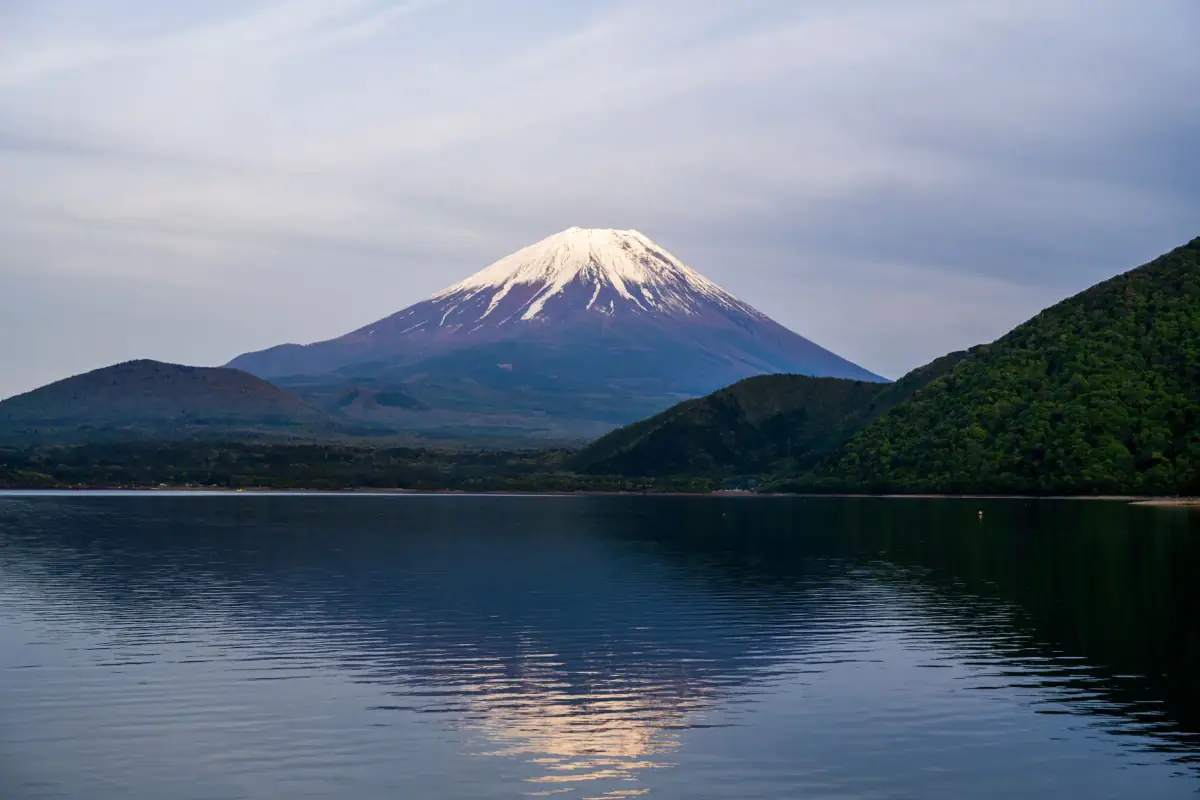
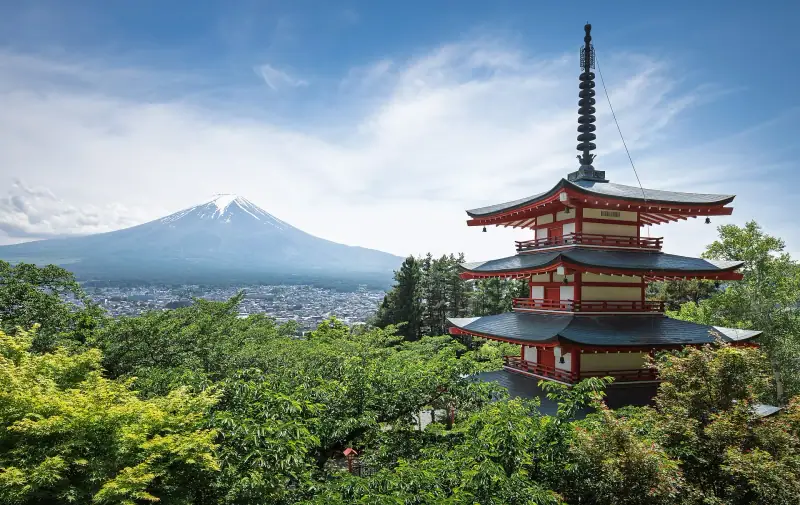
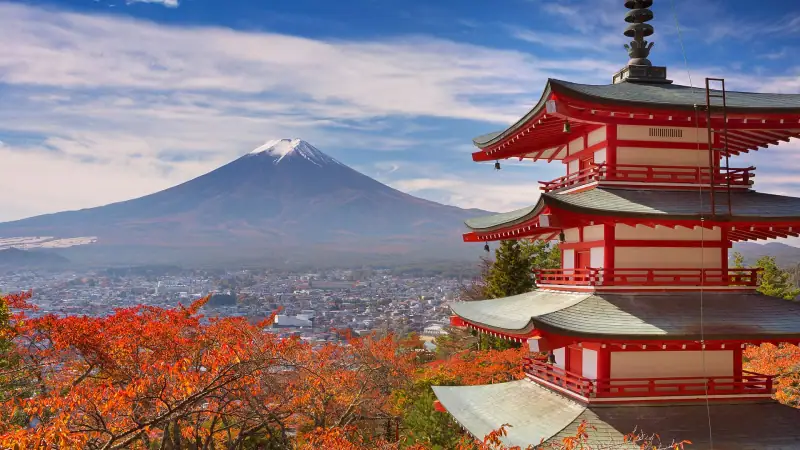
The Five Lakes region, at the foot of the volcano, is a destination in its own right. Lake Kawaguchiko is the easiest to reach, with its hotels, restaurants and panoramic buses. Several viewpoints let you photograph Fuji with a reflection or a foreground: the north shore of the lake, a ropeway that climbs a neighboring hill, or the Chureito Pagoda, near Fujiyoshida, whose view of the volcano and the pagoda is one of the most famous in the country. This view requires climbing a long staircase: bring good shoes.
If the sky is overcast, do not be discouraged: the Five Lakes are also a place for walks, with trails, lava caves and craft villages. And if you want to sleep at the foot of the volcano rather than head back, a night there lets you see Fuji at sunrise, often the best time to see it clear.
Day 5: last views and return to Tokyo
On the last morning, get up early if the weather allows: it is when the sky around the volcano is most often clear. Breakfast by the lake, a walk along the shores and a last stop in a nearby village fill the morning pleasantly.
Heading back to Tokyo
Direct express buses reach Tokyo in about two hours, with frequent departures. Book your tickets ahead in high season, especially on weekends. If your flight leaves that same evening, allow plenty of time: traffic jams on the highway on Sunday late in the day can lengthen the trip noticeably, and you then still have to reach the airport.
What to do with an extra half day
An extra half day in Tokyo lets you visit a museum, wander a quieter neighborhood (Yanaka, Kagurazaka) or add some shopping. For a whole extra day, Kamakura, a coastal town south of Tokyo with its great Buddha and temples, is a popular excursion, reachable by train from the capital.
Budget: how much to budget for these five days
Prices vary strongly by season and comfort level; see our article Japan travel budget for current ranges. In general, keep in mind that:
- Lodging is the biggest expense, notably in Tokyo and for the ryokan night in Hakone, in high demand in fall and on weekends.
- Transport is reasonable in Tokyo, more expensive for Hakone (pass) and Fuji (express bus).
- Temple entry fees are modest, but ropeways, boats and museums add up.
- Meals can stay affordable (konbini, noodle restaurants, station canteens) or climb quickly in fine-dining restaurants.
Also check the entry formalities with our page on entry formalities for Japan and take out suitable travel insurance before you leave.
Guided visits in Tokyo
Neighborhoods, street food, temples: a local guide helps you make the most of two days in the capital.
Mistakes to avoid
Pinning Fuji to a specific day. The volcano is often hidden. Keep some margin, check the forecast the day before and do not hesitate to swap two days if the sky looks clear at Hakone or Lake Kawaguchiko.
Underestimating the trip between Hakone and Fuji. The two regions are close on the map, but there are many connections. Plan half a day of transport and leave early.
Overloading Tokyo. The city is huge: choose two or three neighborhoods per day instead of trying to see everything.
Forgetting etiquette. Take off your shoes when asked, speak softly on transport and in temples, and respect photography rules. In ryokan, meal and bath times are often fixed.
Neglecting reservations. In high season (cherry blossoms, maples, Golden Week in early May), lodging, express buses and ryokan fill up weeks ahead.
Variations by profile
If you are traveling as a family: favor short stages, lodging near a station and the Hakone loop, which has a playful side with its trains, ropeways and boats.
If you like hiking: replace a day in Tokyo with a walk in the hills of the Fuji region, or add a day to explore the trails around the lakes.
If you like calm: travel off-season, favor early starts and sleep in a village rather than at the center of the busiest places.
If you have a week: add two days in Tokyo and an excursion to Nikko or Kamakura, or extend west with a Kyoto module using our 5-day Kansai itinerary.
What after this circuit?
From Tokyo, the Shinkansen reaches Kyoto in a little over two hours: it is the logical next step after a first stay. To build a full trip, the complete guide to Japan will help you choose the right combination for your length of stay and the season, and when to go to Japan gives you the best periods.
Bottom line
In five days, this circuit offers a rare contrast: the energy of Tokyo, the gentleness of a night in an onsen at Hakone and a face-to-face with the most famous of Japan’s volcanoes. The secret of a good stay is to stay flexible: a day of clear weather is worth more than a rigid schedule. You will leave with strong images and, very probably, the wish to come back.
Frequently asked questions
Are five days enough for Tokyo, Hakone and Mount Fuji?
Yes, for a first look. Two days in Tokyo, a day and a night in Hakone, then a day in the Fuji Five Lakes region let you combine city, nature and onsen without rushing. Tokyo deserves more time if you like museums and varied neighborhoods.
Do you need a Japan Rail Pass for this itinerary?
Generally no. Trips are short and use commuter trains, private express trains and buses. A national pass only pays off if you chain long Shinkansen journeys. Always compare with the price of single tickets and see our guide on getting around.
Can you be sure to see Mount Fuji?
No, the volcano is often hidden behind clouds, especially in summer and in humid weather. The best chances are generally from fall to early spring, early in the morning or late in the day. Build flexibility into the schedule so you can swap two days depending on the weather.
Should you sleep in Hakone or make a round trip from Tokyo?
Sleeping there is better: it lets you enjoy an onsen and a ryokan, and avoids rush-hour train returns. A single night is enough for a five-day itinerary.
Can you climb Mount Fuji on this trip?
The climb is only possible during a short summer season, generally from early summer to early fall, with booking and regulation rules that change. It requires real preparation and a night at altitude: it cannot be improvised within a five-day itinerary. Check the official conditions before planning.
What is the best season for this circuit?
Fall (foliage) and early spring (cherry blossoms) are the most beautiful, but also the busiest. Winter often brings clear skies and a snowy Fuji, with cold. Summer is hot, humid and cloudier. See our article on when to go to Japan.
More Japan guides
Keep reading
Japan budget: what a trip costs, item by item, and how to spend less
Lodging, transport, meals, activities: the real cost of a stay in Japan, three budget profiles priced in yen, euros and dollars, and tips to save.
Skiing in Japan: Hokkaido, Niseko, Hakuba, powder, season and budget
Skiing in Japan: Niseko or Hakuba, powder season, 2026-2027 lift pass prices from official sites, access, lodging and budget to plan your trip.
When to go to Japan: seasons, weather and events month by month
What is the best time to travel to Japan? Cherry blossoms, red leaves, rain, typhoons, snow: the month-by-month guide to choosing your dates.
Ready-made
Japan itineraries
5 days
Kyoto, Nara and Osaka in 5 days: a day-by-day itinerary
A 5-day Kansai itinerary: Kyoto temples, Nara deer and Osaka street food, with transport, tips and mistakes to avoid.
10 days
Japan in 10 days with kids: stops, journeys and a realistic pace
TokyoHakoneKyoto
14 days
Japan in 2 weeks: the day-by-day itinerary from Tokyo to Hiroshima
TokyoHakoneKyotoOsakaHiroshima