Plan your trip
Getting around Japan: the Shinkansen, JR Pass and IC cards explained
We may earn a commission when you book through links on this page, at no extra cost to you. We don't visit or try the places we cover: we summarize published sources. How we work
In short
- The Shinkansen is the backbone of long trips: Tokyo to Kyoto is a little over 450 km (280 mi), covered by the fastest trains in a little over two hours.
- Since the price increase of October 2023, the Japan Rail Pass (7 days, standard class, listed around 50,000 yen) only pays off with several long Shinkansen trips; compute your trips before buying.
- A rechargeable IC card (Suica, Pasmo, ICOCA) covers subways, urban trains, many buses and many shops; it can also be added to a smartphone.
- Reserve seats during Golden Week, Obon and the year-end holidays; forward big suitcases between hotels (takkyubin) and travel with a small bag.
Japan has one of the most punctual and densest rail networks in the world. That is good news for travelers, but also a source of confusion: between the JR companies, private lines, urban subways, prepaid cards and the various passes, it is easy to get lost before even leaving the airport.
This guide lays the groundwork for organizing how you get around: the Shinkansen for long distances, IC cards for daily trips, the JR Pass and its alternatives, and the cases where a bus or car is better. To place these trips in a concrete program, see our two-week itinerary for Japan.
The Shinkansen: the backbone of the trip
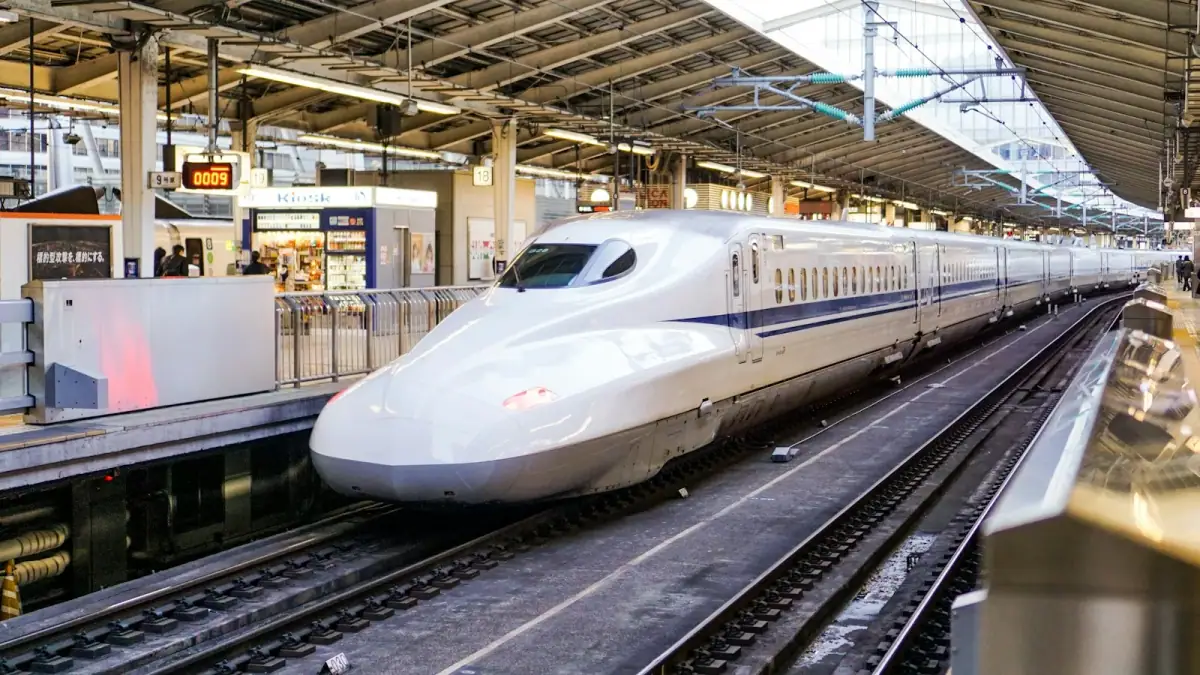
The Shinkansen is the Japanese high-speed train network. Inaugurated in 1964 between Tokyo and Osaka, it now links a large part of the country, from Kyushu to northern Honshu and Hokkaido. The line of most interest to travelers is the Tokaido Shinkansen, which serves Tokyo, Kyoto and Osaka, and continues west on the Sanyo line toward Hiroshima.
The time savings are considerable: Tokyo and Kyoto are separated by a little over 450 km (280 mi), which the fastest trains cover in a little over two hours. Punctuality is remarkable, departures are very frequent on this axis and stations are generally well signed in English.
Types of trains
On the Tokyo-Osaka axis, services differ by number of stops. The fastest stop only at the big stations, while local services serve more cities and therefore take longer. Check the service name on your ticket: a slower train can suit you if you are aiming for a secondary station, but it lengthens the trip to Kyoto or Osaka.
Reserving or not
Trains have reserved-seat cars and cheaper unreserved cars. Outside peak periods, unreserved seats are more than enough. During the big Japanese holidays, notably Golden Week in late April and early May, the Obon period in mid-August and the year-end holidays, it is wise to reserve, especially with large luggage. See our guide to choosing the best time to go to Japan to avoid these peaks.
A practical detail: on the Tokaido Shinkansen, large suitcases must have a specific space reservation or be stowed in a specific place in the car. Check with the company before traveling with a very large bag.
Sleep near a Shinkansen station
Lodging a few minutes' walk from a big station simplifies early departures and connections with luggage.
The JR Pass: calculate before you buy
The Japan Rail Pass is an unlimited travel ticket on JR group lines for a set duration, offered in 7-, 14- or 21-consecutive-day formulas. It was long considered an almost obligatory purchase for foreign visitors.
That is no longer the case since October 2023, when its price rose sharply, by about 70% for some formulas. The seven-day pass in standard class is now listed at around 50,000 yen. You therefore need to chain several long Shinkansen trips to recoup this amount.
Doing the math yourself
The method is simple: list your long-distance trips, look up the price of each single ticket on an online route simulator, add everything up and compare with the pass price. A Tokyo-Kyoto-Tokyo round trip, for example, is generally not enough to pay off a seven-day pass. On the other hand, a route that chains Tokyo, Kyoto, Hiroshima then a return to the capital can come close.
Regional alternatives
Several regional passes cover a limited area at a lower price: some for the Kansai (Kyoto, Osaka, Nara, Kobe), others for the Hakone region or the Japanese Alps. They are often more interesting than the national pass if you concentrate your stay on one area. Always check the exact scope of the lines included, since private companies are not always covered.
IC cards for everyday trips
For urban trips, the simplest solution is a rechargeable IC card. The best known are Suica and Pasmo in Tokyo, and ICOCA in the Kansai, but they are interoperable in most big cities: one card is therefore enough for the whole trip.
The principle is the same everywhere: you tap the card on the reader when entering and leaving the station, and the fare is debited automatically. It works on subways, urban trains, many buses, as well as at many vending machines and small shops. Cards can also be added to a recent smartphone, which avoids going through a counter on arrival.
Two tips: reload it with cash or a bank card at station machines, and do not keep an unnecessary balance at the end of your stay, as refunds are limited and may involve fees.
Subway, buses and private trains
In big cities, the subway is the most practical means of transport. In Tokyo, several lines overlap and are run by different operators, which can complicate working out connections. Free route apps show the platform, the best car for the connection and the exact fare.
In Kyoto, the situation is different: the subway covers only part of the sights, and urban buses play an important role in reaching many temples. They can be crowded in high season. Our guide what to do in Kyoto groups the sights by area to limit trips.
Finally, many classic excursions use private lines rather than JR, for example to reach certain shrines or mountain sites. The route app takes care of integrating them automatically.
Excursions with organized transport
For a day without worrying about connections, guided excursions from Tokyo or Osaka are offered with the trip included.
Airports and arriving in Japan
The two main entry points are the Tokyo region, with Haneda and Narita airports, and Osaka, with Kansai International. Each is linked to the city center by express trains, private lines and buses. Haneda is closer to central Tokyo than Narita, which shortens the trip into town.
If you arrive at one airport and leave from another, for example Tokyo on the way in and Osaka on the way back, you avoid a pointless backtrack and often gain a day. “Open jaw” flights of this kind are common and not systematically more expensive.
Flights to Japan
Compare airlines, stopovers and arrival airports to find the best trade-off between price and duration.
Car, bicycle and walking: when to choose them
Renting a car in Japan is possible with a valid license and the documents required depending on your nationality (check your government’s official travel advice before you book), driving on the left. Dense traffic in big cities, parking costs and tolls make a car poorly suited to Tokyo, Kyoto or Osaka. It makes sense in less well-served regions: countryside, coasts, mountains or nature parks.
Cycling is pleasant in Kyoto and in some flat cities, where distances between sights are reasonable. As for walking, it remains the best way to discover neighborhoods, provided you bring good shoes: you easily rack up ten to fifteen kilometers (6 to 9 mi) a day.
Our tips for traveling light and stress-free
Ship your suitcases. The carrier luggage forwarding service, called takkyubin, lets you send a suitcase from one hotel to the next or to the airport. You travel with a small bag on crowded trains, which completely changes the experience. Ask the front desk at your lodging how to proceed, and generally allow a day or two.
Avoid rush hours. In the morning and late afternoon, urban trains are very crowded in big cities. If you have luggage, shift your departure.
Download a route app. It shows timetables, platforms, durations and fares, and works with JR companies and private lines alike.
Keep some change. Some tickets, lockers and small vending machines accept only cash or an IC card. A little cash avoids unpleasant surprises.
Respect local customs. On trains, people speak softly, set their phone to silent and avoid calls. These courtesy rules are much appreciated and widely observed.
With a little preparation, getting around becomes one of the pleasures of the trip: scenery rushing by at high speed, lively stations, bento boxes to enjoy on the train. To continue your preparation, discover where to stay in Tokyo to choose your departure neighborhood well.
Frequently asked questions
Is the Japan Rail Pass still worth it?
Since the sharp price increase of October 2023, the pass only pays off for a program heavy with long Shinkansen trips. For a Tokyo-Kyoto-Tokyo round trip followed by a few local trips, single tickets are often better value. Do the math trip by trip before buying.
Do you need to reserve seats on the Shinkansen?
It is not mandatory: trains have cheaper unreserved-seat cars. In busy periods (year-end holidays, Golden Week, cherry blossom season), reserving a seat avoids standing, especially with luggage.
How do you pay for the subway and bus in Tokyo or Kyoto?
With a rechargeable IC smart card (Suica, Pasmo, ICOCA), which you tap on the reader at entry and exit. It works on most subways, urban trains and buses in big cities, as well as at many vending machines and shops. A smartphone version also exists.
What do you do with big suitcases on trains?
Bulky suitcases are hard to manage at rush hour. The carrier luggage forwarding service (takkyubin) lets you ship them from one hotel to the next at a moderate cost, and travel with a simple bag for train stages.
Can you rent a car in Japan?
Yes, with a valid license and the documents required depending on your nationality (check your government's official travel advice), driving on the left. A car is mainly useful in rural areas or mountains; in big cities, public transport is far more practical.
More Japan guides
Keep reading
Japan budget: what a trip costs, item by item, and how to spend less
Lodging, transport, meals, activities: the real cost of a stay in Japan, three budget profiles priced in yen, euros and dollars, and tips to save.
When to go to Japan: seasons, weather and events month by month
What is the best time to travel to Japan? Cherry blossoms, red leaves, rain, typhoons, snow: the month-by-month guide to choosing your dates.
Skiing in Japan: Hokkaido, Niseko, Hakuba, powder, season and budget
Skiing in Japan: Niseko or Hakuba, powder season, 2026-2027 lift pass prices from official sites, access, lodging and budget to plan your trip.
Ready-made
Japan itineraries
5 days
Kyoto, Nara and Osaka in 5 days: a day-by-day itinerary
A 5-day Kansai itinerary: Kyoto temples, Nara deer and Osaka street food, with transport, tips and mistakes to avoid.
10 days
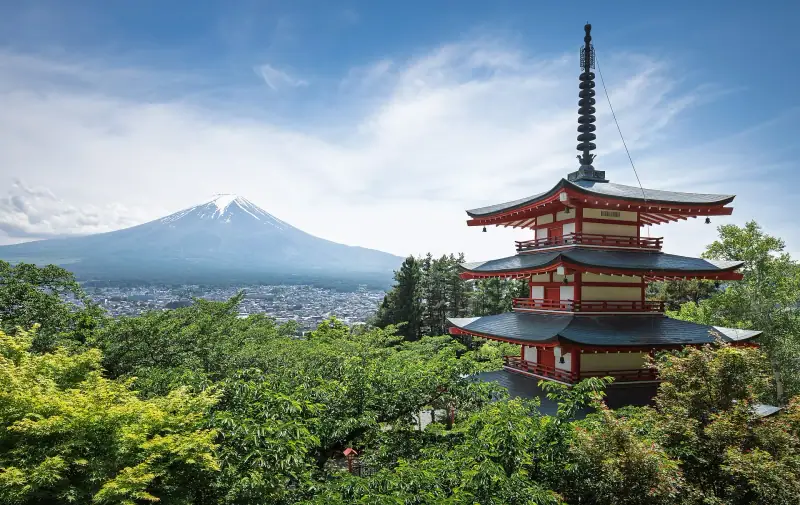
Japan in 10 days with kids: stops, journeys and a realistic pace
TokyoHakoneKyoto
5 days
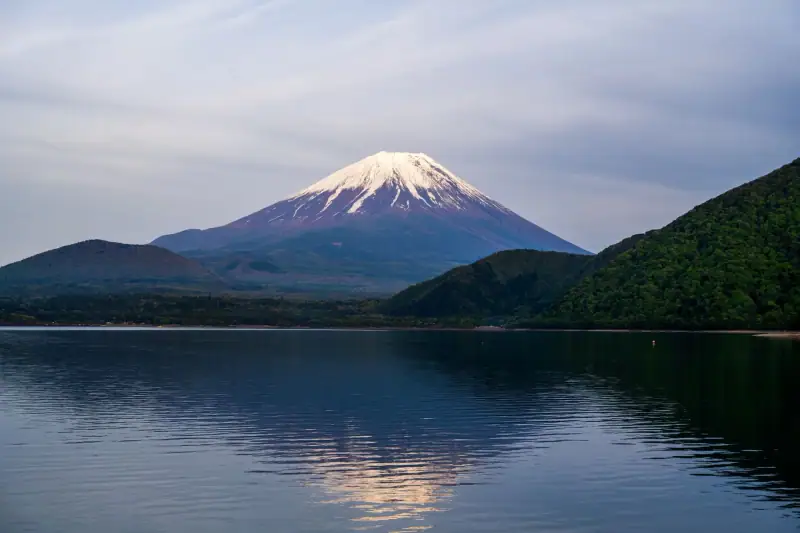
Tokyo, Hakone and Mount Fuji in 5 days: a detailed itinerary
A 5-day itinerary through Tokyo, Hakone and the Mount Fuji lakes: trains, onsen, volcano views, budget and mistakes to avoid on a first trip.