Where to stay
Where to stay in Füssen: areas and types of lodging
We may earn a commission when you book through links on this page, at no extra cost to you. We don't visit or try the places we cover: we summarize published sources. How we work
In short
- For a first stay, the old town (Altstadt) is the most pleasant: pedestrian lanes, restaurants, St. Mang's Abbey and the Lech riverbanks on foot.
- Arriving by train with luggage, the area around the station is more practical and often a little cheaper.
- Hohenschwangau and Schwangau are closest to Neuschwanstein and very quiet at night, but have fewer options and cost more in high season.
- One night lets you visit Neuschwanstein early and enjoy the old town in the evening; two nights are better if you add a lake walk or a hike.
Füssen is a small town in southern Bavaria, at the foot of the Alps, a few kilometers from the Austrian border. It is best known as the gateway to Neuschwanstein and Hohenschwangau, but it deserves more than a quick stop: an old town with colorful facades, an abbey overlooking the Lech, and lakes and forests nearby. Spending one or two nights here changes the experience of the region a great deal.
This guide compares the areas where you can sleep (old town, station, Hohenschwangau and Schwangau, lakeshores) and the types of lodging: hotels, guesthouses, inns, apartments and campsites. To plan the castle visit itself, read our article on visiting Neuschwanstein and Füssen.
Getting your bearings around Füssen
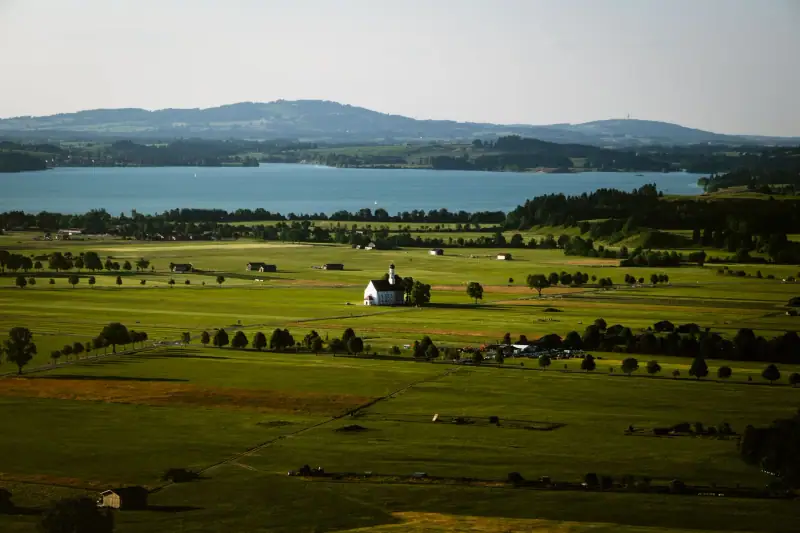
The town is compact. The old town stretches along the bank of the Lech, dominated by the complex of St. Mang’s Abbey and the castle of the prince-bishops. The station, east of the center, is about a ten-minute walk away, which is fine for most travelers. A little farther out, residential areas stretch toward the hills and lakes.
A few kilometers to the east, the villages of Schwangau and Hohenschwangau lie at the foot of Neuschwanstein, near the Alpsee. A local bus links Füssen to Hohenschwangau, which makes choosing a base fairly simple: either you prefer the activity of a town with a station and restaurants, or you prefer the calm of villages facing the mountains.
The key point: the distances between these areas are short, but the atmosphere and the prices differ. Also note that in the evening, clearly more restaurants are open in Füssen than in the neighboring villages.
Compare lodging in Füssen: rates vary a lot with the season and the distance to the old town. Compare availability for your dates and check the walking distance to the station or the bus stop.
The old town: the choice for charm
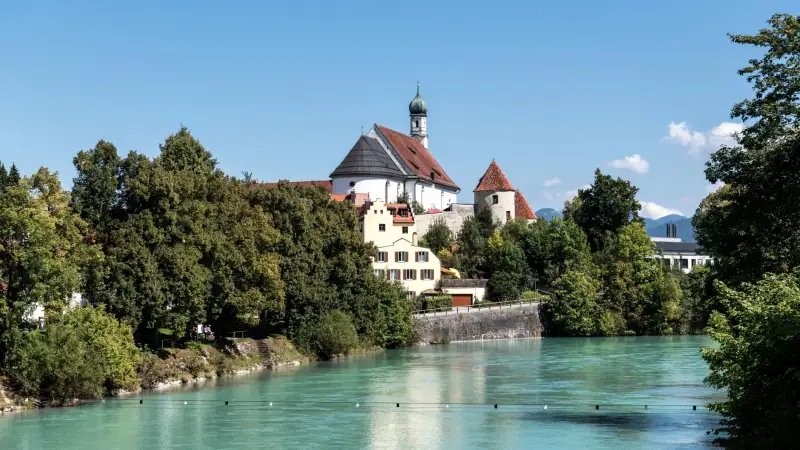
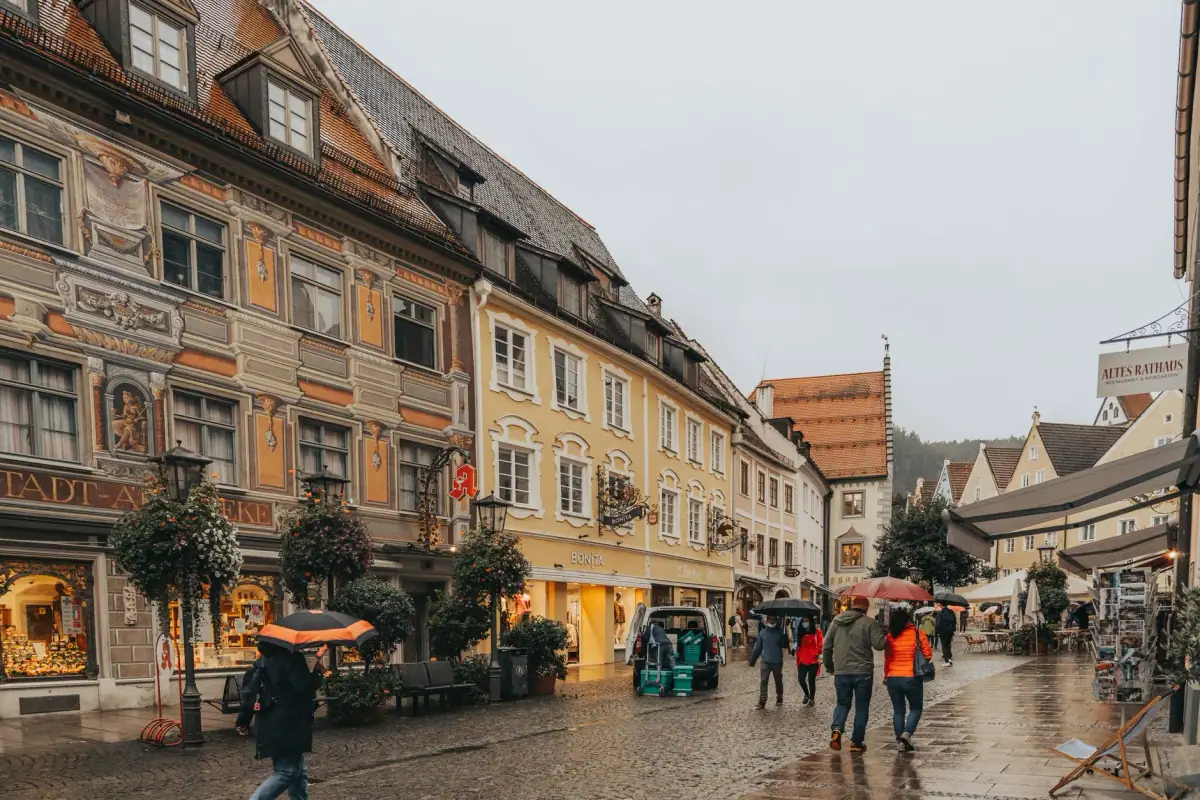
The Altstadt is the most pleasant area for a first stay. Here you will find Reichenstraße, the main street lined with pastel facades, cafés and shops, as well as small lanes that run down to the Lech. St. Mang’s Abbey and the castle, very close by, can be reached on foot in a few minutes.
Sleeping here means being able to stroll in the evening, when the day groups have left and the terraces fill up. Lodgings are often set in old houses: charming hotels, small family guesthouses, rooms above restaurants. Rooms are sometimes modest in size, and some buildings have no elevator, a detail to check if you are traveling with heavy suitcases.
The drawbacks are the usual ones: higher rates than on the outskirts, limited parking, and a bit of noise on summer evenings, especially on the street side. Ask for a room on the courtyard side or on an upper floor if you are a light sleeper. This area suits couples, stays of one to two nights and anyone who wants to do everything on foot. It is less suited to a very tight budget.
Around the station: the most practical
Füssen is the terminus of the railway line from Munich. Sleeping near the station therefore makes a lot of sense if you arrive by train with luggage, if you leave early in the morning or if you want to take the bus to Hohenschwangau without changing neighborhoods.
The area has functional hotels, guesthouses and apartments, often at lower rates than in the old town. The atmosphere is more urban and less picturesque, but the historic center is still a short walk away. It is a good choice for a stopover night, for a moderate budget, or if efficiency matters more than the setting.
Before booking, check on the map the exact walking distance to the station and to Reichenstraße, and read recent reviews about noise from the tracks or the road.
Hohenschwangau and Schwangau: at the foot of the castle
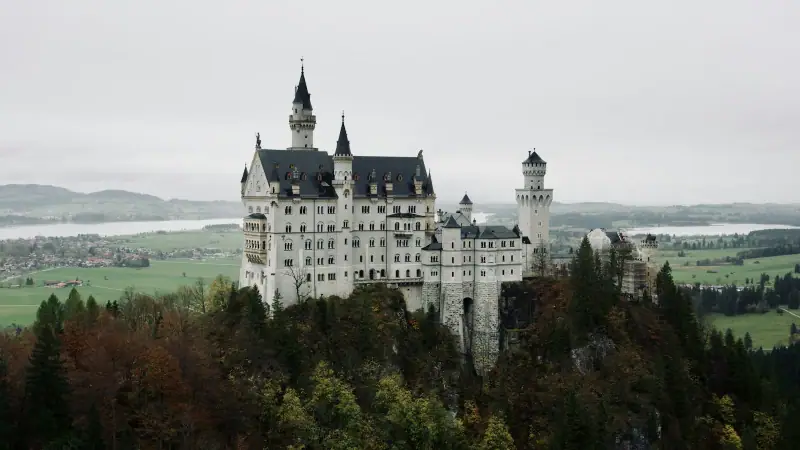
These two villages are near Neuschwanstein, Hohenschwangau and the Alpsee. Sleeping here has a decisive advantage for early risers: you can reach the castle before the tour buses arrive and enjoy the morning light on the mountains. In the evening, the quiet is deep.
In return, the choice of restaurants is more limited, lodgings are often more expensive in high season, and you depend more on the bus or the car to reach Füssen. The lodging types here are mostly hotels, Gasthöfe (traditional inns), guesthouses and holiday apartments, often with mountain views.
This area suits couples looking for peace, photographers and anyone who wants to devote the stay to nature and the castle. Book early: small places fill up quickly in summer.
Tours and excursions around Füssen: a guided tour or an organized excursion can simplify logistics, especially if you do not want to manage train and bus schedules. Compare durations, languages and departure points.
Around the lakes and in the countryside
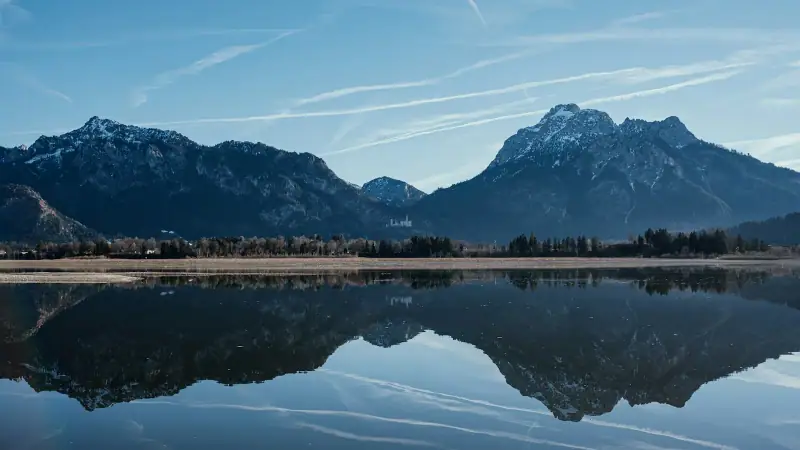
The Füssen region has several lakes, including the Forggensee and the Hopfensee, and many quiet villages in the neighboring Allgäu. Lodgings here are often small converted farms, holiday apartments, guesthouses and a few campsites. The atmosphere is rural, with meadows, walking paths and views of the peaks.
This is an ideal choice for families, stays of several nights and lovers of hiking and cycling. It generally assumes a car or carefully checked bus schedules: find out how often the connections run and when the last departure is before you book. In some lodgings, the tourist tax gives access to a guest card with local benefits: ask your host.
Types of lodging in Füssen
Hotels
The range goes from charming hotels in the old houses of the old town to more modern places near the station and mountain hotels near Schwangau. Check what is included in the rate, especially breakfast, and the cancellation conditions. A flexible rate sometimes costs a little more, but it protects you if the weather turns out unpredictable.
Guesthouses and Gasthöfe
Typical of Bavaria, these family-run places offer simple rooms and a warm welcome, often with a hearty breakfast. There are many around Füssen and Schwangau. It is one of the best ways to taste the local atmosphere, generally at a reasonable price.
Hostels and budget lodging
For solo travelers and small budgets, there are dorm beds and private rooms. Read recent reviews on cleanliness and noise, and check the reception hours if you arrive late by train.
Holiday apartments
For a stay of three nights or more, or with family, an apartment with a kitchen brings space and saves money on meals. They are common in Füssen, in Schwangau and around the lakes. Read the cancellation conditions and the late-arrival rules carefully, which are sometimes strict in small places.
Campsites
Camping is possible around the lakes of the region, especially from spring to fall. It is an economical option for families and van travelers, with nature close at hand. Check the opening dates before planning your stay, because they vary from one site to another.
Which area for your profile?
- First stay, everything on foot, town atmosphere: the old town.
- Arriving by train, moderate budget, a single night: the area around the station.
- Very early visit to Neuschwanstein, quiet and scenery: Hohenschwangau or Schwangau.
- Families, hiking, longer stay: the villages and the lakes, preferably by car.
- Small budget: hostel, guesthouse or campsite outside high season.
If your budget is limited, widen the search to areas that are farther out but well connected: lodging a little set back often costs less than an address in the center. Our guide to the budget for Germany will help you set a realistic ceiling for lodging.
When to book: seasons and crowds
Southern Bavaria attracts visitors all year, but two periods are particularly busy: summer, with its long days and hikes, and school holidays and long weekends. Winter also attracts fans of snowy landscapes and skiing nearby, as well as visitors to the Christmas markets of the region.
Book early for these periods, favor a rate with free cancellation and expect higher rates, including in the villages. Off season, in spring and fall, prices are often lower, trails quieter and the lines at the castle shorter. Our guide on when to go to Germany details the seasons.
Tips for booking well
Always check three points: the distance to the station or the bus stop, the cancellation conditions and recent reviews. Also look at what is included in the rate and whether a tourist tax is added at booking. In the old town, ask whether the building has an elevator and whether the room faces a busy street.
If you are coming from Munich, the train is the simplest option: the trip takes about two hours, sometimes with a change, depending on the schedule. Check the journey time and the last train before you leave. To prepare your stay in the Bavarian capital, see our guide to where to stay in Munich and our 3-day Munich itinerary.
Rent a car to explore the lakes and villages: useful for reaching isolated lodgings or linking several stops in Bavaria. Compare rental companies for your dates and check the pick-up conditions.
Finally, consider travel insurance to cover mishaps before departure, and see our entry requirements for Germany before you go. Entry rules depend on your passport. Check the official travel advice of your government before you book: travel.state.gov (US), GOV.UK (UK), travel.gc.ca (Canada), Smartraveller (Australia) (checked November 2026).
Combining Füssen with other stops
Füssen fits easily into a circuit in southern Bavaria. Munich remains the big complementary stop, by train or by car. To the north and west, the Romantic Road offers a string of old towns, and the Black Forest can be discovered farther on, in our 3-day Black Forest itinerary.
Frequently asked questions
What is the best place to stay in Füssen?
For a first stay, the old town (Altstadt) is the most pleasant choice: pedestrian lanes, restaurants, St. Mang's Abbey and the banks of the Lech all on foot. If you arrive by train with luggage, the area around the station is more practical and often a little cheaper.
Is it better to stay in Füssen or in Hohenschwangau?
Füssen offers far more choice, restaurants and shops, and has a train station. Hohenschwangau and Schwangau are closer to Neuschwanstein and very quiet in the evening, but the choice is smaller and prices are higher in high season.
Is one night in Füssen enough?
One night lets you visit Neuschwanstein early in the morning and enjoy the old town in the evening. Two nights are better if you want to add a walk by the lakes or a hike without rushing.
Do you need a car if you stay in Füssen?
No. Local buses link Füssen to Hohenschwangau and the old town is walkable. A car is only useful for linking several stops in Bavaria or reaching isolated lodgings; check the parking conditions in that case.
When should you book lodging in Füssen?
As early as possible for summer, weekends and long weekends, because demand around Neuschwanstein is high and availability drops fast. Preferably choose a rate with free cancellation.
Can you stay in Füssen when coming from Munich for the day?
Yes, but sleeping there saves you the train ride back at the end of the day and lets you reach the castle before the groups. Check the train times on the Deutsche Bahn website before fixing your schedule.
More Germany guides
Keep reading
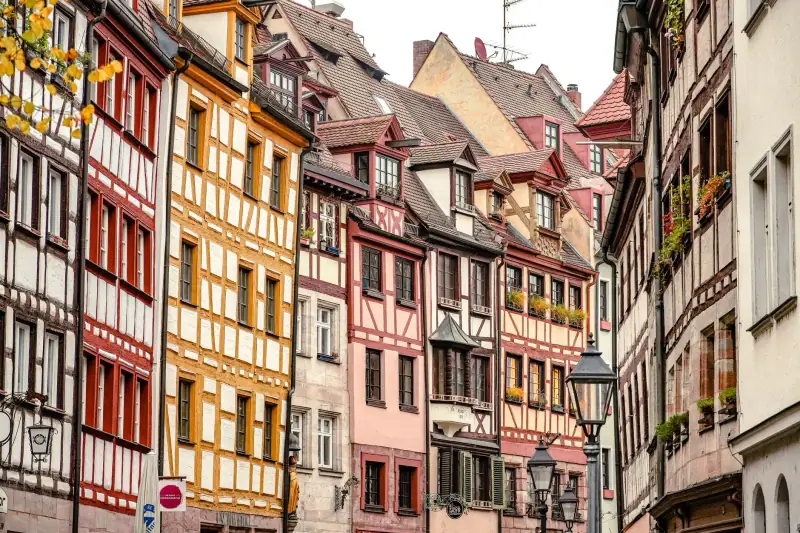
Where to stay in Nuremberg: neighborhoods and types of lodging
Which neighborhood to pick in Nuremberg? Altstadt, station, Gostenhof, Sankt Johannis, Südstadt: atmospheres, transport, lodging types and booking tips.
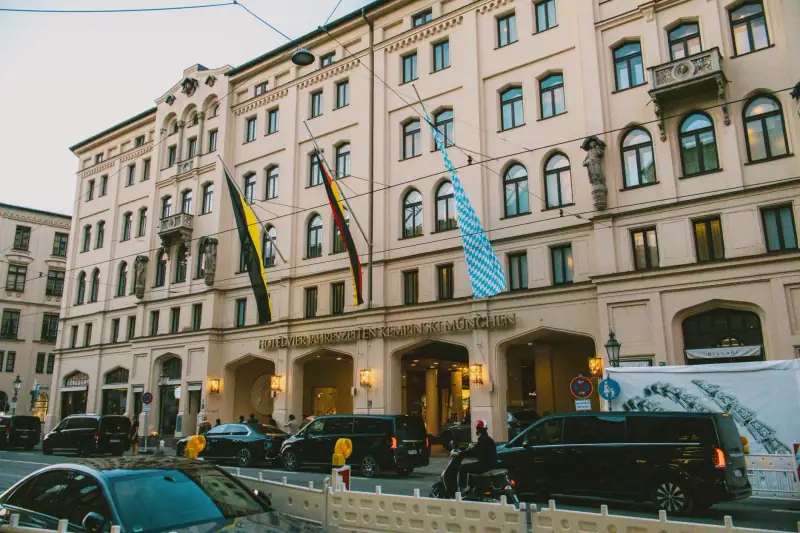
Where to stay in Munich: neighborhoods and types of lodging
Which neighborhood to pick in Munich? Altstadt, Maxvorstadt, Glockenbach, Haidhausen, Schwabing: atmospheres, transport, lodging types and booking tips.
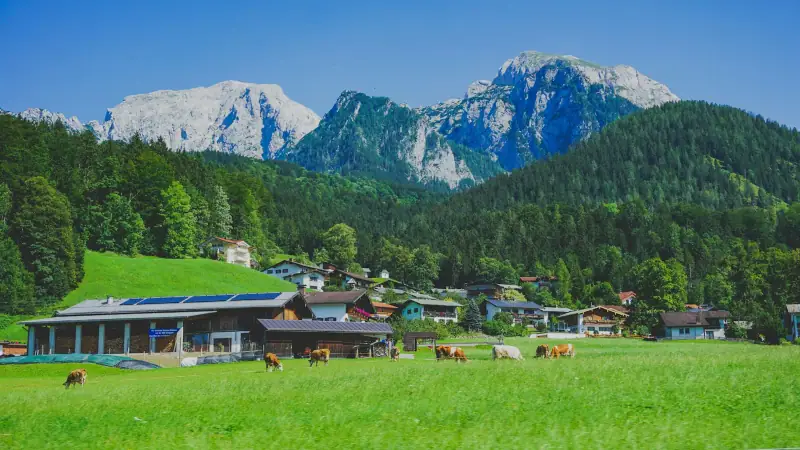
What to see in Bavaria: Munich, castles, the Alps and medieval towns
What to see in Bavaria: Munich, Neuschwanstein, the Romantic Road, Bamberg, Regensburg, Berchtesgaden and the Alps. Tips for planning your trip.
Ready-made
Germany itineraries
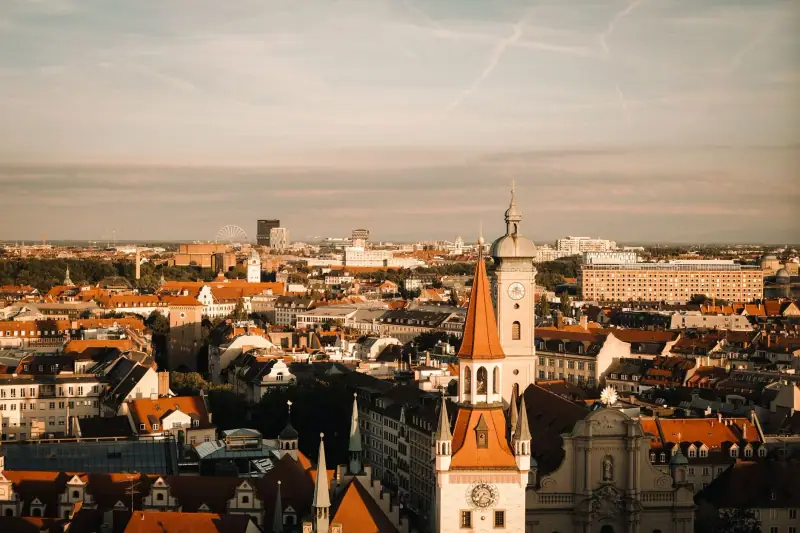
3 days
Munich in 3 days: an itinerary through the old town, museums and parks
What to do in Munich in 3 days? Marienplatz, Residenz, Englischer Garten, Nymphenburg, museums and beer halls: a day-by-day itinerary with practical tips.
3 days
Berlin in 3 days: a day-by-day itinerary
What to see in Berlin in 3 days: Brandenburg Gate, Reichstag, Museum Island, Wall memorial, Potsdam and neighborhoods. A clear day-by-day itinerary.
3 days
Black Forest in 3 days: a road trip itinerary from Baden-Baden to Freiburg
A 3-day Black Forest itinerary: Baden-Baden, Triberg, Gutach, Freiburg im Breisgau, Titisee and Feldberg. Stops, drives, tips and where to stay.