What to see
Visiting Neuschwanstein and Füssen: how to plan your day
We may earn a commission when you book through links on this page, at no extra cost to you. We don't visit or try the places we cover: we summarize published sources. How we work
In short
- The inside of Neuschwanstein can only be visited on a guided tour at a set time slot, about thirty minutes long. Book on the official website of the Hohenschwangau royal castles.
- From Munich, the train to Füssen takes about two hours, sometimes with a change; a local bus then reaches Hohenschwangau in a little under a quarter of an hour.
- From Hohenschwangau village, the walk up to the castle takes about thirty to forty minutes; a shuttle bus and horse-drawn carriages also exist.
- Photography is forbidden inside. The best viewpoints are outside: the Marienbrücke bridge, the Alpsee lakeshore or the road up.
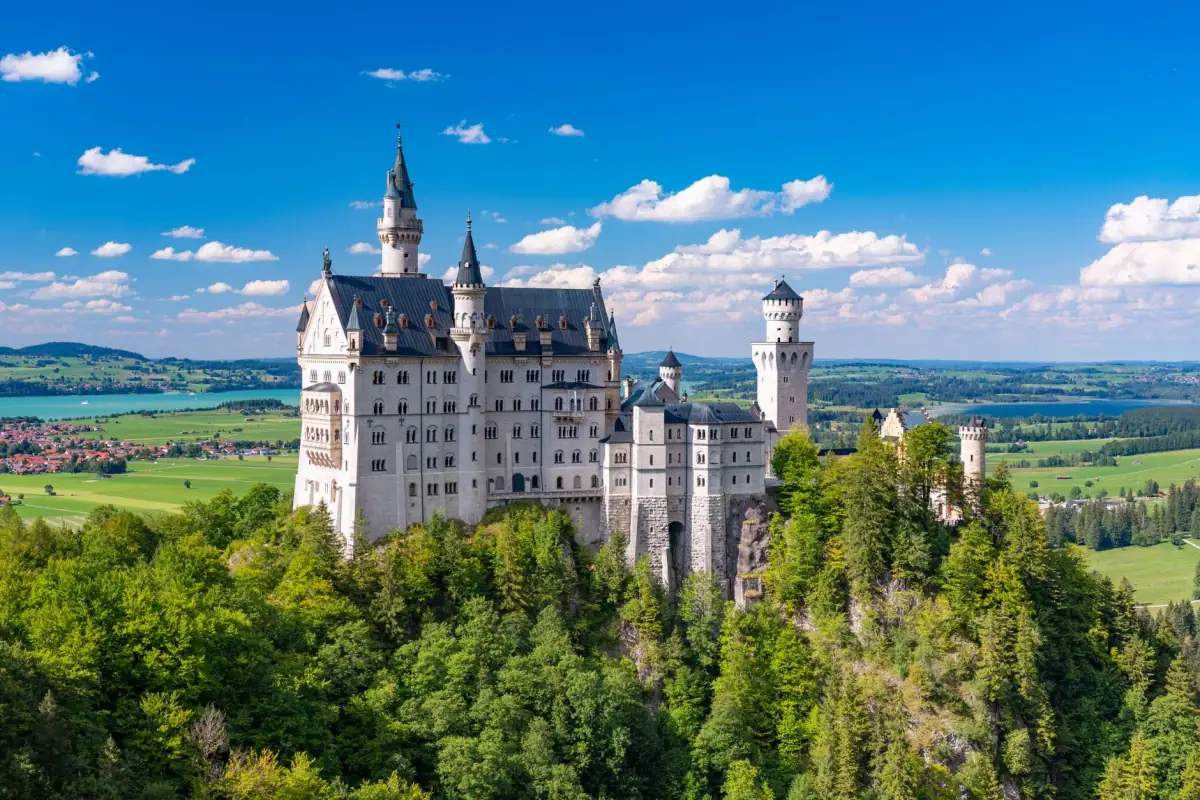
One photo is enough to recognize Neuschwanstein: white towers planted on a rocky spur, fir forests all around and, behind, the first foothills of the Alps. The castle draws visitors from all over the world, and yet many travelers plan the visit badly, arriving without a ticket, at the wrong time of day, or forgetting that it is only part of what the Füssen region offers.
This guide helps you plan the visit: how to get there, how to book, what to see around the castle and how to enjoy Füssen, a small town in southern Bavaria, a few kilometers from the Austrian border.
A fairy-tale castle commissioned by Ludwig II of Bavaria
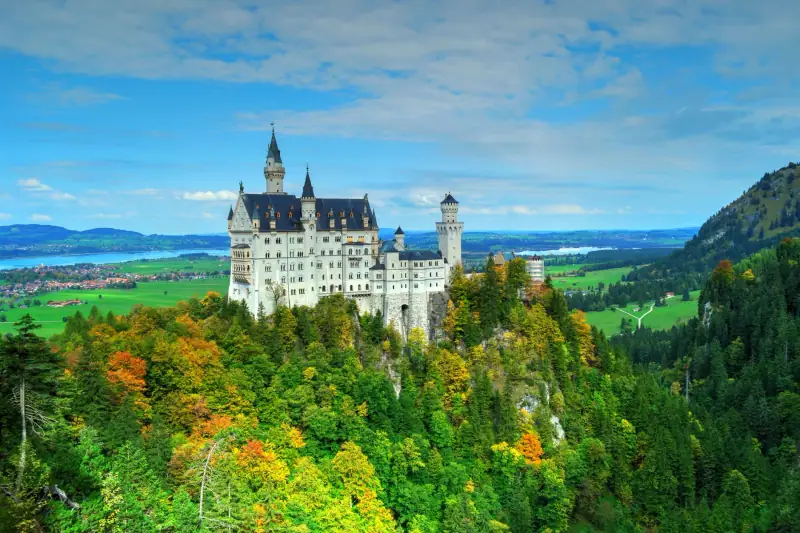
Neuschwanstein was the wish of King Ludwig II of Bavaria, who started its construction in the late 1860s. The king imagined a setting inspired by medieval Germanic legends and the world of Richard Wagner’s operas. It is not a defensive fortress but a romantic retreat, designed as a stage set.
The king died in 1886, before the work was finished. The castle was never completed: several rooms were left unfinished, and only some of the rooms can be visited. Shortly after his death, the site was opened to the public, and it has remained open ever since.
This history explains the particular charm of the visit. You do not walk through a palace inhabited for centuries, but through a very personal dream, with rooms painted with scenes from legends, a throne room inspired by Byzantine basilicas and apartments with carefully worked woodwork.
How to get there: from Munich, Füssen or by car
Neuschwanstein is near the village of Hohenschwangau, a few kilometers from Füssen, in southern Bavaria. The logistical base for the visit is therefore Füssen.
From Munich by train
This is the simplest option for a day trip. Trains link Munich to Füssen in about two hours, sometimes with a change depending on the schedule. From Füssen station, a local bus serves Hohenschwangau in a little under a quarter of an hour. Check the schedules on the Deutsche Bahn website, and keep in mind that late-day trains are often crowded in high season.
By car
From Munich, the road to Füssen is about 120 km (75 mi), or one and a half to two hours depending on traffic. Paid parking lots are at the foot of the castle, in the village of Hohenschwangau, and fill up quickly in summer. If you rent a vehicle to combine several stops in Bavaria, the car is handy, but it changes little once you are there: the climb to the castle is on foot or by shuttle.
Combining with Austria
The Austrian border is very close. If your trip includes Tyrol, Neuschwanstein can easily be combined with a stop across the border.
Where to stay in Füssen: spending a night there lets you visit early, before the groups arrive, and enjoy the old town in the evening. Compare the lodging available for your dates.
Tickets and booking: what to know before you arrive
The inside of Neuschwanstein can only be visited on a guided tour, with a set time slot printed on the ticket. The visit lasts about thirty minutes and is done in a group, with a guide or an audio guide depending on the language. The pace is brisk: you do not linger in the rooms.
A few rules to remember:
- Book ahead: between spring and fall, the day’s slots are often full. Buy your tickets on the official website of the Hohenschwangau royal castles, indicating your date and your language.
- Be on time for your slot: the ticket is valid for a specific time. Allow for the walk up, that is, a comfortable margin before the indicated time.
- No photos inside: photography is forbidden in the rooms, and large bags must be left outside.
- Prices change: check the current rate on the official website when you book; discounts exist for children and young people.
If you could not book, it is still possible to appreciate the castle from outside: the courtyard, the terraces and the panoramas can be enjoyed without a ticket for the castle itself.
Viewpoints: Marienbrücke, Alpsee and hiking paths
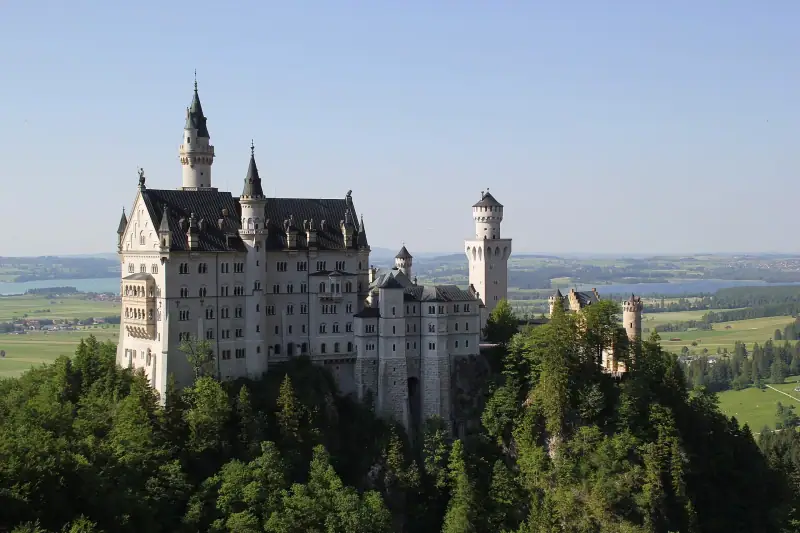
For many visitors, the iconic photo of the castle is taken from the Marienbrücke bridge, a footbridge suspended above a gorge, a few minutes’ walk above the castle. The bridge offers a head-on view of Neuschwanstein, with the plain in the background. It is also the busiest spot: going early in the morning or late in the day avoids the crush.
On the nature side, the small Alpsee lake, at the foot of Hohenschwangau, is worth the detour for a walk with no notable climb. The water is clear, the reflections are lovely in calm weather, and you find a bit of silence again after the climb to the castle. Several forest trails also let you climb to less crowded panoramas, with good shoes and the weather in mind.
Hohenschwangau: the castle of Ludwig II’s childhood
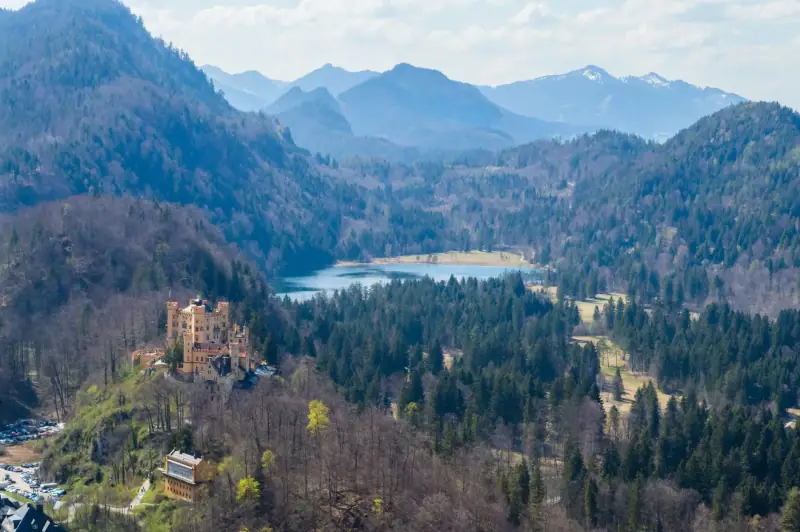
Facing Neuschwanstein, on a neighboring hill, Hohenschwangau Castle was rebuilt by Ludwig II’s father, King Maximilian II of Bavaria. The future king spent part of his childhood there. The tour, also guided, gives an interesting counterpoint: the atmosphere is more family-like, closer to a summer residence than an opera set.
If you have time, combine the two visits on the same day. Check the slots in advance, because you need to leave a reasonable margin between the two, with the walk and the shuttle.
Excursions from Munich: if you prefer not to manage the train and tickets, organized day excursions serve the region. Compare the options and schedules before choosing.
Füssen: a small town not to be overlooked
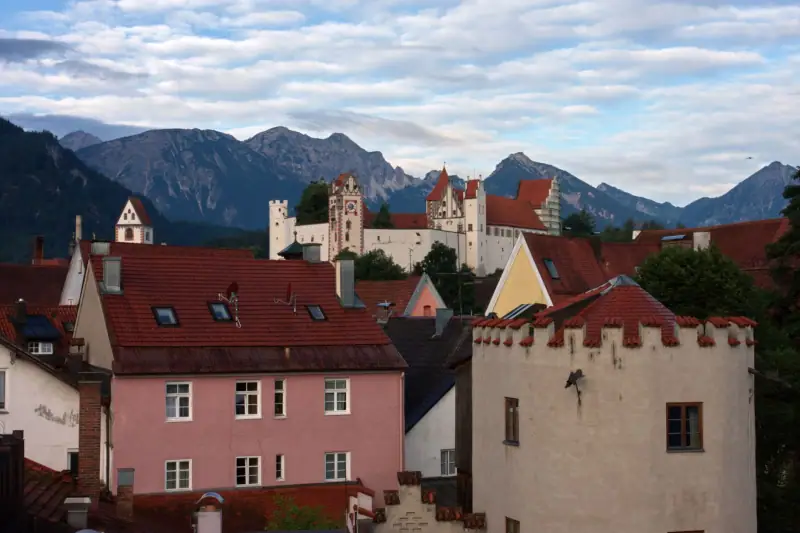
Many travelers only pass through Füssen station. That is a pity: the old town, with its colorful facades and pedestrian lanes, is easily explored in an hour or two. It also holds a former Benedictine monastery, St. Mang, whose complex overlooks the town and the Lech river.
It is a good base for a quiet evening: restaurants serving Bavarian cooking (sausages, spätzle, melted cheese, local beer) and cafés where you can take a break after a day of walking. In winter, snow transforms the town and the surroundings, and the nearby ski resorts draw other visitors than those of the castle.
A typical one-day itinerary from Munich
Here is a realistic plan for a day, without rushing:
- Early morning: train from Munich to Füssen, aiming to arrive in late morning.
- Late morning: bus to Hohenschwangau, light lunch in the village.
- Early afternoon: walk up to the castle, with a margin before the visit slot.
- After the visit: stop at the Marienbrücke if conditions allow, then descend to the Alpsee.
- Late afternoon: back to Füssen, a tour of the old town, then train to Munich.
The day is packed. If you have time, a night there really changes the experience: you avoid the race against train schedules and enjoy the village once the groups have left.
Who this visit is for
Neuschwanstein is a highlight of Bavaria, but it is not a hidden place. If you hate crowds, favor fall, early spring or a weekday visit, and keep in mind that the best photos are taken outside, not inside.
If you are staying in Munich, the day trip is a safe bet. If you are making a longer circuit in southern Bavaria, spending a night in Füssen is preferable. In any case, book your tickets in advance, check the train schedules and bring good shoes for the climb.
Where to stay in Munich before or after the excursion: the Bavarian capital offers a wide choice of lodging for every budget. Compare availability for your dates.
Frequently asked questions
Do you need to book tickets for Neuschwanstein?
Yes, it is strongly recommended. The interior can only be visited on a guided tour at a fixed time slot, and the most popular slots go fast between May and October. Book on the official website of the Hohenschwangau royal castles rather than through an intermediary, and plan to collect your ticket ahead of time.
Can you visit Neuschwanstein in one day from Munich?
Yes, it is the most common option. The train trip to Füssen takes about two hours, then a local bus reaches the village of Hohenschwangau. Leave early in the morning to get a visit slot in the middle of the day and head back without stress in the late afternoon.
How do you get up to the castle?
From the village of Hohenschwangau, allow about thirty to forty minutes of uphill walking. A shuttle bus and horse-drawn carriages also exist, but the last stretch is on foot. Schedules and fares for these options vary by season.
What is the best time to go?
Spring and early fall offer a good compromise between weather and crowds. Summer is the busiest season, and in winter snow gives a fairy-tale setting, but some paths can be slippery or closed.
Can you take photos inside?
No, photography and video are forbidden inside the castle. The best viewpoints are outside: from the Marienbrücke bridge, from the shores of the Alpsee or from the road up.
More Germany guides
Keep reading
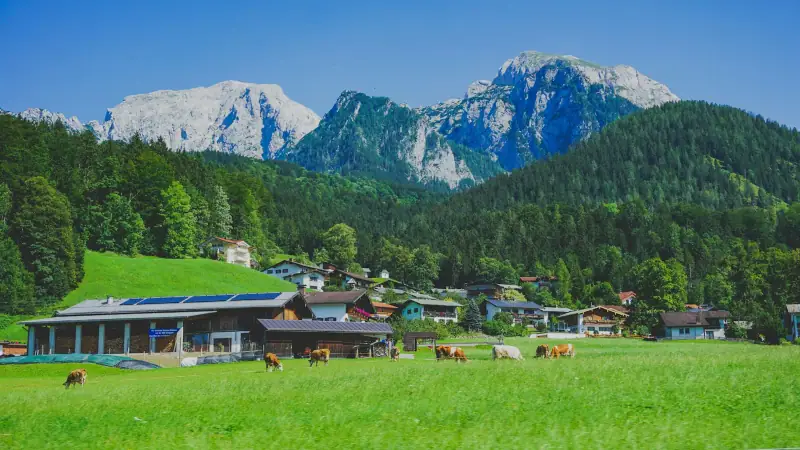
What to see in Bavaria: Munich, castles, the Alps and medieval towns
What to see in Bavaria: Munich, Neuschwanstein, the Romantic Road, Bamberg, Regensburg, Berchtesgaden and the Alps. Tips for planning your trip.
Visiting Nuremberg: what to see and do in 1 or 2 days
What to see in Nuremberg: Kaiserburg, old town, Dürer's house, Christmas market, Reichsparteitagsgelände documentation center and Bratwurst.
What to see in Berlin and Brandenburg: Potsdam, the Spreewald and nature escapes
What to see around Berlin: Potsdam and its palaces, the Spreewald by boat, the Rheinsberg lakes, the Schorfheide and Brandenburg's memorial sites.
Ready-made
Germany itineraries

3 days
Munich in 3 days: an itinerary through the old town, museums and parks
What to do in Munich in 3 days? Marienplatz, Residenz, Englischer Garten, Nymphenburg, museums and beer halls: a day-by-day itinerary with practical tips.
3 days
Berlin in 3 days: a day-by-day itinerary
What to see in Berlin in 3 days: Brandenburg Gate, Reichstag, Museum Island, Wall memorial, Potsdam and neighborhoods. A clear day-by-day itinerary.
3 days
Black Forest in 3 days: a road trip itinerary from Baden-Baden to Freiburg
A 3-day Black Forest itinerary: Baden-Baden, Triberg, Gutach, Freiburg im Breisgau, Titisee and Feldberg. Stops, drives, tips and where to stay.