What to see
Visiting Nuremberg: what to see and do in 1 or 2 days
We may earn a commission when you book through links on this page, at no extra cost to you. We don't visit or try the places we cover: we summarize published sources. How we work
In short
- One day covers the old town, the imperial castle (Kaiserburg) and a museum or two; two days add the Reichsparteitagsgelände documentation center and the Palace of Justice.
- Fast trains link Munich to Nuremberg in a little over an hour; the station sits right at the foot of the old town.
- The Christkindlesmarkt fills the Hauptmarkt during Advent and is very busy: book lodging well ahead.
- The emblematic dish is the Nürnberger Rostbratwurst, small grilled sausages usually ordered in portions of six, eight or twelve.
Nuremberg is the largest city of Franconia, in northern Bavaria. An imperial city in the Middle Ages, home of the painter Albrecht Dürer, capital of gingerbread and toys, it also lived through one of the darkest periods of the 20th century, with the Nazi party rallies and then the trial of the regime’s main leaders after the war. This double face, between medieval charm and 20th-century memory, makes it a deeper stop than it seems.
Many travelers treat it as a simple stopover between Munich and Berlin. That is a pity: the old town, surrounded by walls and dominated by an imperial castle, is explored on foot, its museums are good and its Franconian table is worth the detour. This article helps you plan a stay of one or two days: the top sights, the historical dimension, the local specialties and the possible excursions. To place the city in a wider trip, see our complete guide to Germany.
The imperial castle (Kaiserburg)
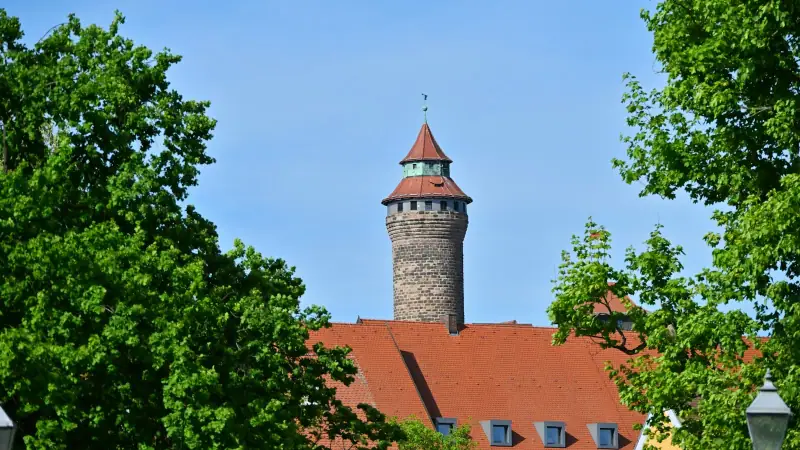
The Kaiserburg crowns a rocky spur north of the old town and serves as a landmark for the whole visit. During the Middle Ages, emperors of the Holy Roman Empire stayed here regularly, and Nuremberg enjoyed the privileged status of a free imperial city. The complex brings together several parts: the imperial fortress proper, the former burggrave’s castle and the buildings around the courtyard.
It is a short, gentle uphill walk from the old town. The visit lets you discover state rooms, a Romanesque double chapel and a very deep well, presented with a demonstration. From the terraces and the ramparts, the view opens onto the red roofs of the old town, the bell towers and the surrounding plain. Even if you do not visit the interiors, a walk around the gardens and fortifications is worthwhile, especially in good weather. Hours and ticket options vary by season: check them on the official website before you come.
Tip: go up in the early morning or late afternoon, when the light is soft and the groups are fewer.
The old town and the market square (Hauptmarkt)
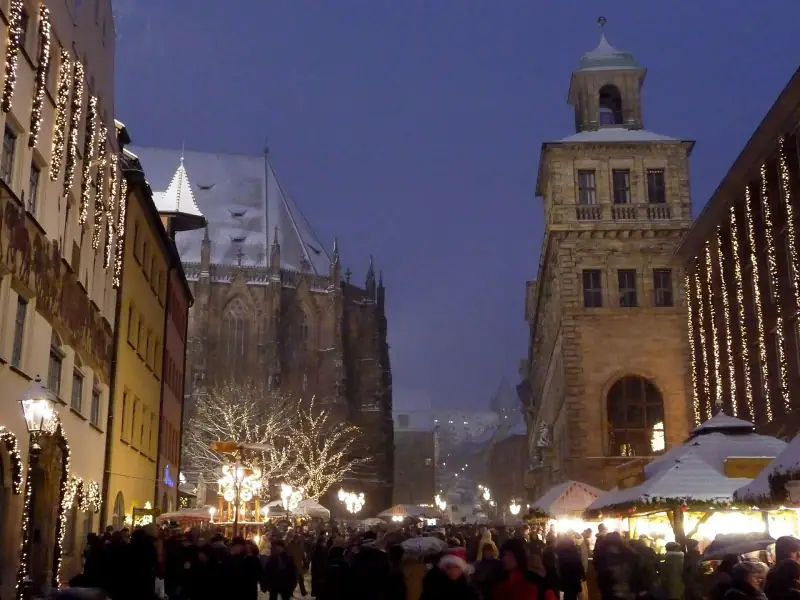
Nuremberg’s Altstadt is surrounded by a long medieval wall, one of the most impressive in Germany, punctuated by towers and gates. The Pegnitz crosses the center and divides it into two halves, around the churches of St. Sebald to the north and St. Lawrence to the south. All of it is easily covered on foot.
At the heart of the city, the Hauptmarkt is the main market square. Here you find the Schöner Brunnen, the “beautiful fountain”: a Gothic fountain shaped like a stone spire decorated with figures, topped by a gilded grille. According to tradition, you must turn a golden ring built into the grille to make a wish. On the east side of the square stands the Frauenkirche, a Gothic brick church whose mechanical clock, the Männleinlaufen, comes to life on the facade at noon: the figures of the prince-electors parade before the emperor.
The square hosts a daily market, with fruit, vegetables, flowers and regional products, except on Sundays. It is a good place to buy something for a picnic. A few steps farther, pedestrian streets lead to shops, cafés and the quiet lanes that border the river.
Where to stay in Nuremberg: the old town is the most practical area for doing everything on foot, a few minutes from the station. Prices rise sharply during the Christmas market and the big fairs: compare lodging for your dates and book early.
The churches of St. Sebald and St. Lawrence
The city’s two great churches deserve a visit. St. Sebald, north of the Pegnitz, is the older of the two. It holds the shrine of the city’s patron saint, a masterpiece of Renaissance metalwork from the workshop of Peter Vischer. The outer walls keep traces of the postwar reconstruction.
St. Lawrence, on the south bank, impresses with its two-tower facade and its large Gothic nave. Inside, a large sculpture hanging in the choir, the Annunciation (Englischer Gruss), by Veit Stoss, and a slender stone tabernacle are among the treasures of the city’s art. Both churches are quiet places for a break between two walks.
Albrecht Dürer’s house
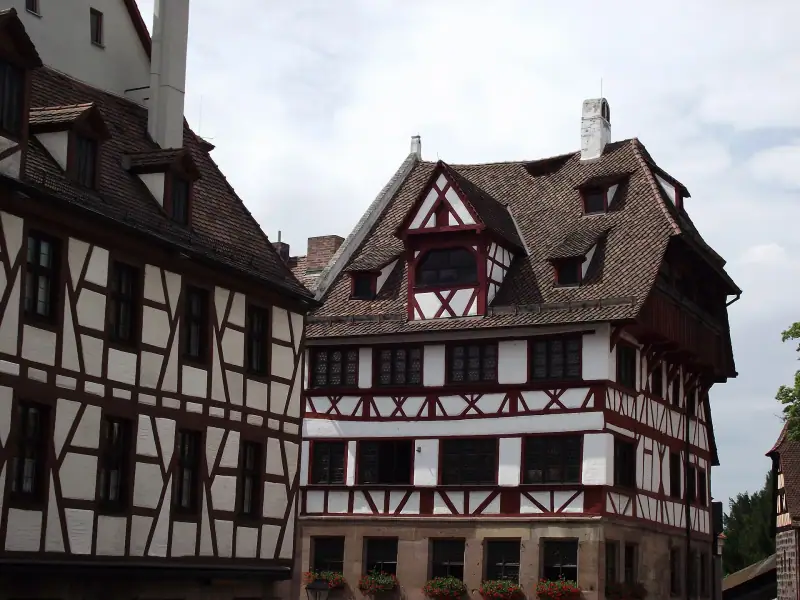
Albrecht Dürer, born in Nuremberg in 1471, is the most famous painter and engraver of the German Renaissance. He lived in a half-timbered house near the castle during the last years of his life. Now open to the public, it presents the daily life of a great Renaissance artist, with a reconstructed workshop and explanations of engraving and printing techniques.
It is a human-scale museum, visited in about an hour. Visitors appreciate the atmosphere of the house, its narrow rooms, its wooden stairs and its small garden. You will also come across another memory of the artist in the city: the famous Dürer hare, reproduced in every form in the shops.
The picturesque areas: Weissgerbergasse and Henkersteg
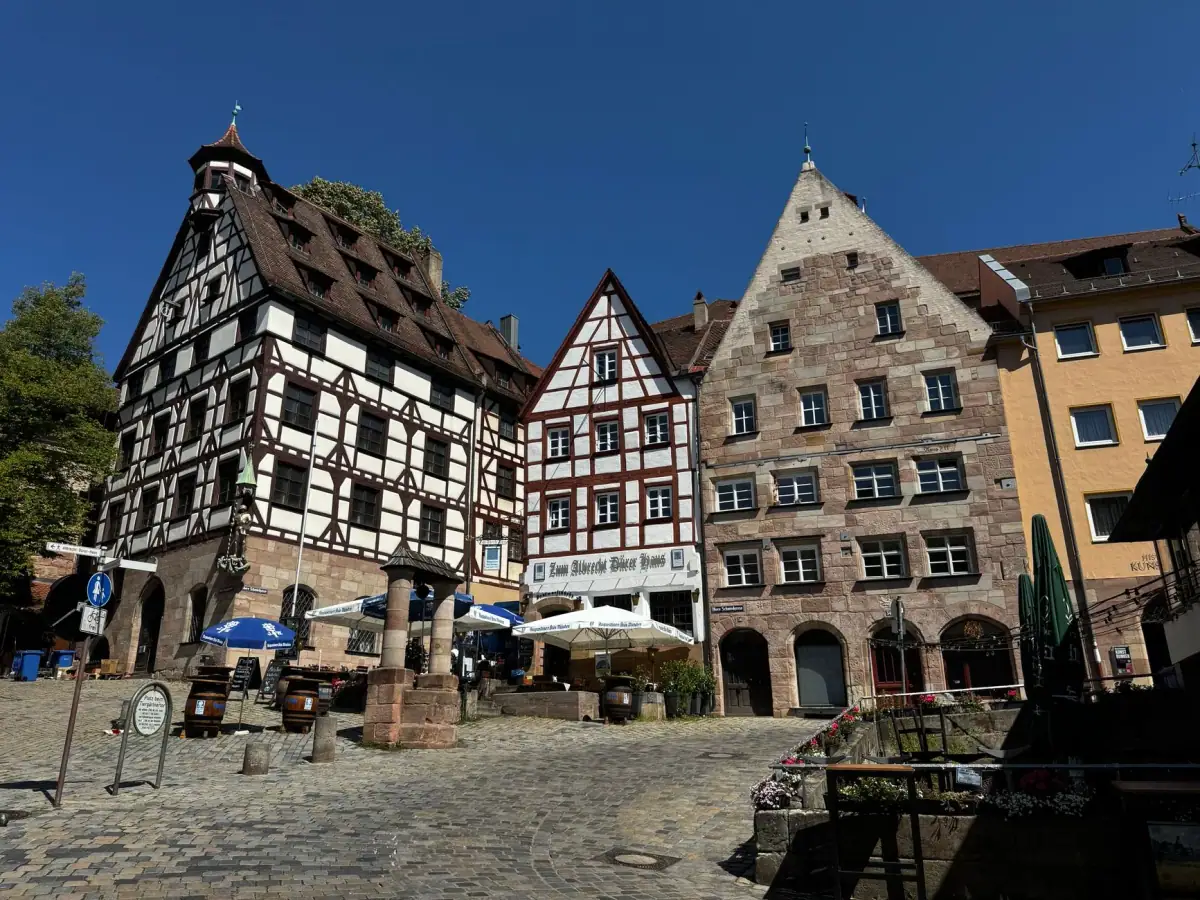
To get off the main axes, stroll along Weissgerbergasse, a cobbled lane lined with restored half-timbered houses whose upper floors overhang the street. It is one of the most photogenic corners of the old town. Farther down, along the Pegnitz, the Henkersteg (the “hangman’s bridge”) is a small covered wooden bridge, with a tower of the old wall in the background and a former wine storehouse whose gables are reflected in the water.
In the same area, the Handwerkerhof is a reconstruction of craftsmen’s lanes, set near the station. The place is very touristy, but handy for tasting a first Bratwurst or buying a souvenir. For a more authentic experience, favor the shops and cafés of the neighboring streets.
The Reichsparteitagsgelände documentation center
Nuremberg cannot be visited without touching on its contemporary history. In the 1930s, the Nazi regime held its big annual rallies here on a vast site on the southeast outskirts of the city, the Reichsparteitagsgelände. Some monumental buildings were never completed and are now preserved as testimony.
The documentation center (Dokumentationszentrum) is set in the wing of the former Congress Hall, an immense unfinished horseshoe-shaped building. The route shows, with documents, images and explanations in several languages, how the regime took power, staged its propaganda and led to catastrophe. The visit is demanding but essential for understanding the history of Germany. Allow about two hours and keep time to walk a little around the site. You get there by public transport from the city center.
The Palace of Justice and the Nuremberg trials
After the war, it was Nuremberg’s Palace of Justice that hosted the trial of the main leaders of the Nazi regime before an international military tribunal, starting in late 1945. This trial laid the foundations of modern international criminal law. The large courtroom, Room 600, is still used by the courts and can only be visited when it is free, so you need to check the access conditions in advance.
A museum set in the building, the Memorium Nuremberg Trials, retraces the course of the trial, its actors and its consequences, using documents, films and testimonies. It is a valuable complement to the visit of the Reichsparteitagsgelände. The two places are close to the center and can be combined on the same day, provided you are ready for a serious immersion.
Nuremberg’s museums
The city has many museums. The Germanisches Nationalmuseum, near the Street of Human Rights, is the largest museum devoted to the art and culture of the German-speaking countries. It brings together collections that run from prehistory to modern times: paintings, sculptures, musical instruments, toys and everyday objects.
Nuremberg is also known for its toys. The toy museum, set in the old town, appeals to children as well as nostalgic adults. The DB Museum, the railway museum, retraces the history of German rail: the country’s first railway line linked Nuremberg to Fürth in 1835, which gives the city a special place in this history. For those who like the unusual, underground galleries dug beneath the city, the Historische Felsengänge, once served as beer cellars and wartime shelters, and can be visited with a guide.
Visit with a guide: to understand the history of the city, from the Middle Ages to the 1945 trial, compare the guided tours offered in Nuremberg. Check the duration, the language of the tour and what is included before you book.
The Christmas market (Christkindlesmarkt)
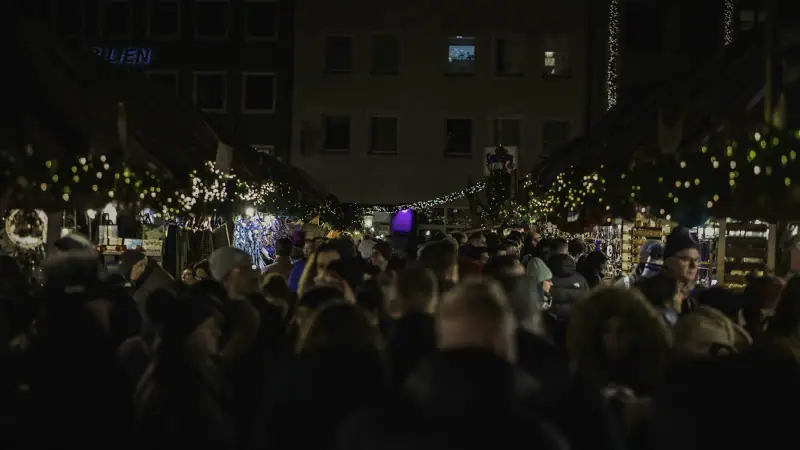
Nuremberg is famous across Europe for its Christkindlesmarkt, one of the oldest and best-known German Christmas markets. It sets up on the Hauptmarkt during Advent, with its small red-and-white wooden stalls. Its opening is marked by a prologue spoken from the balcony of the Frauenkirche by a young woman dressed as an angel, the Christkind. For the 2026 dates, the hours and our practical tips, see our guide to the Nuremberg Christkindlesmarkt.
You find wooden decorations, prune figurines and Lebkuchen, the local gingerbread, to take home in pretty metal tins. Mulled wine (Glühwein) is served in ceramic mugs that are often collected. The market is very busy, especially on weekends: come on a weekday and in the late afternoon if you want to avoid the crush. For the other seasons, see our guide on when to go to Germany.
Eating in Nuremberg: Bratwurst, Lebkuchen and Franconian beer
The emblematic specialty is the Nürnberger Rostbratwurst: a small grilled sausage, thin and spiced with marjoram. It is generally ordered in portions of six, eight or twelve, with sauerkraut or potato salad, or in a small round roll, the “Drei im Weggla” (three sausages in a roll). The sausage has a protected geographical indication at European level.
For sweets, Lebkuchen are the city’s gingerbread, sometimes covered with chocolate or icing. They are sold everywhere in the run-up to Christmas. For drinks, Franconia is a brewers’ region: you will find dark, light or smoked beers in the old town taverns, as well as Franconian wines, served in a typical rounded bottle, the Bocksbeutel. For an overview of the country’s cooking, read our guide to German food specialties.
If you prefer a guided experience, a food tour or a tasting is a pleasant way to discover these flavors in good company.
Getting around and organizing
Nuremberg is a big rail hub in southern Germany. From Munich, fast trains reach the city in a little over an hour; Frankfurt, Würzburg and Regensburg are also well connected. The station sits right at the foot of the old town, which is very handy. The airport is also reachable by public transport from the center. Entry rules depend on your passport. Check the official travel advice of your government before you book: travel.state.gov (US), GOV.UK (UK), travel.gc.ca (Canada), Smartraveller (Australia) (checked November 2026). Our entry requirements for Germany detail the points to check.
In the city, the old town is explored on foot. The U-Bahn, trams and buses serve the farther neighborhoods, such as the Reichsparteitagsgelände. A car is not necessary to visit the city, but it can be useful for exploring the region: you can compare rental companies. Also consider travel insurance to cover medical mishaps or cancellations. For the overall budget of a stay, our guide to the budget for Germany details the main spending items.
A typical day in Nuremberg
Start at the Hauptmarkt in the morning, when the market sets up, then walk up to the Kaiserburg through the lanes. Come down past Dürer’s house and stroll along Weissgerbergasse, before having lunch in an old town tavern: it is the chance to taste the Rostbratwürste.
In the afternoon, choose between history and museums. If you are ready to go deeper into the 20th century, head to the documentation center, then, if time allows, to the Memorium of the trials. Otherwise, stop by the Germanisches Nationalmuseum or the toy museum. At the end of the day, cross the Pegnitz by the Henkersteg and finish the evening in a traditional beer hall.
A second day lets you extend with the underground galleries, the DB Museum, a walk on the ramparts or an excursion in the region.
Excursions from Nuremberg
Nuremberg’s central position makes it a good base. Bamberg, a UNESCO site, is an intact medieval town, known for its smoked beer (Rauchbier); it is reachable by train in under an hour. Würzburg and its Baroque Residenz are about an hour away by train. Rothenburg ob der Tauber, a very busy medieval town on the Romantic Road, is reached by train with a change, or by car. Regensburg, on the Danube, is another medieval UNESCO stop.
To continue toward southern Bavaria, our 3-day Munich itinerary follows on easily, and you can reach the Alps and Neuschwanstein Castle. For another town with character farther west, compare with Heidelberg, more romantic and more compact.
Excursions around Nuremberg: to leave the city, compare day excursions in the region, between Bamberg, Rothenburg and Franconia. Check the departure point, the duration and the season before you book.
Combining Nuremberg with other destinations
Nuremberg fits well into a train circuit through the heart of Germany. A classic sequence links Berlin, Nuremberg and then Munich, with a day devoted to Bamberg or Rothenburg. Connections are frequent, and it is useful to book long-distance trips in advance for a weekend or during school holidays.
Who is Nuremberg for?
Nuremberg will please travelers who like history, whether medieval or contemporary, and the curious who want to understand Germany beyond its postcards. The city suits a weekend, a stop between Munich and Berlin or a stopover in Franconia. Its strength is the richness of its layers: an imperial castle, Gothic churches, the memory of the 20th century and a generous table. Fans of lighter or more romantic towns may prefer Heidelberg, but for a visit rich in meaning, Nuremberg easily deserves one or two nights.
Frequently asked questions
How long do you need to visit Nuremberg?
One day is enough for a tour of the old town, the imperial castle and one or two museums. With two days, you add the documentation center on the former Nazi rally grounds, the Palace of Justice and a long break in the old town taverns.
What are the must-sees in Nuremberg?
The imperial castle (Kaiserburg), the market square (Hauptmarkt) and its Schöner Brunnen, Albrecht Dürer's house, the churches of St. Sebald and St. Lawrence, and the Reichsparteitagsgelände documentation center to understand the city's past.
Was Nuremberg destroyed during the war?
Yes. The bombings of 1945, in particular the one in early January, devastated the old town. The major monuments, the walls and many neighborhoods were rebuilt after the war, often identically, which gives the medieval look you see today.
Can you visit Nuremberg from Munich?
Yes, it is a common excursion. Fast trains link Munich to Nuremberg in a little over an hour. To enjoy the city without rushing, a one-night stay is better than a day return trip.
What is the Nuremberg Christkindlesmarkt?
It is one of the most famous Christmas markets in Germany. It sets up on the market square during Advent and brings together stalls of decorations, Lebkuchen and mulled wine. It is very busy: book your lodging well in advance.
What should you eat in Nuremberg?
Nürnberger Rostbratwürste, small grilled sausages served several at a time in a bread roll or with sauerkraut or potato salad, and Lebkuchen, the city's gingerbread. The region is also known for its Franconian beers.
Is Nuremberg suitable for a stay with kids?
Yes. The castle, the walls, the Christmas market and the toy and railway museums appeal to children. The old town is largely pedestrian, but the cobbled streets and slopes call for comfortable shoes.
More Germany guides
Keep reading
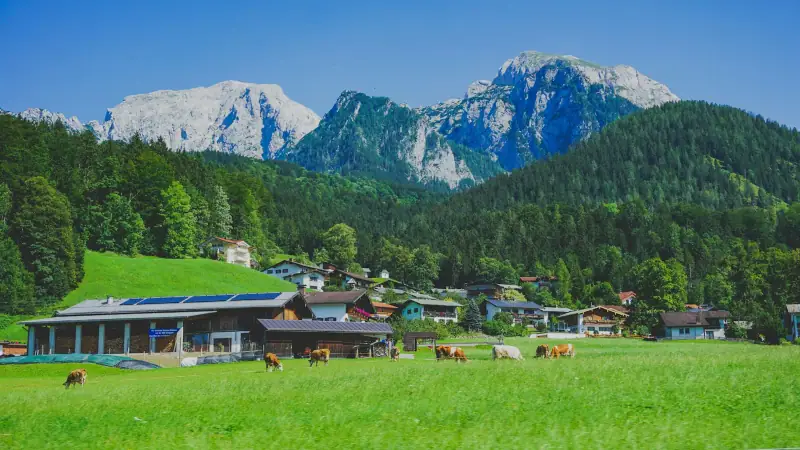
What to see in Bavaria: Munich, castles, the Alps and medieval towns
What to see in Bavaria: Munich, Neuschwanstein, the Romantic Road, Bamberg, Regensburg, Berchtesgaden and the Alps. Tips for planning your trip.
What to see in Berlin and Brandenburg: Potsdam, the Spreewald and nature escapes
What to see around Berlin: Potsdam and its palaces, the Spreewald by boat, the Rheinsberg lakes, the Schorfheide and Brandenburg's memorial sites.
Complete guide to visiting Germany: cities, regions, budget and tips
Visiting Germany: regions, must-see cities, when to go, how to get there and around, where to stay and budget. The main guide for planning your trip.
Ready-made
Germany itineraries
3 days
Munich in 3 days: an itinerary through the old town, museums and parks
What to do in Munich in 3 days? Marienplatz, Residenz, Englischer Garten, Nymphenburg, museums and beer halls: a day-by-day itinerary with practical tips.
3 days
Berlin in 3 days: a day-by-day itinerary
What to see in Berlin in 3 days: Brandenburg Gate, Reichstag, Museum Island, Wall memorial, Potsdam and neighborhoods. A clear day-by-day itinerary.
3 days
Black Forest in 3 days: a road trip itinerary from Baden-Baden to Freiburg
A 3-day Black Forest itinerary: Baden-Baden, Triberg, Gutach, Freiburg im Breisgau, Titisee and Feldberg. Stops, drives, tips and where to stay.