What to see
What to See in the Brazilian Amazon: Beyond Manaus, Anavilhanas, Alter do Chão and Belém
We may earn a commission when you book through links on this page, at no extra cost to you. We don't visit or try the places we cover: we summarize published sources. How we work
In short
- Four main hubs stand out: Anavilhanas National Park and Novo Airão on the Rio Negro, Alter do Chão and the Tapajós National Forest, Belém with the Ver-o-Peso market, and Parintins for its late-June festival.
- Allow at least four to five days for a single base; to combine two distant hubs such as Manaus and Belém, plan nine to ten days, with travel mostly by plane or boat.
- There is no bad season: high water (roughly December to May) means exploring flooded forest by canoe; the drier period (about June to November) brings river beaches such as Ilha do Amor.
- For the forest and river excursions, a lodge or an established agency is simpler and safer: mobile coverage is patchy and distances are deceptive.
When people talk about the Amazon in Brazil, they almost always think of Manaus. Yet the Amazon region is an immense territory, larger than many countries, that can be approached through very different doors: an archipelago of more than four hundred islands on the Rio Negro, freshwater beaches on the Tapajós, a port city rich in flavors such as Belém, or an island where people come to dance and sing at the end of June. This article complements the guide on Manaus by showing what to see elsewhere in the Amazon, how to choose your stop and how to travel with care.
Understanding the Brazilian Amazon before choosing
The Brazilian Amazon covers several states, including Amazonas, whose capital is Manaus, and Pará, whose capital is Belém. Here distances are those of a continent: you move from one stop to the next by plane or boat, rarely by car. A map of the region helps avoid underestimating journeys, and it is better to limit yourself to one or two hubs for a stay of less than two weeks.
The river sets the rhythm of everything. The water level changes strongly between the high-water season and the drier season, which changes the landscapes, the beaches and the possible activities. To choose your dates, read the article when to go to Brazil. To place the Amazon in a wider trip, the complete guide to Brazil gives an overview.
There are three main ways to discover the region:
- The forest and river from Manaus, with lodges, canoe excursions and Anavilhanas park.
- The freshwater beaches of western Pará, around Santarém and Alter do Chão.
- The city and culture in Belém, at the mouth of the Amazon system, and popular festivals such as Parintins.
Anavilhanas National Park, an archipelago on the Rio Negro
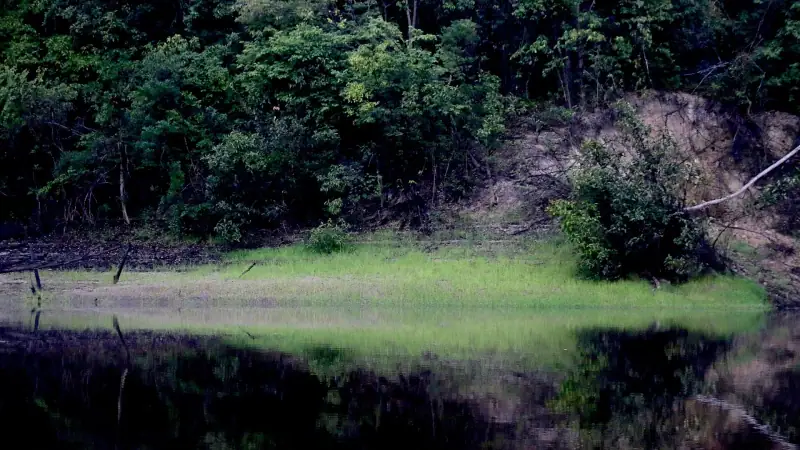
Anavilhanas National Park, managed by the Brazilian institute ICMBio, covers about 350,000 hectares (865,000 acres) and groups more than four hundred river islands. It is often presented as one of the largest river archipelagos in the world. It lies on the Rio Negro, upstream of Manaus, and the small town of Novo Airão, where the park’s administrative base is, is its gateway.
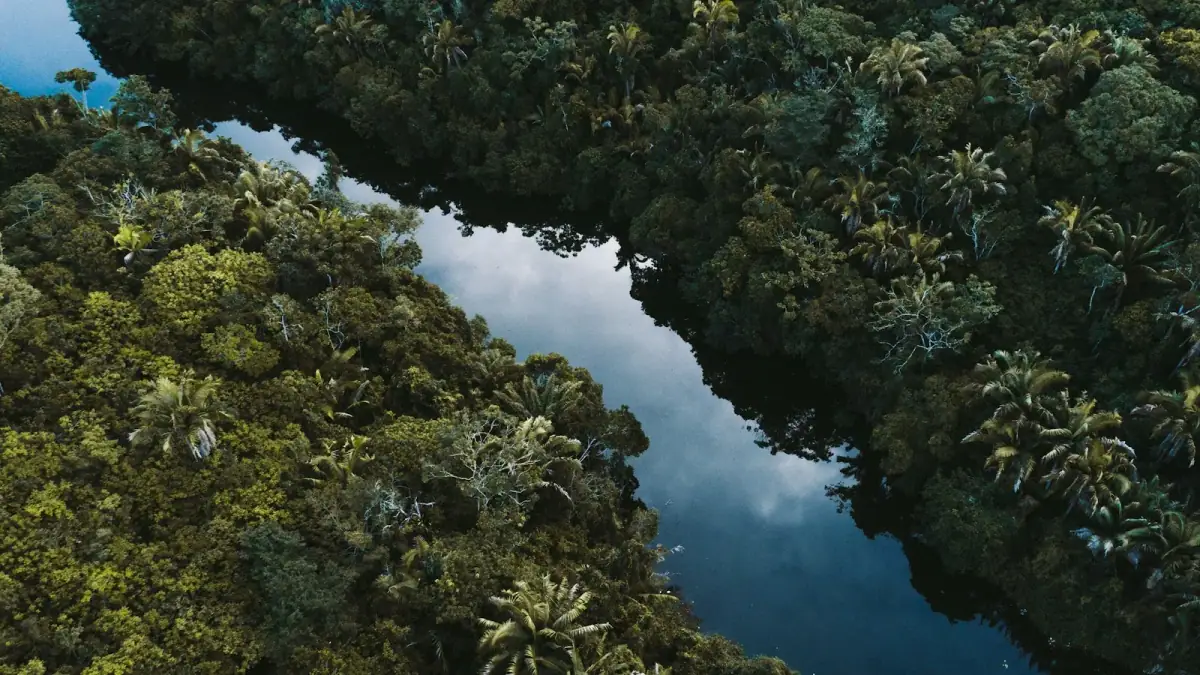
The landscape changes deeply with the water level. At high water, a large part of the islands is flooded, and you navigate between trunks in the flooded forest called igapó: it is a calm, almost silent experience, very different from the upland forest. In the drier period, sand beaches appear along the river and walks on foot become easier.
Common activities are boat rides, birdwatching, short forest walks with a guide and swimming in the dark waters of the Rio Negro, where guides allow it. You can visit the park on a day excursion from Manaus or combine it with one or more nights in a lodge. Schedules, access rules and fees change: check the park’s page on the ICMBio site before booking.
A word on pink dolphins (botos). Novo Airão is known for its arrangements for watching and interacting with these animals. These practices are debated among environmental specialists. If you want to see the dolphins, favor a respectful approach: watching from a distance, no food given outside the official framework, no forced contact. Ask the operator how it manages the activity.
The Rio Negro has a particularity: its dark, acidic waters shelter fewer mosquitoes than white-water rivers. That does not remove the need for protection, especially at dusk and under the canopy. Bring a suitable repellent.
Staying in a lodge: how to choose
A forest stay is the heart of the Amazon experience, and the choice of lodging conditions everything else. A few simple criteria let you compare seriously.
The type of lodging. Some lodges offer real rooms with a fan or air conditioning, others hammocks under a large roof, others still stilt cabins. The more rustic the lodging, the closer nature is, but the more you must accept humidity, night noises and insects.
Supervision. A good lodge works with local guides who know the forest, speak at least English and explain the safety rules. Ask for the guide-to-visitor ratio, the guides’ training and the swimming instructions.
Transport. The trip from Manaus is by boat, by car or a combination of both. Check who organizes it, what is included and what happens in case of a storm.
Local impact. Favor lodges that employ people from the region and work with riverside communities. Avoid offers promising “guaranteed” encounters with wild animals: wildlife cannot be ordered, and encounters that are too easy often hide questionable practices.
Price. An offer far below the others is a warning sign. Guides you meet at random on a dock are not necessarily registered or insured. For a first experience, an established agency or lodge is preferable. See the guide where to stay in Manaus for nights in town before and after the forest, and the budget for Brazil to estimate the whole.
Amazon excursions
River navigation, flooded forest, wildlife watching: compare the excursions offered in the Amazon.
Alter do Chão and the Tapajós, the “Amazonian Caribbean”
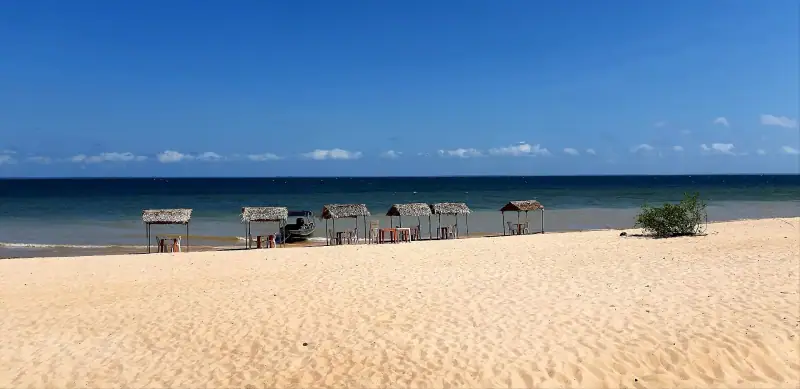
In the west of Pará state, the Tapajós River shows a very different face of the Amazon. Alter do Chão, a village (a district of the city of Santarém) on the water’s edge, is nicknamed the “Amazonian Caribbean” for its pale-sand beaches and clear waters. There is no airport in the village: you reach it through Santarém airport, about thirty kilometers (19 mi) away, then by road.
The most famous attraction is Ilha do Amor, a sandbar facing the village reached in a few minutes by a short crossing in a small boat. It is fully visible only when the water recedes, generally from August to the end of the year, as the water level drops. At high water, the beach shrinks or disappears: ask locally before planning your visit around this beach.
Around Alter do Chão, several excursion ideas exist:
- The Morro da Piraoca viewpoint, a hill that offers a panorama of the river and forest. Go early in the morning or late in the afternoon to avoid the hottest hours.
- Sunsets, on the village’s banks or from a boat.
- The Tapajós National Forest (Flona do Tapajós), a large protected area of more than 500,000 hectares (1.2 million acres) that spans several municipalities. It allows forest walks with a guide and visits to riverside communities that work with community tourism.
- The village itself, with its artisans, river fish restaurants and small shops.
The village also has a cultural highlight, the Sairé, a traditional popular festival tied to local traditions. It draws many people: if you want to see it, check the dates announced by local authorities and book your lodging long ahead.
To reach Alter do Chão from the rest of Brazil, you generally have to fly to Santarém (with connections). Check the links and durations when booking. A stop of two or three nights is a good compromise for enjoying the beaches, the forest and the village’s rhythm.
In Santarém itself, the meeting of the Tapajós and Amazon waters is another phenomenon to watch from the bank, with waters of different colors flowing side by side. It is less known than the one in Manaus, but its surroundings are quieter.
Belém, the gateway to the Amazon at the river’s mouth
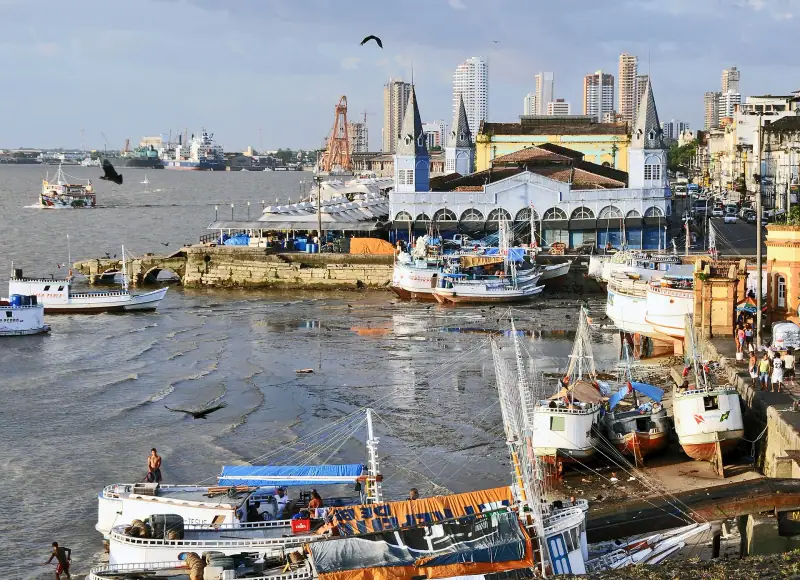
Belém, capital of Pará state, is a large port city on Guajará Bay. It is less visited than Manaus, which gives it an authentic charm: colonial lanes, mango trees lining the avenues, the atmosphere of a living port and food of rare richness.
The most emblematic site is the Ver-o-Peso complex, one of the oldest public markets in Brazil, protected by IPHAN (the Brazilian heritage institute) since 1977 and on Brazil’s UNESCO tentative list. It stretches along the water with its metal hall, its açaí fair, the Clock Square and its stalls: river fish, Amazonian fruits, medicinal herbs, cassava flours, condiments. Early morning is the best time, when fishermen unload their boats.
Next to it, the Estação das Docas is a group of former port warehouses turned into a leisure space with restaurants, cafés and shops, on the bay. The place is pleasant at the end of the day. Farther inland, the city also has the Theatro da Paz, a neoclassical theater, and several churches from the colonial period. Visiting hours and fees change: ask there.
Belém is also known for a very popular religious festival, the Círio de Nazaré, held in October. It draws a considerable number of pilgrims and sharply raises lodging prices: if you travel then, book long ahead.
On food, the city is a destination in itself: tacacá, a hot soup with tucupi and jambu, pato no tucupi (duck in tucupi), grilled river fish, açaí served alongside fish and cassava flour (and not as a sweet dessert as in the south of the country), and ice creams made from Amazonian fruits. To go further, see the Brazilian specialties.
Hotels in Belém
Compare accommodation in the historic center and in neighborhoods near the river for your travel dates.
Safety in Belém. As in other big Brazilian cities, street crime exists, notably around the port, the markets and in sparsely visited areas at nightfall. Keep valuables discreet, avoid walking alone in the evening, use ride-hailing apps for night trips and follow your government’s travel advice (travel.state.gov in the US, GOV.UK in the UK, travel.gc.ca in Canada, Smartraveller in Australia). A local guide for the morning market is a good way to enjoy the place in peace.
Parintins and its late-June festival

On an island in the Amazon River, in Amazonas state, the town of Parintins is known throughout Brazil for its folk festival of the bois-bumbás. Each year, around the end of June, two rival groups, Garantido (red and white) and Caprichoso (blue and white), face off over three evenings of songs, dances and staging in a purpose-built arena, the Bumbódromo. The shows tell legends of the Amazon and give pride of place to Indigenous cultures.
It is a spectacular experience, but one that is organized long in advance. You reach Parintins by boat or plane, lodging is scarce and expensive during the event, and the exact dates vary from year to year: check the official calendar before booking. Outside the festival, the town is much quieter and is visited as a peaceful river stopover, but the tourist interest is then more limited.
Marajó, Mamirauá and other stops to go further
If you have more time, other destinations exist. Marajó Island, a very large river island at the mouth of the Amazon, is known for its buffalo, river beaches and local culture; you reach it by boat from the Belém area, with a trip of several hours. The Mamirauá Sustainable Development Reserve, near Tefé, is a large area of flooded forest devoted to research and low-impact community tourism, with stays in floating lodging. These destinations require more preparation, a higher budget and a specialized operator: do not improvise them.
Whatever you choose, keep in mind that the Amazon is visited slowly. It is better to have fewer, longer stops than to run from one point to another in a region where a day of transport is enough to exhaust a program.
Some combination ideas by duration
5 to 6 days: Manaus and Anavilhanas. Two nights in Manaus for the historic center and the meeting of the waters, then two or three nights in a lodge or around Anavilhanas. It is the simplest formula for a first approach.
8 to 10 days: Manaus and Alter do Chão. Five days around Manaus and the forest, then a flight to Santarém and three days of beaches and forest around Alter do Chão. Check flight connections, which are not always direct.
10 days or more: Belém, Alter do Chão and Manaus. A route from east to west, from the port city of Belém to the Tapajós beaches, then to Manaus and the forest. It requires domestic flights and good organization, but it offers three very different faces of the Amazon.
Combined with the rest of the country. The Amazon is often added to a trip on the coast. The two-week itinerary helps you place the stops relative to one another.
Health, safety and equipment for the Amazon
Health. Mosquitoes can transmit diseases in the Amazon, and requirements and recommendations depend on your route and change over time. Ask your doctor or a travel clinic several weeks before departure, and see the official travel health pages (CDC in the US, TravelHealthPro in the UK). The page on health, safety and entry requirements for Brazil summarizes the points to check.
Safety. In town, apply the usual precautions: discretion, ride-hailing in the evening, valuables at the hotel. In the forest and on the water, follow the guides’ instructions, never enter the water without their agreement, do not stray from the group, and tell the operator of any existing health problem.
Equipment. Light long-sleeved clothing, closed shoes suited to the forest, a light rain jacket, hat, sunscreen, water bottle, waterproof bag for electronics, headlamp and repellent. If you sleep in rustic lodging, a travel mosquito net brings real comfort. You will find more ideas in the article on useful accessories for Brazil.
Staying connected and handling money
Mobile coverage is decent in towns such as Manaus, Belém or Santarém, but it often disappears as soon as you leave inhabited areas: on the river, in lodges, in parks. Download your maps, tickets and reservations before heading into the forest. Check your carrier’s international plan, or use a travel eSIM, which is useful for ride-hailing, maps and messages in town. The article on the SIM card and eSIM in Brazil compares the options.
Mobile internet in Brazil
Saily offers eSIM plans in more than 150 countries: check the offer for Brazil before you leave.
Bank cards are accepted in towns, but carry cash for small villages, markets, riverside communities and excursions where card payment is not possible. Withdraw it at shopping-mall or hotel ATMs rather than in the street.
Traveling responsibly in the Amazon
The Amazon is a fragile ecosystem and a territory where riverside communities and Indigenous peoples live. A few common-sense rules: do not bring back any souvenir made from feathers, bones, teeth or skins of wild animals; do not feed animals; leave no waste in the forest or on the river; always ask permission before photographing a person; favor operators that work with local communities and pass on a share of the revenue. Visits to communities must remain respectful and not resemble shows: if an offer makes you uncomfortable, you can decline it.
Sources
Frequently asked questions
What is there to see in the Brazilian Amazon outside Manaus?
Four main hubs stand out: Anavilhanas National Park and Novo Airão on the Rio Negro, Alter do Chão and the Tapajós National Forest in western Pará, Belém with the Ver-o-Peso market and the Estação das Docas, and Parintins for its late-June festival. The choice depends on your time and the time of year.
How long should you plan for the Amazon?
Allow at least four to five days for a single base (Manaus and its surroundings, for example). To combine two distant hubs, such as Manaus and Belém, plan nine to ten days, because distances are large and links are mostly by plane or boat.
When should you go to see the Amazon?
There is no bad season, only different assets. At high water (broadly December to May), you explore the flooded forest by canoe. In the drier period (roughly June to November), river beaches appear, such as Ilha do Amor near Alter do Chão, and forest walks are easier.
Do you need vaccines to travel in the Amazon?
Health requirements for the Amazon depend on your itinerary and change over time. Ask your doctor or a travel clinic well before departure, and see the official travel health pages (CDC in the US, TravelHealthPro in the UK), including for mosquito protection.
Can you watch pink dolphins responsibly?
Yes, provided you favor watching from a distance, without feeding or touching the animals. Some direct-contact practices are debated by environmental specialists: choose an operator that explains its rules and follows those of the park authorities.
Is the Amazon dangerous for a traveler?
The main risks are mosquito bites, heat, and pickpocketing in cities such as Manaus and Belém. In the forest, traveling with a local guide and a reputable operator greatly reduces the risks. Read your government's travel advice before leaving.
Can you go to the Amazon without an agency?
It is possible in the towns (Belém, Santarém, Alter do Chão), where you can manage alone. For the forest, lodges and river excursions, using a lodge or an established agency is simpler and safer, because mobile coverage there is patchy and distances are deceptive.
More Brazil guides
Keep reading
What to See in Northeast Brazil: Beaches, Dunes and Colonial Towns
What to see in Brazil's Northeast: Recife, Olinda, Porto de Galinhas, Jericoacoara, Lençóis Maranhenses, Fernando de Noronha. Tips, seasons and safety.

What to See in the Pantanal: Jaguars, Transpantaneira, Miranda and Bonito
What to see in the Pantanal: Porto Jofre jaguars, Transpantaneira, Corumbá, Miranda and Bonito. Seasons, wildlife, safety and tips to choose well.
What to See in Southern Brazil: Curitiba, Gramado, Florianópolis
What to see in southern Brazil: Curitiba, Serra Gaúcha, canyons, Santa Catarina, Florianópolis and Foz do Iguaçu. Tips, seasons and safety.
Ready-made
Brazil itineraries
15 days
2-Week Brazil Itinerary: Rio, Paraty, Iguaçu and Salvador
Rio de JaneiroParatyFoz do IguaçuSalvador de Bahia