What to see
The Spanish Basque Country: what to see beyond San Sebastián (Bilbao, Guernica, Vitoria…)
We may earn a commission when you book through links on this page, at no extra cost to you. We don't visit or try the places we cover: we summarize published sources. How we work
In short
- The Spanish Basque Country has three provinces: Gipuzkoa (San Sebastián), Biscay (Bilbao) and Álava (Vitoria-Gasteiz). San Sebastián to Bilbao is about 100 km (62 mi).
- Bilbao deserves at least a full day for the Guggenheim, the Casco Viejo and the Vizcaya Bridge; Guernica is about 35 km (22 mi) away.
- San Juan de Gaztelugatxe (more than 200 steps) generally needs an online time slot booked ahead, especially in high season.
- Buses are enough between the big cities; a car helps for the Biscay coast, Gaztelugatxe and the Rioja Alavesa.
When people talk about the Spanish Basque Country, many travelers first think of San Sebastián and its pintxos. It is an excellent gateway, but the region offers much more: a metropolis transformed by contemporary architecture, fishing villages clinging to the coast, a legendary islet reached by a staircase, a city that symbolizes peace and vineyards at the foot of the mountains.
This guide helps you understand how the region is organized and what is worth the detour in each of its three provinces. If San Sebastián is already on your program, our guides Visiting San Sebastián and San Sebastián in one day from the Basque coast detail the city; here, we widen the view.
Understanding the geography of the Spanish Basque Country
The Basque Autonomous Community is made up of three provinces, from east to west and south:
- Gipuzkoa, bordering France, with San Sebastián, Hondarribia, Pasaia, Getaria and Zarautz;
- Biscay (Bizkaia), to the west, with Bilbao, Guernica and a wild coast;
- Álava (Araba), to the south, which includes Vitoria-Gasteiz, the administrative capital, and the Rioja Alavesa.
Neighboring Navarre, with Pamplona, belongs to the Basque world culturally but is a separate autonomous community: we do not cover it here.
To give a sense of distances: San Sebastián is about 50 km (31 mi) from Biarritz, Bilbao about 150 km (93 mi), and Vitoria-Gasteiz about 120 km (75 mi) from San Sebastián. Between San Sebastián and Bilbao, it is about 100 km (62 mi). These distances let you link everything by car without long days on the road.
Bilbao: the reinvented metropolis
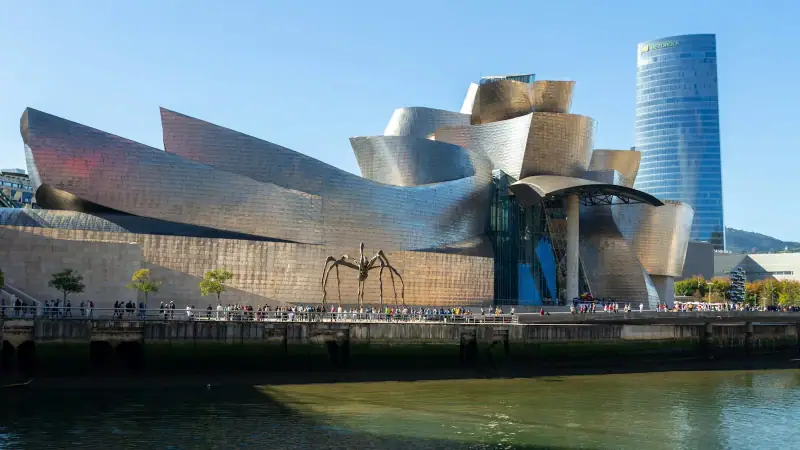
Bilbao is the largest city in the region, with an urban population well above that of San Sebastián. A former industrial and port city, it went through a spectacular cultural conversion from the late 1990s.
The Guggenheim Museum
Opened in 1997 and designed by the architect Frank Gehry, the Guggenheim Museum is the emblem of this renaissance. Its titanium volumes, which change appearance with the light, can also be discovered from outside, on the banks of the estuary (ría): the giant floral dog and the monumental spider at the entrance have become famous. For the interior visit, check hours and fares on the museum’s official website, as temporary exhibitions change regularly.
The Casco Viejo
Bilbao’s old town, the “Siete Calles” (seven streets), is explored on foot. You find Santiago Cathedral, the Plaza Nueva surrounded by arcades, and many pintxos bars. The atmosphere is more local than in San Sebastián’s Parte Vieja, with regulars doing the round at the end of the day. Our guide to pintxos in San Sebastián explains the rules of the round, which also apply in Bilbao.
Other useful visits
- The Fine Arts Museum, which gathers a fine collection ranging from old to contemporary art;
- The Vizcaya Bridge (Puente Colgante), between Portugalete and Getxo, a UNESCO World Heritage site: a transporter bridge put into service in the late 19th century, still operating;
- The Artxanda funicular, which offers a panorama of the city and the ría.
Plan at least one full day, ideally two if you want to add a museum and an evening of pintxos.
Where to stay in Bilbao
Casco Viejo, the Guggenheim district or Abando: compare accommodation by your dates and budget, as weekends and big events push prices up.
Guernica: memory and a symbol of peace
About 35 km (22 mi) from Bilbao, Guernica (Gernika in Basque) is known around the world for the bombing it suffered in April 1937, during the Spanish Civil War. This event inspired Picasso’s painting Guernica, now exhibited in Madrid and not on site.
What to see there
- The Peace Museum (Gernika Bakearen Museoa), which explains the context of the civil war and the values of peace;
- The Casa de Juntas and the Tree of Gernika, a symbolic place of Basque freedoms, where Biscay’s representatives historically met under an oak;
- The Monday market, an old local tradition, which brings the town to life.
The visit takes half a day. It combines well with the nearby Urdaibai Biosphere Reserve, an estuary appreciated by nature and bird lovers.
The Biscay coast: Gaztelugatxe and the wild villages
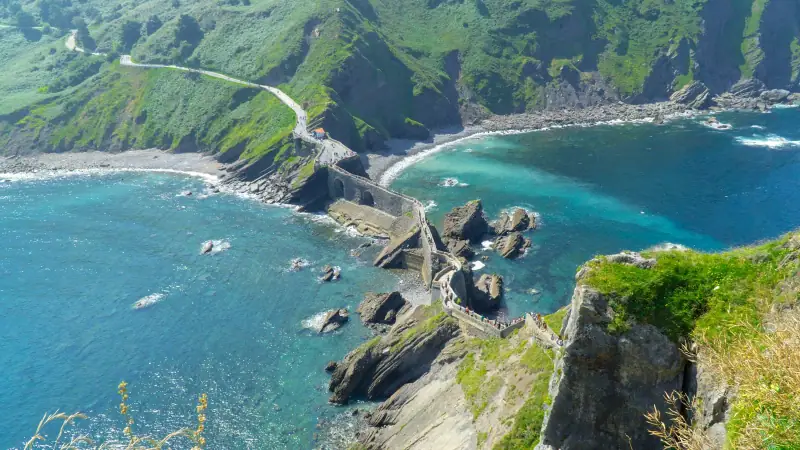
The Biscay coast is wilder and steeper than that of Gipuzkoa. It is best discovered by car, from Bilbao or Guernica.
San Juan de Gaztelugatxe
This is one of the most photographed sites in the Basque Country: a rocky islet linked to the land by a stone bridge, topped by a small hermitage. A long staircase of more than 200 steps leads up to it. Access is regulated to limit visitor numbers: you generally have to book a time slot online in advance, especially in high season. Check the conditions on the official Biscay website before leaving. Wear good shoes: the steps are uneven and slippery in wet weather.
Bermeo, Mundaka and Elantxobe
A few fishing villages punctuate this coast. Bermeo is an active fishing port, Mundaka is known to surfers for its famous left-hand wave, and Elantxobe stacks its colorful houses on a steep slope above the sea. We suggest stopping there for a fish lunch, without trying to see everything: the coast is best savored slowly. Details on board sports on the French side are in our guide to surfing in Biarritz.
Excursions from Bilbao
Guided tours, day trips to Guernica and the Biscay coast: compare the activities available for your dates.
Gipuzkoa: ports, beaches and coastal villages
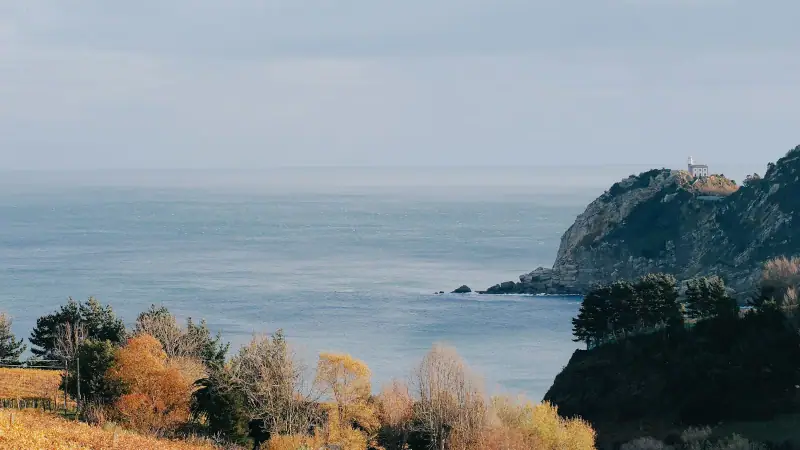
Gipuzkoa, closer to France, lends itself very well to a day trip from Hendaye, Saint-Jean-de-Luz or Biarritz.
Hondarribia (Fuenterrabía)
Located just opposite Hendaye, across the Bidasoa, Hondarribia combines a fortified upper town, with cobbled lanes and colorful wooden balconies, and a fishermen’s district (the Marina) lined with painted houses. The boat crossing from Hendaye is short and makes a pleasant change of scene, as our guide Visiting Hendaye details.
Pasaia (Pasajes)
This enclosed port, a few kilometers from San Sebastián, is organized around a narrow channel. A small boat lets you cross from one bank to the other. People come for the maritime atmosphere and its narrow lanes, more authentic than touristy.
Getaria and Zarautz
Getaria is a charming fishing port, known for its grilled fish and its txakoli vineyard, a light, slightly sparkling white wine produced on the neighboring slopes. The town is also the birthplace of the couturier Cristóbal Balenciaga, to whom a museum is devoted. Zarautz, very close, has one of the longest beaches in the region, much appreciated by surfers and families. Both towns are less than 30 km (19 mi) from San Sebastián, which makes them easy getaways.
To know what to taste along the way, our article on Basque specialties helps you spot the essentials.
Vitoria-Gasteiz: the quiet capital
Often forgotten on tourist circuits, Vitoria-Gasteiz is the administrative capital of the autonomous community. It appeals with its medieval center shaped like a snail shell, its vast central square (Plaza de la Virgen Blanca) and its Santa María Cathedral, whose restoration work can be visited with a helmet and a guide.
The city was named European Green Capital in 2012, and its green ring (Anillo Verde) of parks and wetlands on the outskirts can be covered on foot or by bike. It is also calmer and cheaper than its neighbors. Allow half a day to a day, coming from San Sebastián or Bilbao.
The Rioja Alavesa
In the south of Álava, at the foot of the Sierra de Cantabria, lies the Rioja Alavesa, a renowned vineyard whose center is the fortified village of Laguardia. If you like wine, a day of tasting there is a lovely interlude. Book winery visits in advance and plan on a sober driver or a guided visit with transport.
How to organize your travel
The region is compact, but transport options vary strongly from one area to another.
- Between the big cities: the bus is the simplest way to link San Sebastián, Bilbao and Vitoria-Gasteiz; regional trains also exist on some routes. Check the season’s timetables.
- In the cities: everything is on foot, with city buses and a metro in Bilbao.
- On the coast and inland: a car makes things much easier, notably for Gaztelugatxe, the Biscay coast or the Rioja Alavesa.
Remember to check parking rules, sometimes paid or reserved for residents, and to avoid the car in the heart of historic centers. To understand how to reach Spain from the French coast, see our guide to getting around the Basque Country.
Rent a car for the coast and the inland area
For Gaztelugatxe, the fishing villages or the Rioja Alavesa, compare rental companies and choose the option that suits you.
Sample itineraries
Depending on your length of stay, here are realistic ideas, with trips of under 200 km (124 mi) a day.
A weekend (2 to 3 days)
Spend a day in San Sebastián, a day on the Gipuzkoa coast (Pasaia, Getaria, Zarautz), then head to Bilbao for the last day and the Guggenheim.
One week
- Days 1 and 2: San Sebastián and Hondarribia;
- Day 3: Getaria, Zarautz, then the road to Bilbao;
- Day 4: Bilbao, Guggenheim and Casco Viejo;
- Day 5: Guernica, Urdaibai and Gaztelugatxe;
- Day 6: Vitoria-Gasteiz;
- Day 7: Rioja Alavesa or return toward France.
If you are looking for a program that combines the French coast and inland villages, our 3 days in the Basque Country itinerary usefully complements this one.
Budget and when to go
The Spanish Basque Country is overall more expensive than the rest of Spain, but remains comparable to the French Basque coast. Pintxos and lunchtime set menus (menú del día) help keep the budget under control, while summer accommodation, in San Sebastián in particular, weighs most. Our Basque Country budget guide helps you estimate the whole.
As for seasons, May, June and September are the most pleasant. The oceanic climate is rainy, especially in fall and spring, and temperatures stay mild. Our article when to go to the Basque Country details the months one by one. Entry rules depend on your passport: check the official travel advice of your government before you book: travel.state.gov (US), GOV.UK (UK), travel.gc.ca (Canada), Smartraveller (Australia) (checked November 2026). For health questions, ask your doctor or a travel clinic, and see the official travel health pages (CDC in the US, TravelHealthPro in the UK).
For your phone, check your carrier’s international plan or use a travel eSIM.
Key takeaways
- Three provinces: Gipuzkoa (San Sebastián), Biscay (Bilbao) and Álava (Vitoria-Gasteiz).
- Bilbao for the Guggenheim, the Casco Viejo and the Vizcaya Bridge.
- Guernica for memory and peace, about 35 km (22 mi) from Bilbao.
- Gaztelugatxe is visited by reservation, with good shoes.
- Hondarribia, Pasaia and Getaria are fine getaways from the Gipuzkoa coast.
- Vitoria-Gasteiz is the quiet capital, calmer and greener.
- Car or bus: the bus is enough between cities, a car helps for the wild coast and the inland area.
To place this region within the whole territory, see our complete guide to the Basque Country.
Frequently asked questions
What are the provinces of the Spanish Basque Country?
The Basque Autonomous Community has three provinces: Gipuzkoa with San Sebastián, Biscay (Bizkaia) with Bilbao, and Álava (Araba) with Vitoria-Gasteiz. Navarre, which has a strong Basque identity in the north, is a separate autonomous community.
How much time should you plan to visit the Spanish Basque Country?
Four to five days let you combine San Sebastián, the Gipuzkoa coast and Bilbao. With a week, you can add Guernica, the Biscay coast and Vitoria-Gasteiz without rushing. A simple weekend is enough for one big city and a coastal getaway.
Do you need a car to visit the Spanish Basque Country?
The three capitals can be explored on foot and are linked to each other by bus and train. A car becomes useful for the Biscay coast, Gaztelugatxe or inland villages, where transport is less frequent.
What is the distance between San Sebastián and Bilbao?
It is about 100 km (62 mi) by motorway, or a little over an hour's drive without traffic. A bus links the two cities several times a day: check the season's timetables with the companies.
Can you do Bilbao in a day from Biarritz?
It is possible but long: Bilbao is about 150 km (93 mi) from Biarritz, or more than 1 h 30 of driving each way. It is better to spend a night there, or to include the city in a stay in Spain of at least two days.
Do you need to speak Spanish or Basque?
Signs are bilingual Basque and Spanish, and Spanish is quite enough. A few words of Basque, such as "kaixo" (hello) or "eskerrik asko" (thank you), are always appreciated. English is common at tourist sites.
What is the best time to visit?
May, June and September offer a good compromise between weather and crowds. Summer draws many people to the coast, and the oceanic climate stays rainy in every season: always bring a windbreaker.
More Basque Country guides
Keep reading
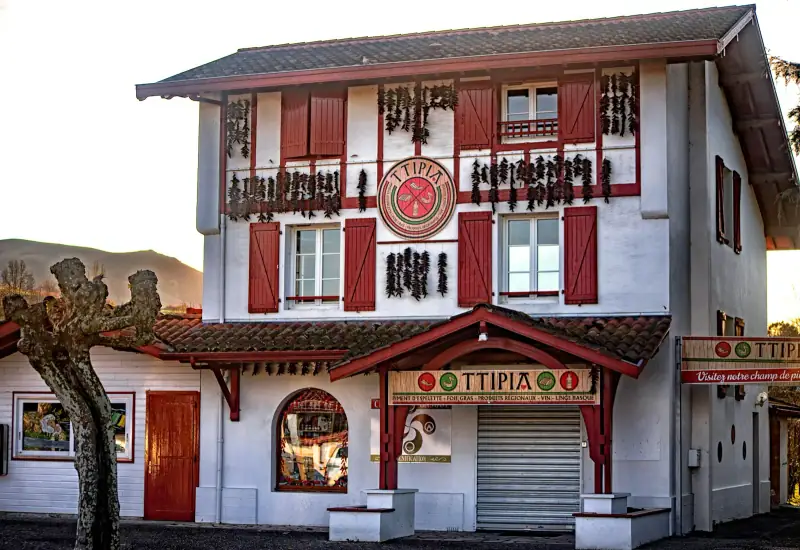
Visiting Espelette: what to see and do in the chili pepper village
What to see in Espelette: pepper-decked facades, castle, church and tombstones, shops, walks in Labourd and when to go.
What to see in Soule: Mauléon, Tardets, Larrau and wild gorges
What to see in Soule, the smallest French Basque province: Mauléon-Licharre, Tardets, Larrau, Sainte-Engrâce, Holzarté and pastorales.
Visiting Biarritz: what to see and do (beaches, lighthouse, old port, museums)
What to see and do in Biarritz: Grande Plage, Rocher de la Vierge, lighthouse, fishermen's port, Côte des Basques, museums and food.
Ready-made
Basque Country itineraries
1 day
San Sebastián in 1 day from the Basque coast: itinerary and tips
One day in San Sebastián from Biarritz, Saint-Jean-de-Luz or Hendaye: how to get there, what to see and where to taste pintxos.
5 days
The Basque Country in 5 days with kids: stops and pace
The Basque Country with kids in 5 days: drive times, beaches, La Rhune cog train, Sare caves and a rainy-day plan B, at a child's pace.
3 days
3 days in the Basque Country: coast and inland itinerary
A 3-day Basque Country itinerary: Biarritz, Bayonne, Saint-Jean-de-Luz, Espelette and La Rhune, with distances, tips and good addresses.