What to see
Visiting Sukhothai: Guide to the Historical Park and the First Capital of Siam
We may earn a commission when you book through links on this page, at no extra cost to you. We don't visit or try the places we cover: we summarize published sources. How we work
In short
- There are two Sukhothai: the new town, with restaurants and bus stations, and the historical park about 12 km (7 mi) west.
- One full day covers the central zone and one or two outer zones; two days let you add Si Satchanalai, about an hour north.
- Cycling is the most common way to visit; the site is flat. Leave at dawn from March to May.
- From Bangkok it is about 430 km (267 mi) and from Chiang Mai about 300 km (186 mi): plan at least one night there.
Sukhothai is often presented as the first capital of the Kingdom of Siam. In the 13th century, a Thai kingdom asserted itself here and left behind temples, Buddhas and ponds, now spread across a park of ruins listed as a UNESCO World Heritage site since 1991. Less visited than Angkor or the sites around Bangkok, the place keeps a calm atmosphere, especially at dawn.
This guide presents the history of the site, its different zones, the key temples, how to visit them and how to get there. It is aimed at those preparing a circuit between the center and the north of the country: Sukhothai fits very naturally between Ayutthaya and Chiang Mai.
Why Sukhothai matters in Thai history
The name Sukhothai is generally translated as “dawn of happiness.” The kingdom is associated with a founding period of Thai history: it is where the beginnings of a political, religious and artistic culture are placed, one that Thais consider one of their foundations. King Ramkhamhaeng is the most famous figure of that era, and he is traditionally credited with creating a Thai script.
On the religious side, Theravada Buddhism holds a central place. It is reflected in the architecture, with lotus-bud-shaped chedis, typical of the Sukhothai style, and in Buddha statues with flowing lines, notably the famous “walking” Buddha. The ruins seen today are a mix of influences: you spot Khmer elements in some towers and Sri Lankan influences in several chedis.
The kingdom then declined and was eventually absorbed by that of Ayutthaya. This succession explains the logical order of a trip: you move up through history from Sukhothai to Ayutthaya, then Bangkok, or go through it in reverse by traveling from south to north.
Understanding the geography: new town and historical park
The first source of confusion for travelers: there are two Sukhothai. The modern town, often called “Sukhothai Thani” or “New Sukhothai,” holds the bus stations, shops and most restaurants. The historical park, sometimes called “Old Sukhothai” or “Muang Kao,” is about a dozen kilometers (7 miles) to the west.
Minibuses and songthaews, pickup trucks fitted with benches, link the two. The trip takes about half an hour depending on the option chosen. Allow for this transfer time in your plans, especially if you want to arrive at opening time.
The park itself is divided into several zones: the central zone, enclosed by ramparts and moats, and outer zones to the north, south, east and west. The central zone, the richest, requires an entrance ticket; some outer zones have a separate fee, others are free to enter. Fees change: check them there or at the tourist office.
The central zone: Wat Mahathat and its surroundings
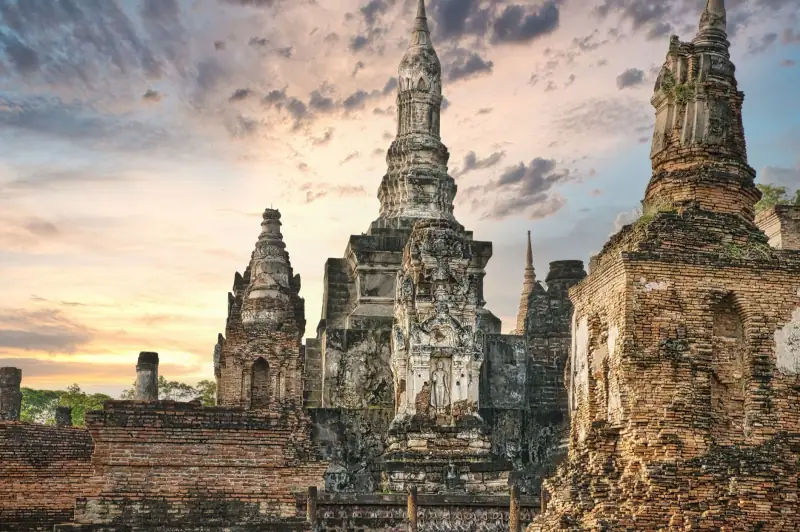
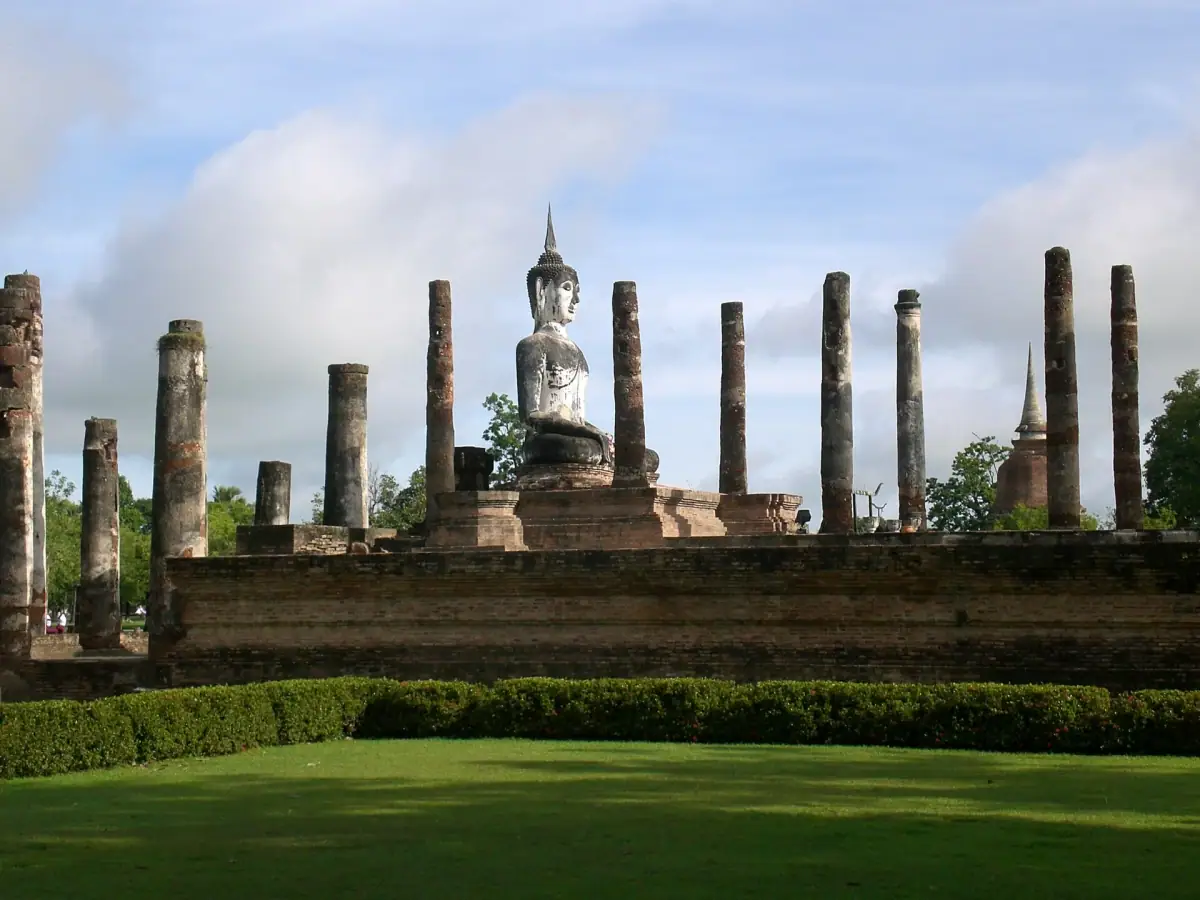
Wat Mahathat is the kingdom’s great temple. It gathers a vast group of chedis, viharn bases and seated Buddha statues, many still quite legible despite the centuries. The central chedi, shaped like a lotus bud, dominates a row of columns that once supported a large pavilion. In morning light, the stones take on a warm tint and the inner courtyards are nearly empty.
Nearby is Wat Sa Si, one of the most photogenic temples in the park. It rises on a small island in the middle of a pond, with a Sri Lankan-style chedi and a seated Buddha. Sunset is a popular time to visit, but early-day light also works very well.
Wat Traphang Ngoen, farther west in the central zone, shares this atmosphere of ponds and water lilies. Take the time to walk around: this is where you understand the general plan of the city, made of water as much as stone.
Where to stay in Sukhothai
Compare lodging in the new town and near the historical park, for your dates.
Wat Si Sawai and Khmer influence
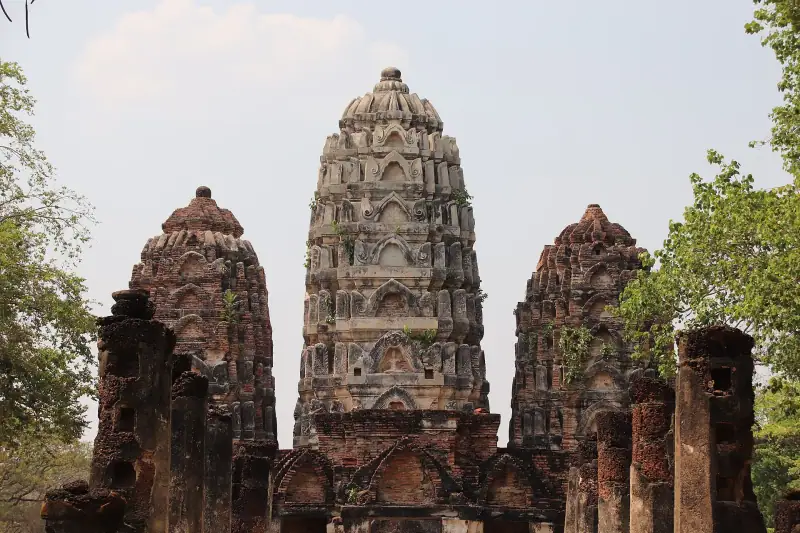
Wat Si Sawai stands out from the other temples with its three prang-type towers, Khmer in inspiration, surrounded by moats and enclosure walls. It is probably one of the oldest remains on the site, and it recalls that this region experienced the influence of the Khmer Empire before the rise of the Thai kingdom.
If this architecture interests you, you can then compare it with that of the great temples of neighboring Cambodia, on a combined trip, without having to fit everything into the same itinerary.
The temple is close to the Ramkhamhaeng National Museum and the entrance to the central zone, which makes it a good first stop to begin the route.
Wat Si Chum: the great seated Buddha
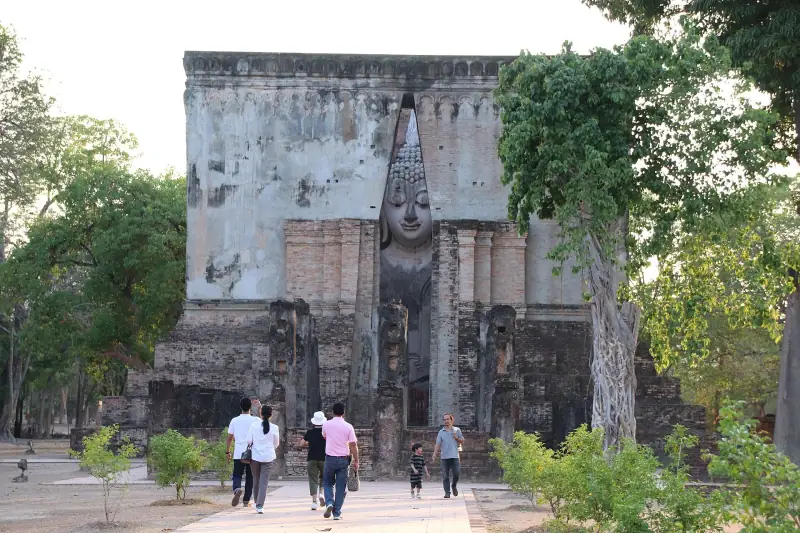
In the north zone, Wat Si Chum houses one of the site’s best-known images: an immense seated Buddha, set in an open-air square structure, the mondop, whose thick walls surround the statue. The statue is visible through a narrow entrance, which gives it a particular effect as you approach.
It is a place where you want to stay a while. Many visitors come in the morning, especially groups; arriving early or at the end of the day lets you appreciate the stillness of the place. Follow the dress required: shoulders and knees covered, and do not climb on the structures.
The north, west and south zones: fewer people, more nature
Beyond the central zone, the temples are more scattered among rice fields and trees. This takes a bit more effort, but that is precisely what makes the visit pleasant: you meet few people and move at your own pace.
In the west zone, Wat Saphan Hin is a temple perched on a hill, reached by a paved path. It is known for its large standing Buddha, facing the plain, and for the panorama it offers. Bring good shoes and water, since the climb is in the sun.
The south and east zones have other temples, often less visited. Depending on the time you have, choose one or two rather than trying to see everything: distances add up quickly by bike.
How to visit: bike, scooter, tuk-tuk or guided tour
The site is flat, which makes it ideal terrain for cycling. Several rental shops are near the park entrance and in the neighboring streets. Check the brakes and tires, and bring a bottle of water and a hat.
A scooter widens your range, but it requires a minimum of experience, a valid license and suitable insurance. Tuk-tuks and songthaews offer day tours: agree on the price and itinerary before leaving.
To understand the ruins better, a guided tour can be useful: explanations of architectural styles, Buddhist symbols and the kingdom’s history greatly enrich the visit.
Sukhothai excursions
Guided visit of the historical park, bike ride or excursion to Si Satchanalai: compare the offers.
Si Satchanalai: an excursion worth making
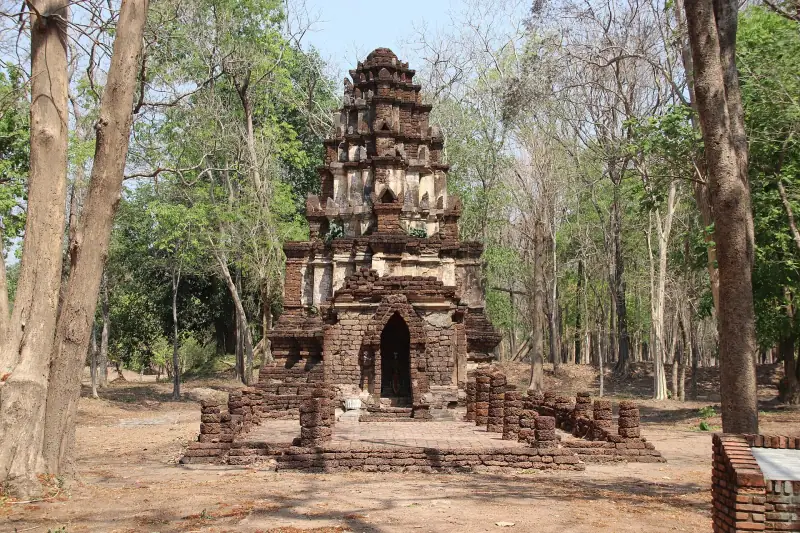
If you have a second day, the Si Satchanalai historical park, about an hour’s drive north of the new town, is an excellent extension. It is listed by UNESCO along with Sukhothai and Kamphaeng Phet, and it is clearly quieter.
Among the temples in the park, Wat Chang Lom is famous for its large chedi resting on a base decorated with sculpted elephants. Wat Chedi Chet Thaeo, very close, gathers dozens of chedis of different sizes. The visit is best done by bike, in a green setting.
The trip from Sukhothai is by car, scooter or local transport. An organized excursion can simplify the logistics if you are not comfortable driving.
Getting to Sukhothai: from Bangkok, Ayutthaya or Chiang Mai
From Bangkok, Sukhothai is about 430 km (267 mi) by road. Long-distance buses link the two cities in several hours, and there are also domestic flights to Sukhothai airport, which is a reasonable distance from town. Check schedules and airlines before leaving, since service varies by season.
From Chiang Mai, the distance is about 300 km (186 mi). Direct buses serve Sukhothai, and you can also go via Phitsanulok, the large neighboring city, which has a railway station and an airport. It is a frequent option for those traveling by train.
Renting a car gives freedom between the park’s different zones and as far as Si Satchanalai, provided you are comfortable driving on the left.
Sukhothai in a wider trip
Sukhothai fits very well into a circuit between central and northern Thailand. A classic itinerary links Bangkok, Ayutthaya, Sukhothai, then Chiang Mai and Chiang Rai. To organize the whole, see our two-week itinerary in Thailand and our guide on what to do in Chiang Mai.
For food, do not miss the local specialties: the region is often associated with noodles served in small restaurants in town, and there are night markets in the new town. Our guide to street food in Thailand will give you pointers on the dishes to taste.
Flights to Thailand
Compare flights to Bangkok or Chiang Mai, the two most practical gateways for reaching Sukhothai.
When to come: cool season and Loy Krathong
The cool season, generally November to February, is the most comfortable for walking among the ruins. In the hottest months, daytime exploring becomes tiring: leave very early and take a break in the shade at midday. In the rainy season, the ruins are greener, but showers can interrupt the visit. Our guide on when to go to Thailand details the seasons.
Sukhothai is also known for its Loy Krathong celebration, in November, at the time of the full moon. Lanterns and small floating offerings are placed on the water, and the park hosts shows. Lodging fills up at this time: book ahead.
Practical tips
- Hours: arrive as early as possible. The light is softer and the groups are not there yet.
- Clothing: shoulders and knees covered, shoes that are easy to remove to enter the sanctuaries.
- Water and protection: bring water, sunscreen and a hat; shade is limited among the ruins.
- Respect for the sites: do not climb on the structures and do not stand higher than a Buddha statue.
- Money: keep cash for entrance tickets, bike rental and small meals.
- Duration: plan a minimum of one night there so you do not have to rush.
Frequently asked questions
How long do you need to visit Sukhothai?
A full day is enough to see the main temples of the central zone and one or two outer zones. Two days let you do it without rushing, and add the Si Satchanalai historical park.
How do you visit the Sukhothai historical park?
Cycling is the most common way: the site is flat and the ruins are spread over a vast area. You can also rent a scooter, take a tuk-tuk for the day or join a guided tour.
Where should you stay to visit Sukhothai?
Two options: the new town, with more restaurants and services, or the edges of the old town, quieter and a few minutes from the ruins. The park is about a dozen kilometers (7 miles) from the new town.
Can you visit Sukhothai as a day trip from Bangkok?
It is not recommended: the road is long, about 430 km (267 mi). It is more reasonable to plan at least one night there, or to include Sukhothai in a Bangkok, Ayutthaya, Sukhothai and then Chiang Mai circuit.
What is the best time to visit Sukhothai?
The cool season, generally November to February, is the most pleasant for walking and cycling among the ruins. Between March and May it is very hot: leave at dawn. In November, the Loy Krathong festival is renowned there.
More Thailand guides
Keep reading
Which Thai Island to Choose: Phuket, Koh Samui, Koh Lanta or Koh Tao?
Phuket, Koh Lanta, Koh Samui, Koh Phangan or Koh Tao? Comparison of Thailand's main islands by atmosphere, season, activities and travel style.
Visiting Ayutthaya: Temples, Ruins and a Day Trip from Bangkok
Visit Ayutthaya from Bangkok: iconic temples, the UNESCO historical park, transport, bikes, tuk-tuks and tips to plan your day or overnight stay.
Complete Guide to Visiting Thailand: Regions, Highlights and Tips
Visiting Thailand: regions, cities and highlights, best time to go, transport, lodging and budget. The pillar guide to prepare your trip.
Ready-made
Thailand itineraries
14 days
Thailand Itinerary for 2 Weeks: From the Historic North to the Beaches
A 14-day itinerary in Thailand: Bangkok, Ayutthaya, Sukhothai, Chiang Mai, Chiang Rai, then the beaches of Krabi. Stops, transport and tips.
10 days
Thailand in 10 Days Without a Car: Bangkok, Chiang Mai and Krabi, a Realistic Itinerary
BangkokChiang MaiKrabi
3 days
3 Days in Bangkok: A Day-by-Day Itinerary for First-Time Visitors
What to do in 3 days in Bangkok? Grand Palace, Wat Pho, Wat Arun, Chinatown, Chatuchak and markets: a day-by-day plan with transport and tips.