What to see
Visiting Walvis Bay: a complete guide to the flamingo lagoon
We may earn a commission when you book through links on this page, at no extra cost to you. We don't visit or try the places we cover: we summarize published sources. How we work
In short
- Walvis Bay is about 380 km (236 mi) from Windhoek (4 to 4 h 30 by road) and 30 km (19 mi) from Swakopmund; the towns are usually visited together.
- The lagoon is a Ramsar site with flamingos all year and the biggest gatherings from March to November.
- The 3-hour catamaran cruise (about N$600 to 800, oysters and sparkling wine included) leaves at 8 am; book ahead in high season.
- A 4x4 is essential for Sandwich Harbour, 50 km (31 mi) south; a guided half-day is the simplest option (about N$700 to 1,000).
Walvis Bay is not the postcard Namibia you imagine first. No giant dunes within reach, no safari, no picturesque colonial architecture. What this port town of 85,000 people offers instead is subtler and ultimately rarer: one of the most beautiful lagoons in Africa, a Ramsar site for its migratory birds, thousands of flamingos turning the landscape pink at sunset, dolphins playing around the catamarans, and the best fresh oysters in all of Namibia. 30 km (19 mi) south of Swakopmund, Walvis Bay deserves much more than a quick stop.
The Walvis Bay lagoon: a bird sanctuary
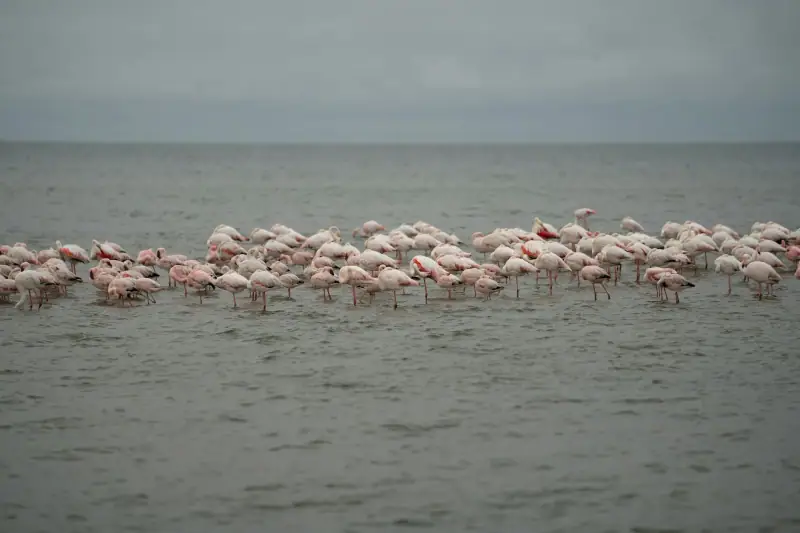
The Walvis Bay lagoon covers 45,000 hectares (111,000 acres) between the town and the Pelican Point dune spit. Listed as a Ramsar site in 1995, it is one of the most important wetlands on the whole African continent, a crucial stopover for millions of migratory birds that come down from the northern hemisphere each autumn.
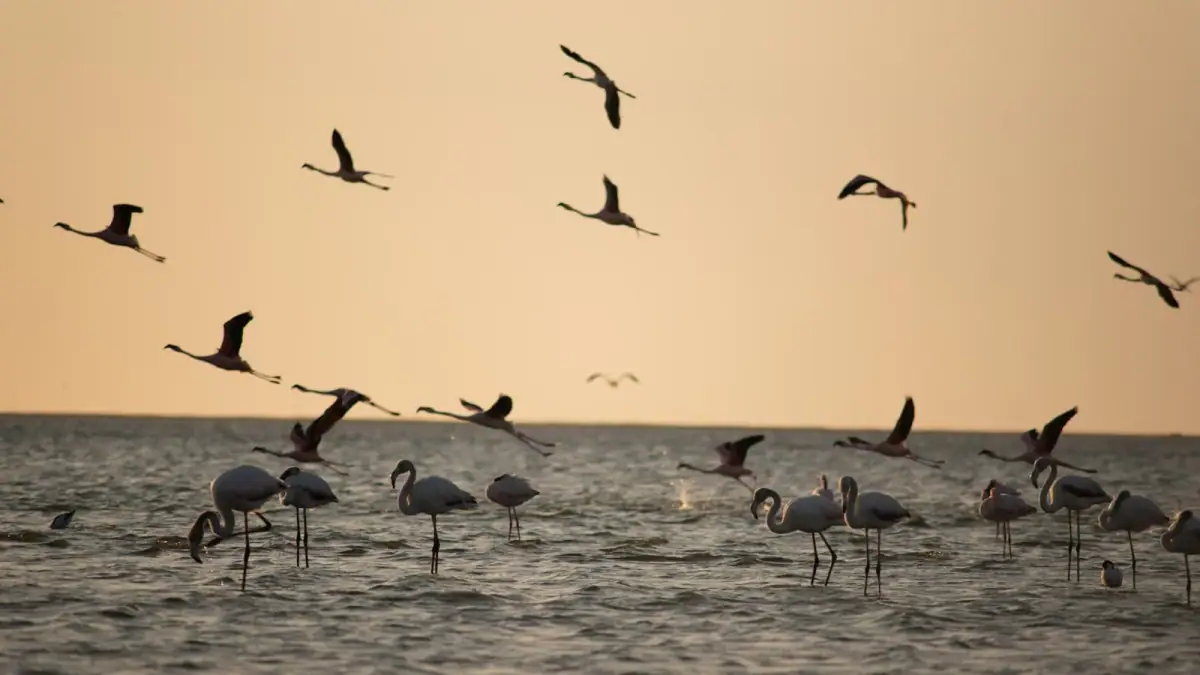
What strikes you on arriving at the lagoon is the pink. Thousands of greater flamingos (Phoenicopterus roseus) and lesser flamingos (Phoeniconaias minor) color the shallow waters with a shade that seems unreal in this landscape of desert and Atlantic. Numbers vary between 10,000 and 80,000 depending on the season, with peaks from March to November.
Species to watch for
The lagoon is not only about flamingos. Birdwatchers will record:
- White pelicans (Pelecanus onocrotalus): colonies of several hundred birds, often seen flying in formation
- Cape cormorants: permanent breeders, in large colonies on buoys and metal structures
- Terns and gulls: crested terns, Caspian terns, kelp gulls
- Godwits and curlews: migratory waders, present in large numbers in autumn (September to November)
- Avocets: recognizable by their upturned bill
- Goliath herons: the largest herons in the world, discreet along the shoreline
Tip: come early in the morning (7 to 9 am) for photographic light and the greatest bird concentrations. Sunset is spectacular but harder for photography (backlight).
Excursions and activities in Walvis Bay
Catamaran cruises, Sandwich Harbour 4x4, dolphin and seal watching.
Catamaran cruise: dolphins, seals and fresh oysters
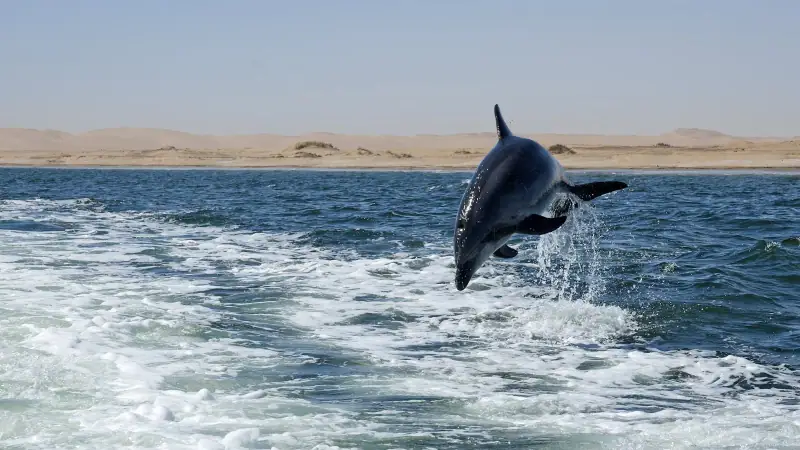
This is Walvis Bay’s flagship activity, the one that alone justifies stopping here. Every morning, several catamarans leave the waterfront for a 3-hour outing in the lagoon and beyond Pelican Point. The tours are consistently excellent.
What you will see
Bottlenose dolphins (Tursiops truncatus) are the stars of the show. They frequent the lagoon and its surroundings all the time, used to boats and often playful, positioning themselves in the wake or leaping a few meters from passengers. Some captains let the boldest get into the water to swim briefly with them.
Cape fur seals colonize the buoys and sandbanks around Pelican Point by the hundreds. Their underwater acrobatics and squabbles on the rocks delight photographers. The smell, on the other hand, is part of the Namibian experience.
Pelicans approach the boat hoping for a ration of fish; some captains deliberately feed the pelicans for the show, allowing photos of these big birds within arm’s reach.
The oyster tasting
The highlight of the cruise. Out in the lagoon, the boat stops for the tasting: fresh oysters caught that very morning, opened in front of you, with a glass of Namibian sparkling wine. Walvis Bay oysters are famous throughout southern Africa: the upwelling of cold, plankton-rich water (the Benguela Current) gives them an intense briny taste and firm flesh.
Average price of a catamaran cruise: N$600 to 800 per adult (oysters and sparkling wine included). Operators: Mola Mola Safaris, Catamaran Charters Walvis Bay. Departure: 8 am from the waterfront. Booking essential in high season.
Sandwich Harbour: where the dunes plunge into the Atlantic
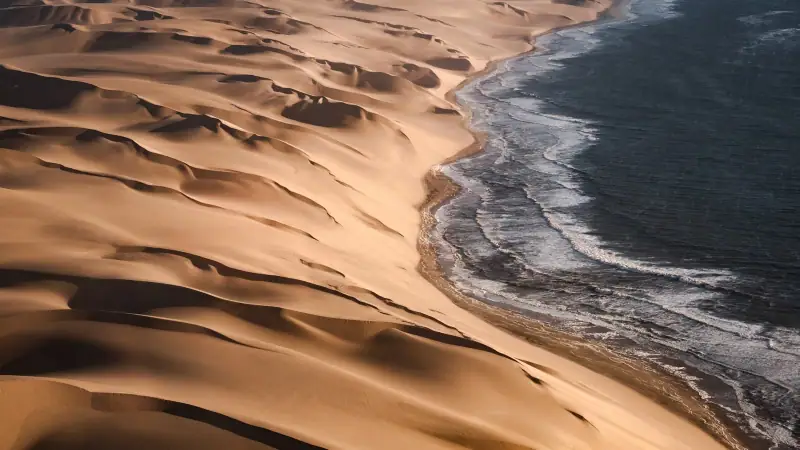
50 km (31 mi) south of Walvis Bay, Sandwich Harbour is one of the most dramatic landscapes in Namibia. This is where the great red dunes of the Namib fall straight into the Atlantic, a breathtaking sight that few travelers get to see, because access requires a 4x4 and precise knowledge of the tides.
The track follows the beach, between the Atlantic on one side and 200 m (656 ft) dunes on the other. At high tide, some passages are submerged. Sandwich Harbour is a protected lagoon (Namib-Naukluft National Park) that also hosts thousands of birds, including flamingos that sometimes nest in remote areas inaccessible to tourists.
How to get there
On a guided excursion (recommended): several operators in Walvis Bay and Swakopmund offer half-day 4x4 trips to Sandwich Harbour, generally in the afternoon (for better sunlight on the dunes). The guide knows the tide times and the passable routes. Allow N$700 to 1,000 per person.
Self-drive: possible with your own 4x4 and an entry permit for Namib-Naukluft Park (ask the Namibian Ministry of Environment or a local operator where to get it and the current rate). Check the tide times before you leave, without fail; do not attempt the passage at high tide.
4x4 rental in Namibia
Compare 4x4 offers to explore Sandwich Harbour and Namibian tracks.
Pelican Point and the salt pans
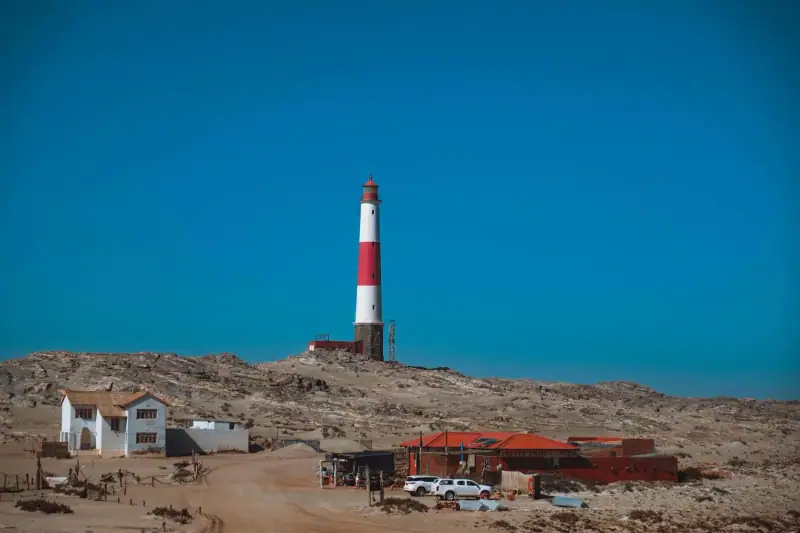
Pelican Point is the sand spit that partially closes the lagoon on the north side. It is reached by boat from the waterfront. At its tip, a red and white lighthouse (built in 1913 by the Germans) now houses a small seal colony that has literally taken possession of the structure.
The Walvis Bay salt pans stretch for several kilometers north of the town. These industrial salt works produce sea salt and, paradoxically, are a remarkable habitat for wildlife: the shallow waters rich in microscopic algae attract flamingos and avocets. You can drive alongside them on the road to Swakopmund; stop at the viewing points provided.
Dune 7
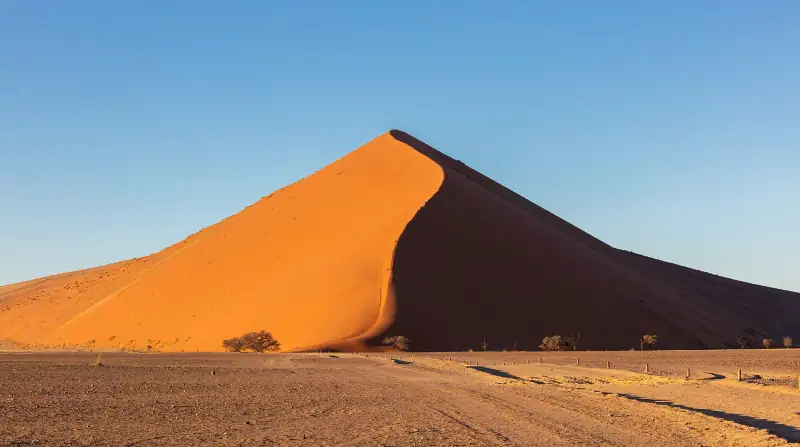
10 km (6 mi) east of Walvis Bay, Dune 7 is said to be the tallest coastal dune in Namibia (over 100 m / 328 ft). Unlike the protected dunes of Sossusvlei, this one has free and open access. Locals come on weekends for improvised sandboarding on the flanks.
Climbing on foot takes 20 to 30 minutes depending on your fitness; the first steps in soft sand are tiring. From the top, the view of the lagoon, the Atlantic and the town is spectacular. Get up early to avoid the heat and the weekend crowds.
Access: B2 toward Rooikop/airport, then the “Dune 7” sign. Free entry.
Food: oysters, rock lobster and Benguela Current fish
Walvis Bay is the Namibian seafood capital, by far. The Benguela Current coming up from subantarctic waters along the Namibian coast is one of the most nutrient-rich in the world. The result: fish-rich waters, exceptional shellfish and oysters whose reputation goes well beyond the borders.
Where to eat in Walvis Bay
The Raft: the top restaurant in Walvis Bay, set on a floating terrace above the lagoon. Fresh lagoon oysters, Cape rock lobster (kreef), grilled fish. Direct view of the flamingos. Book ahead, especially on weekends.
Lagoon Raft: a more casual version of the Raft, reached by boat from the waterfront (check access and hours before coming). The ideal place for an oyster tasting with a glass of white wine while watching the sunset over the lagoon.
Anchor: seafood restaurant on the waterfront, cheaper than the Raft but good quality. Fishing port atmosphere, a mix of local and tourist customers. Excellent fish and chips.
Waterfront market: in the morning, vendors sell oysters by the dozen for a fraction of restaurant prices (about N$40 to 60 per dozen). The quintessential local experience.
Hotels in Walvis Bay
From lagoon lodge to guesthouse, find your accommodation in Walvis Bay.
Weather and best time to visit
Like the whole Namibian coast, Walvis Bay enjoys a climate tempered by the Benguela Current, which means surprisingly cool summers and mild winters.
Temperatures: 15 to 22 °C (59 to 72 °F) all year. The great heat of the interior (30 to 40 °C / 86 to 104 °F in summer) is never seen on the coast. Winter nights drop to 8 to 10 °C (46 to 50 °F).
Fog: frequent in the morning, especially from April to September. It generally clears by mid-morning. This fog (the “Benguela fog”) is vital for the wildlife and plants of the coastal desert.
Wind: Walvis Bay is less exposed than Lüderitz to the Südwester, but the wind is still present. November to January are the windiest months.
Rain: almost nonexistent (less than 30 mm / 1.2 in per year). The Namibian coastal desert is one of the driest on the planet.
Best period for the lagoon: March to November for the largest bird concentrations. For cruises (dolphins, seals, oysters), all year works; the cetaceans are present permanently.
Getting there, transport and logistics
From Windhoek: 380 km (236 mi) on the B1 then the C28. Allow 4 to 4 h 30 on the road. The C28 crosses the Namib Desert and offers remarkable lunar landscapes.
From Swakopmund: 30 km (19 mi) on the coastal B2. Allow 30 minutes. The two towns are often combined in one stay.
From Sossusvlei: 280 km (174 mi), about 3 hours. Walvis Bay is the natural coastal gateway after the Sossusvlei dunes if you do an east-west circuit.
Airport: Walvis Bay Airport (WVB) is 10 km (6 mi) from the center. Domestic connections exist with Windhoek, but frequencies and operators vary; check current availability.
In town: Walvis Bay is a human-scale town, easy to get around by car. The lagoon, waterfront and center are less than 5 km (3 mi) from each other. Local taxis run but the booking app is not developed; negotiate the price before getting in.
Walvis Bay in your Namibian itinerary
Walvis Bay and Swakopmund naturally form a pair. Most travelers spend 2 to 3 days on the Atlantic coast, combining the two towns.
Classic Namibian coast circuit (2 days):
- Day 1 morning: catamaran cruise from Walvis Bay (dolphins, seals, oysters)
- Day 1 afternoon: Sandwich Harbour 4x4 excursion
- Day 2 morning: oyster market, lagoon, Dune 7
- Day 2 afternoon: Swakopmund (30 km / 19 mi), colonial town, activities
Fitting into a Namibian road trip: Walvis Bay fits ideally between Sossusvlei (to the east) and the rest of the coast (Swakopmund, Skeleton Coast to the north). See our Namibia road trip guide for distances and planning.
Practical tips
Average daily budget: N$1,000 to 1,800 per day (mid-range accommodation + catamaran cruise + restaurant meals).
Currency and ATMs: Standard Bank and First National Bank have ATMs in the center and on the waterfront. Walvis Bay is more “modern” than Lüderitz in this respect.
Network: 4G available throughout the town and as far as Sandwich Harbour (the first kilometers). Signal varies on remote excursions. Check your carrier’s international plan or consider a travel eSIM.
Safety: Walvis Bay is a town of port workers and industry. Safe in tourist areas by day. Avoid night outings in industrial areas or far from the waterfront.
Accommodation: the offer is smaller than in Swakopmund. Main properties: The Pelican Bay Hotel (lagoon view), Courtyard Hotel Walvis Bay, several good-value guesthouses. Book ahead in July and August.
Supermarket: Spar and Woermann Brock are well stocked. Ideal for stocking up before a road trip into the desert.
Walvis Bay does not try to seduce. It is a workers’ town, an industrial port, a Namibian logistics hub. But behind this utilitarian facade lies one of the purest nature experiences in the country: a lagoon pink with flamingos at dawn, a catamaran gliding between dolphins, oysters opened by hand on a floating terrace. It is a Namibia unlike any other, and that is precisely why it is worth the detour.
To round out your discovery of the Namibian coast, see our guide on where to stay in Swakopmund and our article on the Namib Desert. And for the big trip, our Namibia road trip fits Walvis Bay into a full circuit.
Frequently asked questions
How do you get to Walvis Bay from Windhoek?
Walvis Bay is about 380 km (236 mi) from Windhoek, or 4 to 4 h 30 by road on the B1 to Okahandja, then the B2 via Karibib, Usakos and Swakopmund. This route is paved (the C28, which also leaves Windhoek, is a gravel track). Check the road conditions before you go, as roadworks have been announced. Air Namibia, liquidated in 2021, no longer serves the route: check with current airlines for available connections. Most travelers go through Swakopmund (30 km / 19 mi to the north) and then head down.
Can you see flamingos in Walvis Bay all year?
Yes, the Walvis Bay lagoon hosts greater and lesser flamingos permanently, but numbers vary. The largest gatherings are from March to November. The lagoon is a protected Ramsar site that holds tens of thousands of birds depending on the season.
Do you need a 4x4 to go to Sandwich Harbour?
Yes, a 4x4 is absolutely essential for Sandwich Harbour. The track follows the Atlantic beach and crosses dune areas where the tide affects passability. Most visitors choose a guided 4x4 excursion, which greatly simplifies the logistics.
Where can you eat fresh oysters in Walvis Bay?
The Raft restaurant, on stilts in the lagoon, is the reference for fresh Walvis Bay oysters. You can also buy oysters directly from fishermen at the morning waterfront. Catamaran cruises often include an oyster and sparkling wine tasting out in the lagoon.
What is the best activity in Walvis Bay?
The catamaran cruise in the lagoon is the essential experience: dolphins, seals, flamingos, pelicans and a fresh oyster tasting. It lasts about 3 hours and takes place in the morning. To complement it, a 4x4 excursion to Sandwich Harbour (afternoon) takes you into a landscape of red sand dunes dropping straight into the Atlantic.
Is Walvis Bay safe for tourists?
Walvis Bay is an industrial port town, generally safe by day in the tourist areas (waterfront, lagoon, center). As everywhere in Namibia, avoid night outings in isolated areas and leave nothing visible in your car. The lagoon and waterfront are busy and carry no particular risk.
More Namibia guides
Keep reading
Visiting Etosha National Park: a complete guide to the Namibian safari
Complete guide to Etosha National Park: best season, camps, waterholes and animals to see. Everything to plan your safari in Namibia.
Visiting Lüderitz: a complete guide to the desert ghost town
Complete guide to Lüderitz: Kolmanskop, penguins, German architecture and the Namib Desert. All you need to visit this unique town in Namibia.
Visiting Swakopmund: a complete guide to Namibia's colonial pearl
Complete guide to Swakopmund: German architecture, sandboarding, Living Desert tours and restaurants. Everything to visit this unique Namibian town.
Ready-made
Namibia itineraries
10 days
Namibia in 10 days without a car: a realistic itinerary by shuttle and transfer
WindhoekEtoshaDamaralandSwakopmundSesriem / SossusvleiWindhoek
10 days
Namibia road trip in the rainy season (January to March): itinerary and passable roads
WindhoekEtosha (Okaukuejo)Khorixas / TwyfelfonteinSwakopmundSesriemWindhoek

21 days
Namibia road trip: a complete 2 to 3 week 4x4 itinerary
WindhoekSossusvlei / Namib-NaukluftSwakopmund / Walvis BayDamaraland / SpitzkoppeTwyfelfonteinSkeleton Coast, southern partEtoshaWaterberg PlateauFish River CanyonLüderitz and return to Windhoek