Itineraries
Namibia in 10 days without a car: a realistic itinerary by shuttle and transfer
We may earn a commission when you book through links on this page, at no extra cost to you. We don't visit or try the places we cover: we summarize published sources. How we work
Day by day
- Day 1Arrive in Windhoek
- Day 2Windhoek, discovering the capital
- Day 3Private transfer Windhoek to Etosha
- Day 4Etosha safari in a lodge vehicle
- Day 5Transfer Etosha to Damaraland and Twyfelfontein
- Day 6Transfer Damaraland to Swakopmund
- Day 7Swakopmund, organized activities there
- Day 82-day excursion Swakopmund to Sesriem and Sossusvlei
- Day 9Sunrise guided tour at Sossusvlei, transfer back to Windhoek
- Day 10Windhoek, departure
Where to sleep
- Windhoek2 nights
- Etosha2 nights
- Damaraland1 night
- Swakopmund2 nights
- Sesriem / Sossusvlei1 night
- Windhoek1 night
In short
- Namibia has no reliable public transport between tourist sites; the workable solution is private shuttles, lodge-to-lodge transfers and, for the longest legs, small-plane flights.
- The 10-day plan covers Windhoek, Etosha, Damaraland, Swakopmund and Sossusvlei, about 1,740 km (1,081 mi) entirely in vehicles driven by others.
- Transfers and excursions cost about €900 to 1,600 ($1,045 to 1,855) per person for 10 days, excluding lodging; a shared 4x4 about €500 to 900 ($580 to 1,045).
- Sesriem to Deadvlei needs a guided shared 4x4 excursion: the last 5 km (3 mi) of sandy track are closed to non-authorized vehicles.
Namibia is a country made for the 4x4 road trip; that is even its reputation. But not everyone wants to, or can, drive 2,000 km (1,243 mi) on gravel tracks: a tight rental budget, apprehension about driving on sand, or simply the wish to travel without a steering wheel in your hands. The good news is that a Namibian itinerary without your own car is entirely feasible in 10 days, provided you build it around private shuttles, lodge-to-lodge transfers and a few well-placed domestic flights. Here is a day-by-day plan, with real distances and travel times, to see the essentials of Namibia without ever holding a steering wheel.
Why visiting Namibia without a car changes things
Outside Windhoek and a few main roads, Namibia has no city bus network or train suited to tourists. The only serious long-distance operator, Intercape (check its current lines), links the main towns but rarely stops at the entrance to national parks or isolated lodges, so it is useless for visiting Etosha or Sossusvlei directly. The solution that works in practice is a well-developed parallel market: private transfer companies and shared shuttles that link the tourist points of interest precisely, lodge to lodge, with a driver who knows the tracks. It is more structured than a fully free road trip, but it is still an immersive trip, without the risk of a puncture on an isolated track or a night of tired driving.
The three concrete ways to get around without a car
Private shuttles and lodge-to-lodge transfers. Namibian operators organize on-demand trips between the main tourist stops (Windhoek, Etosha, Damaraland, Swakopmund, Sesriem). The vehicle is an air-conditioned minibus with a driver, and trips generally leave in the morning to arrive before the afternoon heat. Book these slots ahead, especially between June and September.
Small-group organized tours. An alternative to point-to-point transfers: join a Namibian tour in an 8 to 16 seat minibus, with a fixed itinerary and a driver-guide. This option often includes the excursions along the way (game drive in Etosha, guided walk at Sossusvlei), which simplifies logistics.
Domestic flights in small planes. For the longest distances (Swakopmund to Sesriem in particular), a charter flight on a Cessna saves half a day of road. It is the most expensive option but the most comfortable, to reserve for the stages that tire you most by land shuttle. See our guide to domestic flight baggage limits before booking; the rules are strict.
For an objective comparison, our article on 4x4 rental in Namibia details the driving option if you are still deciding between the two options.
Organized tours in Namibia
Compare minibus tours with a driver-guide to see Namibia without driving.
A realistic 10-day itinerary without a car

Day 1: Arrive in Windhoek Day 2: Windhoek, discovering the capital Day 3: Private transfer Windhoek → Etosha (430 km / 267 mi, about 5 h) Day 4: Etosha safari in a lodge vehicle Day 5: Transfer Etosha → Damaraland / Twyfelfontein (350 km / 217 mi, about 4 h 30) Day 6: Transfer Damaraland → Swakopmund (280 km / 174 mi, about 3 h 30) Day 7: Swakopmund, organized activities there Day 8: 2-day organized excursion Swakopmund → Sesriem / Sossusvlei (340 km / 211 mi, about 6 h, C14 gravel track) Day 9: Guided sunrise excursion at Sossusvlei, then transfer back to Windhoek (340 km / 211 mi, about 4 h) Day 10: Windhoek, departure
Total: about 1,740 km (1,081 mi) covered, entirely in vehicles driven by others: shuttles, private transfers and lodge vehicles.
Days 1-2: Windhoek, the logistics base
Collect your shuttle tickets and confirm your bookings as soon as you arrive: Windhoek is where most private transfers are negotiated and confirmed, often directly at your hotel’s reception. Use your first full day to visit the historic center, the Post Street Mall crafts market and the Christuskirche. For accommodation, favor a central area such as Klein Windhoek, within walking distance or a short taxi ride of shuttle meeting points. Our full selection: where to stay in Windhoek.
Hotels in Windhoek
Book a central hotel, close to the shuttle meeting points.
Days 3-4: Etosha, the safari without driving
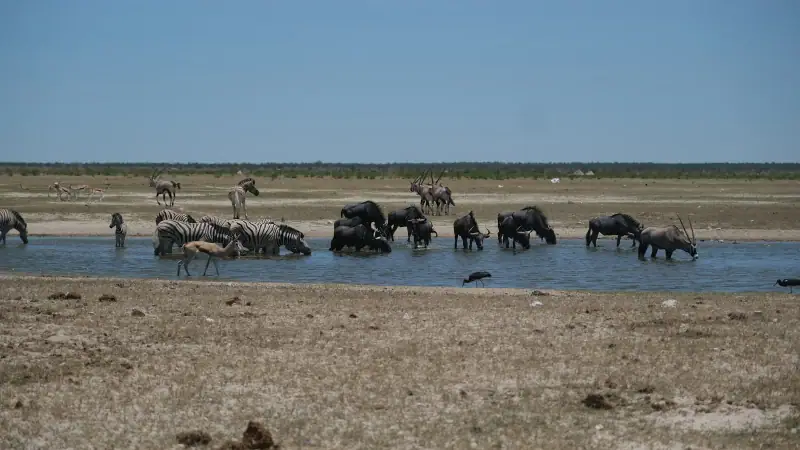
The private Windhoek to Etosha transfer takes the B1 then the C38 to Anderson Gate, at the south of the park: allow about 5 hours with a lunch break at Otjiwarongo. Etosha is precisely where not having a personal car is least felt: most lodges offer morning and evening game drives in an open vehicle with a local ranger, a format often more effective for spotting wildlife than driving yourself. Settle in for two nights near a floodlit waterhole like Okaukuejo, where lions and rhinos come to drink after nightfall. Practical details in our Etosha safari guide and our selection of where to stay in Etosha.
Days 5-6: Damaraland then the Atlantic coast
The trip to Damaraland crosses landscapes of rocky mountains and semi-desert savanna. A guided excursion to Twyfelfontein (UNESCO-listed rock engravings) is included in most transfer packages with a stop. From Damaraland, allow about 3 h 30 by road to reach Swakopmund on the Atlantic coast, where the air cools abruptly on contact with the Benguela Current.
Day 7: Swakopmund without a car is easy
Unlike the rest of the country, Swakopmund is very easy to visit on foot or by local taxi: the colonial center, the waterfront and the lighthouse are concentrated in a few streets. For activities in the surrounding dunes (sandboarding, quad biking, kayaking at Walvis Bay), book an excursion with hotel pick-up directly, with no need for a personal vehicle. Our complete guide: visiting Swakopmund.
Activities in Swakopmund
Sandboarding, quad biking and kayaking with hotel pick-up, no car needed.
Days 8-9: Sossusvlei, the stage that needs the most organization
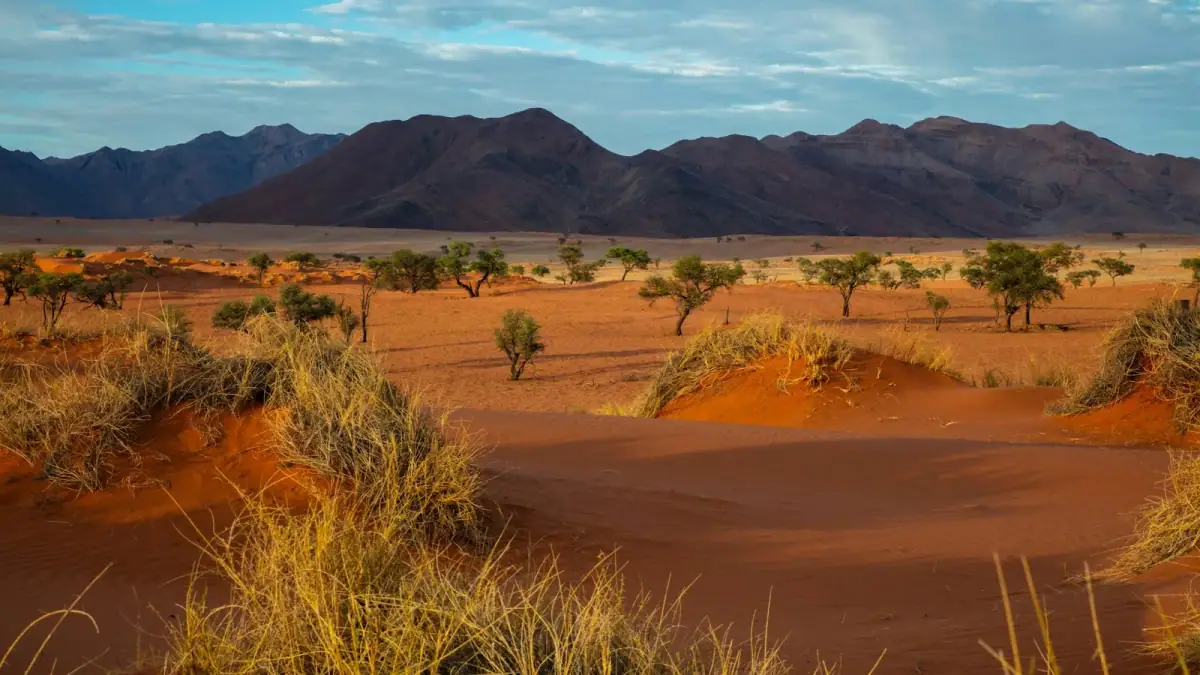
This is the trickiest part of the car-free itinerary: Sesriem, the gateway to Sossusvlei, is far from Swakopmund (340 km / 211 mi, about 6 h on the C14 gravel track) and poorly served by regular shuttles. The most reliable solution is to book a 2-day/1-night organized excursion including the round-trip transfer and a guide there, or to opt for a direct charter flight if your budget allows. Once there, a guided shared-4x4 excursion is essential to reach Deadvlei at sunrise: the last five kilometers of sandy track are forbidden to unauthorized vehicles. For accommodation, see our selection of where to stay in Sossusvlei and our guide to the Sossusvlei dunes.
Lodges near Sossusvlei
Book your lodge at Sesriem, the starting point for guided excursions to Deadvlei.
Day 10: Back to Windhoek
The return transfer to Windhoek (about 4 h) gets you to Hosea Kutako International Airport at the end of the day for an international flight. Allow a safety margin of 3 to 4 hours before departure time; transfers in Namibia can accumulate delays on gravel tracks.
Budget: shuttle versus 4x4 rental
On this 10-day itinerary, all the private transfers and organized excursions generally come to €900 to 1,600 ($1,045 to 1,855) per person, excluding accommodation, a wide range that depends mostly on the level of privacy chosen (shared group shuttle versus dedicated private transfer). By comparison, renting a 4x4 over the same period costs more like €500 to 900 ($580 to 1,045) in total, fuel included, but that amount is split among the vehicle’s occupants. For a solo traveler or a couple who dreads driving on gravel, the car-free option stays competitive once you factor in the stress and puncture risk you avoid. To refine your overall budget, see our Namibia budget guide.
Tips for making this car-free circuit work
- Book transfers as soon as your flight is confirmed, especially between June and September: shared shuttle slots fill faster than a rental car.
- Leave margins between each transfer: unlike a personal car, you depend on the operator’s schedule, not yours.
- Keep cash on you for local excursions in Swakopmund and Sesriem; card payments are not systematic outside the big towns.
- Check the season before leaving: see our guide to the best time to visit Namibia; some shuttles reduce their frequency outside the dry season.
- Compare a domestic flight and a land transfer for the Swakopmund to Sesriem stage: the difference in comfort and time saved often justifies the extra cost on an itinerary of only 10 days.
A trip to Namibia without a personal car requires a bit more advance booking than a classic road trip, but it lets you see the same emblematic sites (Etosha, Damaraland, the Atlantic coast and the Sossusvlei dunes) without ever worrying about a gravel track or a flat tire in the middle of the desert. If you are still hesitating between the two formulas, our 10-day 4x4 itinerary offers a direct comparison to help you choose.
Frequently asked questions
Can you really visit Namibia without renting a car?
Yes, but not fully independently. Namibia has no reliable public transport between tourist sites: the solution that works is a chain of private shuttles, lodge-to-lodge transfers and, for the longest distances, domestic flights in small planes. It is a different formula from a 4x4 road trip, but it covers the same highlights (Etosha, Damaraland, Swakopmund, Sossusvlei).
How much does a shuttle itinerary cost compared with renting a 4x4?
Over 10 days, expect to pay about €900 to 1,600 ($1,045 to 1,855) per person for all private transfers and shared shuttles (excluding accommodation), against €500 to 900 ($580 to 1,045) for renting a 4x4 over the same period, fuel included. The car remains cheaper for two or for a family; shuttles become attractive mainly for a solo traveler or a couple who want to avoid driving on gravel.
Do tourist shuttles really serve Etosha and Sossusvlei?
Yes, several Namibian operators (Gondwana's Go2 Tourism Shuttle, for example, or shared shuttles such as Welwitschia Shuttle on the Windhoek to Swakopmund route) offer regular or on-request transfers between Windhoek, Etosha, Damaraland, Swakopmund and Sesriem (the gateway to Sossusvlei). Book these trips ahead, especially in high season, as services are less frequent than an urban bus.
Do you need a guide to visit Etosha or Sossusvlei without a vehicle?
In Etosha, most lodges organize game drives in an open vehicle with a ranger, which is a good substitute for self-driving. At Sossusvlei, a guided shared 4x4 excursion from Sesriem is needed to reach Deadvlei, because the sandy track of the last 5 km (3 mi) is closed to 2WD vehicles and to unaccompanied pedestrians outside an organized excursion.
Is a domestic flight a good option to shorten this car-free itinerary?
Yes, replacing one or two long road transfers (Swakopmund to Sesriem, for example) with a small-plane flight saves a whole half day and spares you the fatigue of gravel tracks. It costs more than a land shuttle, but is very efficient on a 10-day itinerary where every day counts. Check the baggage limits specific to these flights before you pack.
What is the best time for a car-free trip to Namibia?
The dry season, May to October, remains the most suitable: gravel roads are in better condition, transfers are less likely to be delayed by rain, and game-drive visibility in Etosha is best around the waterholes. Outside this period, some shuttle routes reduce their frequency, so book even earlier.
More Namibia guides
Keep reading
Where to stay in Etosha: NWR camps, lodges and practical tips
Choose where to stay in Etosha: official Okaukuejo, Halali and Namutoni camps or lodges outside the park. Budget, booking and safari tips.
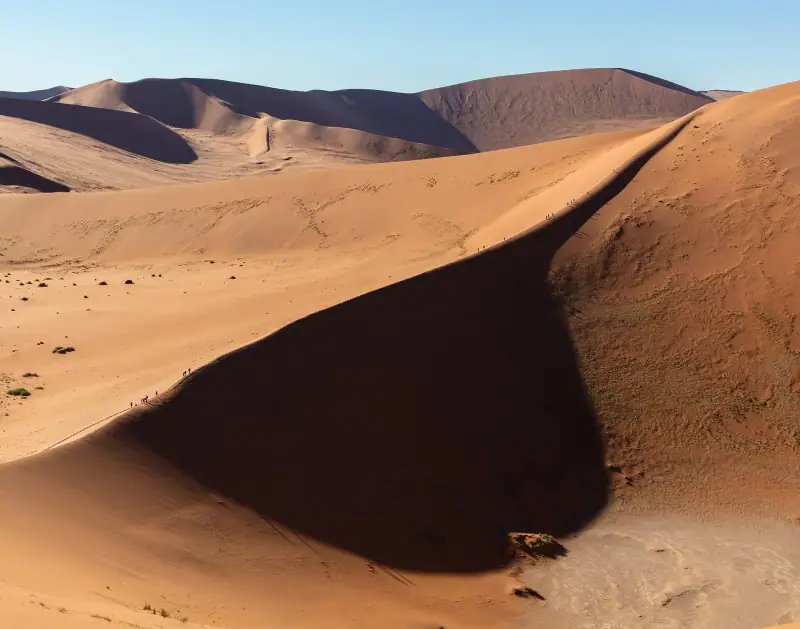
Best time to visit Namibia: a month-by-month guide
When to go to Namibia? Climate, seasons, wildlife and month-by-month advice to choose the best time for what you want to do.
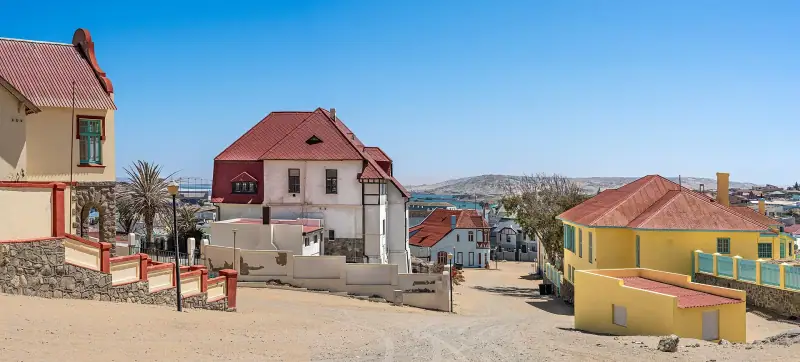
What to do in Lüderitz: activities and must-see visits
Kolmanskop, penguins at Halifax Island, Bogenfels, diving, flamingos: a complete guide to things to do in Lüderitz, Namibia's southern colonial gem.
Ready-made
Namibia itineraries
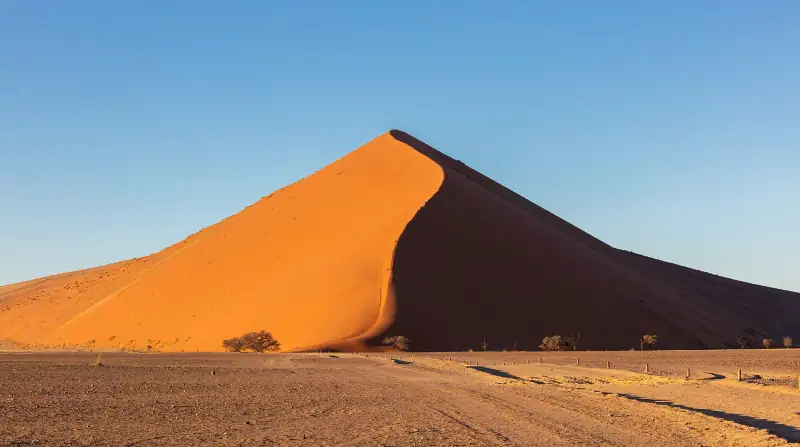
10 days
Namibia road trip in the rainy season (January to March): itinerary and passable roads
WindhoekEtosha (Okaukuejo)Khorixas / TwyfelfonteinSwakopmundSesriemWindhoek

21 days
Namibia road trip: a complete 2 to 3 week 4x4 itinerary
WindhoekSossusvlei / Namib-NaukluftSwakopmund / Walvis BayDamaraland / SpitzkoppeTwyfelfonteinSkeleton Coast, southern partEtoshaWaterberg PlateauFish River CanyonLüderitz and return to Windhoek