Things to do
What to do in Lüderitz: activities and must-see visits
We may earn a commission when you book through links on this page, at no extra cost to you. We don't visit or try the places we cover: we summarize published sources. How we work
In short
- Kolmanskop, a sand-covered ghost town 10 km (6 mi) away, offers a guided visit or a dawn photography slot; book 2 to 3 days ahead in July to September.
- Boat trips to Halifax Island (1 h 30 to 2 h) approach African penguins and Cape fur seals; penguins are present all year.
- Bogenfels arch, about 95 to 100 km (59 to 62 mi) south in Sperrgebiet National Park, is reached only by scenic flight or an accredited guided 4x4 excursion.
- Plan 2 to 3 days; May to October is ideal, while the summer wind (November to January) can make boat trips difficult.
Lüderitz is one of the most fascinating and least visited towns in Namibia. Perched on a rock on the edge of the South Atlantic, between the sands of the Sperrgebiet and the icy waters of the Benguela Current, this former German colonial town hides unsuspected treasures: a sand-covered ghost town 10 minutes away by car, a colony of African penguins within reach by boat, Art Nouveau architecture preserved since 1909, and seabeds among the richest in all of southern Africa. Here is the complete guide to everything you can do in Lüderitz.
Kolmanskop: the sand-covered ghost town
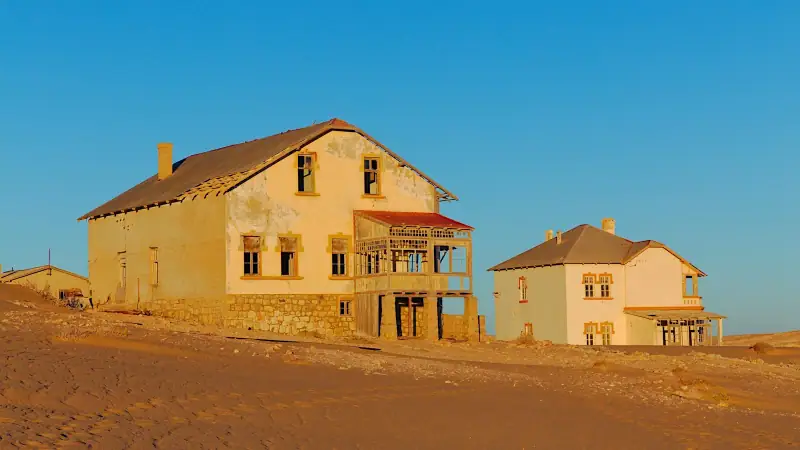
It is impossible to talk about Lüderitz without starting with Kolmanskop, one of the most photographed destinations in southern Africa and the region’s must-see attraction.
Kolmanskop is a ghost town 10 kilometers (6 mi) east of Lüderitz, in the middle of the Namib Desert. It was built after diamonds were discovered nearby in 1908 by a railway worker named Zacharias Lewala, who found a shiny stone and showed it to his foreman, August Stauch. Within months a diamond rush broke out and a town rose from the sand: German-style houses, a casino, a theater, a ballroom, the first X-ray machine in southern Africa, a bakery, a swimming pool. At its peak in the 1920s, Kolmanskop had several hundred inhabitants and was one of the richest places in Africa.
The gradual exhaustion of the surface deposits and the discovery of even richer diamond fields farther south (Oranjemund) sealed its decline. The town was gradually abandoned from the 1950s and completely deserted in 1956. Since then, the Namib dunes have been reclaiming the town: the rooms of the houses are half filled with fine sand, doors bang in the wind, wallpaper crumbles on cracked walls.
Guided visit or photography access?
Two options exist to discover Kolmanskop:
Classic guided visit (8 am or 10 am): accompanied by an English- or German-speaking guide, you explore the main houses (the manager’s house, the hospital, the casino, the bowling alley) in 60 to 90 minutes. The guide explains the history of the town, the De Beers diamond company that still owns the site, and anecdotes of the settlers’ daily life. This option is perfect for understanding the historical context.
Dawn photography access (6:30 to 8 am): reserved for photographers, this slot lets you enter the houses in the golden morning light, when the sand glows and the shadows are long. It is by far the best moment to capture Kolmanskop’s spectral atmosphere. Visitor numbers are limited and there is no guide; you are free to explore with your camera.
Practical information:
- Open daily from 8 am to 1 pm (photo access from 6:30 am)
- The site is managed in partnership with Namdeb (the diamond company); check with the Lüderitz tourist office which operator sells permits and visits
- Bring a hat, water and good shoes; the sand inside the houses can be deep
- Drone photography: subject to specific prior authorization
Kolmanskop excursion from Lüderitz
Book a guided visit of the Kolmanskop ghost town, 10 km (6 mi) from Lüderitz.
Halifax Island: the African penguin colony
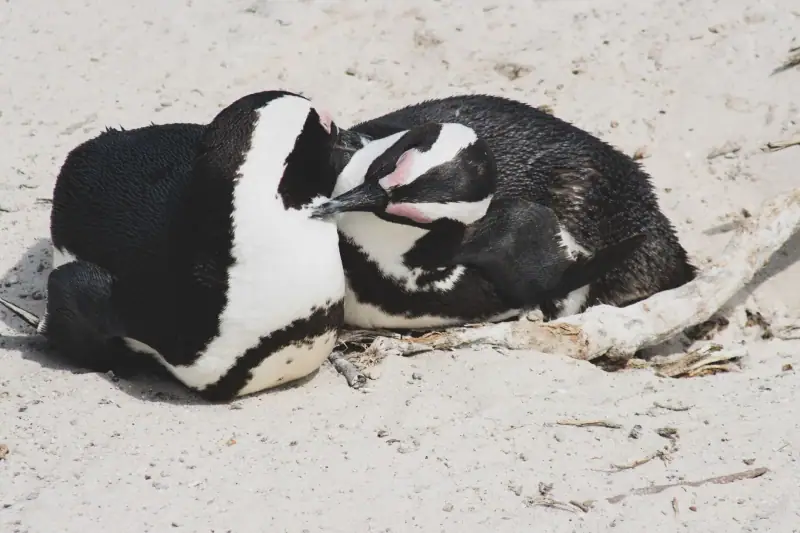
Less than 2 kilometers (1.2 mi) from Lüderitz harbor lies Halifax Island, a small rocky islet that is home to one of the most accessible colonies of African penguins (Spheniscus demersus) in southern Namibia. These penguins, also called “Cape penguins” or “jackass penguins” (because their call resembles a donkey’s bray), are listed as “Endangered” on the IUCN Red List; seeing them in the wild is an increasingly rare privilege.
Boat trips from Lüderitz harbor let you approach Halifax Island to within a few meters of the penguins without landing on the (protected) island. You can watch the birds in their nests, see them dive from the rocks, and sometimes meet them swimming beside the boat. Most tours last between 1 h 30 and 2 h and also include watching the Cape fur seals (Arctocephalus pusillus) that colonize the surrounding rocks.
On the way, depending on the season, it is not rare to spot bottlenose dolphins (Tursiops truncatus) playing in the boat’s wake, or even southern right whales (Eubalaena australis) between August and November.
What you generally see:
- African penguins (all year, peak June to September)
- Cape fur seals (all year)
- Cormorants, pelicans, Cape gannets
- Bottlenose dolphins (frequent)
- Southern right whales (August to November)
- Occasionally orcas in transit (rare but documented)
Halifax Island boat trip
Book a boat excursion to watch African penguins and seals near Lüderitz.
Colonial architecture: a walk through time
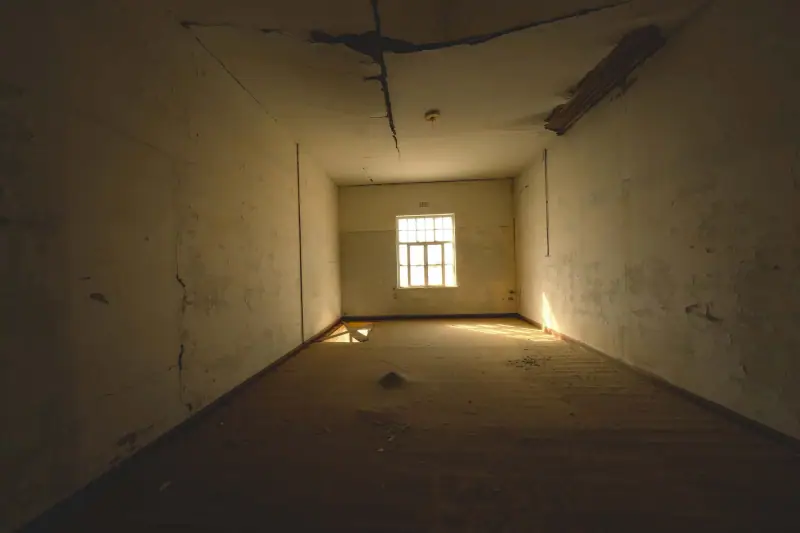
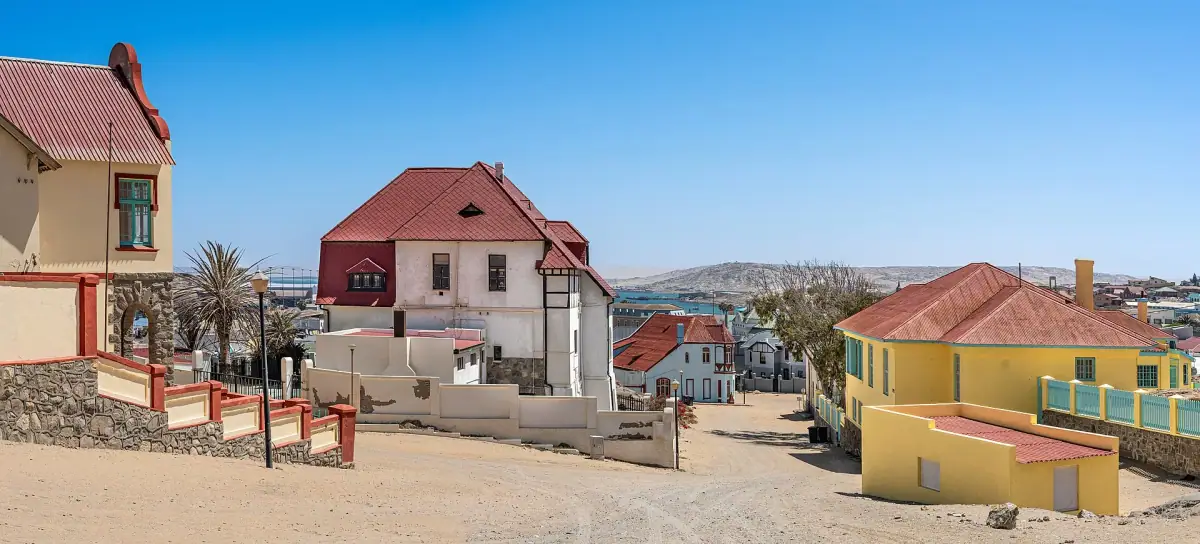
Lüderitz is one of the best-preserved towns of the German colonial era in southern Africa. Founded in 1883 when the tobacco merchant Adolf Lüderitz bought the bay from the Nama people to set up a trading post, the town developed rapidly after the diamond rush of 1908.
The result is a remarkable architectural ensemble: Art Nouveau and Jugendstil houses in pastel colors, Lutheran churches with pointed bell towers, granite cellars built right into the rock. The main street (Bismarck Straße, since renamed) and the surrounding lanes make an open-air museum.
The architectural sites not to miss
Felsenkirche (Church on the Rock, 1912): the most emblematic building in Lüderitz, built in granite on a rocky spur overlooking the whole town. Its style blends German neo-Gothic and Art Nouveau. The view over the bay from the forecourt is worth the climb on its own. The interior, modest but bright, holds a stained-glass window given by Kaiser Wilhelm II.
Goerke-Haus: the former residence of Captain Hans Goerke, one of the most important diamond traders of the era. This Jugendstil villa (1909-1910) is visited irregularly (check opening with the Lüderitz tourist office) and shows the lavish standard of living of the colonial elites. The interior woodwork, tiles and ironwork are remarkably well preserved.
The harbor and the jetty: the walk along the harbor, with its fishing boats, old warehouses and the view of the rocky islets, is one of the most typical moments in Lüderitz. Sunset seen from the jetty, with the silhouettes of cormorants on the posts, is often unforgettable.
Lüderitz Museum: small but informative, this local museum traces the town’s history from the Nama peoples to the colonial period and the diamond rush. The collections include mining tools, period photographs and examples of rough diamonds found in the region.
Scuba diving: the riches of the Benguela Current
The cold waters bathing Lüderitz are part of the Benguela Current, one of the richest deep-water upwellings in the world in terms of marine biodiversity. This abundance of cold, nutrient-rich water makes the Namibian coast an exceptional ecosystem, less known than tropical sites but spectacular for those willing to wear a 7 mm wetsuit.
What you see underwater in Lüderitz
Namibian rock lobsters (Jasus lalandii, commercially harvested) colonize the rocky bottoms in high density. Cape octopus, other cephalopods and various reef fish live in the pebble and kelp zones. Fur seals that regularly dive beside divers make each outing memorable.
Wrecks also make dive sites: a few ships have sunk in the turbulent waters off Lüderitz, creating artificial reefs colonized by local fauna. The diving conditions (variable visibility, sometimes strong current, cold water) make it a site better suited to experienced divers.
General conditions:
- Water temperature: 12 to 18 °C (54 to 64 °F) depending on the season
- Visibility: 3 to 15 m (10 to 49 ft) (varies with wind and season)
- Best period: June to October
- Recommended wetsuit: 7 mm minimum, hood advised
Bogenfels and the Sperrgebiet: the diamond arch
About 95 to 100 kilometers (59 to 62 mi) south of Lüderitz, in Sperrgebiet National Park (the former “Forbidden Zone” of the diamond companies), stands the natural arch of Bogenfels, one of the most spectacular geological formations in Namibia. This arch of dolomite and schist, about 55 meters (180 ft) high, rises straight out of the Atlantic Ocean, eroded by millions of years of waves and wind.
Access to Bogenfels is strictly controlled because the zone is still partly managed by Namdeb (the diamond mining company). Two options exist:
Helicopter or light aircraft flyover: the fastest and most spectacular way to see Bogenfels. Operators departing from Lüderitz offer scenic flights over the Skeleton Coast, Halifax Island and Bogenfels in 2 to 3 hours. The aerial view of the arch above the Atlantic is striking.
Guided excursion via an accredited tour operator: a few agencies have the necessary accreditations to take groups to Bogenfels by 4x4. The track through the Sperrgebiet is long (a full day from Lüderitz) but crosses coastal desert landscapes of absolute beauty.
Sperrgebiet and Bogenfels flyover
Book a scenic flight or a guided excursion to Bogenfels from Lüderitz.
Flamingos and birdwatching
The Lüderitz lagoon and the surrounding coastal wetlands are among the most important bird sites on the Namibian coast. Greater flamingos (Phoenicopterus roseus) and lesser flamingos (Phoeniconaias minor) regularly visit the shallow parts of the lagoon, especially at low tide.
Besides flamingos, the region’s birdlife is remarkable for an arid coastal environment:
- White and pink-backed pelicans: in large colonies on the islets
- Cape, bank and white-breasted cormorants: nest on Halifax and other islets
- Cape gannets: recognizable by their black and white plumage, extraordinary divers
- Caspian and royal terns: abundant in the harbor
- Egrets and herons: along the rocky shores
- Sandpipers, godwits and shanks: on sandy beaches and mudflats
For birdwatching, early morning (6:30 to 9 am) and late afternoon (4 to 6 pm) outings are the most productive. The sandy beach north of the harbor, the rocks of Shark Island and the lagoon edge are the best spots without special equipment.
Shark Island and Lüderitz’s beaches
Shark Island is a peninsula linked to Lüderitz by a causeway, home to one of the most spectacularly located campsites in Namibia. Set on a rock lashed by wind and waves with a 270-degree view of the Atlantic, this campsite, run by Namibia Wildlife Resorts (check it is open before you come), is one of a kind.
Even if you are not camping, the walk to the tip of Shark Island is worth the detour: the rocks are colonized by hundreds of cormorants and pelicans, seals laze on the granite blocks, and in clear weather you can see Halifax Island with its penguins less than a kilometer (0.6 mi) away.
The notorious history of Shark Island (the site was used as a concentration camp by the Germans between 1905 and 1907, during the Herero and Nama genocide) is commemorated by a memorial on the peninsula. To fully understand the history of Lüderitz, this visit is essential.
Accessible beaches:
- Agate Beach (6 to 8 km / 4 to 5 mi north of town): beach of sand and colorful pebbles, agates sometimes found at low tide
- Diaz Point (22 km / 14 mi): rocky cape with a Bartolomeu Dias memorial cross (1488) and a seal colony
Accommodation in Lüderitz
Find your hotel or guesthouse in Lüderitz to explore the region at your own pace.
How to organize your stay in Lüderitz
Getting to Lüderitz
Lüderitz is about 680 to 700 km (423 to 435 mi) south of Windhoek via the B1 then the B4; allow 8 to 9 hours on the road with stops. The road is in good condition and fully paved, making it one of the few places in Namibia reachable in a two-wheel-drive vehicle. A 4x4 remains useful for exploring the surroundings (Bogenfels, Diaz Point).
The town has a small airport with regional flights from Windhoek (FlyNamibia and FlexFlight depending on the period; check schedules with the airlines). For travelers in a hurry, flying shortens the trip considerably.
Recommended 2-day itinerary
Day 1:
- Early morning (6:30 am): photo session at Kolmanskop before the crowds and the heat
- Morning: guided visit of Kolmanskop (if not done during the photo slot)
- Lunch in town
- Afternoon: walk through the colonial district, Felsenkirche, Goerke-Haus, local museum
- Sunset from the jetty or the Shark Island causeway
Day 2:
- Morning (7:30 am): Halifax Island boat trip (penguins, seals, birds)
- Lunch in town
- Afternoon: Agate Beach, Diaz Point (seals and the Bartolomeu Dias cross)
- Option: diving if you are certified and equipped
Day 3 (optional):
- Full-day excursion to Bogenfels with an accredited tour operator
- OR a scenic flight over the Sperrgebiet
Renting a car for the surroundings
A rental car lets you range around Lüderitz independently. The tracks to Diaz Point and Agate Beach are passable in a standard vehicle. For the Sperrgebiet, only guided access with an accredited operator is allowed.
Sport fishing
The Lüderitz region is recognized among Namibian anglers for the richness of its waters. Lüderitz kob (Argyrosomus coronus) and various coastal species are the target of fishing trips from the harbor. Casting from the rocks at Diaz Point and Shark Island is also practiced.
Sea trips with local operators let you try big-game fishing (mackerel, bonito), mainly in the southern autumn (March to May). A marine fishing permit is required for recreational fishing, including from the shore (check with the Ministry of Fisheries in Lüderitz), and rock lobster catches are regulated by Namibia’s Ministry of Fisheries and Marine Resources.
Practical tips for your activities in Lüderitz
Book ahead: In July and August (high season), Kolmanskop and Halifax Island trips are often full. Book 2 to 3 days ahead through your accommodation or directly with operators in town.
The Lüderitz wind: the “Suud-ooser” (southeast wind) is Lüderitz’s most striking weather feature. This strong wind (sometimes 40 to 60 km/h / 25 to 37 mph) can make boat trips difficult or even impossible and turns any walk in town into an obstacle course. It is most frequent from October to January.
Money and services: Lüderitz has ATMs and a few shops. Restaurant choice is limited but sufficient. Fill up with fuel on arrival; the next station on the road to Windhoek can be far.
Suitable clothing: even in summer, bring a windbreaker or light jacket; the Atlantic winds and morning fog keep temperatures cool in the morning and evening.
Safety in the Sperrgebiet: never try to enter the Sperrgebiet without authorization. Diamond zones are monitored and unauthorized access is a serious offense under Namibian law.
Frequently asked questions
Do you need to book a Kolmanskop visit ahead?
Yes, especially in high season (July to September). Tickets for the morning guided visit (8 am) and the dawn photography slot sell quickly. Book directly with the company that runs the site or through your lodge in Lüderitz, ideally 2 to 3 days ahead.
Can you see African penguins from Lüderitz?
Yes, Halifax Island has one of the most accessible African penguin colonies (Spheniscus demersus) in southern Namibia. Boat trips from Lüderitz harbor let you approach the island to within a few meters. Penguins are present all year, but June to October offers the best sea conditions.
What is the Sperrgebiet and can you enter it?
The Sperrgebiet ("forbidden zone" in German) is a vast desert area south of Lüderitz, closed since colonial times to protect the diamond deposits. Since 2008, part of it has been open as a national park (Sperrgebiet NP). Access to Bogenfels and certain sites requires a permit, generally obtained through a tour operator holding a concession from the Ministry of Environment (ask at the ministry's office in Lüderitz).
Is diving possible in Lüderitz?
Yes, the cold waters of the Benguela Current off Lüderitz are remarkably rich in biodiversity: lobsters, octopus, various fish species, seals. The water is cold (12 to 18 °C / 54 to 64 °F), so a thick wetsuit (7 mm minimum) is essential. A few local operators offer dives with equipment, mainly from June to November when the sea is calmest.
How long do you need to visit Lüderitz?
Allow 2 to 3 days for the essentials: a morning at Kolmanskop, a boat trip to Halifax Island, half a day for colonial architecture and the crafts market, and if possible an excursion to Bogenfels. An extra day lets you explore the coastal surroundings or follow the coast toward Oranjemund.
When is the best time to visit Lüderitz?
May to October is ideal: moderate temperatures (15 to 22 °C / 59 to 72 °F), calmer sea, good visibility for diving and boat trips. Summer (November to March) can be very windy, with the southeast wind nicknamed "Suud-ooser" sometimes making water outings difficult. July and August concentrate the most tourists but offer the best overall conditions.
More Namibia guides
Keep reading
Things to do in Swakopmund: sandboarding, quad biking, kayaking and Namibian adventures
Sandboarding, dune quad biking, kayaking with seals, skydiving: all the adventure activities in Swakopmund, Namibia's adrenaline capital.

Spitzkoppe in Namibia: camping or day visit, entry fees and hiking without a guide
Spitzkoppe 2025-2026 fees (day visit N$180, camping N$300), booking, unguided hiking, rock paintings and tips for sleeping there.
Where to stay in Etosha: NWR camps, lodges and practical tips
Choose where to stay in Etosha: official Okaukuejo, Halali and Namutoni camps or lodges outside the park. Budget, booking and safari tips.
Ready-made
Namibia itineraries
10 days
Namibia in 10 days without a car: a realistic itinerary by shuttle and transfer
WindhoekEtoshaDamaralandSwakopmundSesriem / SossusvleiWindhoek
10 days
Namibia road trip in the rainy season (January to March): itinerary and passable roads
WindhoekEtosha (Okaukuejo)Khorixas / TwyfelfonteinSwakopmundSesriemWindhoek

21 days
Namibia road trip: a complete 2 to 3 week 4x4 itinerary
WindhoekSossusvlei / Namib-NaukluftSwakopmund / Walvis BayDamaraland / SpitzkoppeTwyfelfonteinSkeleton Coast, southern partEtoshaWaterberg PlateauFish River CanyonLüderitz and return to Windhoek