Things to do
Spitzkoppe in Namibia: camping or day visit, entry fees and hiking without a guide
We may earn a commission when you book through links on this page, at no extra cost to you. We don't visit or try the places we cover: we summarize published sources. How we work
In short
- A day visit costs N$180 per adult and N$120 per child aged 4 to 11, per the official 2025-2026 rates.
- Camping costs N$300 per adult and N$200 per child per night, with access to the massif included; you do not pay the entry fee on top.
- Rates are valid from November 1, 2025 to October 31, 2026 and may change afterwards: check before you go.
- Unguided walking around the rocks is possible; the rock paintings are visited with a local community guide, whose fee is not published.
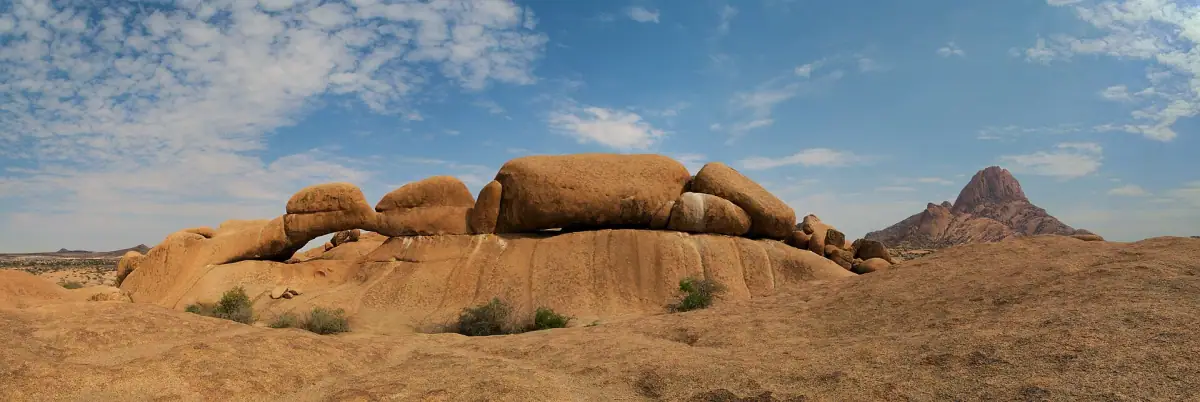
Rising from the plain at 1,728 m (5,669 ft), Spitzkoppe is a granite massif nicknamed the “Matterhorn of Namibia”. You can visit for the day for N$180 per adult, or sleep there for N$300 per adult (official 2025-2026 rates), without paying the entry fee on top.
In short: for a day visit, allow N$180 per adult and N$120 per child aged 4 to 11. For camping, it is N$300 per adult and N$200 per child, access to the massif included. The official rates run until October 31, 2026, then may change. Walking around the rocks without a guide is possible; the rock paintings are visited with a local guide.
Spitzkoppe: entry fees and day visit
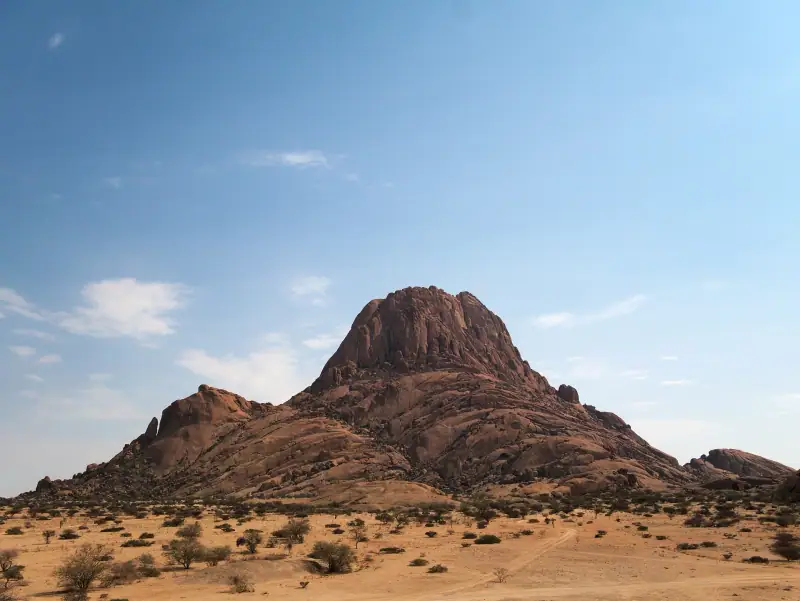
The site is run by the local community. On the official Spitzkoppe Rest Camp page, the rate table shows the following, taxes and community levy included:
| Option | Adult | Child (4-11) |
|---|---|---|
| Day visit | N$180 | N$120 |
| Camping (per night) | N$300 | N$200 |
These amounts are valid from November 1, 2025 to October 31, 2026. They are in Namibian dollars, and it is best to keep cash: see our guide to cash, bank cards and ATMs in Namibia so you don’t arrive empty-handed in an area with no ATM.
The day visit works if you are passing between Damaraland and the coast. It leaves time for a loop on foot and a picnic, but not for the most spectacular moment: sunset, when the granite turns orange.
Camping at Spitzkoppe: booking and sites
Staying overnight is the real appeal of the place. The community camp has sites scattered among the granite blocks, some almost backed against a rock. There is no large infrastructure: bring your own water, food and stove.
To book, the official site gives an e-mail address dedicated to camping reservations. Write with your dates, the number of adults and children, and the type of vehicle. The same operator also offers permanent accommodation (a lodge and a “cabin camp”) with online booking, useful if you don’t want to pitch a tent.
A few practical points:
- Arrive before 4 pm: choosing your site in daylight avoids circling among the rocks at nightfall.
- No artificial light: the sky is exceptional, but you need a flashlight to get around.
- The wind often rises in the late afternoon: secure the tent with heavy pegs.
- Fires only in designated spots: do not light one anywhere else.
Free camping or official camp: what is the rule?
Do not confuse the community camp with wild bivouacking. Around Spitzkoppe, the land belongs to the community: you sleep at the camp and you pay. For the country’s general rules, read our article on wild camping in Namibia: what is allowed or forbidden.
Hiking at Spitzkoppe without an agency
No agency is needed to walk. From the camp, you reach the viewpoints on the rocks on foot, and the granite offers good grip when dry. Common-sense guidelines:
- Set out early in the morning or in late afternoon: at midday, the granite radiates heat.
- Bring at least 2 liters (0.5 US gal) of water per person: there is no water point on the rocks.
- Note your way back: between the blocks, everything looks alike. Keep a visible landmark, such as the camp or a summit.
- Avoid wet slabs or slabs covered in sand, which are very slippery.
Rock paintings and Bushman’s Paradise: with or without a guide
Spitzkoppe is an important San rock art site. The best known is the area called Bushman’s Paradise, where you climb the rock to reach paintings. The path is steep and slippery in places, hence the value of a community guide, who knows the way and explains the site. No guide fee is published on the official site: ask on arrival and bring cash. To better understand this heritage, read our article on Namibian culture.
What else to do: climbing, photography, stars
- Climbing: the massif is known to climbers, and the camp’s official page presents climbing as its main activity. It is a technical pursuit: do not attempt it without experience and equipment.
- Photography: the contrast between granite and clear sky works best at sunrise and sunset. Drones are regulated; see our rules on drones in Namibia.
- Astronomy: far from any town, the Milky Way is visible to the naked eye on moonless nights.
Getting there and combining with the rest of your trip
Spitzkoppe sits between the coast and Damaraland. It fits well on the route between Swakopmund and Twyfelfontein: see our Damaraland guide for the sequence. The last stretch is on a gravel track: reread our tips on driving on gravel roads in Namibia, and fill up before leaving the main road.
To compare rental companies, go through a car rental comparison site.
Sleeping indoors near Spitzkoppe
If camping doesn’t appeal, look at the accommodation in the Erongo and Damaraland area. See accommodation near Spitzkoppe on Booking.com lets you compare the lodges and rooms available on your dates.
Excursions in Namibia: see the excursions offered around Spitzkoppe on GetYourGuide if you prefer to go with a guide.
Quick reference
| Question | Short answer |
|---|---|
| Day visit | N$180 adult, N$120 child (4-11) |
| Camping | N$300 adult, N$200 child, entry included |
| Rate table validity | November 1, 2025 to October 31, 2026 |
| Camping booking | By e-mail, address on the official site |
| Free walking | Yes, around the rocks |
| Rock paintings | With a local guide, ask for the fee |
| Altitude of the massif | 1,728 m (5,669 ft) |
Frequently asked questions
How much is entry to Spitzkoppe?
N$180 per adult and N$120 per child aged 4 to 11 for the day visit, per the official 2025-2026 rate table.
Do you pay the entry fee on top of camping?
No, camping includes access to the massif.
Can you hike without a guide?
Yes around the rocks. The rock paintings are visited with a community guide.
Do you need to book ahead?
In high season, it is prudent: write to the booking address on the official site.
Is an ordinary rental car enough?
To arrive, often yes; inside the camp, a 4x4 helps on the sandy stretches.
Sources
Frequently asked questions
How much is entry to Spitzkoppe?
According to the official Spitzkoppe Rest Camp rate table valid from November 1, 2025 to October 31, 2026, a day visit costs N$180 per adult and N$120 per child aged 4 to 11, taxes and community levy included. Rates may be updated on November 1: check before you go.
Do you pay the entry fee on top of camping?
No. The official rate table separates the day visit from camping (N$300 per adult and N$200 per child for the 2025-2026 period). When you sleep there, access to the massif is part of the stay: you do not pay both.
Can you hike at Spitzkoppe without a guide?
Yes, to walk around the rocks and reach the viewpoints from the camp. For the rock paintings, access is generally with a community guide, whose fee is not shown on the official site: ask at reception. Climbing the summit is a technical activity reserved for equipped climbers.
Do you need to book the campsite ahead?
Campsite reservations go through the booking e-mail address shown on the official site. In high season (July to October), writing ahead keeps you from arriving at a full camp after 2 hours on a gravel track. Off-season, there is often room on arrival.
Is Spitzkoppe accessible in an ordinary rental car?
The major sites in the region can be reached in an ordinary car, but the camp's internal tracks are sandy in places. A 4x4 makes it easier to reach the most distant sites. In any case, bring a spare wheel in good condition.
More Namibia guides
Keep reading
What to do in Lüderitz: activities and must-see visits
Kolmanskop, penguins at Halifax Island, Bogenfels, diving, flamingos: a complete guide to things to do in Lüderitz, Namibia's southern colonial gem.
Things to do in Swakopmund: sandboarding, quad biking, kayaking and Namibian adventures
Sandboarding, dune quad biking, kayaking with seals, skydiving: all the adventure activities in Swakopmund, Namibia's adrenaline capital.
Where to stay in Etosha: NWR camps, lodges and practical tips
Choose where to stay in Etosha: official Okaukuejo, Halali and Namutoni camps or lodges outside the park. Budget, booking and safari tips.
Ready-made
Namibia itineraries
10 days
Namibia in 10 days without a car: a realistic itinerary by shuttle and transfer
WindhoekEtoshaDamaralandSwakopmundSesriem / SossusvleiWindhoek
10 days
Namibia road trip in the rainy season (January to March): itinerary and passable roads
WindhoekEtosha (Okaukuejo)Khorixas / TwyfelfonteinSwakopmundSesriemWindhoek

21 days
Namibia road trip: a complete 2 to 3 week 4x4 itinerary
WindhoekSossusvlei / Namib-NaukluftSwakopmund / Walvis BayDamaraland / SpitzkoppeTwyfelfonteinSkeleton Coast, southern partEtoshaWaterberg PlateauFish River CanyonLüderitz and return to Windhoek