What to see
Gásadalur: The Village at the Edge of the World (Múlafossur Waterfall)
We may earn a commission when you book through links on this page, at no extra cost to you. We don't visit or try the places we cover: we summarize published sources. How we work
In short
- From Tórshavn, Gásadalur is about 75 km (47 mi) and 1 h 15 by car via Vágar and the single-lane Gásadalsvegur tunnel (about 1.4 km / 0.9 mi). From Vágar Airport, allow 25 to 30 minutes.
- The Múlafossur viewpoint is free; parking may be paid in high season. There is no restaurant or shop in the village.
- The old Bøur to Gásadalur path (about 400 m / 1,310 ft of climb, 45 min to 1 h uphill) is still open.
- Best light is late evening in summer; avoid 11 am to 3 pm when tour buses arrive.
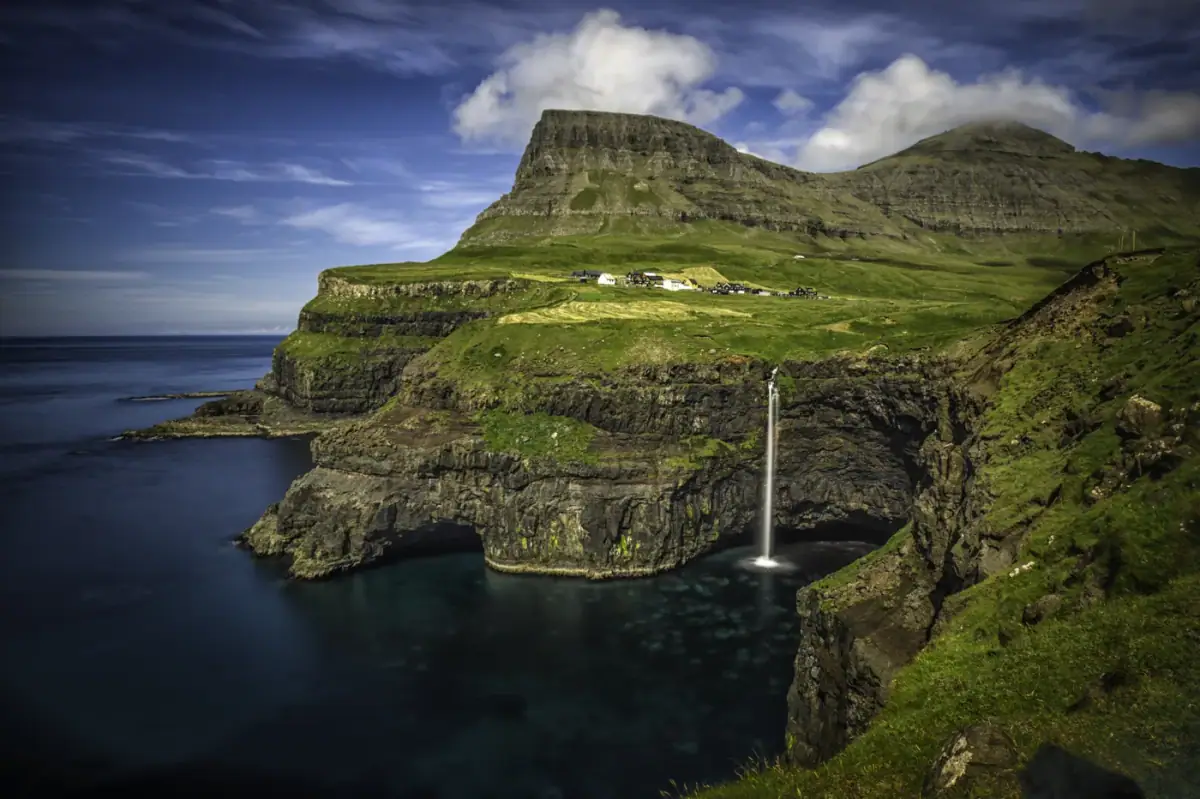
There are places on Earth where the sight alone takes your breath away. Gásadalur is one of them. This village of 18 residents, perched on the cliffs of the island of Vágar, is home to one of the most photographed waterfalls in the world: Múlafossur, a ribbon of water that plunges straight into the Atlantic from 70 meters (230 ft) up. An image that has become the symbol of the Faroe Islands.
But Gásadalur is more than a postcard. It is a living village, a demanding hike, a window onto an isolated, preserved way of life found nowhere else in Europe. Here is everything you need to know before going.
Gásadalur: a village at the end of the world
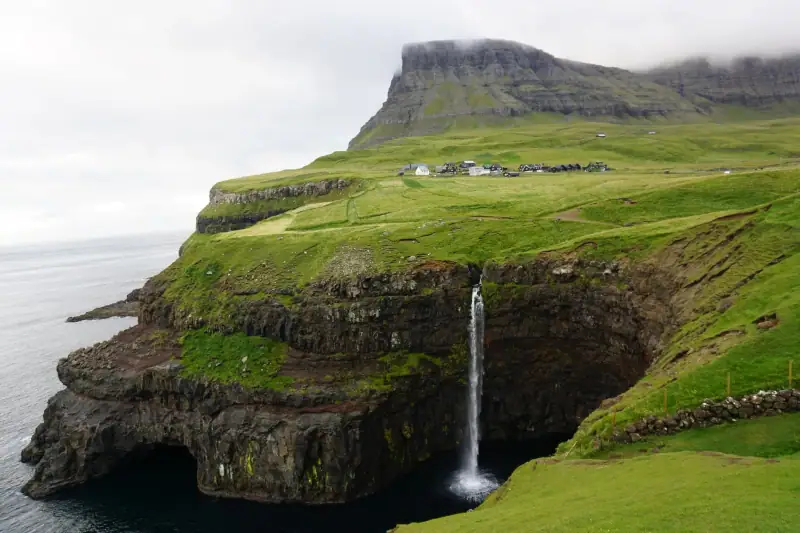
For centuries, Gásadalur was one of the most isolated villages in the Faroe Islands. Perched high above the sea on the west coast of Vágar, it could only be reached by a mountain path from the village of Bøur, a walk of about 45 minutes over rough terrain. Everything (food, materials, mail) had to be carried on people’s backs or brought by boat when conditions allowed.
In 2004, a tunnel of about 1.4 km (0.9 mi) changed everything. For the first time, Gásadalur was linked by road to the rest of Vágar. But this easier access did not turn the village into a resort. With about twenty permanent residents, a few stone-and-turf houses and no shops (apart from an occasional waffle stand in summer), Gásadalur remains true to its soul.
The village takes its name from the Faroese words gás (wild goose) and dalur (valley). Before the tunnel, the community was mainly farmers, sheep breeders and fishermen. Today several houses serve as second homes or tourist accommodation.
Car rental in the Faroe Islands
The most practical way to reach Gásadalur and explore Vágar at your own pace.
The Múlafossur waterfall: icon of the Faroes
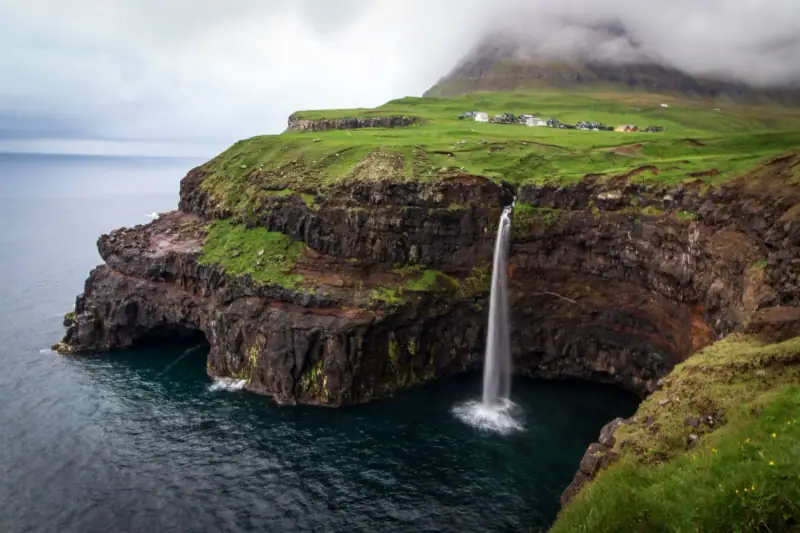
Múlafossur is the main reason thousands of visitors make the detour to Gásadalur every year. And for good reason: few waterfalls in the world plunge straight into the ocean from the edge of an inhabited cliff.
What exactly will you see?
The waterfall rises from the streams and grassy moorland above the village. It crosses the green roofs of Gásadalur’s houses, then tips into the void from the headland. Below, 70 meters (230 ft) down, the Atlantic. In between, nothing but wind and spray.
The official viewpoint is a few hundred meters past the tunnel, on the road that climbs to the village. A parking lot has been built (paid in high season). From there the view is already striking: the village in the background, the waterfall in the foreground, the ocean as far as the eye can see and, in clear weather, the islands of Mykines and Tindhólmur on the horizon.
The “reverse waterfall” phenomenon
In strong west winds, which are frequent in the Faroe Islands, Múlafossur can seem to flow upward rather than fall. Gusts from the Atlantic blow the water inland, creating a waterfall that “rises”. This spectacular phenomenon has become one of the most viral images of the Faroe Islands on social media. It is unpredictable but not rare, especially in fall and winter.
Best time to photograph
In summer (June to August), the sun sets late, around 10 pm or even later. The golden light of late evening lights up the waterfall and cliffs perfectly. Avoid peak hours (between 11 am and 3 pm) when tour buses unload their waves of visitors.
In winter, conditions are more dramatic: thick fog, moving clouds, low light, a completely different mood, much sought after by photographers who like “moody” shots.
Hikes from and to Gásadalur
Gásadalur is also an excellent starting point for several hikes on Vágar. Unlike many Faroese tourist sites, the trails here see few people.
The old Bøur to Gásadalur crossing (4 km / 2.5 mi, 2 h round trip)
Before the tunnel, this mountain path was the only access to the village. It starts from the parking lot at the entrance to Bøur and climbs steadily about 400 meters (1,310 ft) to Gásadalur. The view from the pass over the Atlantic, the cliffs of Vágar and the surrounding islands is exceptional.
Level: Intermediate (path sometimes slippery, no formal waymarking along the whole route) Time: 45 min to 1 h uphill, 35 to 45 min downhill Starting point: Bøur parking lot (GPS: 62.083°N, 7.368°W) Tip: Do the crossing from Bøur to Gásadalur to get the view of the waterfall on arrival. Return through the tunnel if you are tired.
The hike to Trælanípan and Sørvágsvatn
From Gásadalur, climbing toward the pass, you can join the trail that leads to Trælanípan and Lake Sørvágsvatn, the famous lake that seems to “float above the ocean” in wide-angle photos. This is not the most direct connection (it is better to start from Sørvágur for this trail), but experienced walkers can link the two. See our guide to hiking in the Faroe Islands for details of this route.
Guided tours on Vágar
Organized tours to Gásadalur, Múlafossur and the other wonders of Vágar.
How to get to Gásadalur
By car (recommended)
By far the best option. From Tórshavn:
- Take the main road west (subsea tunnel to Vágar)
- On Vágar, follow the signs to Sørvágur then Bøur
- Just before Bøur, take the Gásadalsvegur tunnel (about 1.4 km / 0.9 mi, single lane)
- Follow the road to the viewpoint parking lot
Total time: About 1 h 15 from Tórshavn (75 km / 47 mi) Parking: Free out of season, sometimes paid in summer (check locally)
Watch out for the Gásadalsvegur tunnel: It has only one lane, with alternating traffic. In high season, short queues can form: follow the signs and yield to vehicles already in the tunnel.
From Vágar Airport
The international airport of the Faroe Islands is on the island of Vágar, which makes it an ideal entry point if you plan Gásadalur as a first stop. From the airport, allow 25 to 30 minutes by car to the village.
Rent your car directly at the airport from Sixt, Avis or local providers. Book well ahead in summer, as the fleet is limited.
By bus + taxi
The bus network of the operator SSL (Strandfaraskip Landsins) can get you there: bus 300 from Tórshavn (or from Vágar Airport) to Sørvágur, then bus 350 to Gásadalur. Services are limited, especially on weekends: check the timetables at ssl.fo before you go. A taxi from Sørvágur remains an option (about 200 to 300 DKK, rate to be confirmed locally).
The village itself: what to see
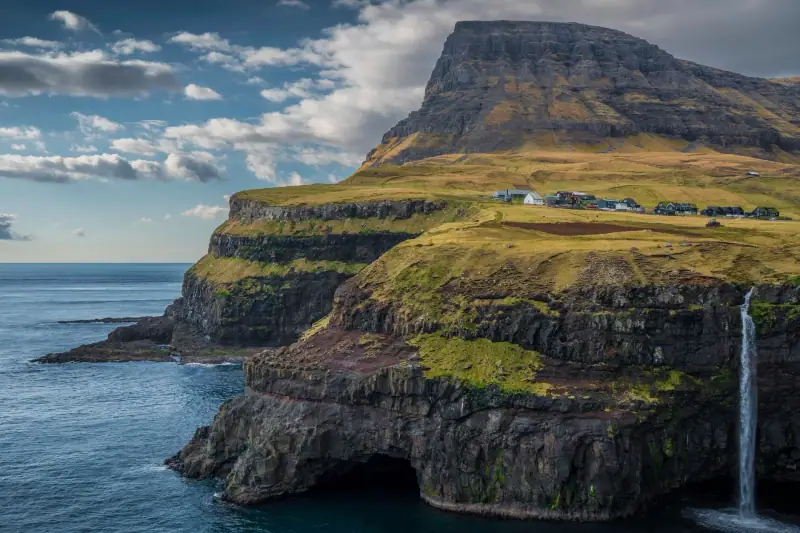
Beyond the waterfall, Gásadalur deserves a quiet stroll. The village is tiny: a few dozen stone houses, drystone walls, meadows where sheep and horses graze. The atmosphere is soothing, almost unreal.
The turf-roofed houses
As across the archipelago, several houses in Gásadalur have the traditional turf roof, an insulation technique inherited from the Vikings. These living roofs, which turn green in spring and brown in fall, give the village its typically Faroese look. They are private homes, so admire them from the outside only.
The little church
Gásadalur church (Gásadalur Kirkja) is a modest white chapel serving the village’s few families. It dates from the time when every Faroese village had its own place of worship, even the most isolated. It is not always open to visitors, but its location, between the grassy slopes and the ocean horizon, makes it photogenic from every angle.
The sheep of Vágar
The Faroe Islands have about 80,000 sheep for 55,000 people, more sheep than humans. In Gásadalur, these animals are everywhere. They graze freely on the slopes, sometimes right up to the cliff edge. Do not feed them and respect their space: they belong to the village families.
Where to stay near Gásadalur
Gásadalur itself has no structured accommodation. The best bases for exploring the area are:
Sørvágur (15 to 20 min)
The closest town to Gásadalur on Vágar, Sørvágur has a few guesthouses and a hotel. This is also where the ferry dock for Mykines is. See our Vágar accommodation guide for the best places.
Bøur (5 min)
This small village next to Gásadalur offers a few rooms in private homes (peer-to-peer listings). The location is strategic, at the entrance to the Gásadalur tunnel, and the village itself is very picturesque, with its houses overlooking the fjord and the islet of Tindhólmur.
Tórshavn (1 h 15)
The capital has the biggest choice of accommodation in the Faroe Islands. If you have a busy program across several islands, Tórshavn remains the logical starting point for day trips.
Accommodation on Vágar
Guesthouses and hotels near Gásadalur and Vágar Airport.
Fitting Gásadalur into your itinerary
Gásadalur deserves half a day, ideally a full day if you include the hike from Bøur and a long stop at the viewpoint. Here is how to fit it in depending on the length of your stay.
With 5 to 7 days in the Faroe Islands
Devote a whole day to the island of Vágar, combining:
- Morning: Sørvágsvatn and Trælanípan (early start)
- Lunch in Sørvágur
- Afternoon: Gásadalur through the tunnel or on foot from Bøur
- Late day (6 pm to 10 pm): golden light on Múlafossur for photos
For those with time, the crossing to Mykines (departing from Sørvágur) can be done the day before or the day after. See our Faroe Islands road trip guide for a day-by-day plan.
With 3 to 4 days
Gásadalur is still a highlight. Combine it with the airport (arrival/departure on Vágar) and save the rest of your stay for Tórshavn and Streymoy.
As a day trip from Tórshavn
It is doable in a day, with an early start (7 am to 8 am) to avoid crowding at the Gásadalsvegur tunnel. Bring supplies, as there is no restaurant there.
Photo tips for Múlafossur
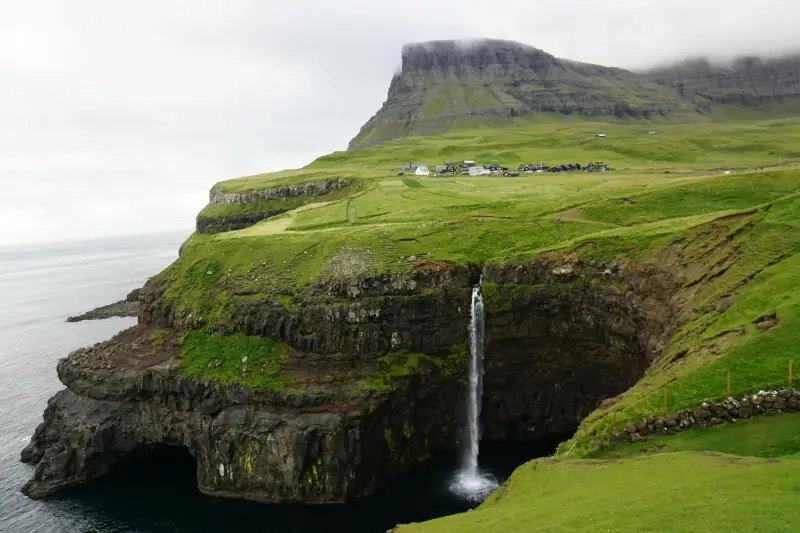
Gásadalur is one of the most photographed sites in the Faroe Islands. A few tricks to get the most from it:
Recommended gear:
- A tripod is useful if you want long exposures (slow shutter on the waterfall)
- A polarizing filter reduces reflections and intensifies the greens of the meadows
- Wide-angle (16-24 mm) to frame the waterfall AND the village houses
- Telephoto (70-200 mm) for tight shots of the falling water
Composition:
- Include a turf-roofed house in the foreground to give scale
- Frame from the bottom of the path to get the cliffs in the background
- In strong wind, expose longer to “freeze” or, on the contrary, “smooth out” the reverse waterfall
Mistakes to avoid:
- Do not climb onto private property for a “better angle”
- Avoid direct flash: the scene is already bright and flash flattens depth
- Come early in the morning in low season to be alone facing the waterfall
Weather and best time to go
The Faroe Islands have unpredictable weather in every season. At Gásadalur, on the Atlantic-exposed coast, conditions can change in minutes.
Summer (June to August): Mild temperatures (10 to 15 °C / 50 to 59 °F), very long days (up to 20 hours of light), but heavy tourist traffic. The waterfall is beautiful but the parking lot can be full.
Spring (April to May): Few tourists, intensely green grass after the winter rains, waterfall at maximum flow. Variable but spectacular weather.
Fall (September to October): Dramatic light, frequent fog on the cliffs, fewer people. The “reverse waterfall” in storm winds is particularly impressive at this time.
Winter (November to March): The tunnel is sometimes closed in extreme storms. But between two fronts, the low winter light is sublime. For the brave only.
To choose your travel window, see our guide to the best time to visit the Faroe Islands.
Flights to the Faroe Islands
Compare available flights to Vágar (FAE), the international airport of the Faroe Islands.
Practical information
Access: Car recommended (bus 300 then 350 via Sørvágur, limited service) Parking: Available at the viewpoint (paid in summer) Gásadalsvegur tunnel: Single lane, alternating traffic Shops: None (occasional coffee/waffle stand in summer) Toilets: Public toilets at the parking lot (in high season) Mobile network: Good (4G Faroese Telecom and TF) Distance from Tórshavn: 75 km (47 mi) / 1 h 15 Distance from Vágar Airport: 22 km (14 mi) / 25 min
Must bring:
- Waterproof clothing (even in summer)
- Hiking shoes if you walk from Bøur
- Water and supplies for the day
- A charged camera
- Thermal layers (the Atlantic wind cools you quickly)
Gásadalur is not just a viewpoint to tick off a list. It is a place that leaves a mark. Standing in front of Múlafossur, with the wind whipping the cliffs and the Atlantic horizon vanishing into the clouds, you will understand why so many travelers return to the Faroe Islands again and again. This village of 18 souls, at the end of a tunnel cut through the rock, is one of the most authentic and moving places in Europe.
To plan your complete trip, see our complete guide to the Faroe Islands and our 7-day Faroe Islands itinerary.
Frequently asked questions
How do you get to Gásadalur from Tórshavn?
From Tórshavn, take the road to Vágar (about 45 min), then reach the Gásadalsvegur tunnel from Bøur (about 1.4 km / 0.9 mi). In total, allow 1 h 15 to 1 h 30 by car from the capital. A car is the most practical: by public transport, take bus 300 to Sørvágur then bus 350 to Gásadalur (check timetables at ssl.fo, services are limited, especially on weekends).
Do you have to pay to see the Múlafossur waterfall?
Access to the Múlafossur viewpoint is free. There is no entrance fee. Parking may be paid in high season: check the signs there. The site is managed by the villagers.
Can you hike to Gásadalur without the tunnel?
Yes, the old hiking path that existed before the tunnel in 2004 is still passable. The walk from Bøur takes about 45 minutes one way for an elevation gain of 400 m (1,310 ft). It is a magnificent but physical hike, with views of the ocean and the surrounding villages.
When should you photograph the Gásadalur waterfall?
The light is best in the evening (sunset around 10 pm in summer). In winter, dramatic conditions with clouds and fog create unique moods. The waterfall is at peak flow in spring after the rains.
Is there a café or restaurant in Gásadalur?
The village has only 18 residents. There is no restaurant and no permanent café. In high season (June to August), villagers sometimes run a small waffle and coffee stand. Bring your own supplies from Sørvágur or Bøur.
Can you stay overnight in Gásadalur?
There is no hotel in Gásadalur. A few rooms in private homes and guesthouses may be available. Most travelers stay in Sørvágur (20 min) or Tórshavn and visit as a day trip.
Does the Múlafossur waterfall flow all year?
Yes, Múlafossur is fed all year by the streams and rainfall of the island of Vágar. In winter, in strong wind, the spray rises spectacularly upward under gusts coming off the Atlantic, a phenomenon photographed by thousands of visitors.
More Faroe Islands guides
Keep reading
Visiting Eysturoy: Complete Guide to the Faroe Islands' Second Island
Everything for exploring Eysturoy in the Faroe Islands: Gjógv, Eiði, Slættaratindur, Funningur, the Two Giants. Hikes, villages and dramatic landscapes.
Visiting Klaksvík: Complete Guide to the Faroe Islands' Second Town
Klaksvík, second town of the Faroe Islands on Borðoy: what to see and do, where to stay, how to get there. A complete practical guide for your visit.
Kirkjubøur from Tórshavn without a car: bus, time needed and is it worth the detour?
Getting to Kirkjubøur from Tórshavn without a car: bus, visit time, St. Magnus Cathedral, Roykstovan and Ólavskirkjan church. Worth the detour?
Ready-made
Faroe Islands itineraries
14 days
Faroe Islands Road Trip: A 10 to 14 Day Itinerary by Car
Faroe Islands road trip itinerary in 10 to 14 days. Scenic roads, subsea tunnels, remote villages and the essential natural sites.
2 days
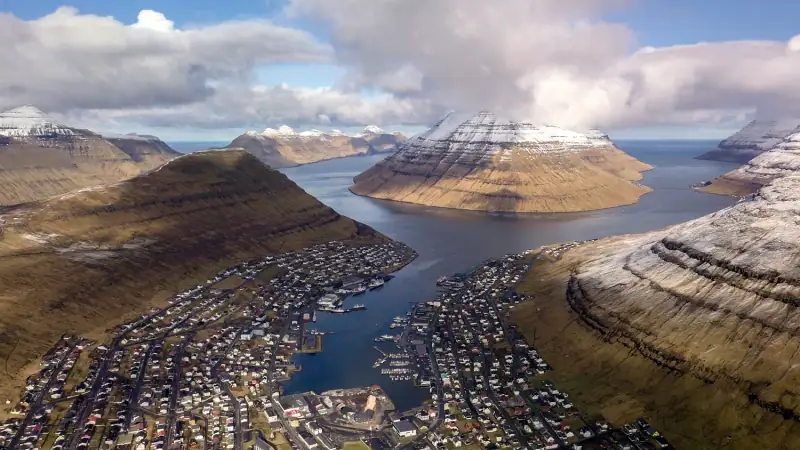
Borðoy Road Trip: 2 Days Between Klaksvík and the Northern Islands
2-day itinerary on Borðoy: Klaksvík, Klakkur, the Kallur lighthouse on Kalsoy, Kunoy and Viðoy. The wild north of the Faroe Islands.
2 days
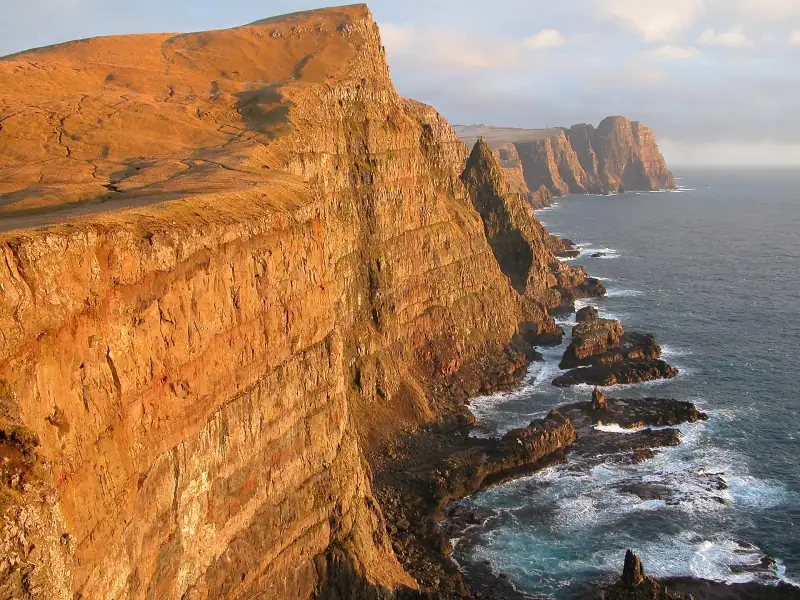
Suðuroy Road Trip: Complete Guide to the Island at the End of the World
Suðuroy road trip in the Faroe Islands: ferry, Fámjin, Beinisvørð cliffs, Tvøroyri, Vágur, Sumba. 2-day itinerary and practical tips.