What to see
Faial Island: A Complete Guide to the Blue Island of the Azores
We may earn a commission when you book through links on this page, at no extra cost to you. We don't visit or try the places we cover: we summarize published sources. How we work
In short
- Plan at least 3 days: Horta and its marina, the caldera (about 2 km / 1.2 mi wide) and island loop, then the Capelinhos volcano and its museum.
- A rental car is recommended; the caldera and Capelinhos are not reachable without a vehicle. Horta itself is walkable.
- The Pico–Horta ferry takes about 30 minutes; SATA Air Açores flies Ponta Delgada–Horta in about 55 minutes.
- Best months: June to August for hydrangeas and calm seas, May and September for fewer crowds. Rim trail around the caldera: 6.8 km (4.2 mi), 1 h 30 to 2 h.
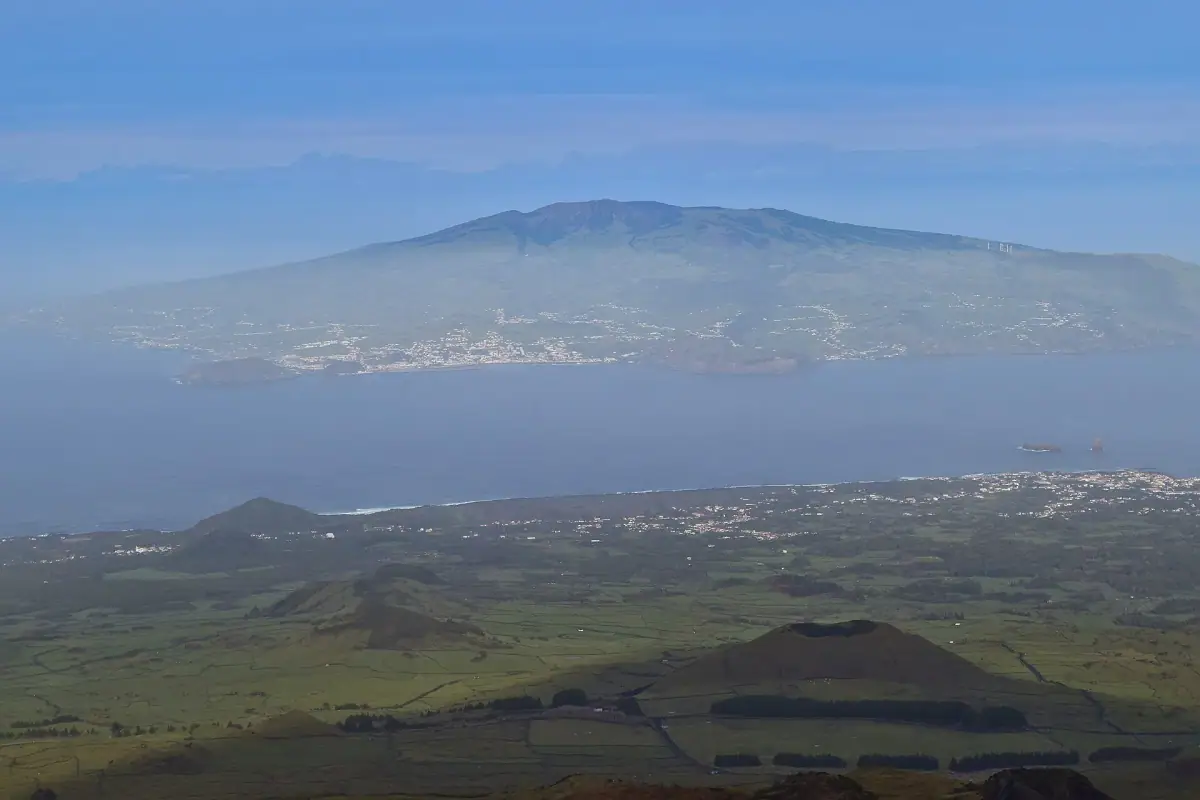
Faial is the Blue Island of the Azores, and the nickname is not a metaphor. In June and July, the hydrangeas lining every road, path and embankment on the island burst into shades of blue, violet and mauve that turn the landscape into a painting. But Faial is much more than its flowers: it is the island of the spectacular caldera, of Capelinhos, the archipelago’s last land-based volcanic eruption, and of the Horta marina, a legendary stop for transatlantic sailors for several decades. Here is everything you need to know to visit Faial.
The Caldeira do Faial: the crater at the top of the world
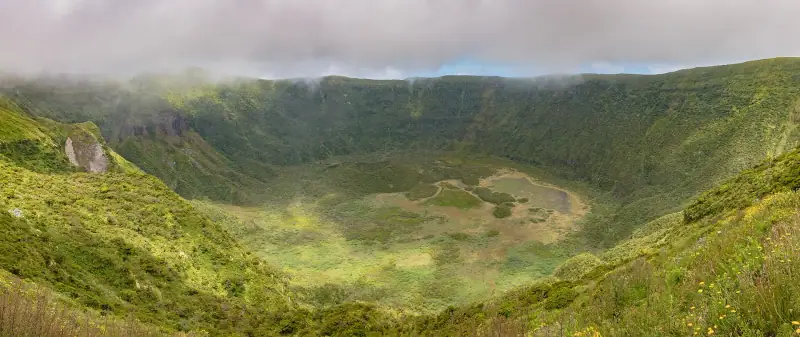
Faial’s caldera is one of the most accessible in the Azores. From Horta, a winding but passable road climbs to the crater rim at about 1,000 meters (3,280 ft) of elevation, in the heart of the Faial Natural Park. There is no long, exhausting approach hike: you can park a few hundred meters from the edge and walk to the crater in a few minutes.
The crater and its vegetation
What strikes you first is the scale: the crater of the caldera measures about 2 km (1.2 mi) across and about 400 meters (1,310 ft) deep. Its floor is carpeted with a dense forest of trees endemic to Macaronesia (laurels, vinagreiras, tree ferns and cryptomerias), forming an ecosystem of extraordinary richness, sheltered from Atlantic wind and moisture by the crater walls.
The area is classified as a strict nature reserve: going down into the caldera is forbidden. But the hiking trail that circles the whole crater rim (6.8 km / 4.2 mi, 1 h 30 to 2 h) is one of the island’s finest walks. On a clear day, the view from the rim takes in the caldera floor, the silhouette of Pico to the east and the Atlantic stretching out of sight to the west.
When to go
The caldera can be visited all year, but clouds and fog can hide the view and make the trail slippery in autumn and winter. From May to September, the chances of a clear sky are much better. Arrive early in the morning: the morning mist often lifts around 9 to 10 am and the light is better for photos.
Hikes and guided tours on Faial
Caldeira loop, trek to Capelinhos, whale-watching trip from Horta. Certified local guides.
Capelinhos: the volcanic tip of the Blue Island
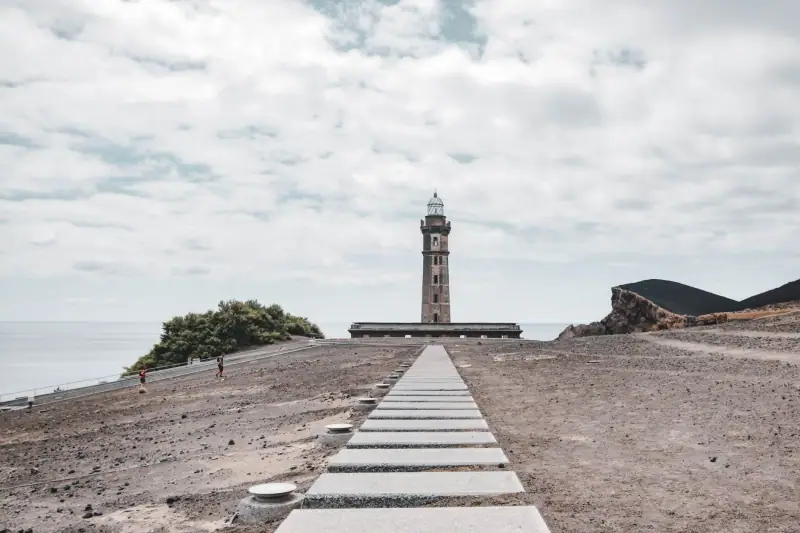
At the western end of Faial lies one of the most fascinating geological sites in the entire North Atlantic. Capelinhos is the result of a submarine and aerial volcanic eruption that began in September 1957 and continued until October 1958, about thirteen months. The eruption created a new volcanic peninsula at the island’s western tip, adding several hundred hectares of new land to Faial.
A lunar landscape frozen in lava
The Capelinhos site is now a nearly lunar landscape: fields of black lava, scoria cones, crumbling cliffs of tephra (compacted volcanic ash) that the Atlantic has been patiently nibbling at for nearly 70 years. Vegetation is gradually recolonizing some areas, but the part closest to the eruption remains a mineral desert of austere, overwhelming beauty.
The 1957-1958 eruption deeply marked the island: several villages in Capelo were buried under ash, and a large part of Faial’s population emigrated to the United States (notably the New Bedford area of Massachusetts), a migration that left deep traces in the Azorean American diaspora.
The Capelinhos Interpretation Center
The Centro de Interpretação do Vulcão dos Capelinhos is one of the finest museum achievements in the whole archipelago. Built largely underground, right at the foot of the old Capelinhos lighthouse (of which only the top rises above the ash), the museum recounts the 1957-1958 eruption through exceptional photographic and film archives, immersive projections, models and geological specimens.
The most moving part is probably the one devoted to the accounts of residents who lived through the eruption and the great wave of emigration that followed. The visit takes about 1 h 30. From the lighthouse terrace, reached from the museum, the view of the frozen lava field, the new peninsula and the ocean is striking.
Places to stay on Faial
Hotels in Horta, guesthouses with marina views and guesthouses in the villages of the interior.
Horta and its legendary marina
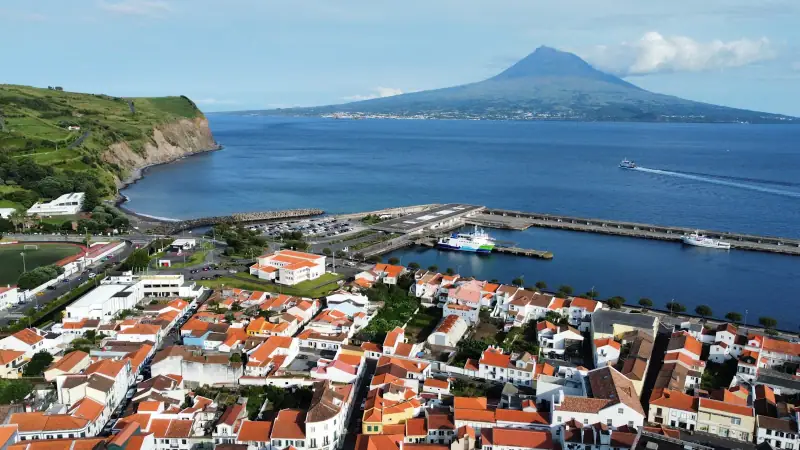
The town of Horta is the beating heart of Faial and one of the most famous nautical stops in the world. Its marina has been the gathering point for sailors crossing the Atlantic for decades. Tradition says each crew leaves a painting on the harbor quays before sailing on. There are now more than 30,000 works of all sizes and styles, covering the entire breakwater and making the Horta marina an open-air museum unlike any other.
For a full exploration of the town (Peter’s Bar, Monte da Guia, the Museu da Horta and the historic districts), see our complete guide to Horta. Here, we focus on what Faial offers beyond its capital.
Faial’s beaches and coastline
Faial is not known for fine sand beaches. The island, like most of the Azores, is essentially basaltic and its coastline is often made up of cliffs and volcanic rock. But a few beaches are worth the detour.
Praia do Almoxarife
Praia do Almoxarife, on Faial’s north coast, is the island’s best-known beach. A beach of pebbles and dark sand, it has a direct view of Pico volcano rising on the horizon on clear days, an exceptional photographic setting. The water is cool (between 18 and 22 °C / 64 and 72 °F in summer), but brave swimmers regularly turn up in July and August. Basic facilities are available in season.
Porto Pim
The bay of Porto Pim, south of Horta and framed by Monte da Guia, is a protected natural area with a small dark-sand beach and a calm swimming zone. It is one of the few places where you can swim in relatively sheltered water near town. The bay is lined with cliffs and a former whale-processing factory, now restored.
The cliff coast
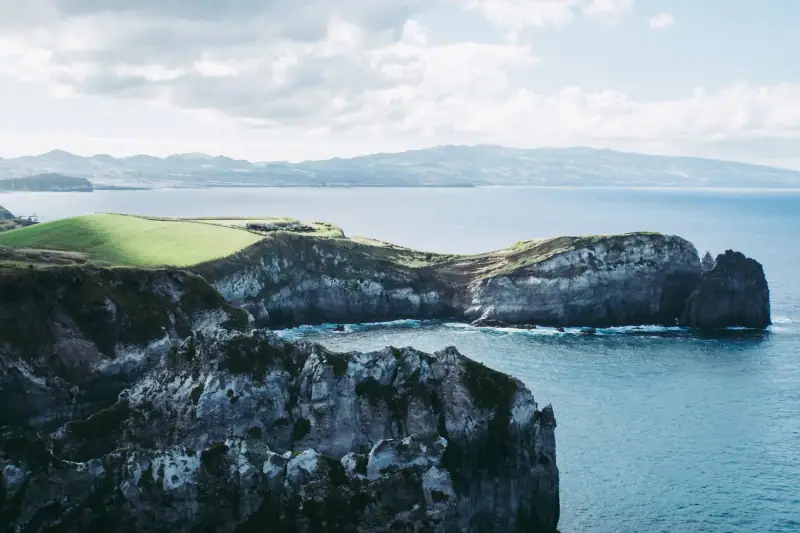
For lovers of wild landscapes, Faial’s west coast, especially around Capelo and Capelinhos, offers views of volcanic cliffs among the most spectacular in the archipelago. It is not a swimming area, but an exceptional place for walking and photography.
Hiking on Faial
The caldera loop (PRC04 FAI)
The trail around the caldera rim is Faial’s most emblematic. About 6.8 km (4.2 mi) long, with moderate elevation change and 360-degree views over the caldera, the island and the ocean. The trail crosses a dense forest zone and a few windswept stretches of open heath. Plan 1 h 30 to 2 h for the full loop.
The Capelinhos and Capelo trail
From the Capelo area at the far west of the island, several trails let you explore the Capelinhos lava fields and the coastal cliffs. Some reach the Capelinhos museum along the coast. This hike is more exposed to wind and sea spray, and good walking shoes are recommended. For a full overview of the archipelago’s trails, read our guide to hiking in the Azores.
Flights to Faial (Horta)
Flights from Lisbon, Porto and São Miguel to Horta airport (HOR). Compare the best offers.
Azorean food on Faial
Specialties to try
Faial’s cooking is rooted in the archipelago’s traditions, with a few local particularities:
- Lapas grelhadas: limpets grilled with butter and garlic, served in their volcanic shell. A staple of every seaside restaurant on Faial.
- Caldo de peixe: fish broth with local vegetables, a daily dish in Azorean homes.
- Polvo grelhado: Faial leans more toward seafood than meat. Octopus grilled with olive oil and garlic, lagosta (spiny lobster) and crab are among the local favorites. Alcatra, the famous beef stew simmered in a clay pot with red wine and spices, is the signature dish of neighboring Terceira, not of Faial.
- São Jorge cheese: although made on the neighboring island of São Jorge, it is everywhere in Faial’s restaurants and worth trying alongside a glass of local wine.
- Queijadas: small cakes of fresh cheese and sugar, an Azorean pastry specialty found in every bakery in Horta.
Where to eat
Horta has the vast majority of the island’s restaurants. The harbor and marina area has several places specializing in grilled fish and fresh seafood. A few villages in the interior (notably Flamengos and Salão) have their own quieter, more local spots. Check recent reviews on TripAdvisor or Google Maps to get oriented, as the offerings vary by season.
Whale watching from Faial
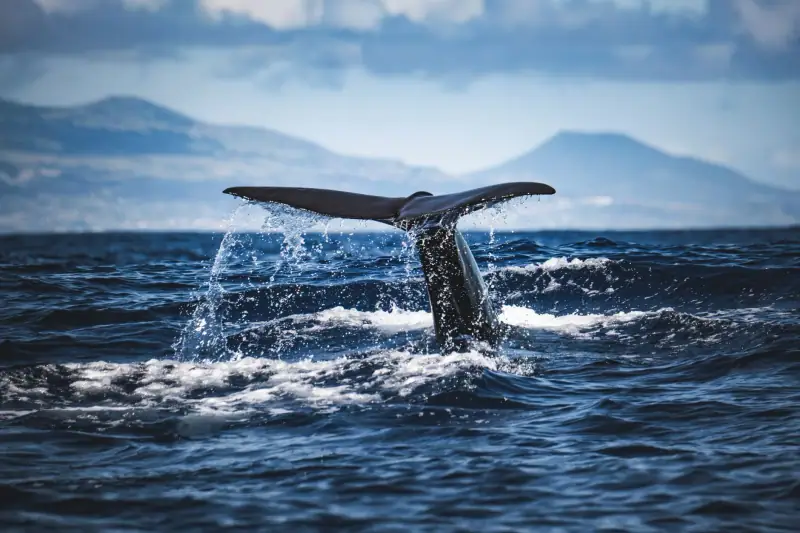
Faial is one of the best departure points for cetacean-watching trips in the Azores. The central group (Faial, Pico, São Jorge) lies near very deep ocean trenches that attract sperm whales, common dolphins, Risso’s dolphins and, from March to May, migrating humpback whales.
Several operators offer zodiac or catamaran trips from Horta harbor, with vigias on land (lookouts posted on the island’s headlands) who spot the animals from a distance and guide the boats by radio. This technique, inherited from whaling, now serves watching and conservation. For everything on how to choose your boat trip, see our guide to whale watching in the Azores.
Practical information for visiting Faial
How to get to Faial
By air: Faial airport (IATA code: HOR) is about ten minutes from Horta. SATA Air Açores flights connect Horta to Ponta Delgada (São Miguel) in about 55 minutes, and to Lisbon in about 2 hours in high season. Connections with other islands of the archipelago also exist.
By ferry: From Pico (Madalena), the ferry reaches Horta in about 30 minutes, the shortest inter-island connection in the entire archipelago. From São Jorge (Velas), allow about 1 h 40 to 2 h 10. The Atlânticoline company runs most inter-island connections.
Getting around Faial
A rental car is recommended for exploring the island beyond Horta. Roads are well maintained, signage is decent and distances are reasonable: Faial covers about 173 km² (67 sq mi) and measures about twenty kilometers (12 mi) from east to west. Rental agencies are available at the airport and in Horta; book ahead in high season.
To reach the caldera or Capelinhos, a vehicle is essential. The sights in the town of Horta (marina, historic center, Monte da Guia), on the other hand, are reachable on foot.
Budget for a stay on Faial
Lodging: Guesthouse or room in Horta: €55 to €90 (~$64 to 105) a night in high season. Comfortable hotel: €100 to €160 (~$115 to 185) a night.
Meals: Lunch in a local restaurant: €12 to €20 (~$14 to 23) per person. Dinner with seafood and wine: €25 to €40 (~$29 to 46) per person.
Activities: Whale-watching trip: €40 to €60 (~$46 to 70) per person. Capelinhos museum entry: about €5 to €8 (~$6 to 9) per adult. Car rental: from €35 to €50 (~$41 to 58) a day.
Transport: Madalena–Horta ferry: about €8 to €12 (~$9 to 14) one way. Ponta Delgada–Horta flight: €40 to €100 (~$46 to 115) depending on availability.
For a global view of costs across the archipelago, read our guide to the Azores budget.
Best time to visit Faial
June to August: The most stable weather, hydrangeas in full bloom (especially June and July), sea suitable for swimming and whale watching, long days. This is the high tourist season.
May and September: An excellent compromise, with fewer people than in summer, pleasant temperatures and lower prices. Whale watching is also excellent in May (migrating humpback whales).
October to April: Fewer tourists and reduced prices, but the weather is more unpredictable. The caldera can be in clouds for several days in a row. A visit to Capelinhos remains worthwhile in any season.
To choose the best dates for your stay in the archipelago, see our guide to the best time to go to the Azores.
Car rental on Faial
Essential for the caldera and Capelinhos. Book at Horta airport or at the port.
Suggested itinerary: 3 days on Faial
Day 1: Horta and its marina
- Morning: arrive in Horta, check in, stroll the marina quays and discover the sailors’ 30,000 paintings.
- Mid-morning: visit the Museu da Horta and the historic center.
- Afternoon: climb Monte da Guia (about 20 min on foot from the center) for the view over Porto Pim bay, swim at Porto Pim if the weather allows.
- Evening: a drink at Peter’s Bar among passing sailors, dinner at a harbor restaurant.
Day 2: Island loop: caldera and inland landscapes
- Morning: drive to the caldera (about 20 to 25 min from Horta). Walk the crater rim (6 km / 3.7 mi, 1 h 30 to 2 h). Picnic at the edge of the caldera.
- Early afternoon: come down via the northern road through Flamengos and Salão, stopping in typical villages. Views of the blue hydrangeas along the roadside.
- Late afternoon: Almoxarife beach for the sunset and the view of Pico.
- Evening: back to Horta.
Day 3: Capelinhos and the west coast
- Morning: drive to Capelinhos via Capelo (25 to 30 min from Horta, about 21 km / 13 mi). Visit the Interpretation Center (1 h 30). Climb the lighthouse for the view of the lava fields.
- Lunch at a snack bar in the village of Capelo.
- Afternoon: hike the Capelinhos lava trails or take a relaxed drive back to Horta along the north coast.
- Evening (optional): boat trip to watch whales or dolphins from Horta.
To fit Faial into a wider tour of the Azores’ central group with Pico and São Jorge, see our guide to the Faial-Pico-São Jorge triangle.
Faial is the Azorean island that reconciles everything: the softness of blue hydrangeas, the silent brutality of the Capelinhos lava fields, the dizziness of the caldera rim and the unique atmosphere of a port town where sailors who have just crossed the Atlantic meet. It is a human-scale island, small enough to circle in a day, rich enough to spend a whole week. And with Pico visible on clear days from Horta, its black volcano at 2,351 meters (7,713 ft) rising to the east like a promise, Faial is also the best gateway to the Azores’ central group.
Frequently asked questions
Why is Faial called the 'Blue Island'?
Faial is nicknamed the Blue Island (Ilha Azul) because of the huge numbers of hydrangeas (hortênsias) that grow wild across the island, especially along roadsides and embankments. These blue and mauve flowers are everywhere from June to September and give the island a characteristic tint you can recognize from far away, from the sea or from neighboring Pico.
What is the difference between visiting Horta and visiting Faial?
Horta is the capital of Faial: it is where the marina with its 30,000 paintings, Peter's Bar and most of the lodging are found. Faial is the whole island: the caldera reachable by car at about 1,000 m (3,280 ft) of elevation, Capelinhos and its underground volcanology museum at the western tip, the northern beaches and the hiking trails. A stay on Faial that doesn't go beyond Horta would miss the essentials.
How do you get to Faial from São Miguel?
SATA Air Açores flights connect Ponta Delgada (São Miguel) to Faial airport (IATA code: HOR) in about 55 minutes. You can also reach Faial by combining a flight to another island of the central group with a ferry, notably from Pico (Madalena to Horta in 30 minutes) or from São Jorge (Velas to Horta in about 1 h 40 to 2 h 10). In summer, more frequent direct connections are available.
How many days do you need to visit Faial?
Plan at least 3 days to see the essentials: one day for Horta and its marina, one day for the caldera and the island loop, one day for a deeper look at Capelinhos. With 4 or 5 days, you can add an excursion to nearby Pico, a whale-watching trip and a hike in the highlands. The more athletic can devote half a day to the volcanic trails of Capelo and Capelinhos.
Can you go down into Faial's caldera?
No, going down into Faial's caldera is not allowed. The caldera is a protected area because of its endemic flora and fauna. However, the hiking trail around the crater (about 6.8 km / 4.2 mi) offers exceptional panoramic views over the caldera's 2 km (1.2 mi) diameter, the vegetation carpeting its floor and the Atlantic all around. On a clear day, you can see Pico volcano and São Jorge from the crater rim.
Is the Capelinhos museum worth visiting?
Yes, the Capelinhos Volcano Interpretation Center (Centro de Interpretação do Vulcão dos Capelinhos) is one of the finest volcanology museums in the Azores. Largely underground, it recounts the 1957-1958 eruption through immersive projections, models and exceptional photographic archives. The visit takes about 1 h 30. From the heights of the old lighthouse, reached from the museum, the view of the frozen lava field and the new peninsula is striking.
More Azores guides
Keep reading
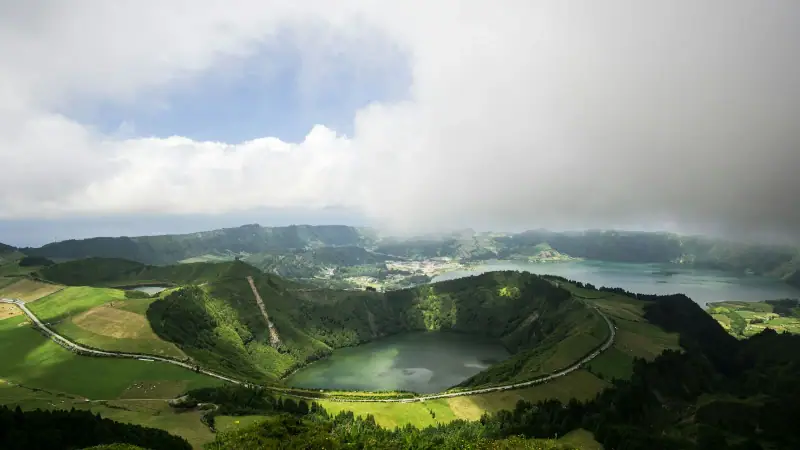
Azores Lakes and Volcanoes: The Main Natural Sites
The most beautiful volcanic lakes in the Azores. Sete Cidades, Fogo, Furnas, Algar do Carvão: the archipelago's natural wonders.
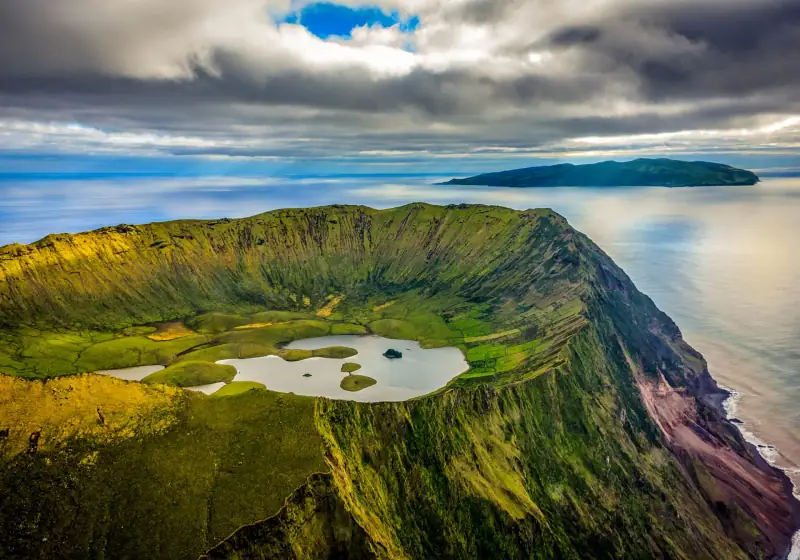
Corvo Island: A Complete Guide to the Smallest Island in the Azores
Complete guide to Corvo in the Azores: the Caldeirão, Vila do Corvo, birdwatching and practical tips for the archipelago's most remote island.
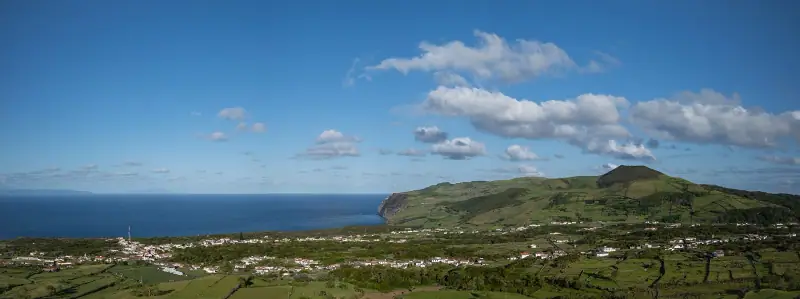
Graciosa Island: complete guide to the pearl of the Azores
Complete guide to Graciosa in the Azores: Furna do Enxofre, Santa Cruz, Carapacho hot springs, PDO wines and the UNESCO biosphere reserve.
Ready-made
Azores itineraries
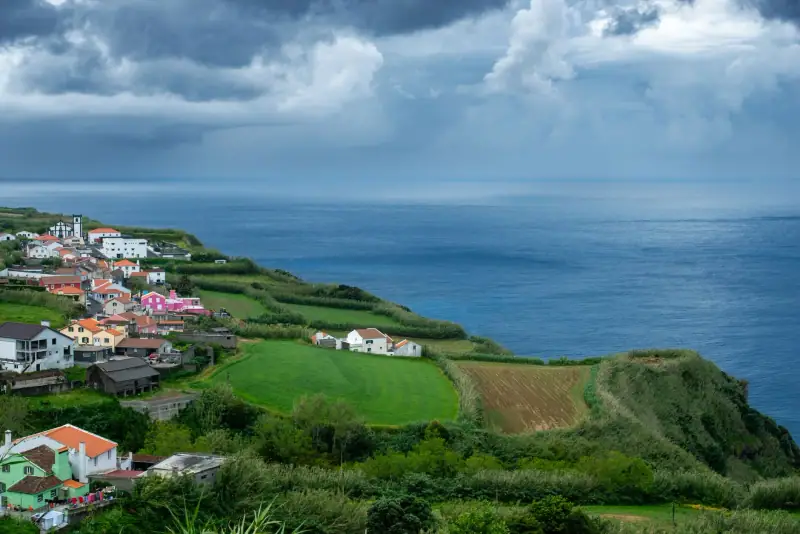
São Miguel Road Trip: Driving Around the Island
A complete guide to driving around São Miguel in the Azores: route, essential stops, road tips and lesser-known spots.
4 days
São Miguel in 4 Days Without a Car: A Realistic Itinerary by Bus and Organized Tour
Can you visit São Miguel without a rental car? A realistic 4-day itinerary with public buses, organized tours, schedules, prices and distances.
5 days
São Miguel in 5 days with kids: stops, miles and a realistic pace
5 days on São Miguel (Azores) with kids: day-by-day stops, distances and drive times, naps, swims, whales and pace pitfalls to avoid.
Can be adapted in the planner