Plan your trip
Vietnam budget: how much a trip costs, item by item

We may earn a commission when you book through links on this page, at no extra cost to you. We don't visit or try the places we cover: we summarize published sources. How we work
In short
- Recent guides put budget travel at about $25 to 40 a day, mid-range at $50 to 100 and comfort at $100 to 200, excluding the international flight.
- Street meals cost about $1 to 3, a full meal in a local restaurant $3 to 7; hostels run about $10 to 25 a night and mid-range hotels $35 to 80.
- Prices rise fast for Ha Long Bay cruises, upscale hotels, late-booked domestic flights and holiday periods such as Tết; the long-haul flight is usually the biggest expense.
- Cash in dong remains essential in streets, markets and rural areas; compare your bank's fees for foreign withdrawals.
Vietnam has a reputation as one of the most affordable destinations in Southeast Asia, and it is largely deserved: a bowl of soup costs a few tens of cents to a euro or two, a night in a dorm costs almost nothing and night buses are cheap. But that reputation hides big gaps. Depending on whether you sleep in a hostel or a boutique hotel, and whether you cross the country by train or by plane, your budget can vary by a factor of five.
This guide details real costs item by item (accommodation, transport, meals, activities, paperwork), offers three budget profiles with figures and ends with concrete tips for spending less. Prices in dong come from cross-checked recent sources (travel guides, published rates of sites, companies and operators), then converted at about 30,000 dong for 1 euro (about $1.16). They change from year to year: take them as orders of magnitude, not guaranteed rates.
The three budget profiles at a glance
The amounts below are per person per day, calculated for a traveler sharing a room with one other person, excluding the international flight and personal purchases. They are cross-checked against the ranges published by guides (backpacker: about $25 to 40 a day; mid-range: $50 to 100; comfort: $100 to 200) with the prices detailed below.
| Item | Backpacker | Comfort | Upscale |
|---|---|---|---|
| Accommodation | €8-15 (~$9-17) | €20-40 (~$23-46) | €45-90 (~$50-105) |
| Meals and drinks | €6-10 (~$7-12) | €12-20 (~$14-23) | €25-45 (~$29-52) |
| Transport (local and intercity) | €3-8 (~$3-9) | €10-20 (~$12-23) | €20-40 (~$23-46) |
| Activities and entry fees | €3-6 (~$3-7) | €8-15 (~$9-17) | €20-40 (~$23-46) |
| Total per day | about €20-40 (~$23-46) | about €50-95 (~$58-110) | about €110-210 (~$125-245) |
For a two-week stay, these three profiles give, as a guide: about €300 to 560 ($350 to 650) as a backpacker, €700 to 1,300 ($815 to 1,510) at comfort level and €1,500 to 3,000 ($1,740 to 3,480) upscale, international flight not included. The following sections detail each item so you can build your own mix: you can very well sleep in a private room and eat in the street.
Accommodation: the item that makes the difference
Accommodation is the most elastic item. The ranges published for 2026 are about $10 to 25 a night for a hostel or homestay, $35 to 80 for a mid-range hotel and $120 to 300 and more for a luxury resort, the room being shared by two.
A few practical markers:
- Dorms and hostels: very common in Hanoi, Hoi An, Da Nang and Ho Chi Minh City, with breakfast often included. It is the choice of most backpackers.
- Mid-range hotels: in Hanoi, the Old Quarter concentrates a large choice of small family hotels with often excellent value. See our guide what to see and do in Hanoi to pick the right area.
- Boutique hotels and resorts: the biggest price gaps are by the sea (Da Nang, Phu Quoc) and in properties with a pool and views.
- Season matters a lot: rates climb in high season, as the Lunar New Year approaches and in beach destinations in the dry season. Our article on the best time to go helps you weigh weather against price.
Compare accommodation in Vietnam
Hostels, family hotels or boutique properties: compare prices and reviews for your dates before booking.
Transport: trains, night buses and domestic flights
Vietnam stretches more than 1,600 km (994 mi), and how you cross it weighs heavily on the budget. Three main options.
The Reunification train
The Hanoi – Ho Chi Minh City line takes between 32 and 35 hours. For 2026, hard sleepers with six berths are between 1,300,000 and 1,650,000 dong (about €43 to 55 / $50 to 64), soft sleepers with four berths between 1,750,000 and 2,400,000 dong (about €58 to 80 / $67 to 93), and two-berth VIP cabins go up to about 3,600,000 dong (€120 / $139). Fares rise 30 to 50% during Tết and about 15% in July-August. It is rarely taken end to end: a night leg (Hanoi – Hue or Da Nang) saves a hotel night while gaining time. Check schedules and fares on the railway company’s official site before booking.
Night buses
Cheaper than the train, they cover most connections. Example: Hanoi – Sapa by sleeper bus costs about 250,000 to 350,000 dong for a standard seat (€8 to 12 / $9 to 14) and 400,000 to 550,000 dong in a VIP cabin (€13 to 18 / $15 to 21), for 5 h 30 to 7 h of travel. To go deeper into what you will do there, read our Sapa guide.
Domestic flights
To cross the country quickly, the plane is often surprisingly affordable if you book ahead. On Hanoi – Ho Chi Minh City, Vietjet base fares range from 600,000 to 1,400,000 dong (€20 to 47 / $23 to 55) and Vietnam Airlines from 900,000 to 2,200,000 dong (€30 to 73 / $35 to 85). On Hanoi – Da Nang, allow 400,000 to 800,000 dong with Vietjet (€13 to 27 / $15 to 31) and 700,000 to 1,500,000 dong with Vietnam Airlines (€23 to 50 / $27 to 58).
Watch the baggage: Vietjet’s economy fare includes only 7 kg (15 lb) in the cabin, and a 20 kg (44 lb) checked bag adds 180,000 to 350,000 dong (€6 to 12 / $7 to 14). Vietnam Airlines already includes 23 kg (51 lb). So calculate the total price with baggage before comparing.
Find a flight to Vietnam
Compare flights to Hanoi, Da Nang or Ho Chi Minh City: the price varies a lot with the season and the booking lead time.
Getting around town
On arrival in Hanoi, a Grab (ride-hailing app) ride from Nội Bài Airport to the center is generally between 200,000 and 300,000 dong, toll included or not (€7 to 10 / $8 to 12). Express bus 86 is much cheaper: about 30,000 dong (€1 / about $1) for about 55 minutes of travel, from about 6:30 am to 11:30 pm from terminal 1. In cities, Grab motorbike or car rides remain very inexpensive and avoid negotiating with taxis.
Meals: the best value of the trip
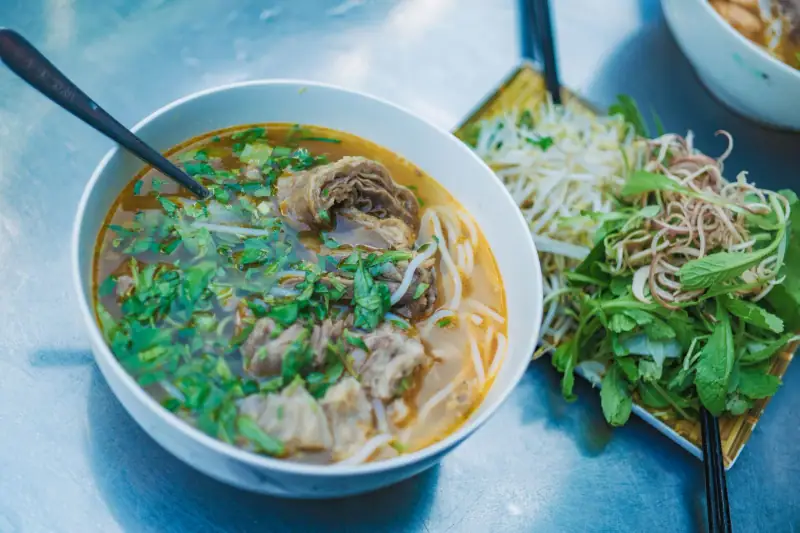
This is the item where Vietnam excels. In the street and at roadside eateries, a meal costs $1 to 3, and a full meal in a local city restaurant $3 to 7. A few markers in dong:
- Phở: 30,000 to 80,000 dong depending on the place and the city (€1 to 2.70 / $1.20 to 3.15);
- Bánh mì: 15,000 to 25,000 dong (€0.50 to 0.85 / $0.60 to 1);
- Bún chả: 40,000 to 70,000 dong (€1.30 to 2.30 / $1.50 to 2.70);
- Bánh cuốn: 30,000 to 50,000 dong (€1 to 1.70 / $1.20 to 2);
- Cơm tấm: about 40,000 to 50,000 dong (€1.30 to 1.70 / $1.50 to 2);
- Iced milk coffee (cà phê sữa đá): 20,000 to 35,000 dong (€0.70 to 1.20 / $0.80 to 1.40);
- Bia hơi (local draft beer): a few tens of cents a glass.
Tourist-oriented restaurants, rooftops and fine dining cost noticeably more. Our article on Vietnamese cuisine’s must-try dishes helps you spot what to taste, and where.
For a meal budget, keep these orders of magnitude per person per day: about €6 to 10 ($7 to 12) eating mostly in the street, €12 to 20 ($14 to 23) alternating street and restaurants, and €25 ($29) and more with dinners at pricier places and drinks.
Activities and site entry fees: budget ahead
Many visits are free or nearly so (walks in old quarters, markets, pagodas), but the major sites charge entry and guided excursions weigh more.
- Hue Imperial City: 200,000 dong per adult (about €6.70 / $8). The royal tombs (Minh Mang, Tu Duc, Khai Dinh) cost 150,000 dong each, and a combined ticket for the citadel plus two tombs comes to around 420,000 dong. Details in our guide Hue: what to see and do.
- Hoi An old town: the access ticket costs 120,000 dong (about €4 / $5) and gives access to the old town and several sites of your choice. See our guide Hoi An: what to see and do.
- Ha Long Bay: visit and port access tickets total a few euros (port fees of about 40,000 dong and a route fee of 290,000 to 790,000 dong depending on length), but most travelers book a cruise, whose price varies a lot with standard. Compare the options in our article on the Ha Long Bay cruise.
- Excursions and cooking classes: guided activities (food tours, day excursions, cooking classes) generally cost several tens of euros per person, depending on the group and length.
Excursions and guided tours in Vietnam
Food tours, cooking classes, day excursions: compare prices, durations and reviews before booking.
Extra costs not to forget
- Visa: entry rules and any visa fees depend on your passport. Check the official travel advice of your government: travel.state.gov (US), GOV.UK (UK), travel.gc.ca (Canada), Smartraveller (Australia) (checked November 2026). If you need an e-visa, go only through the government portal: intermediary sites charge much more.
- Mobile connection: a tourist eSIM with 5 GB for 30 days is around €8 to 9 ($9 to 10), 20 GB around €28 ($32). Some well-known plans are much more expensive: compare before buying. You can also check your carrier’s international plan.
- Travel insurance: essential to cover medical care and cancellations (typhoons, flights), and not to be skimped on.
- International flight: the biggest item of the trip, and the most variable. Fares climb in summer, during school holidays and around Tết. Booking early and staying flexible on dates saves money.
- Tips and small extras: not mandatory, but bring a little change for guides, drivers and masseurs.
Budget examples for two weeks
Take a 14-day trip from north to south, inspired by our 15-day Vietnam itinerary, per person and excluding the international flight.
Backpacker (about €300 to 560 / $350 to 650): dorms or very simple double rooms, street meals, night buses or hard-sleeper trains, a few site entries and a day excursion. You live well, but with basic services and no extra comfort.
Comfort (about €700 to 1,300 / $815 to 1,510): a private room with bathroom in a three-star hotel, a mix of street food and restaurants, one or two domestic flights, several guided visits, a night in Ha Long Bay. It is the most common profile for a two-week trip with friends or as a couple.
Upscale (about €1,500 to 3,000 / $1,740 to 3,480): boutique hotels or resorts, quality restaurants, flights between the main stops, private guides, a high-end cruise and spa. Vietnam then remains clearly cheaper than many European destinations at equal comfort.
10 tips for spending less
- Eat like the locals: places frequented by Vietnamese people are the best and the cheapest. A packed stall is generally a good sign.
- Travel outside peaks: avoid Tết, July-August and school holidays, when flights and hotels soar.
- Book domestic flights early and check the cost of checked baggage before comparing airlines.
- Take a night train or bus for long trips: you save a hotel night.
- Compare accommodation: even when sleeping in a hotel, price gaps between neighborhoods are large. A hotel a bit outside the center is often cheaper, and a Grab ride costs little.
- Use Grab rather than negotiating with a taxi: the price is shown in advance.
- Choose your paid excursions: concentrate your budget on 2 or 3 signature experiences rather than booking everything.
- Withdraw dong from an ATM, and avoid airport exchange offices, often unfavorable. Check your bank’s fees.
- Get an eSIM on arrival rather than using roaming.
- Haggle with a smile in markets, but not in restaurants or hotels, where prices are posted.
Should you pay in cash or by card?
Bank cards and mobile payments are spreading in big cities, but cash remains essential in the street, in markets, for short trips and in rural areas such as Sapa or the Red River Delta. Withdraw dong from ATMs of reputable banks, in larger amounts to limit fixed fees, and spread your cash across several pockets. A simple tip: count in your head by dividing by 30 to go from thousands of dong to euros (30,000 dong is worth €1).
Final thoughts
A trip to Vietnam can come in under €600 ($700) on the ground for two weeks if you accept simple comfort, or exceed €3,000 ($3,480) for a high-end experience. The real secret is to combine: sleep comfortably, eat in the street, travel at night on long legs and book only the experiences that really matter. Set your profile, choose the right season, then build your itinerary according to the available envelope.
Sources
- Hue Monuments Conservation Centre: figures checked November 2026
- Hoi An Ancient Town Heritage Management Centre: figures checked November 2026
Frequently asked questions
What budget should you plan per day in Vietnam?
Recent travel guides put budget travel at around $25 to 40 a day, mid-range between $50 and $100 and comfort between $100 and $200, excluding the international flight. The exact figure depends on your pace and your transport choices.
Is Vietnam still a cheap destination?
Yes, compared with Europe, especially for meals, land transport and simple rooms. Prices rise quickly, however, for Ha Long Bay cruises, upscale hotels, domestic flights booked late and holiday periods such as Tết.
Do you have to pay for a visa for Vietnam?
Entry rules and any visa fees depend on your passport. Check the official travel advice of your government before you book: travel.state.gov (US), GOV.UK (UK), travel.gc.ca (Canada), Smartraveller (Australia) (checked November 2026). If you need an e-visa, use only the official government portal.
Is it better to pay in cash or by card?
Cards are accepted in hotels, big restaurants and shopping centers, but markets, street stalls, small taxis and many shops work in cash. Withdraw dong from an ATM for everyday spending and compare your bank's fees. Keep small bills, which are hard to change in rural areas.
What currency is used and what is the exchange rate?
The currency is the Vietnamese dong (VND). In 2026, one euro is worth about 30,000 dong (about $1.16 at the rate used on this site): this approximation is enough to convert prices quickly. The rate fluctuates, so check it before you leave.
How can you cut your budget without giving up the essentials?
Eat where Vietnamese people eat, favor the night train or bus for long trips, book domestic flights ahead, avoid peak periods and book paid excursions only for the sites you really want to see. A local eSIM also avoids roaming fees.
More Vietnam guides
Keep reading

When to go to Vietnam: weather by region and best time
When to go to Vietnam? Climate in the north, center and south, rainy season, typhoons, Tết: the month-by-month guide to choosing the best time.
Hanoi: what to see and do in 3 days, a guide to the capital
What to see in Hanoi? Old Quarter, Hoàn Kiếm Lake, Temple of Literature, mausoleum, citadel, street food: a 3-day itinerary, tips and where to stay.

Mai Châu without a car from Hanoi: bus, Lac village or Pom Coong
Getting to Mai Châu from Hanoi without a car: bus or van, duration, prices, Lac or Pom Coong, how many nights and what to know before booking.
Ready-made
Vietnam itineraries

10 days
Vietnam in 10 days without a car: a realistic itinerary by train, bus and plane
Vietnam in 10 days without a car: Hanoi, Ninh Binh, Hue, Hoi An and Ho Chi Minh City, with distances, real travel times and train, bus or plane options.
7 days
Northern Vietnam in 7 days: Hanoi, Ninh Binh and Ha Long Bay
HanoiNinh BinhHa Long Bay cruise

15 days
Vietnam 15-day itinerary: north to south, day by day
HanoiNinh BinhHa Long or Lan Ha Bay cruiseHoi An