Things to do
The Lycian Way in Turkey: A Guide to Hiking the Coast's Most Famous Trail
We may earn a commission when you book through links on this page, at no extra cost to you. We don't visit or try the places we cover: we summarize published sources. How we work
In short
- The marked trail is about 540 km (335 mi) long, from the Fethiye area (Ovacık, near Ölüdeniz) to the Antalya hinterland (Geyikbayırı); most hikers walk only a section.
- Spring and fall are the most comfortable seasons; summer is very hot on the coast, and winter can be damp.
- The trail is marked with red and white paint on rocks and walls, but carry an offline map or GPS track, plenty of water and a warm layer.
- Day hikes from Fethiye or Kaş let you sleep in town each night; plan each day's lodging in advance and book in high season.
Among Turkey’s hikes, the Lycian Way (Likya Yolu in Turkish) is the one that fires the imagination: a marked trail that follows the southwest coast of the country, between turquoise coves, pine forests, stone villages and ancient remains. It was laid out in the late 1990s by the Briton Kate Clow, with the help of volunteers, and remains today one of the great hiking routes of the Mediterranean.
This guide helps you decide how to walk it: a one-day section, a week of trekking or a simple escape from the beach. You will find the route, the best season, the waymarking, lodging, budget and mistakes to avoid. To place the walk in a broader stay, see also our five-day itinerary on the Lycian coast.
The Lycian Way in brief
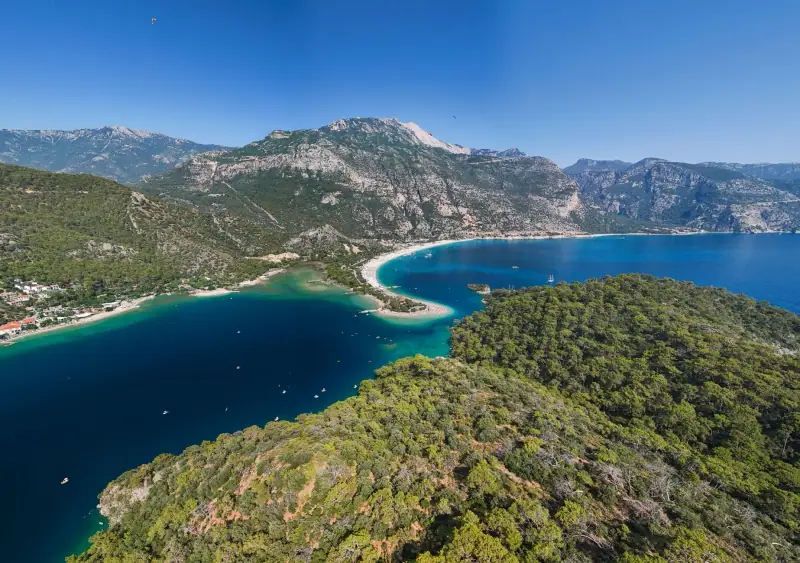
The trail is about 540 km (335 mi) long. It starts near Ovacık, just inland from Ölüdeniz, near Fethiye, and ends in the Antalya hinterland, toward Geyikbayırı. In between, it crosses the historic region of Lycia, an old land of ancient cities where you still come across rock-cut tombs, theaters and walls.
The route alternates three types of scenery:
- cliffs and coves above the Mediterranean;
- pine and cedar forests on the hinterland’s relief;
- plateaus, fields and small villages where farming life still sets the daily rhythm.
The route is not a stroll: there are long climbs, rocky passages and little shade on the coast. But you can cut it up as you wish. Many travelers walk only a day or two, from their base in Fethiye or Kaş, and return to the hotel in the evening.
Waymarking and navigation
The trail is marked in the style of long-distance trails: a rectangle half white, half red, painted on rocks, walls or posts. On variants and access paths, the white is replaced by yellow. A red cross signals that you have strayed from the right direction, and a slanted mark announces a change of heading.
The waymarking is useful but does not exempt you from equipping yourself. Paint fades, vegetation grows back and some passages, notably after a storm, are less obvious. Download a GPS track and an offline map before leaving, check your position regularly and do not commit to an unknown section late in the day.
Keep a simple rule in mind: if you have not seen a mark for a while, go back to the last one you identified instead of moving on at random. It is the most common way to get lost on marked trails.
When to go
The ideal season is spring and fall. Temperatures are pleasant for walking, the sea is still mild in fall and landscapes are greener in spring. Summer is very hot on the coast: walking in full sun becomes painful and dangerous without water or shade. Winter suits short outings in low areas, but rain makes some passages slippery and rural lodgings may be closed.
Whatever the season, set out early in the morning and plan to arrive at the stage before the end of the afternoon. To compare months by weather and crowds, see our guide on when to go to Turkey.
Stage 1: from Fethiye to Ölüdeniz
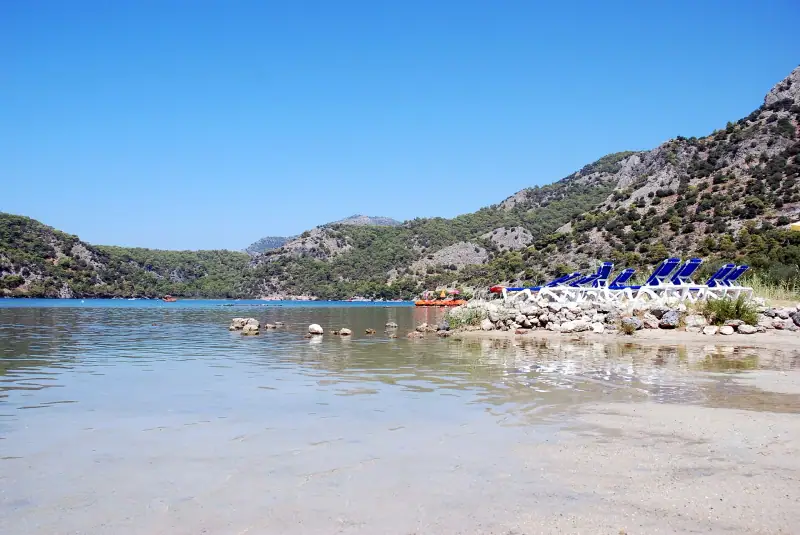
This is the opening section, the one chosen by most day hikers. Fethiye is a practical port town, well served, with a wide choice of lodging and restaurants. It serves as a base for many travelers and can be reached by car or shuttle from Dalaman Airport, about 50 km (31 mi) away.
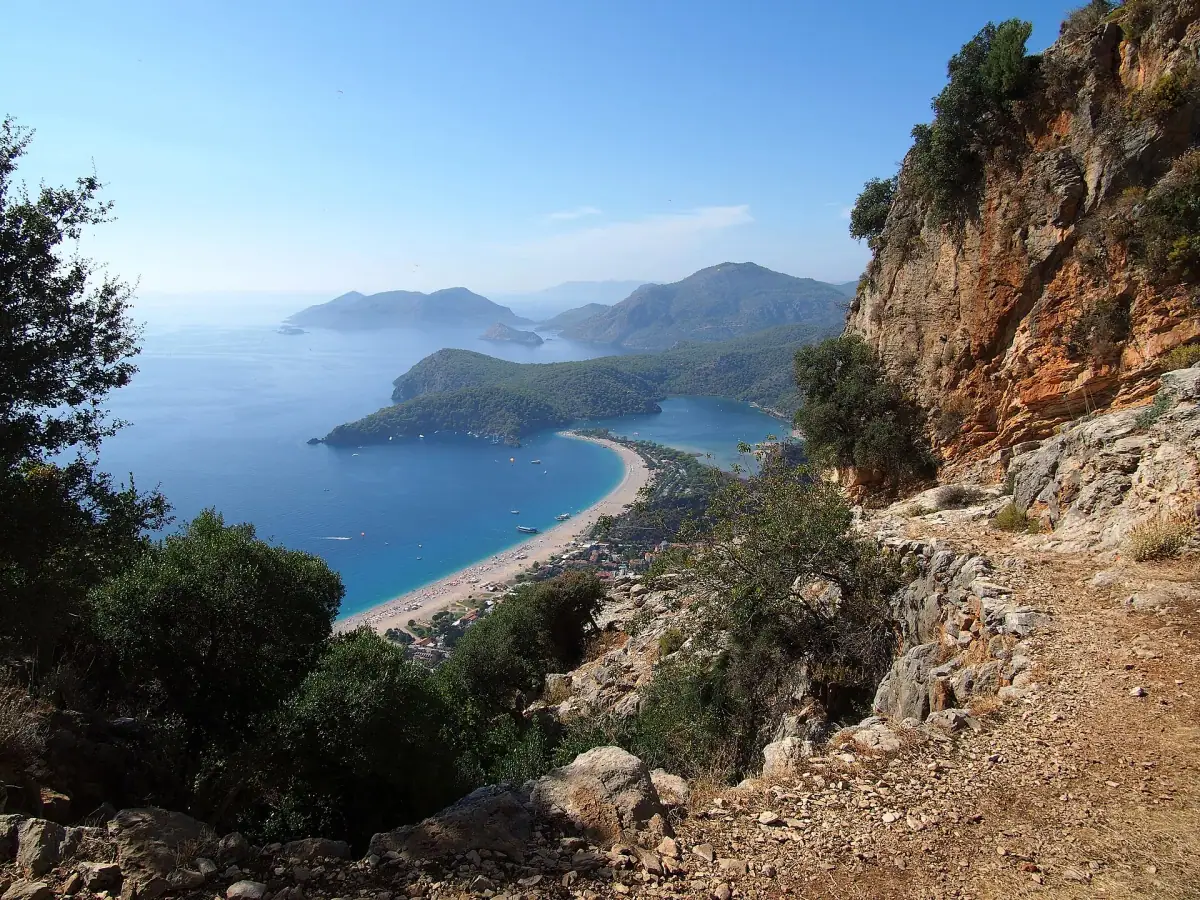
From Ölüdeniz and its surroundings, the trail quickly gains altitude and offers viewpoints over the coast, with the famous lagoon in the foreground in clear weather. The atmosphere is more touristy than elsewhere: the path is busy, services are plentiful and it is easy to return by minibus or taxi if you tire.
For a first experience, this area suits well: you can walk in the morning, have lunch in a village and return to town without planning a night of trekking.
Stage 2: the hinterland between Fethiye and Kaş
As the stages go on, the coast becomes wilder. The trail alternates forest climbs, ledge-like stretches above the sea and descents to small bays. Villages become rarer: you generally find family guesthouses, grocery stores and simple tables where you eat what the region produces.
This is where preparation matters most. Water points are not always reliable, shops can be far away and days are long. Fill up at every opportunity, find out the distance to the next stage and do not count on constant mobile coverage.
History enthusiasts will appreciate the Lycian remains scattered along the way: tombs carved into the rock, old walls, ruins of forgotten cities. They give the route a cultural dimension and justify planning longer breaks than on a purely sporting trail.
Lodging in Fethiye
Compare hotels and guesthouses to sleep before or after your hike, by your dates and budget.
Stage 3: Kaş and the surroundings
Kaş is the other major base of the Lycian coast: a compact, easygoing port, lanes lined with white houses and bougainvillea, terraces facing the sea and a slightly bohemian side. You find hiking shops, restaurants and agencies that organize boat or kayak outings.
It is an excellent support point for day hikes: you can do a section of trail in the morning, swim in the afternoon and dine in town in the evening. Travelers who want variety will also find sea excursions and diving there, which can be combined with walking to rest the legs.
Tours around Kaş
Boat rides, kayaking and guided activities: compare the offers available before booking.
Stage 4: toward Antalya
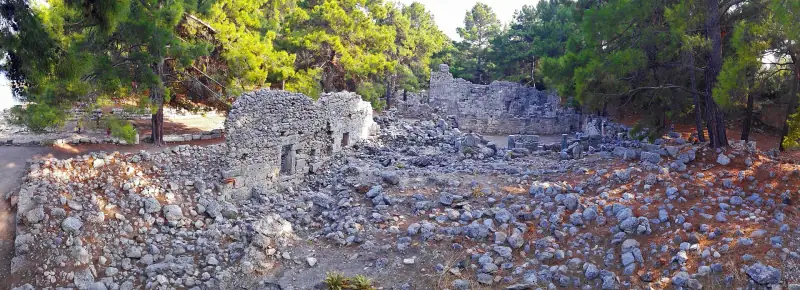
In the eastern part, the trail partly leaves the coast and runs along more mountainous massifs before reaching the Antalya hinterland. The landscapes become more open, the elevation changes more marked and the isolation greater. This is the section for experienced walkers, who organize several consecutive days.
The arrival toward Geyikbayırı is a few dozen kilometers from the city, and local buses reach Antalya. Those who end their trip here can devote a day or two to visiting the city: our guide Antalya, what to see and do helps you organize this recovery time, and our article where to stay in Antalya details the neighborhoods by travel style.
Where to sleep during the hike
You have three options on the Lycian Way:
- Lodging in town or village: hotels and guesthouses in Fethiye, Kaş or intermediate localities. It is the most comfortable solution for day hikes.
- Rural family guesthouses: often with dinner and breakfast, they let you walk light and taste local cuisine. Book before setting out in high season.
- Bivouac and camping: possible for self-sufficient hikers, provided you respect nature, do not light fires and find out about local rules.
Whichever option, plan your route around the lodgings and not the other way round: a day that is too long is dangerous. If in doubt, lengthen the walk by a day rather than forcing it.
Gear and preparation
Preparation counts as much as physical fitness. Here are the essentials to bring:
- Comfortable, broken-in hiking shoes: stones and dry descents do not forgive blisters.
- A sufficient water reserve and a way to purify it if you walk several days.
- Hat, sunglasses and sunscreen, essential even in spring.
- A windbreaker and a warm layer, because it is cool at altitude in the morning and evening.
- A first-aid kit, walking poles and a headlamp.
- An offline map, a GPS track and an external battery.
- Cash for villages where bank cards are not accepted.
Also remember to check that your travel insurance covers hiking and assistance in remote areas: contracts do not all have the same exclusions. Read the conditions carefully before buying a policy.
Getting around
To reach the trail, the simplest way is to go through Fethiye, reachable by car or minibus from Dalaman Airport. There, dolmuş (shared minibuses), taxis and local buses link villages and hike starting points. Schedules are variable and services can be reduced off-season: ask your hotel the day before.
If you want to combine several sections or reach isolated points, a car gives a lot of freedom, though you may have to backtrack to pick up the vehicle at the start. Compare rental offers for your dates before booking.
Budget: how much to plan
The Lycian Way is one of the cheapest activities in Turkey: the trail is free and requires no entry fee, apart from a few archaeological sites that may be paid. Your budget depends mainly on lodging, meals and local transport.
In family guesthouses, with simple meals and travel by dolmuş, daily spending remains reasonable compared with a beach stay. It rises if you choose more comfortable hotels in Kaş or Fethiye, or if you add boat tours. Prices change from one season to the next, so it is better to check current rates. To place this spending in the complete trip, read our budget for Turkey.
Mistakes to avoid
A few mistakes come up often among novice hikers:
- Setting out too late: the sun beats down quickly and night falls earlier than you think.
- Underestimating water: on dry sections, it is better to carry too much than not enough.
- Relying only on the waymarking: always keep a map or a backup track.
- Walking in midsummer: the heat is dangerous. Prefer spring or fall.
- Ignoring sheepdogs: stay calm, avoid running and go around flocks at a distance.
- Planning stages that are too long: choose realistic days, with a safety margin.
- Forgetting entry rules: they depend on your passport. Check the official travel advice of your government before you leave: travel.state.gov (US), GOV.UK (UK), travel.gc.ca (Canada), Smartraveller (Australia) (checked November 2026).
How to organize your stay
For a first stay, the simplest option is to stay two or three nights in Fethiye then in Kaş, and walk day sections. You keep flexibility if the weather changes, you enjoy the restaurants and you carry only a small pack. The more seasoned can then plan a week of trekking with nights in guesthouses.
In every case, tell your hotel or host your route, set out with a charged phone and do not head alone onto an isolated section without preparation. The Lycian Way rewards patience: the morning light on the sea, the smells of pine and thyme and the welcome in the villages make you forget the kilometers.
Frequently asked questions
How long is the Lycian Way?
The marked trail measures about 540 km (335 mi) and links the Fethiye region, in the west, to the surroundings of Antalya, in the east. Most hikers do only one section: a few days are enough to get a taste of the Lycian coast.
What is the best time to walk the Lycian Way?
Spring and fall are the most comfortable seasons. Summer is very hot on the coast and winter can be damp, with high-altitude sections sometimes snowy. See also our guide on the best time to go to Turkey.
Do you need a guide to hike the Lycian Way?
It is not required: the trail is marked in the style of long-distance trails, with red and white marks painted on rocks and walls. A map or GPS track, enough water and a good reading of the weather remain essential.
Can you do the Lycian Way without camping?
Yes. Many hikers alternate villages, family guesthouses and small stage lodgings. Distances between two lodgings vary widely: plan each day in advance and book in high season.
Where does the trail start?
The classic starting point is at Ovacık, near Ölüdeniz, close to Fethiye. The finish is on the Geyikbayırı side, in the Antalya hinterland. You can also walk the trail in the other direction.
What gear should you bring?
Broken-in hiking shoes, a hat, sun protection, a water reserve, a light windbreaker and a first-aid kit. A phone with an offline map completes the set.
Is the Lycian Way suitable for beginners?
Short day sections are accessible to regular walkers. Multi-day trekking takes endurance: elevation gain, heat and rocky paths tire quickly if you are not prepared.
More Turkey guides
Keep reading
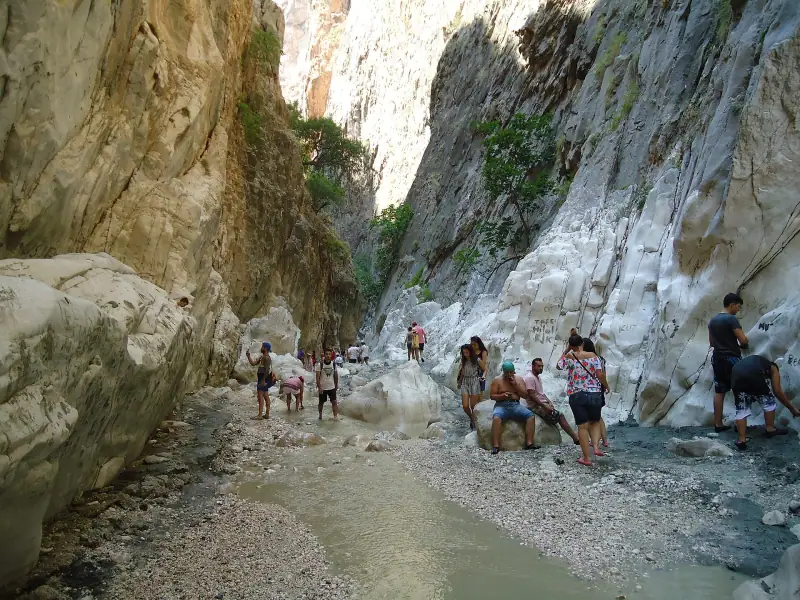
Saklıkent Gorge Without a Tour: Getting There Alone from Fethiye, Prices and Conditions
Saklıkent Gorge from Fethiye without an agency: dolmuş or car, entry, season, gear, kids and organized tours, to pick the option that suits you.

Turkish Hammam: A Complete Guide to a Traditional Bath in Turkey
Hammam in Turkey: how the ritual works, packages, Istanbul's historic hammams, etiquette, tips for women, families and traps to avoid.

Budget for a Trip to Turkey: Real Costs, 3 Costed Profiles and Ways to Spend Less
What budget for Turkey in 2026? Lodging, transport, meals and activities, three costed profiles and concrete tips to save money.
Ready-made
Turkey itineraries
2 days

3 days
Istanbul in 3 Days: A Day-by-Day Itinerary to See It All
A 3-day Istanbul itinerary: Hagia Sophia, Topkapı, Grand Bazaar, Bosphorus, Galata and the Asian side, with a realistic pace and practical tips.
3 days
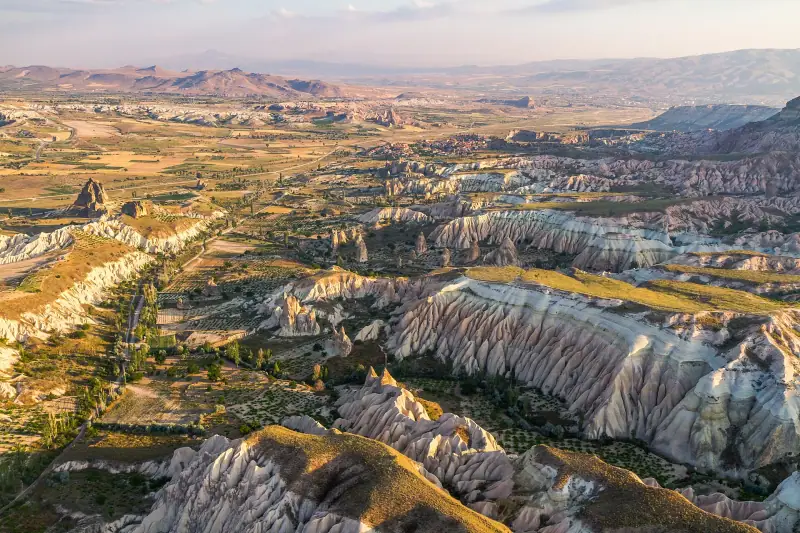
Cappadocia in 3 Days: A Detailed Itinerary of Valleys, Underground Cities and Hot Air Balloons
What to see in Cappadocia in 3 days? Day-by-day itinerary: Göreme, valleys, Uçhisar, Derinkuyu, Avanos, hot air balloons and tips for your stay.