What to see
Visiting the Sharqiyah: Wahiba Sands, wadis and Oman's east coast
We may earn a commission when you book through links on this page, at no extra cost to you. We don't visit or try the places we cover: we summarize published sources. How we work
In short
- Plan at least 4 days: a Wahiba desert night, Wadi Bani Khalid, Sur and Ras al Jinz. Add Wadi Shab and Bimmah Sinkhole with 5 to 6 days.
- A standard car is enough for the main roads; a 4x4 is essential to go into the Wahiba dunes beyond the established camps.
- Desert camps cost about 30 to 60 OMR (mid-range) or 80 to 200 OMR (luxury) a night for two.
- Book the Ras al Jinz turtle visit ahead; turtles nest all year, with a peak from May to October.
The Sharqiyah, or Ash Sharqiyah (“the east” in Arabic), is the region that condenses everything that makes Oman original. Within a few hundred kilometers of coast and interior, it brings together the huge dunes of the Wahiba desert, turquoise wadis that split white limestone gorges, a fishing coast facing the Indian Ocean, and beaches where giant turtles have been nesting for millennia. It is the most complete region of the country for a first trip, and one that still partly escapes mass tourism, which will not last long.
The Wahiba desert (Sharqiyah Sands): the dune experience
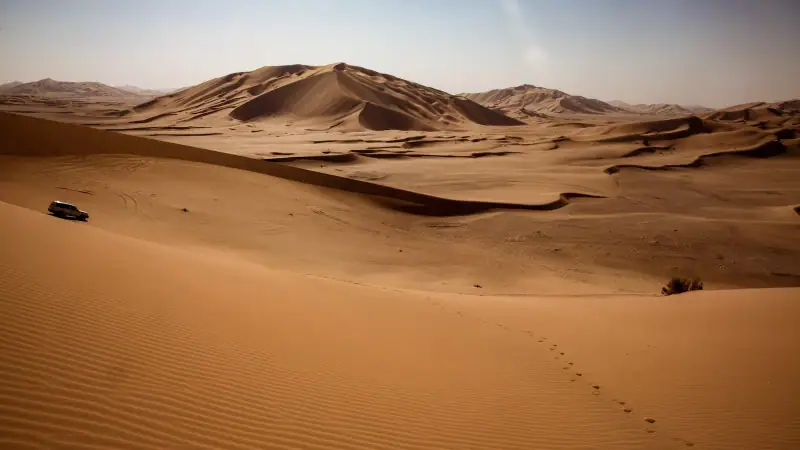
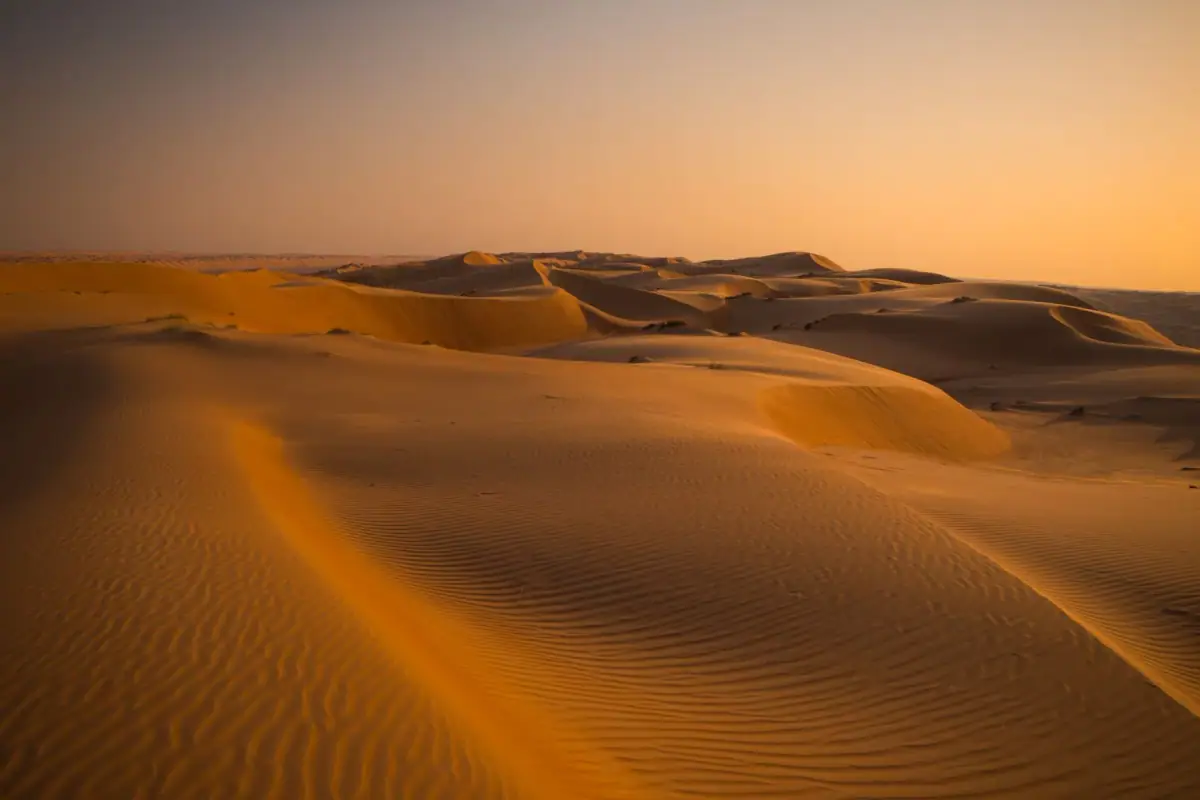
The Wahiba desert, officially renamed Sharqiyah Sands, is Oman’s tourist desert par excellence. It extends about 180 km (112 mi) north to south and 80 km (50 mi) east to west, forming a sea of dunes whose crests sometimes reach 100 m (330 ft). The dunes are alive: the wind from the Gulf of Oman sculpts them constantly, shifting their summits and creating shadows that change color through the day, from pale ocher to deep gold at sunset.
What sets Wahiba apart from other tourist deserts in Arabia is the diversity of its dunes: in the north, linear dunes with sharp ridges; in the center, complex star formations; in the south, the dunes gradually flatten toward the coastal lowlands of the Jalan region (Al Kamil, Al Wafi). At the base of the dunes there is vegetation and even Bedouin villages: families of the Wahiba tribe have lived in this desert for centuries and raise camels here.
The desert camp experience:
Spending a night in the Wahiba is one of the most memorable experiences of a trip to Oman. Camps fall into two categories:
- Luxury camps: Berber-style tents or air-conditioned bungalows with private bathrooms, sometimes a pool, and a restaurant. Hotel comfort in the middle of the desert. Prices range from 80 to 200 OMR a night for two people.
- Mid-range camps: fabric tents on platforms, shared bathrooms, meals included (barbecue or Omani buffet). A more authentic atmosphere for 30 to 60 OMR.
Most camps include a camel ride at sunset, a 4x4 excursion over the dunes (dune bashing) and, in the evening, a show of Omani music around a campfire. Stargazing, tens of kilometers from any light pollution, is exceptional.
For a more detailed look at the camps and activities in the desert, see the dedicated guide: Wahiba desert: everything you need to know.
A night in the Wahiba desert
Compare desert camps: Berber tents, dune bashing, sunset over the dunes and Omani dinner included.
Wadi Bani Khalid: the region’s oasis
About 255 km (158 mi) from Muscat (about 3 hours by road) and about 86 km (53 mi) west of Sur, Wadi Bani Khalid is considered by many to be the most beautiful accessible wadi in Oman, and the competition is tough. What sets it apart: permanent water flow all year (unlike many wadis that dry up in summer), crystal-clear water of an intense turquoise green, and natural pools carved into immaculate white limestone, surrounded by date palms and tamarisks.
The lower part of the wadi, reached by a paved road, has several pools to swim in: cool water (about 20 to 22 °C / 68 to 72 °F even in summer), very clear, with small fish swirling around your legs. The site has parking and a few drink shops. It is popular on weekends with Omani families and can get very busy.
For walkers, a trail goes up the wadi for about 2 km (1.2 mi) to a cave and other, less crowded pools. The path is marked but can be slippery on the rocks; sandals with non-slip soles or trail shoes are advised. The cave at the end of the trail holds an underground pool with remarkably clear water, one of the most emblematic photos of the region.
Practical information:
- Free entry
- Swimming is possible all year, with optimal conditions from October to April
- Avoid Fridays and Omani public holidays if you want some peace
- Proper dress required at the entrance (swimwear accepted in the water, but cover up outside)
- Carry out your trash; the site already suffers from overcrowding
Ras al Jinz: the night of the giant turtles
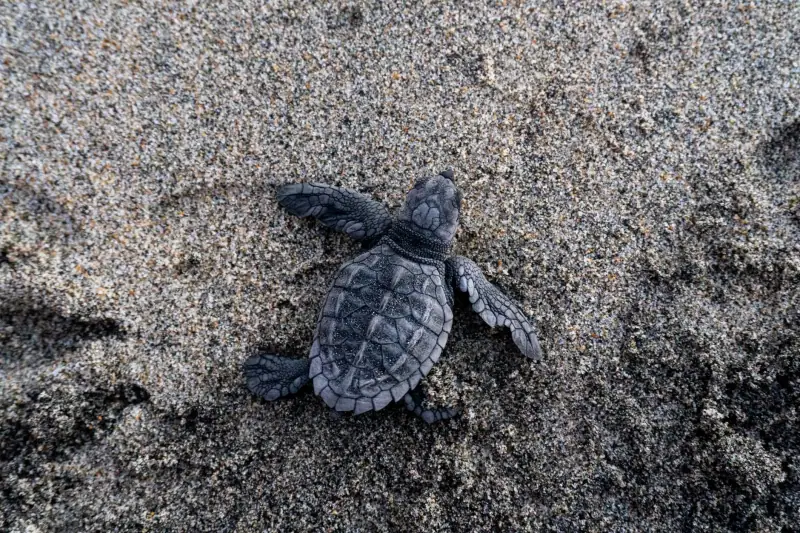
On the easternmost tip of the Arabian Peninsula, about 40 to 45 km (25 to 28 mi) southeast of Sur, Ras al Jinz is one of the most important sea turtle nesting sites in the Indian Ocean. Thousands of green turtles (Chelonia mydas) return every year to lay their eggs on this beach. Females systematically go back to where they themselves were born, a phenomenon of biological navigation that is still partly unexplained.
The Ras al Jinz Turtle Reserve manages the site with care: visits are guided, at night, in small groups, with trained guides who make sure nobody disturbs the turtles (no flash, silence, distances respected). Watching a 150 kg (330 lb) turtle dig her nest in the sand by the light of a red lamp, lay about a hundred eggs, then laboriously head back to the sea is an experience most travelers cite as one of their strongest memories of Oman.
Practical information:
- Booking in advance is strongly advised (the reserve’s website sells tickets for the night visits)
- The usual night visit is around 9 pm, plus a morning visit around 5:30 am (check current times)
- Morning visits (sunrise) are also possible to see turtles return to the sea
- An interpretation center at the site explains the green turtle’s life cycle
- Quality lodging is available directly on the reserve site, ideal for combining a night and a morning visit
- Turtles nest all year, with a stronger peak from May to October
Ras al Jinz excursion from Sur
See the giant turtles with a local guide. Transport, reserve entry and night visit included.
Wadi Shab and Bimmah Sinkhole: the coastal road
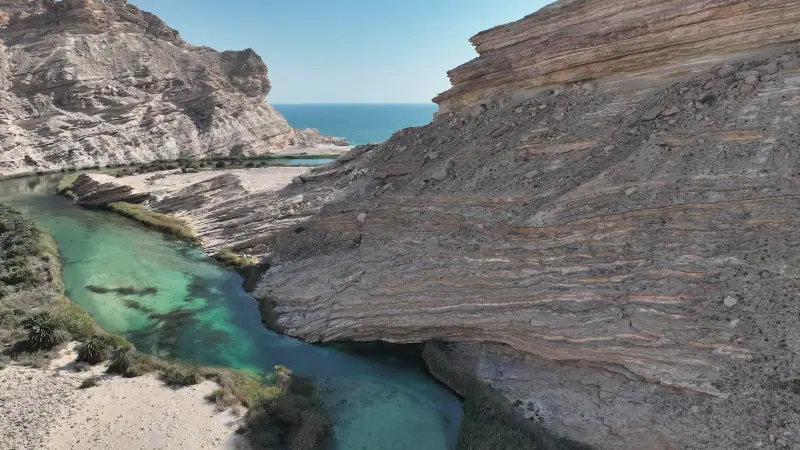
On the coastal road linking Muscat to Sur, one of the most beautiful scenic roads in Oman, two stops are worth planning.
Wadi Shab
About 165 to 180 km (103 to 112 mi) from Muscat by the coastal road, Wadi Shab is the wadi on every Omani postcard: narrow gorges with white limestone walls, palm trees leaning over brilliant blue-green pools, and, after an hour of walking in the water, a waterfall hidden in a cave. Access is from a parking lot on the coastal road: a small boat crosses the wadi (about 1 OMR round trip, cash) and then you walk upstream, sometimes knee-deep.
The highlight is the underground waterfall, reached by swimming through a tunnel about ten meters (33 ft) long: a pool hidden in the rock, lit by a natural shaft of light. The effort (swimming in the tunnel can be intimidating) is well rewarded by the sight. Bring a waterproof bag for your things and a swimsuit.
Bimmah Sinkhole (Hawiyat Najm Park)
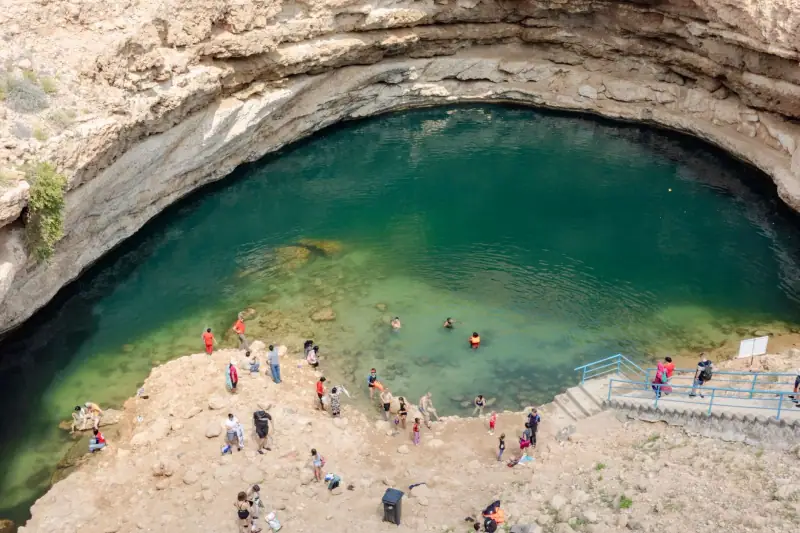
About 31 km (19 mi) north of Wadi Shab (about 120 km / 75 mi from Muscat), Bimmah Sinkhole is a limestone sinkhole filled with slightly brackish, deep blue-green water. The pool measures about 50 m × 70 m (164 × 230 ft, elliptical) and is 20 m (66 ft) deep. It is reached by a built staircase from a small park. Swimming is allowed and the small fish that live in the pool nibble at your feet, an activity families enjoy.
The geology of the sinkhole is simple: the sea seeped under the limestone through cracks, gradually dissolving the carbonate until the ceiling collapsed. The result is photogenic and the site is well managed.
Sur: the city of boats
Sur, a former great corsair city and center of Omani shipbuilding, is the main town on the Sharqiyah’s east coast. A detailed guide is in the article Visiting Sur, but here are the essentials to remember to fit it into your Sharqiyah itinerary.
Sur’s shipyard is one of the few places in the world where dhows are still built using traditional wooden methods. Visiting is free and the craftsmen welcome the curious. Depending on the season and orders, you can see different stages of construction.
Khor al Batah lagoon separates Sur’s old town from the Ayjah district. A stone bridge links the two banks. At sunset, the reflection of the dhows on the lagoon’s calm water makes a particularly fine picture.
Ras al Hadd beach, about 55 to 60 km (34 to 37 mi) from Sur, is a good stopover before Ras al Jinz. It is good for swimming and less busy than the beaches of the north coast.
For lodging in Sur and its surroundings, see our guide Where to stay in Sur.
Hotels in Sur and the Sharqiyah
From the town hotel to the coastal resort, compare options for your base in the region.
4-day itinerary in the Sharqiyah
Here is a turnkey itinerary to discover the region without spreading yourself thin. You need a rental car (and a 4x4 for the night in the desert).
Day 1: coastal road, Muscat to Sur
Early departure from Muscat. First stop at Bimmah Sinkhole (about 1 hour by road, 30 minutes there). Lunch break in Tiwi or on the road. Afternoon: hike up Wadi Shab (allow 2 hours round trip with swimming). Arrive in Sur in the late afternoon. Sunset over Khor al Batah lagoon from the old bridge.
Day 2: Sur, shipyard and Ras al Jinz
Morning: visit Sur’s shipyard and the fish market (early morning, before 8 am). Free afternoon or Ras al Hadd beach. In the evening: drive to Ras al Jinz for the night turtle visit (reservation required). Spend the night at the reserve or nearby to continue with the morning visit.
Day 3: Wadi Bani Khalid and entering the desert
Leave toward the northwest via Ibra. Morning at Wadi Bani Khalid (swimming, cave). Picnic there. Afternoon: drive to the Wahiba desert. Arrive at the camp before sunset. Camel ride, Omani dinner, night in a tent under the stars.
Day 4: Wahiba desert and return
Get up before dawn to watch the sun rise over the dunes. Breakfast at the camp. 4x4 excursion if available. Return to Muscat via Ibra and the inland road (about 3 hours). You can stop at Ibra for its Wednesday morning market (a traditional women’s market, very colorful).
This 4-day circuit can stretch to 5 or 6 days by spending more time at each stage, or by exploring the coast between Sur and Ras al Jinz at greater length.
Lodging in the Sharqiyah
The region offers varied lodging suited to each stage:
In the Wahiba desert: Several desert camps of different standards are set up on the edge of the desert, mainly in the Bidiyah and Al Mintirib area. High-end camps offer all the comfort of a hotel (air conditioning, private shower, restaurant). Mid-range camps offer an experience closer to Bedouin life. Booking several weeks ahead is advised in high season (November to March).
In Sur: Sur has a leading four-star hotel, several three-star ones and a range of guesthouses and furnished apartments. The town is a practical base for day trips to Ras al Jinz, Wadi Bani Khalid and the desert.
At Ras al Jinz: The reserve runs its own lodging (chalets and camping), convenient for the night visits. Book well in advance during the heavy nesting period (June to September).
How to get to the Sharqiyah
From Muscat by car: This is the recommended option. The coastal road via Bimmah and Wadi Shab (about 200 to 250 km / 125 to 155 mi to Sur) is excellent and scenic. The inland road via Ibra (about 300 km / 186 mi) is faster but less spectacular. The Sharqiyah road network is of good quality on the main routes.
By bus: Mwasalat (formerly ONTC) runs services from Muscat to Sur; timetables and departure points change, so check them on its website. The trip takes about 4 to 5 hours. Local buses then link Sur to the region’s smaller towns, but frequency is limited.
Car rental: Essential for getting around the region at your own pace. The big agencies are available at Muscat airport. Plan on a 4x4 if you intend to spend a night in the desert without going through an organized camp.
Car rental for the Sharqiyah
Compare offers from Muscat to cover Wadi Bani Khalid, Wahiba and Sur at your own pace.
Practical tips
Water and supplies: Stock up on bottled water in Muscat or the main towns. In the desert, plan at least 3 liters (about 3 qt) per person per day. Supermarkets and gas stations are found in Sur and Ibra, but are rare in isolated areas.
Phone and connectivity: Oman’s network coverage (Omantel, Ooredoo) is good on the main roads and in Sur. In the heart of the Wahiba desert, the signal can be intermittent or absent. Download offline maps (Maps.me or Google Maps) before you leave. Check your carrier’s international plan or consider a travel eSIM.
Money: Carry cash in Omani rials. ATMs are available in Sur and Ibra but absent at most desert camps. Traditional markets do not accept bank cards.
Clothing: Swimsuit for the wadis, light and breathable clothing for the desert by day. Nights from December to February can be cool in the desert (10 to 15 °C / 50 to 59 °F): a vest or thin sweater is useful. Cover shoulders and knees in villages and markets.
Driving in the desert: If you drive off-road in a 4x4, follow the basic rules: do not go alone, tell someone your itinerary, lower tire pressure slightly on the dunes (about 1.5 bar / 22 psi), and never stop on an uphill slope of a dune (risk of getting stuck).
Safety: The Sharqiyah region is safe for travelers. The main risks are heat, vehicles getting stuck in the desert and flash floods in the wadis during the rainy period (November to March). If it rains upstream, never go down into a wadi: flash floods are frequent and sudden.
The Sharqiyah is the region that sums up Oman in its most immediate diversity: in four days you can sleep on the dunes, swim in turquoise pools, watch giant turtles lay eggs at midnight and spend a day aboard a fishermen’s dhow. Few regions in the world offer such a density of experiences in such an accessible area. To prepare your full circuit across the country, see our complete guide to Oman and our Oman road trip ideas.
Frequently asked questions
How many days do you need to explore the Sharqiyah?
Plan at least 4 days to cover the essentials: a night in the Wahiba desert, a day for Wadi Bani Khalid, a stop in Sur and an excursion to Ras al Jinz. To add Wadi Shab and Bimmah Sinkhole and explore the coast at your own pace, allow 5 to 6 days. Most travelers fit the Sharqiyah into a Muscat-Sharqiyah-interior Oman (Nizwa) circuit or a Muscat-Sharqiyah-Salalah trip.
Do you absolutely need a 4x4 in the Sharqiyah?
Not for everything. The main roads to Sur, Wadi Bani Khalid and Bimmah Sinkhole are paved and accessible in a standard car. However, to venture into the Wahiba desert (Sharqiyah Sands) beyond the established camps, a 4x4 is essential: an ordinary car gets stuck in the dunes immediately. If you stay in a desert camp, transfers from the road are generally included in a 4x4.
What is the best time to visit the Sharqiyah?
From October to March, temperatures are pleasant (25 to 35 °C / 77 to 95 °F by day), the sea is calm for diving and kayaking at Sur, and the desert is comfortable for nights in camp. In December and January, desert nights can be cool (12 to 15 °C / 54 to 59 °F), so bring a warm layer. Avoid June to August: temperatures regularly exceed 45 °C (113 °F) in the desert. The turtles of Ras al Jinz nest all year, with a peak between May and October.
How do you get to Sur from Muscat?
Two roads link Muscat and Sur, both of good quality. The coastal road (about 200 to 250 km / 125 to 155 mi, 2.5 to 3.5 hours) follows the ocean via Bimmah Sinkhole and Wadi Shab; it is the most beautiful and the most recommended. The inland road goes through Ibra and Sinaw (about 300 km / 186 mi), more direct but less spectacular. By bus, Mwasalat (formerly ONTC) runs Muscat-Sur services; check current timetables and stops on its website. With a rental car, the coastal road is the best option.
Can you camp in the Wahiba desert?
Yes, in two ways. The most accessible is to stay at one of the many established desert camps on the edge of the desert: tent camps or luxury chalets offering food, quad excursions and camel rides. The second option, for equipped adventurers, is wild camping on the dunes with a 4x4 and suitable gear. In that case, never go alone, tell someone your itinerary and carry enough water.
How do you see the giant turtles at Ras al Jinz?
The Ras al Jinz Turtle Reserve runs guided night visits to watch green turtles (Chelonia mydas) lay their eggs on the beach. Night visits are generally at 9 pm; morning visits (around 5:30 am) let you see turtles return to the sea (check current times on the reserve's website). Booking in advance is strongly advised, especially from May to October (peak nesting). The reserve has an interpretation center and on-site lodging.
More Oman guides
Keep reading
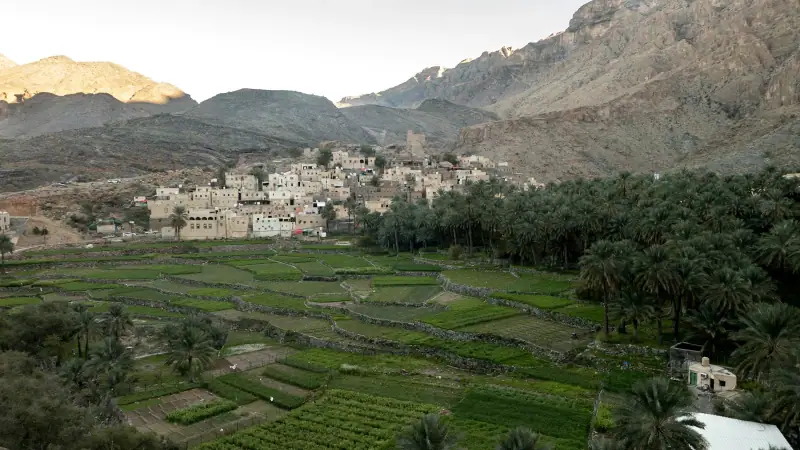
Visiting Jebel Akhdar: a complete guide to Oman's Green Mountain
Jebel Akhdar: Damask roses, hiking, perched villages and luxury resorts. A complete guide to visiting Oman's Green Mountain.
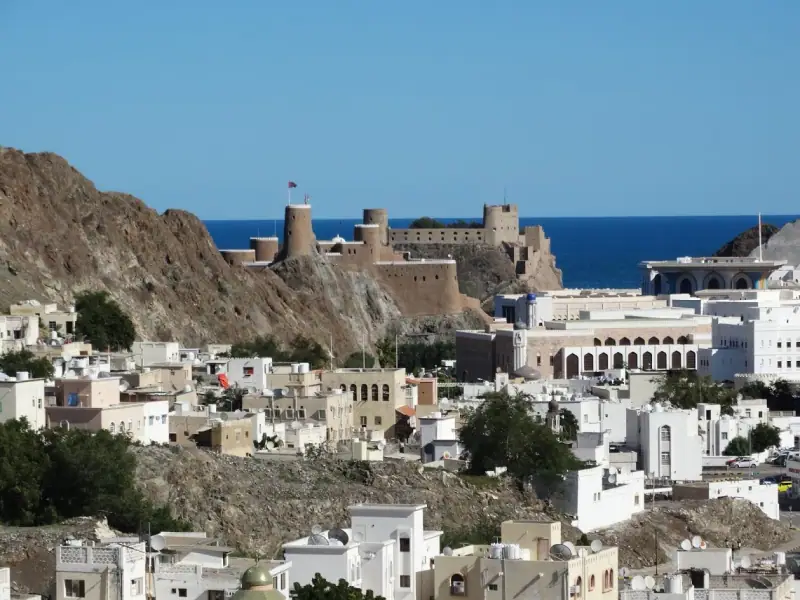
Muscat's top sights: the must-sees of Oman's capital
What to see in Muscat? Grand Mosque, Mutrah souk, Al Alam Palace and the corniche: the essential visits in the Omani capital.
Visiting Nizwa: a complete guide to Oman's cultural capital
Nizwa in practice: medieval fort, Friday souk, Hajar mountains and oases. All you need to know to visit the pearl of inland Oman.
Ready-made
Oman itineraries
10 days
Oman road trip: a 10-day itinerary to explore the sultanate
MuscatNizwaJebel AkhdarWahiba desertSurSalalah
3 days
Musandam in 3 days: an itinerary through Oman's fjords
3-day Musandam itinerary: fjords, dolphins, dhow cruise and Khasab. All you need to plan a stay on Oman's enclave peninsula.
7 days