What to see
Rotterdam, Delft and The Hague: What to See and How to Combine Them
We may earn a commission when you book through links on this page, at no extra cost to you. We don't visit or try the places we cover: we summarize published sources. How we work
In short
- The three cities are about a quarter hour apart by frequent train: modern Rotterdam, compact Delft, and The Hague with the Mauritshuis and a beach.
- Delft and The Hague can be done in one day; Rotterdam deserves a full day. Allow two to three days to take your time.
- Rotterdam and The Hague are good bases for the three cities; Delft is smaller and suits a calm stay.
- No car is needed: train, tram and bike are enough, and city-center parking is expensive and complicated.
When you plan a stay in the Netherlands, Amsterdam takes all the space. Yet a few dozen kilometers farther south, three very different cities follow one another almost without interruption: modern Rotterdam, Delft with its museums and The Hague, the discreet seat of government. Each has its own character, and their proximity makes it easy to link them by train.
Here is how to discover them, what is really worth the detour and how to organize your days. Site hours and rates change: check them on the official sites before leaving.
Rotterdam: the city that rebuilt everything
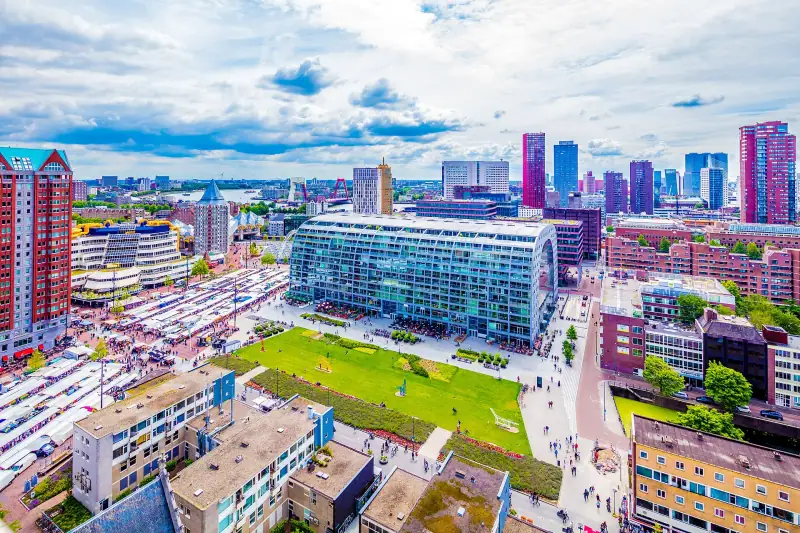
Rotterdam was heavily bombed in May 1940, and its center was almost entirely rebuilt after the war. The result is an urban landscape at the opposite extreme from Amsterdam’s gabled houses: glass towers, spectacular bridges and architecture that dares unexpected shapes. It is also the largest port in Europe, and you realize it as soon as you walk along the Meuse.
The Erasmus Bridge (Erasmusbrug), with its slanted pylon, has become the symbol of the city. You cross it on foot to reach the Kop van Zuid district on the south bank, where former wharves have been converted into housing and offices.
The essentials
- The Markthal: an immense covered market in the shape of an arch, whose ceiling is covered with a colorful mural. There are stalls and places to grab a quick lunch.
- The Cube Houses (Kubuswoningen): designed by the architect Piet Blom, these tilted dwellings on stilts are one of the city’s most recognizable sights. One of them can be visited.
- The Euromast: an observation tower that offers a panorama of the city and the port.
- The Van Nelle Factory: a former modernist factory listed by UNESCO, located in the northwest of the city.
- A boat trip in the harbor: to gauge the scale of the cranes, containers and ships.
🏨 Sleeping in Rotterdam: the city is an excellent base for fanning out to Delft, The Hague and Kinderdijk, often with lower rates than Amsterdam. Compare offers for your dates.
How much time to plan?
A full day lets you see the essentials without rushing: in the morning, the Erasmus Bridge and the Kop van Zuid; at noon, the Markthal; in the afternoon, the Cube Houses then a walk or an outing on the water. Design fans can easily spend a weekend.
Delft: canals, blue pottery and Vermeer
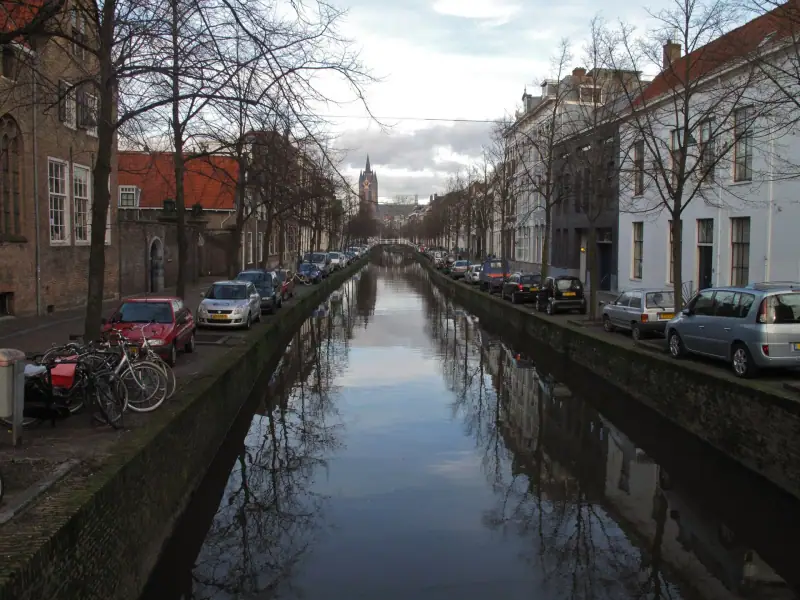
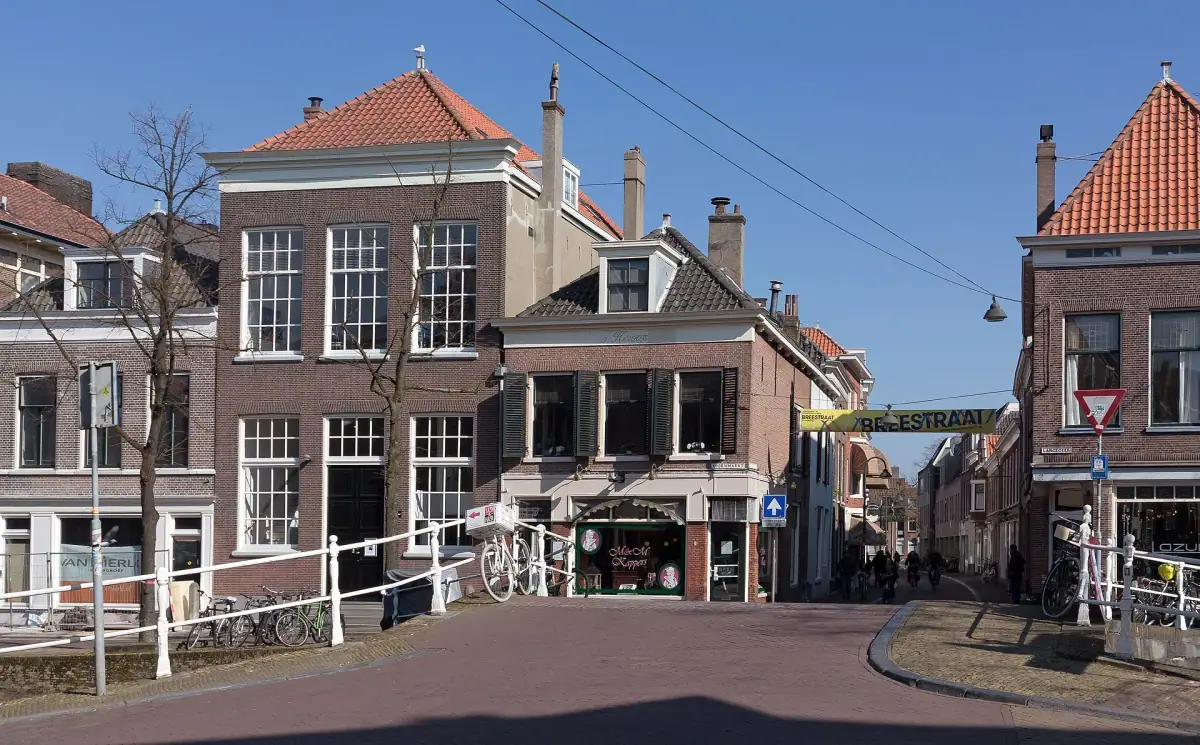
Delft is the exact opposite of Rotterdam. This small town with canals lined with old houses can be covered entirely on foot. It is associated with two famous names: the painter Johannes Vermeer, born here in the 17th century, and the blue-and-white pottery known as “Delftware,” which took its inspiration from porcelain coming from Asia.
The heart of the city is the Markt, the large market square, which separates the town hall (Stadhuis) from the Nieuwe Kerk, the “new church,” whose tower can be visited. A few minutes’ walk away, the Oude Kerk, the “old church,” leans slightly, which is part of its charm.
What to do in Delft
- Stroll along the canals around Oude Delft and Oosteinde: it is the best part of the stay and it costs nothing.
- Climb the Nieuwe Kerk tower to see the city and the surrounding countryside.
- Visit a pottery workshop to see how pieces are painted by hand: several workshops open their doors to visitors.
- Follow in Vermeer’s footsteps: the painter is everywhere in the city, even though his famous painting “View of Delft” is kept in The Hague.
- Take a break at a café terrace on the market square or by the water.
🎟️ Tours and excursions: boat rides, guided tours and day excursions from Amsterdam can be compared online, often with free cancellation.
Delft is about fifteen minutes by train from Rotterdam and about as far from The Hague. It is therefore the ideal link between the two: you can spend half a day there in transit without upsetting your program.
The Hague: the Mauritshuis, politics and the beach
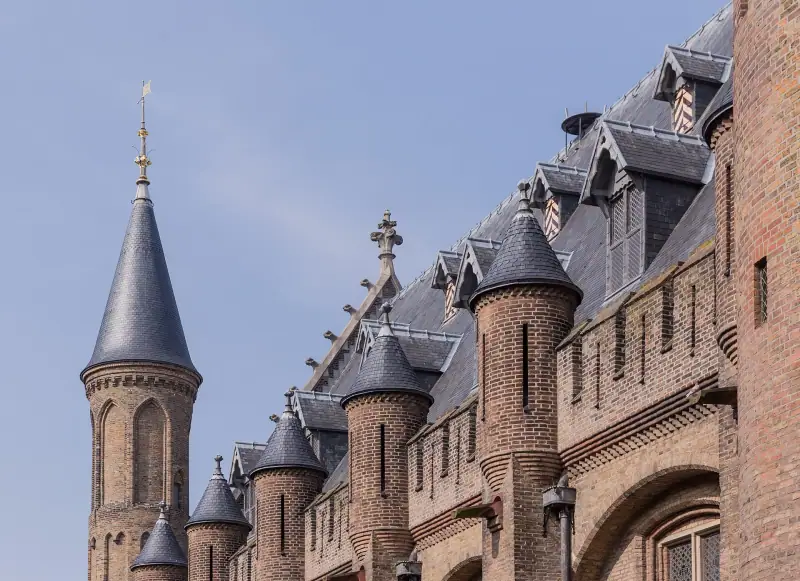
The Hague (Den Haag) is the seat of the Dutch government, even though the official capital remains Amsterdam. The city has a more bourgeois and calmer look than its neighbors: elegant avenues, mansions, parks and international institutions. It is notably home to the International Court of Justice, housed in the Peace Palace (Vredespaleis).
The historic heart is organized around the Binnenhof, a complex of medieval buildings where Parliament sits, and the Hofvijver pond, which offers one of the city’s most photographed views. The place can be seen from the outside, and some parts can be visited at certain times: find out before coming.
The Mauritshuis, a small museum of big names
Housed in a former mansion next to the Binnenhof, the Mauritshuis holds one of the finest collections of Dutch Golden Age painting. You can see notably Vermeer’s “Girl with a Pearl Earring” and the “View of Delft.” The museum is modest in size, which lets you go through it without fatigue, and is a good alternative to Amsterdam’s big museums, covered in the guide to Amsterdam museums.
Scheveningen, the sea within reach of the tram
The Hague has an asset rare for a government capital: a North Sea beach. Scheveningen, the seaside district, is linked to the center by tram and offers a long sandy beach, a pier and fish restaurants. In summer, people swim; out of season, they gladly walk into the wind.
How to combine the three cities
The three cities are linked by frequent trains, with trips of about twenty minutes between them. Here are two ways to organize them.
| Option | Program | For whom |
|---|---|---|
| One day, two cities | Delft in the morning, The Hague in the afternoon | Visitors in a hurry starting from Amsterdam |
| Two days | Day 1 in Rotterdam, day 2 in Delft then The Hague | Fans of architecture and museums |
| Three days | One city per day, with Scheveningen or Kinderdijk added | Those who want to take their time |
This trio fits naturally into the 7-day itinerary in the Netherlands. If you sleep in Rotterdam, add an excursion to the windmills, detailed in the guide Kinderdijk and Zaanse Schans.
🎟️ Rotterdam seen from the water: harbor cruises, guided architecture tours and boat rides can be compared online before you leave.
Getting around between the cities
The train is the simplest way: stations are in city centers or close by. Within each city, trams and bikes are natural allies. In Delft, everything is done on foot. In The Hague, the tram serves Scheveningen. In Rotterdam, the metro and tram link the main districts.
A car is of little use: parking in city centers is expensive and limited, and distances are very short.
When to go?
Spring and early summer are the most pleasant, with long days and busy café terraces. Summer is ideal for Scheveningen. Fall brings soft light and fewer people in the museums. In winter, days are short, but indoor visits (Mauritshuis, Markthal, pottery workshops) remain very pleasant. See the guide when to go to the Netherlands to choose your period.
Practical tips
- Bike: the region is flat and very well equipped with bike lanes, but stay alert to city traffic.
- Booking: book tickets for busy museums in advance, especially on weekends and during school vacations.
- Payment: bank cards are widely accepted; still, keep a little cash for some small shops.
- Weather: bring a light raincoat, because showers are frequent and brief.
- Travel insurance: compare health and cancellation cover before you leave.
Frequently asked questions
Can you visit Rotterdam, Delft and The Hague in one day?
It is possible by train, since the three cities are very close to one another, but the day will be packed. It is better to devote one day to Rotterdam and a second to Delft and The Hague, or to stay overnight to avoid rushing.
Which city to choose if I only have half a day?
Delft is the most compact and the most charming on foot. Rotterdam will appeal to fans of modern architecture, The Hague to those who want a major museum and the sea.
Where to sleep to visit the three cities?
Rotterdam and The Hague are good bases: rail links are frequent between the three cities and with Amsterdam. Delft, smaller, suits a calm stay.
Do you need a car?
No. Train, tram and bike are more than enough, and city-center parking is expensive and complicated. A car adds nothing for this trio of cities.
More Netherlands guides
Keep reading
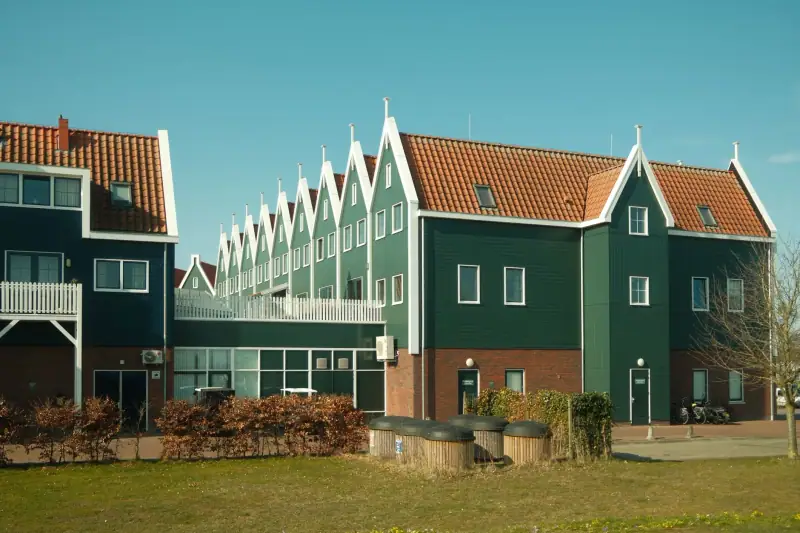
What to See in North Holland: Villages, Cheese and Dunes
What to see in North Holland: Haarlem, Zaanse Schans, Volendam, Marken, Edam, Alkmaar, Zandvoort dunes and Texel. Tips and trips from Amsterdam.
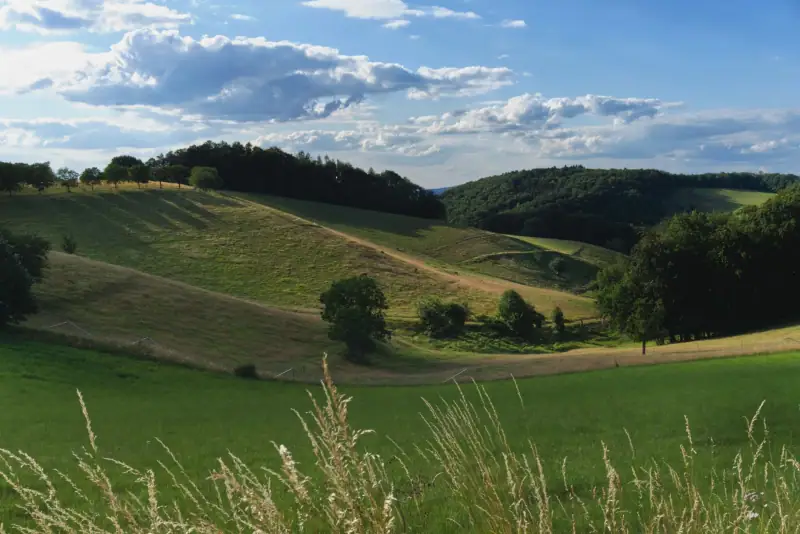
What to See in Dutch Limburg: Valkenburg, Thorn, Roermond
Beyond Maastricht, Limburg offers hills, marl caves, the white village of Thorn, Roermond and the country's highest point. What to see and how to plan.
What to See Around Utrecht and Central Netherlands: Veluwe, Amersfoort, Arnhem
Beyond Utrecht, central Netherlands has Amersfoort, De Hoge Veluwe park, the Kröller-Müller, Arnhem and castles. What to see and how to plan.
Ready-made
Netherlands itineraries
4 days
Amsterdam and Maastricht in 4 Days Without a Car: Is It Doable by Train?
AmsterdamMaastricht
7 days
Netherlands 7-Day Itinerary: Amsterdam, Delft, Rotterdam, Kinderdijk and Utrecht
A one-week itinerary in the Netherlands by train: Amsterdam, Haarlem, Zaanse Schans, The Hague, Delft, Rotterdam, Kinderdijk and Utrecht, day by day.