What to see
Visiting Yogyakarta, Borobudur and Prambanan: The Cultural Center of Java
We may earn a commission when you book through links on this page, at no extra cost to you. We don't visit or try the places we cover: we summarize published sources. How we work
In short
- Three nights let you see Borobudur, Prambanan and the historic center without rushing; add a fourth for Merapi or craft villages.
- Borobudur (about 40 km / 25 mi northwest, 1 to 1.5 hours by road) is Buddhist; Prambanan (about 20 km / 12 mi east) is Hindu. Both are UNESCO sites from around the 9th century.
- Access to Borobudur's upper terraces is regulated (quota, booking, guide, specific footwear): check the official conditions before planning your morning.
- Prambanan is best in late afternoon; visit early or late to avoid the heat, and beware of people claiming a site is 'closed'.
Yogyakarta, which Indonesians often call “Jogja,” is considered the cultural heart of Java. The city still has a sultan, an inhabited palace, batik and puppet workshops, and it serves as a base for two of the greatest religious monuments in Southeast Asia: the Buddhist temple of Borobudur and the Hindu complex of Prambanan. It is an excellent starting point for a first trip to the island.
This article helps you choose what to see, how to organize and where to stay. To place Java in a broader itinerary, see our complete guide to visiting Indonesia.
Borobudur: the largest Buddhist monument in the world
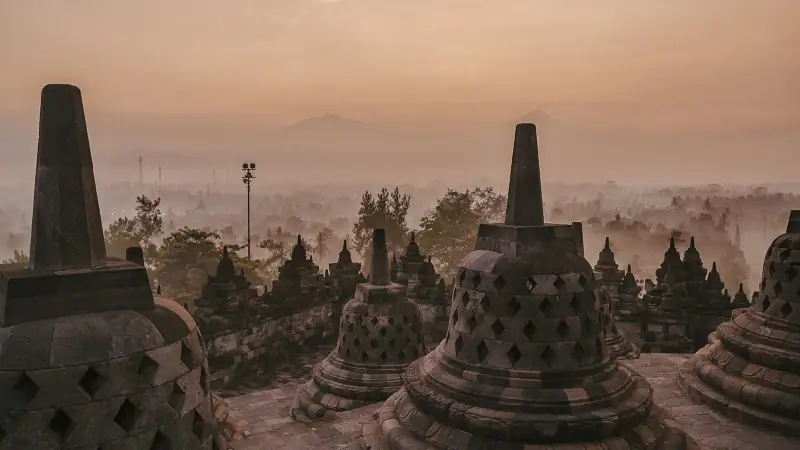
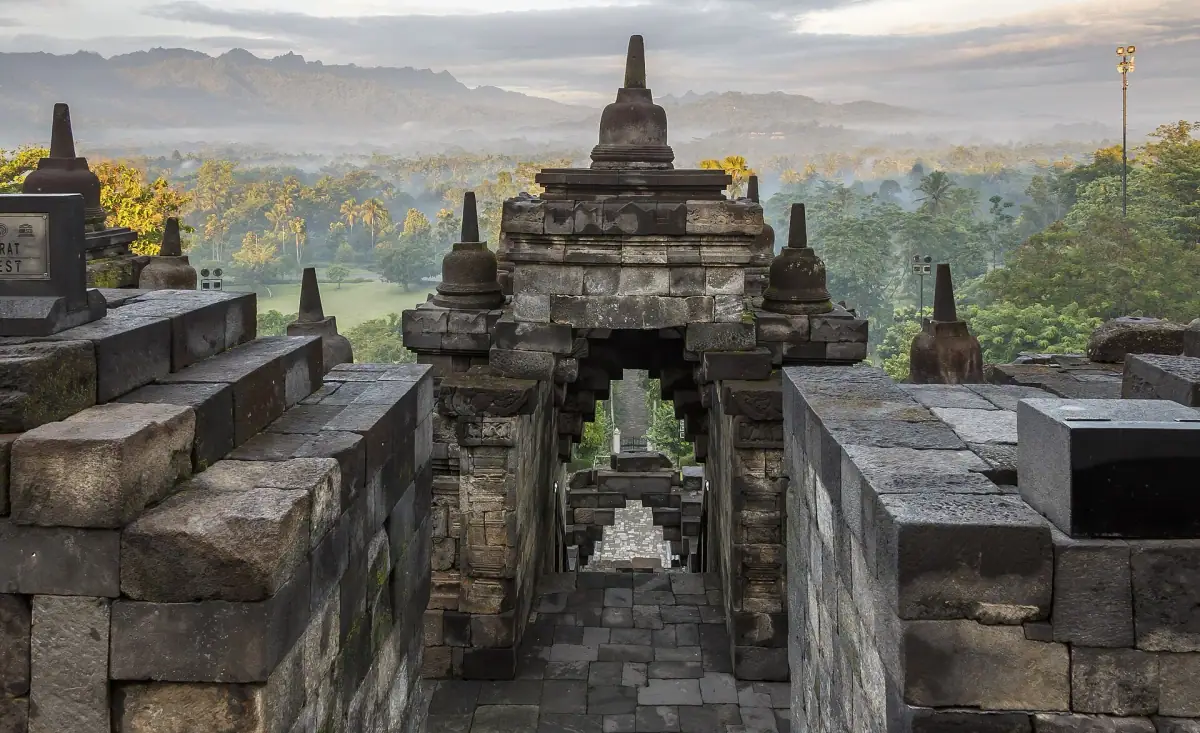
Borobudur rises in the Magelang area, northwest of Yogyakarta, in the middle of a plain of rice fields surrounded by hills and volcanoes. It was built around the 8th and 9th centuries and then abandoned, before being cleared of vegetation and ash in the 19th century and restored in the 20th. It is a UNESCO World Heritage site.
The monument is not a temple you enter: it is a structure to climb. It consists of several stacked terraces, the lower ones square, the upper ones circular, crowned by a central stupa. The lower galleries are covered with bas-reliefs telling the life of the Buddha and moral tales, while the plainer upper terraces hold 72 perforated stupas, each containing a Buddha statue. Together with those in the gallery niches, the monument counts about 500 Buddha statues.
The climb follows a circumambulation route: you walk around the monument as you go up, from left to right, as pilgrims do. Take the time to look at the reliefs at the base, often neglected by visitors in a hurry to reach the top. They are the essence of what Borobudur has to tell.
Sunrise or mid-morning?
Sunrise over Borobudur, when the hills emerge from the mist, is the image that draws most visitors. It is also busier and more expensive than the standard visit, and it is not always spectacular: an overcast sky erases everything. If you want soft light and fewer people, late morning or mid-afternoon is a reasonable compromise, but the heat is heavier then.
Access to the upper terraces is now regulated: daily quota, booking, accompanied visit and suitable footwear to protect the stone. These rules have changed several times, so check the official conditions before committing to a time slot. Also plan covered clothing, since it is a place of worship still used for Buddhist ceremonies.
🛕 Borobudur and Prambanan excursions
Compare guided visits of Borobudur and Prambanan with transport from Yogyakarta, at sunrise or during the day.
Prambanan: the great Hindu complex
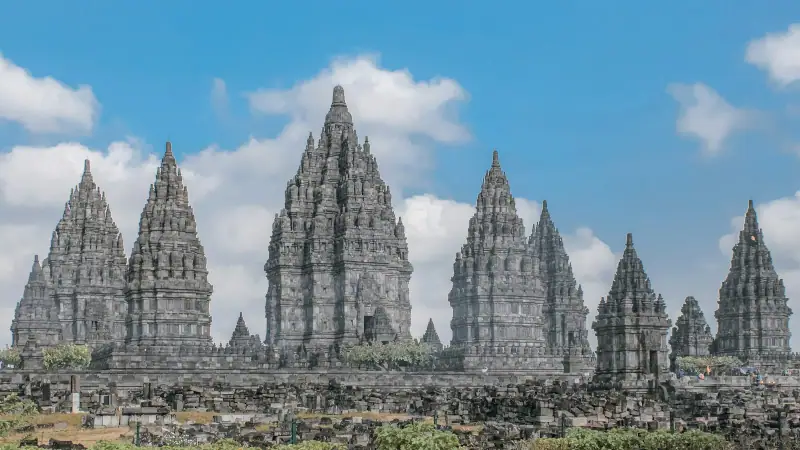
East of Yogyakarta, about 20 km (12 mi) away, Prambanan is the largest Hindu complex in Indonesia. It also dates from the 9th century. Its slender, sculpture-covered towers stand much higher than the neighboring temples. The three main shrines are dedicated to the Hindu trinity: Shiva, the destroyer and regenerator, in the center and tallest, Vishnu and Brahma on either side.
The bas-reliefs on the balustrades tell episodes of the Ramayana, the great Hindu epic. Again, you need to look up but also at eye level: that is often where the finest details are. The site was heavily damaged by earthquakes, notably the 2006 one in the region, and some of the temples remain under reconstruction or closed to visits. Do not expect to be able to enter every shrine.
Prambanan is best visited in late afternoon: the low light brings out the dark stone, the heat eases and the groups have left. In the dry season, performances of the Ramayana ballet are given in the evening near the site, in an open-air theater. Dates and rates change from year to year: ask at the site or at your accommodation.
The neighboring temples
Several more modest sanctuaries lie near Prambanan, some of them Buddhist. They are far less visited and suit you if you have already seen the two big sites and want to continue in the same spirit without meeting groups. The Ratu Boko site, on a hill south of Prambanan, adds an open viewpoint over the complex, especially popular at sunset.
In Yogyakarta: kraton, Taman Sari and Malioboro
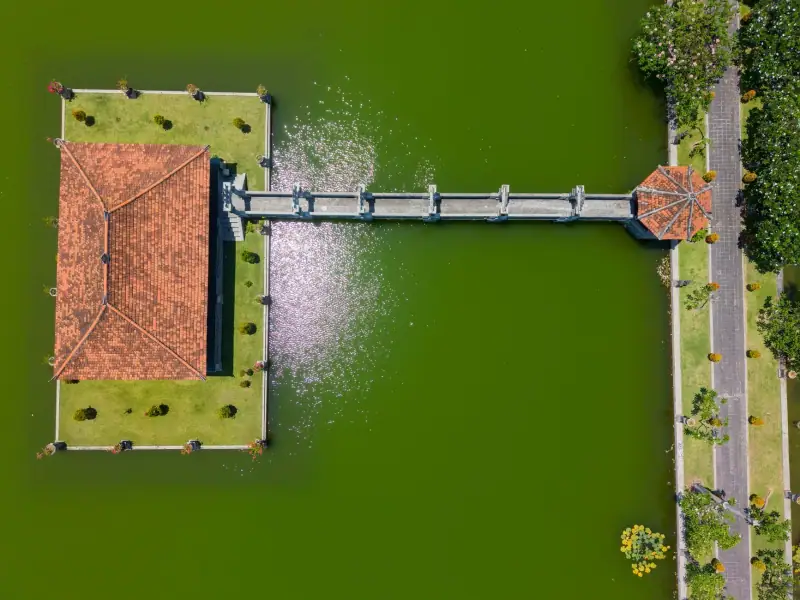
Between two days of temples, the city deserves at least half a day. The kraton, the sultan’s palace, is at the heart of the old town and remains the royal family’s residence: only part of it can be visited, with pavilions, a small museum and cultural performances at certain times. Dress modestly.
Not far away, Taman Sari, the sultan’s former “water castle,” is a maze of pools, passages and ruins. It can be visited on foot, but local guides offer their services at the entrance: accept one if you want to understand the place, agreeing on the price before starting. The surrounding neighborhood is a web of lanes where you find batik workshops, galleries and small cafes.
Malioboro Street is the city’s shopping artery, lively and noisy. You come for the atmosphere, the souvenir stalls and the street food more than to buy. Compare prices, bargain with a smile and beware of people who tell you a place is “closed” to steer you elsewhere, a classic scam in the region’s tourist areas.
🏨 Where to stay in Yogyakarta
Compare hotels and guesthouses in Yogyakarta, near Malioboro, the kraton or somewhere quieter, with recent reviews.
What to eat in Yogyakarta
The city has its specialty: gudeg, a dish of green jackfruit, meaning young jackfruit, simmered for a long time with coconut milk and palm sugar. It is served with rice, egg, chicken and a spicy sauce. The taste is mild and sweet, sometimes surprising for a Western palate, but it is a local classic. It is eaten in small family restaurants as well as at street stalls, often from the morning.
Warungs, those small eateries, offer the best value. Choose places frequented by locals, with a visible turnover of dishes, and prefer food prepared in front of you. For a broader view of dishes to try across the country, see our article on what to eat in Indonesia.
Getting there and getting organized
Yogyakarta has an international airport, west of the city, about an hour by road from the center depending on traffic. Most international travelers connect through Jakarta, Bali or another major Asian city. You can also arrive by train from Jakarta or Surabaya: the trip is long, but comfortable and slower than the plane, which lets you see the landscapes.
✈️ Flights to Yogyakarta and Java
Compare flights and connections to Jakarta, Bali or Yogyakarta by dates.
Once there, motorbike and car ride-hailing apps work well in town and spare you negotiations. For the temples, two options: a group excursion that bundles transport, tickets and a guide, or a private driver by the day, more flexible for timing sunrise. Driving yourself is not recommended for a first stay because of dense traffic and two-wheelers.
How many days, and in what order?
A simple sequence over three nights: arrival and evening on Malioboro, Borobudur day in the morning then rest, Prambanan in late afternoon with the kraton and Taman Sari in the morning. A fourth night lets you add an excursion to the slopes of Merapi, an active volcano whose access depends on the authorities’ instructions.
Yogyakarta is also the natural starting point for a trip to eastern Java: Bromo and Ijen are presented in our article on Bromo and Ijen, then a boat crossing leads to Bali. The best time to go depends on the season, detailed in our guide to the best time to go to Indonesia.
Practical tips
- Dress: shoulders and knees covered in temples and at the palace, and a hat against the sun;
- Heat: visit early or late, bring water, and keep midday for the city or a nap;
- Money: entry tickets are often higher for foreigners than for Indonesians, and are paid by methods that change (card, app);
- Respect: temples are places of worship, do not climb on unauthorized structures and do not touch the statues;
- Scams: beware of middlemen who claim a site is closed and offer a paid alternative.
Yogyakarta lends itself well to a relaxed stay: distances are short, culture is visible everywhere and the pace is slower than in the island’s big cities. It is often the stop that travelers regret having cut too short.
Frequently asked questions
How much time should you plan in Yogyakarta?
Three nights let you see Borobudur, Prambanan and the historic center without rushing. With two nights, you have to choose between a day of temples and a day in town. If you add Merapi volcano or craft villages, plan four nights.
Is Borobudur Buddhist and Prambanan Hindu?
Yes. Borobudur is a Buddhist monument from about the 9th century, Prambanan a Hindu complex from the same period, dedicated to Shiva, Vishnu and Brahma. Both are UNESCO World Heritage sites and are easily visited on the same day or over two days.
Do you need to book Borobudur in advance?
It is recommended. Access to the upper terraces is governed by a visitor quota and visiting rules (guide, specific footwear) that have changed in recent years. Check the conditions and rates in force on the official site before planning your morning.
How do you get from Yogyakarta to Borobudur?
Borobudur lies northwest of the city, about 40 km (25 mi) away. You get there on an organized excursion, with a private driver or by local transport. Allow between one and one and a half hours by road depending on traffic.
Can you visit Yogyakarta in the rainy season?
Yes, the temples stay open, but showers are frequent and sunrises more often veiled. The dry season offers more reliable conditions. See our article on the best time to go to Indonesia.
More Indonesia guides
Keep reading
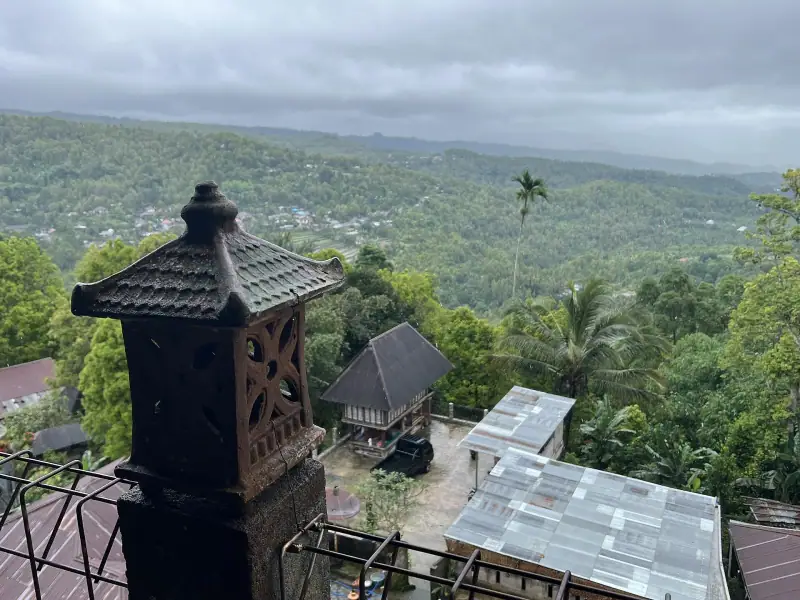
Munduk, Bali: Waterfalls, Lakes and Mountain Coffee, Is It Worth the Detour?
Munduk, a mountain village in northern Bali: waterfalls, twin lakes, drive time from Ubud, ideal length of stay, budget and tips for getting there.
Visiting Ubud: Rice Fields, Temples and Culture in the Heart of Bali
What to see in Ubud: Monkey Forest, Tegallalang rice terraces, Tirta Empul, dance and markets. How to plan 2 to 3 days, avoid the crowds and choose well.
Complete Guide to Visiting Indonesia: Bali, Java, Lombok, Komodo and Raja Ampat
Bali, Java, Bromo, Lombok, Komodo, Flores, Sulawesi, Raja Ampat: a complete guide to planning an Indonesia trip, from season to budget and itineraries.
Ready-made
Indonesia itineraries
10 days
10 Days in Bali: Ubud, the North, the East and the South Coast Day by Day
Bali in 10 days: a detailed itinerary through Ubud, the rice terraces, the north, the east coast, Nusa Penida and the south. Stops, drive times and tips.
6 days
Yogyakarta to Bali Without a Car: Bromo, Ijen and the Ferry in 6 Days
Yogyakarta, Bromo, Ijen then Bali by train, minibus and ferry: stages, distances, realistic travel times and pitfalls to avoid on this car-free route.
8 days
Flores Itinerary: From Labuan Bajo to Kelimutu Volcano in 8 Days
Flores in 8 days: Labuan Bajo, Komodo, spiderweb rice fields, Ruteng, Bajawa, Ende and the Kelimutu lakes. Stops, drive times, pace and tips.