Things to do
Visiting Bromo and Ijen: The Volcanoes of Eastern Java, a Practical Guide
We may earn a commission when you book through links on this page, at no extra cost to you. We don't visit or try the places we cover: we summarize published sources. How we work
In short
- Bromo (cone about 2,300 m / 7,550 ft) is watched at sunrise from a viewpoint such as Penanjakan, usually on a jeep tour; Ijen is a night walk of about 1 h 30 to 2 h to the crater rim.
- Both are active volcanoes: access can be restricted or closed, so check the situation before leaving.
- Nights are cold at altitude: bring a fleece, hat, gloves and windbreaker; for Ijen, a headlamp, an acid-gas mask and a local guide are not optional.
- A classic route links Yogyakarta, Bromo, Ijen and the Ketapang-Gilimanuk ferry to Bali in four to five days.
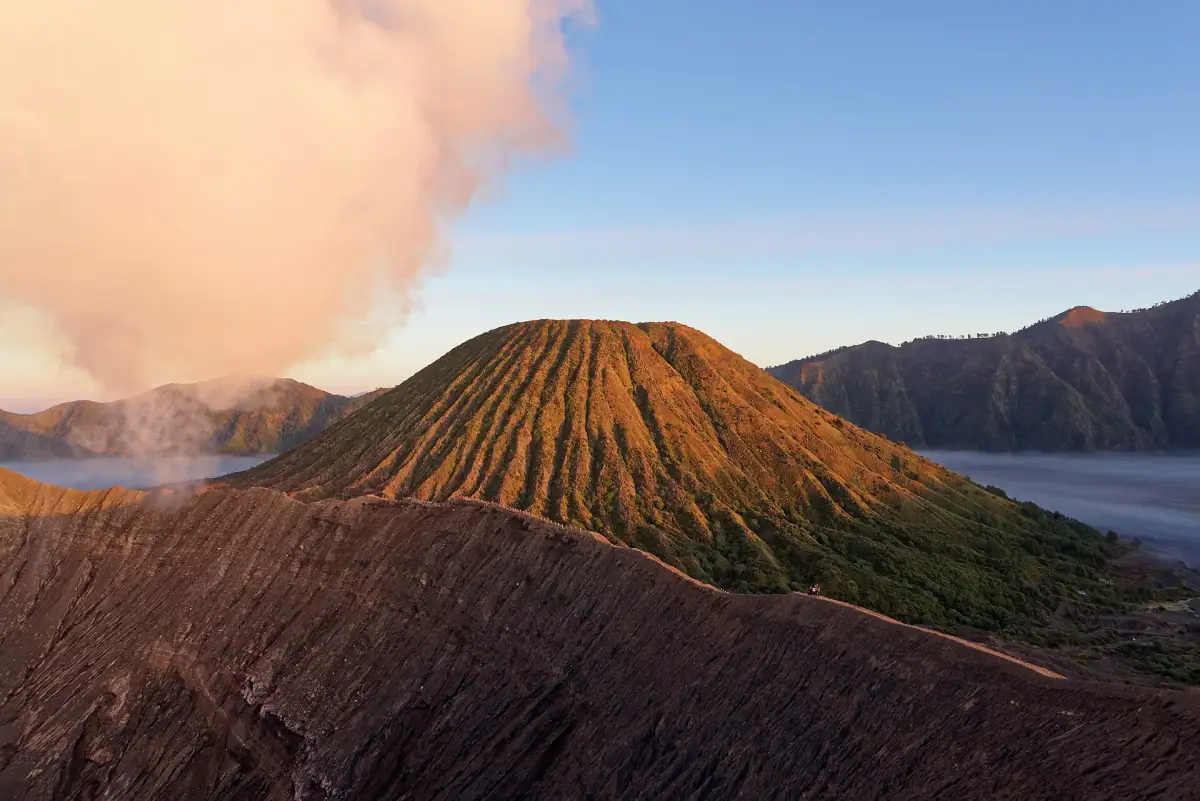
Eastern Java holds two of Indonesia’s finest volcanic experiences. Bromo, in the Tengger massif, is a smoking cone rising from an immense caldera, in the middle of a plain of gray sand. Ijen, farther east, hides a turquoise crater lake and the work of the sulfur miners. The two sites are prepared differently, but they form a natural pair before heading on to Bali overland.
This article details what you see, how to organize and what precautions to take. To place these volcanoes in a broader trip, see our complete guide to visiting Indonesia.
Bromo: caldera, sea of sand and sunrise
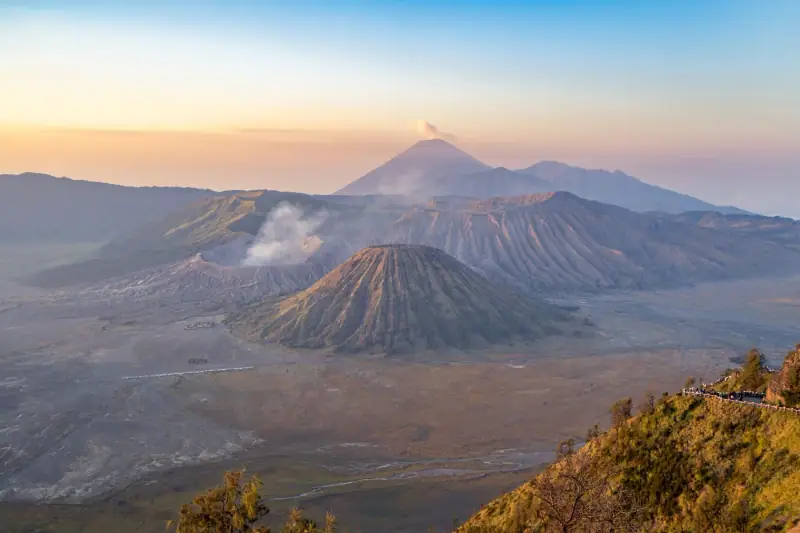
Mount Bromo lies in Bromo Tengger Semeru National Park, in East Java province. Its cone, about 2,300 m (7,550 ft) high, rises in the center of a vast caldera, surrounded by a plain of volcanic sand called the “sea of sand.” It smokes constantly and remains an active volcano: access to the crater can be restricted, even closed, during periods of activity. Find out before you leave.
The classic ritual begins well before dawn. Travelers get up in the middle of the night to reach a viewpoint on the heights of the caldera, generally Mount Penanjakan, from which you see the sun rise over Bromo, neighboring Batok and, in the distance, Semeru, the highest peak in Java. When the sky is clear, the valleys fill with a sea of clouds and the show justifies the early wake-up. Spots at the viewpoint are quickly taken: arriving early is better than staying behind the crowd.
Nights are cool at altitude, sometimes close to freezing in the dry season. Bring a fleece, a hat, thin gloves and a windbreaker, even if the next day is hot at sea level.
After sunrise
Once day breaks, the jeeps descend into the sea of sand and stop at the foot of Bromo. A trail crosses the plain to a staircase up to the crater rim. Horses are offered for the plain section, but the final staircase is climbed on foot. From the rim, you lean over the smoking crater. The sulfur stings the throat: a scarf or light mask helps, and you must stay behind the guardrail on narrow stretches.
Bromo also has a cultural dimension. It is sacred to the Tenggerese community, which practices a form of Hinduism and celebrates the Yadnya Kasada ceremony each year by offering produce of the land to the volcano. Respect places of worship, such as the temple at the foot of the cone, and do not approach ceremonies unless invited.
Where to sleep to see Bromo
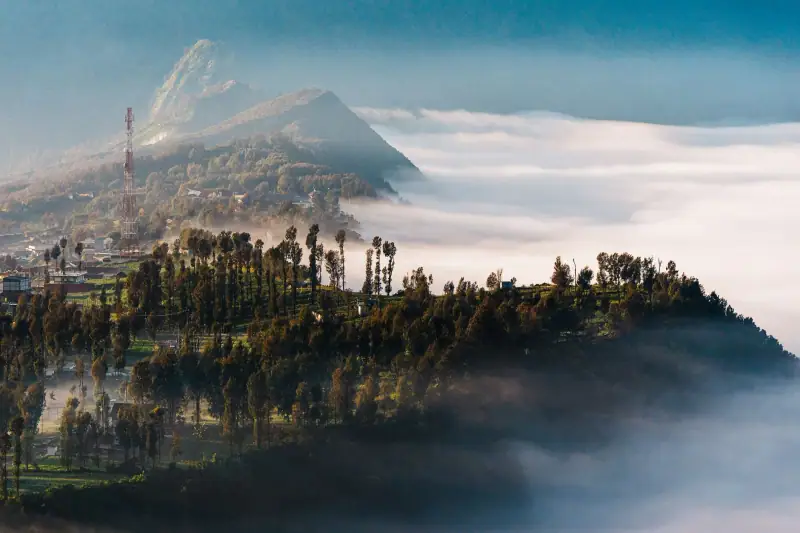
There are broadly three solutions. The first is to sleep in the village of Cemoro Lawang, on the edge of the caldera, which shortens the night trip to a minimum. The second is to spend the night in a departure town, such as Probolinggo or Malang, and drive a few hours before dawn. The third is to book a full excursion from Yogyakarta or Surabaya, often with a departure in the early evening.
Sleeping nearby is more expensive in comfort than in price and clearly more pleasant: you go to bed early and get up without rushing. The accommodations in Cemoro Lawang are simple, sometimes without heating, although nights are cold; check recent reviews for warm blankets and hot water.
🏨 Where to sleep near Bromo
Compare accommodation in the Bromo and Malang area by dates and budget, with recent traveler reviews.
Ijen: turquoise lake and blue flames
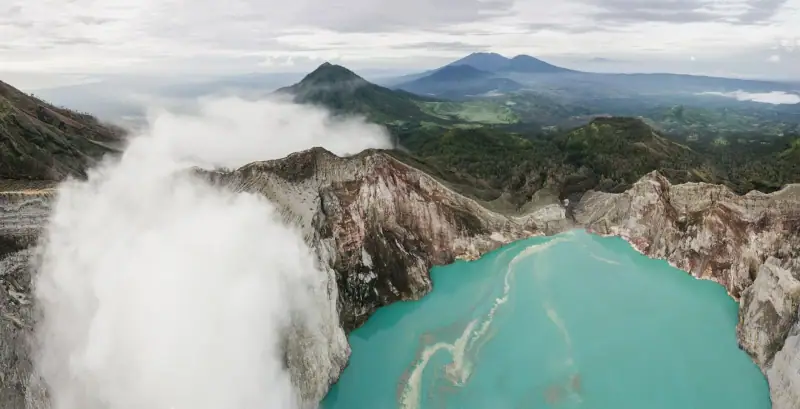
The Ijen massif is located in the far eastern tip of Java, in East Java province, not far from the coast facing Bali. Its crater holds a strikingly turquoise lake, very acidic, and sulfur fumaroles. Visits leave at night to see the “blue flames”: sulfurous gases that ignite on contact with air and produce a bluish glow visible in the dark. It is a rare phenomenon, which explains its success, but it is hard to photograph with a simple phone.
The walk starts from a trailhead at the foot of the volcano and climbs gradually on a wide but in places steep trail. Allow about an hour and a half to two hours to reach the crater rim, depending on your fitness. From there, the trail descends toward the flame zone, on unstable ground. This descent is the riskiest part: the gases can change direction without warning. A local guide, a headlamp and a gas mask are not optional.
At sunrise, the lake takes on its turquoise color and you see the sulfur miners climbing out of the crater, loaded with very heavy baskets. Their work is hard and dangerous. If you photograph them, ask permission first, and do not give money to children.
What to bring for Ijen
- A gas mask suited to acid gases, provided or rented by your guide;
- A headlamp with spare batteries;
- Warm clothes, because the wind is cold at the top, and high-top shoes with grippy soles;
- Water and a light snack;
- Good physical condition: the walk is long in the dark and comes after a short night.
If you have respiratory or heart problems, ask your doctor before going down into the crater. The rim already offers a fine view of the lake at sunrise.
🌋 Bromo and Ijen excursions
Compare Bromo and Ijen excursions with transport, guide and a night departure from your accommodation.
How to get there and link the two sites
The usual gateways are Surabaya and Malang for Bromo, and Banyuwangi for Ijen. Surabaya has a large international airport, and Banyuwangi also has a small airport. Road trips are long: distances are modest on the map, but the roads are winding and traffic slows everything. Allow several hours between Bromo and Ijen and do not plan a visit on the same day as a long transfer.
A classic itinerary links Yogyakarta to Bali in four to five days: Yogyakarta, then Bromo, then Ijen, then the boat crossing between Java and Bali, from the port of Ketapang, near Banyuwangi, to Gilimanuk. The crossing is short, on the order of an hour. This option avoids a domestic flight and lets you see genuine rural landscapes.
Travelers who want to save time book a group excursion that includes transport, guide and night schedules. Those who prefer independence hire a private driver for the length of the circuit: it is more flexible than driving yourself, as signage and local driving are bewildering on a first trip to Indonesia.
✈️ Flights to Surabaya
Compare flights to East Java, for example to Surabaya, by dates and stopovers.
When to go and how to prepare
The dry season, roughly April to October, offers the clearest skies for sunrise and for the night walk. It is also the period when nights are coldest at altitude. The rainy season makes trails slippery and views more often hidden, but it does not rule out a visit.
A few basic rules:
- Check volcanic activity before you leave: access to Bromo and Ijen can be restricted or closed depending on the authorities’ alerts;
- Book in advance in high season, especially in July and August, because accommodation near the sites fills up;
- Do not plan two sleepless nights in a row: night departures are tiring and fatigue makes the trails more dangerous;
- Keep a margin in the calendar for the weather, which can block a sunrise;
- Protect your gear: volcanic dust and sulfur damage cameras and irritate the skin.
These volcanoes combine well with the country’s other stops. For sleeping in the south of the island once you reach Bali, see our comparison of where to stay in Bali. For the more adventurous, Indonesia has many other natural sites, such as Komodo National Park or the Raja Ampat archipelago.
Frequently asked questions about Bromo and Ijen
Answers to the most common questions are in the FAQ below. In short: combine the two volcanoes on one circuit between Yogyakarta and Bali, dress warmly, equip yourself with a gas mask for Ijen and keep a margin for the weather and for the fatigue of night departures.
Frequently asked questions
Do you have to choose between Bromo and Ijen?
No, the two complement each other. Bromo offers a caldera landscape and a sunrise accessible to almost everyone, Ijen a more demanding night walk to a crater lake. Many travelers link them on a trip between Yogyakarta and Bali.
Are Ijen's blue flames visible all year?
The phenomenon is tied to the burning of sulfurous gases and is visible at night, but its intensity varies with the volcano's activity and the weather. An overcast sky or thick mist can hide it. Do not rely on seeing it.
Do you need a guide for Bromo?
It is not mandatory for the crater trail, but most visitors go on a jeep tour to reach the viewpoint before dawn, which avoids finding your way in the dark. For Ijen, a local guide is strongly recommended at night.
Do you need a gas mask for Ijen?
Yes, it is advised. The crater's sulfur fumes irritate the eyes and airways. A mask suited to acid gases is better than a simple cloth mask. If you have asthma or other respiratory problems, ask your doctor before going down into the crater.
What is the best time to go?
The dry season, roughly April to October, offers the clearest skies, but nights are cold at altitude. In the rainy season, trails are slippery and views more often hidden. Also check for closures decided during phases of volcanic activity.
More Indonesia guides
Keep reading
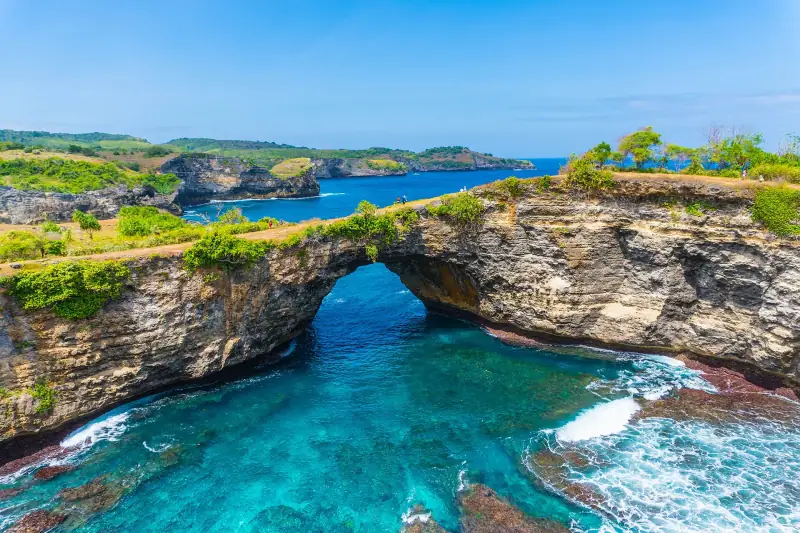
Nusa Penida in One Day from Bali: Boat, Scooter or Organized Tour?
Nusa Penida in one day from Bali: fast boat from Sanur, scooter or driver, west or east circuit, schedules, prices and mistakes to avoid.
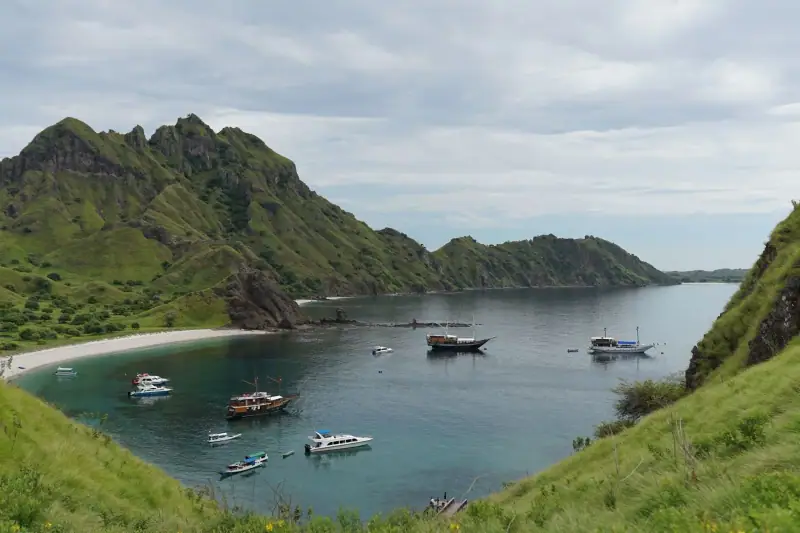
Visiting Komodo National Park: Dragons, Padar and Diving from Labuan Bajo
How to plan a visit to Komodo National Park: dragons on Komodo and Rinca, the Padar panorama, beaches, diving and cruises from Labuan Bajo.
Visiting Lombok and the Gili Islands: Rinjani, Beaches and Snorkeling
Lombok and the Gili Islands in practice: the Rinjani trek, southern beaches, snorkeling with turtles, which Gili to pick and how to get there from Bali.
Ready-made
Indonesia itineraries
10 days
10 Days in Bali: Ubud, the North, the East and the South Coast Day by Day
Bali in 10 days: a detailed itinerary through Ubud, the rice terraces, the north, the east coast, Nusa Penida and the south. Stops, drive times and tips.
6 days
Yogyakarta to Bali Without a Car: Bromo, Ijen and the Ferry in 6 Days
Yogyakarta, Bromo, Ijen then Bali by train, minibus and ferry: stages, distances, realistic travel times and pitfalls to avoid on this car-free route.
8 days
Flores Itinerary: From Labuan Bajo to Kelimutu Volcano in 8 Days
Flores in 8 days: Labuan Bajo, Komodo, spiderweb rice fields, Ruteng, Bajawa, Ende and the Kelimutu lakes. Stops, drive times, pace and tips.