Itineraries
Kauai 7-day itinerary: the best road trip on the wild island
We may earn a commission when you book through links on this page, at no extra cost to you. We don't visit or try the places we cover: we summarize published sources. How we work
Day by day
- Day 1Arrive in Lihue: Kalapaki Beach, groceries, dinner in Nawiliwili
- Day 2Wailua River, Fern Grotto, Opaekaa and Wailua Falls, Lydgate, Kapaa
- Day 3Kilauea Lighthouse, Limahuli Garden, Hanalei Bay, Ke'e Beach
- Day 4Na Pali Coast: boat trip, Kalalau Trail start or helicopter
- Day 5Waimea Canyon lookouts, Koke'e State Park, Waimea town
- Day 6Poipu Beach, Tunnels and Brennecke beaches, Spouting Horn, Allerton Garden, Koloa
- Day 7Last morning activity and departure from Lihue
Weather through the year on this route
| Jan | Feb | Mar | Apr | May | Jun | Jul | Aug | Sep | Oct | Nov | Dec | |
|---|---|---|---|---|---|---|---|---|---|---|---|---|
| High °F (°C) | 7625 | 7625 | 7625 | 7725 | 7826 | 8027 | 8027 | 8228 | 8228 | 8127 | 7926 | 7826 |
| Low °F (°C) | 7323 | 7222 | 7222 | 7323 | 7424 | 7625 | 7625 | 7826 | 7826 | 7826 | 7625 | 7323 |
Normals 1991–2020 at Honolulu / Waikiki and Kailua-Kona: averages over 30 years, not a forecast. Source: NASA POWER (MERRA-2), grid of about 50 km. Figures computed by us in November 2026. Rain is shown only where a weather station confirms the figures.
In short
- Seven days cover Lihue, the east coast, Hanalei and the north shore, the Na Pali Coast, Waimea Canyon and Koke'e, and the Poipu south coast.
- A car is essential on Kauai: there is no efficient public transport, and rental cars run short in high season, so book well ahead.
- The article estimates about $2,300 (mid-range) to $4,500 (comfort) per person for 7 days, not counting international flights.
- Kalalau Trail beyond 2 km (1.2 mi), Hā'ena State Park (Ke'e Beach) and Kilauea Point need permits or reservations. Na Pali boat trips run May to September.
Kauai, the wild island of Hawaii
Kauai is the oldest island in the Hawaiian archipelago, shaped by five million years of erosion and lush vegetation. Nicknamed the “Garden Isle”, it stands apart from its neighbors through its preserved character, dramatic landscapes and intimate feel. There are no skyscrapers or commercial strip here: Kauai has deliberately chosen to limit tourist development to protect its exceptional environment.
The island is known worldwide for two sites that rank among the most beautiful on the planet: the Na Pali Coast, a series of dizzying cliffs plunging into the Pacific, and Waimea Canyon, nicknamed the “Grand Canyon of the Pacific”. But Kauai is also golden sand beaches like Hanalei Bay, tropical valleys crossed by legendary hiking trails, and an authentic Hawaiian culture far from the crowds of Oahu.
With 7 days you have the right amount of time to explore all four corners of the island, soak in its green silence and understand why visitors who come to Kauai swear they will never go anywhere else. If you are still torn between islands, our Oahu vs Maui comparison will help you narrow down your choice according to what you want.
Itinerary overview
| Day | Area | Highlights |
|---|---|---|
| Day 1 | Arrival / Lihue | Settling in, Kalapaki Beach, local market |
| Day 2 | East coast (Coconut Coast) | Wailua River, Fern Grotto, Lydgate Park |
| Day 3 | North shore (Hanalei) | Hanalei Bay, Kilauea Lighthouse, Limahuli Garden |
| Day 4 | Na Pali Coast | Kalalau Trail hike (start) or boat trip |
| Day 5 | Waimea Canyon | Grand Canyon of the Pacific, Koke’e State Park |
| Day 6 | South coast (Poipu) | Beaches, snorkeling, Spouting Horn |
| Day 7 | Last morning | Activity of your choice, departure |
Day 1: arrival in Lihue and first steps on the island
Picking up your rental car at the airport
Lihue Airport (LIH) is the only gateway to Kauai. Most flights from the U.S. mainland connect via Honolulu (about 1 hour of extra flight time). Airlines serving Lihue from Honolulu include Hawaiian Airlines (now part of the Alaska Airlines group), Southwest and Alaska Airlines.
As soon as you leave baggage claim, pick up your rental car. It is your essential companion for the whole week. The main agencies (Hertz, Avis, Enterprise, Budget) have counters in the terminal or nearby. Book well in advance: Kauai is chronically short of available vehicles and prices soar at the last minute.
First afternoon in Lihue
After a long trip, keep the afternoon easy. Kalapaki Beach, reached from the Royal Sonesta Kauai Resort Lihue (formerly the Marriott), is a pretty beach sheltered by a breakwater, ideal for a first swim. The water is calm and conditions are safe for all levels. It is also one of the few windsurfing and kitesurfing spots on the east coast.
Then head to Kukui Grove Center or the local Walmart to stock up. On Kauai, food is expensive in neighborhood grocery stores; shopping in a big store as soon as you arrive can save a significant amount over the week.
In the evening, go to the Nawiliwili area for dinner. Kalapaki Joe’s serves good burgers and fish tacos at reasonable prices, with a view of the harbor. For an authentic local meal, look for a food truck selling plate lunch (rice, mac salad, protein), one of Hawaii’s signature low-cost dishes.
Where to sleep in Lihue
Lihue is not the most romantic part of Kauai, but it has good lodging for a first night, often cheaper than in Hanalei or Poipu. The Aston Islander on the Beach and the Royal Sonesta Kauai Resort Lihue (formerly the Kauai Marriott Resort) are well located. For budget lodging, B&Bs and Airbnb apartments are available in residential neighborhoods.
Day 2: the Coconut Coast and the Wailua River
Wailua River State Park
The Wailua River is the only navigable river in Hawaii and one of the most sacred in Hawaiian culture. For centuries its banks held the seats of power of the ali’i (chiefs). Paddling up the river by kayak is one of the most popular experiences on Kauai.
You have two options: rent a kayak at Wailua Kayak & Canoe (about $30-40 per person) and paddle to the Fern Grotto on your own, or take an organized boat tour (about $30-35, 1 h 30). The Fern Grotto is a natural cave covered with hanging tropical ferns, reachable only by the river; you can no longer go inside and you admire it from a built viewing platform. The site is magical but can be crowded in high season, so go in the morning if you can. Check access conditions with the operators before you go.
Going up the river, you will pass several heiau (Hawaiian temples), including Holoholokū Heiau, one of the oldest in the archipelago. These sacred sites deserve respect and a quiet attitude.
Opaekaa Falls and Wailua Falls
A few kilometers from the river mouth, a lookout reachable by car gives a spectacular view of Opaekaa Falls, a 40-meter (130 ft) waterfall surrounded by tropical vegetation. In late morning, the light is perfect for photos.
Wailua Falls, 5 kilometers (3 mi) north of Lihue, are another major waterfall on the island, reached from a parking lot on Ma Alo Road (Route 583). These twin falls of 26 meters (85 ft) were the opening scene of the TV series Fantasy Island in the 1970s. Access is easy and the view from the lookout is striking.
Lydgate Beach Park
In the afternoon, head to Lydgate Beach Park, one of the safest beaches on Kauai for families and less experienced swimmers. A natural lagoon is protected by rocks, creating a natural pool that is perfect for snorkeling. Tropical fish are plentiful and unafraid.
The park also has one of the largest children’s play structures in Hawaii, Kamalani Playground, built entirely of wood by community volunteers.
Kapaa: local life
Kapaa is the main town on the east coast, with a more relaxed and local feel than the tourist areas. The waterfront promenade leads to the Kauai Bike Path, a bike path that runs along the ocean for several miles. Art galleries, cafes and local restaurants sit pleasantly side by side.
For dinner, Kountry Kitchen is a local institution for breakfast and lunch. In the evening, Verde or Hukilau Lanai serve good local produce in a friendly atmosphere.
Day 3: the north shore and Hanalei Bay
The road north: key stops
The road from Kapaa to Hanalei (Route 56 then 560) is one of the most beautiful drives in Hawaii. Leave early to avoid the traffic that builds in mid-morning near Hanalei’s one-lane bridge.
First stop: the Kilauea Lighthouse and the Kilauea Point National Wildlife Refuge ($10 per adult, plus a $1 reservation fee). This 1913 lighthouse stands on a cliff overlooking the ocean. It is one of the best places to watch Hawaii’s marine and bird life: brown boobies, great frigatebirds, Laysan albatross, shearwaters and, with luck, whales in winter. The refuge is open only Wednesday to Saturday (10 am-4 pm) and an online reservation on Recreation.gov is required from age 16: check the hours before planning this stop.
Continue to Limahuli Garden, one of the properties of the National Tropical Botanical Garden. This preserved valley has a collection of native Hawaiian and Polynesian plants in an enchanting setting at the foot of the Na Pali cliffs. A guided visit (about $45) immerses you in 1,200 years of traditional Hawaiian agriculture.
Hotels in Kauai
The best places to stay on the island, with free cancellation.
Hanalei Bay: the most beautiful bay in Hawaii
Hanalei Bay is regularly named among the most beautiful bays in the world. This 3-kilometer (1.9 mi) crescent of golden sand, framed by cliffs covered in taro and rainforest, offers an exceptional visual spectacle. The bay is protected by a reef that makes swimming safe in summer (May to September). In winter, powerful waves attract experienced surfers.
Hanalei village is one of the most charming in Hawaii. Its small wooden shops, galleries, picturesque restaurants and Ching Young Village (local market) have an authentic feel. Hanalei Taro & Juice Co. makes smoothies from fresh taro grown in the adjacent valley, a unique treat.
Ke’e Beach and the start of the Kalalau Trail
At the end of the paved road is Ke’e Beach, the starting point of the famous Kalalau Trail. The beach is beautiful, but the water can be dangerous. Take the opportunity to glimpse the first cliffs of the Na Pali Coast and watch the surfers in the water in summer.
Even if you don’t do the full Kalalau Trail, walk the first 2 kilometers (1.2 mi) to Hanakapi’ai Beach to see the Na Pali from the inside. Note: a permit is required to go beyond the 2 km (1.2 mi) mark. Permits are booked months ahead on the official Hawaii State Parks website ($35 per person per night for non-residents). Access to Ke’e Beach itself also requires an advance reservation (see “Permits and reservations” below).
Day 4: the Na Pali Coast, the highlight of the stay
The Na Pali Coast is one of the most spectacular wild coasts on the planet. These volcanic basalt cliffs rising to 1,200 meters (3,940 ft), covered in waterfalls and dense vegetation, cannot be reached by road. There are three ways to see them, depending on your level and preferences:
Option A: boat trip (May to September only)
This is the most spectacular way to follow the Na Pali Coast. Catamarans and Zodiacs leave from Port Allen (south coast) or Hanalei Bay (north shore) for 4 to 6 hour trips along the whole coast, with snorkeling in sea caves, dolphin and turtle watching, and access to beaches reachable only by sea.
The operators Na Pali Riders, Liko Kauai Cruises and Na Pali Explorer run regular trips from May to September. Expect $150-250 per adult depending on the operator and duration. The sea can be rough even in good weather: check the marine forecast and choose an experienced operator.
Option B: Kalalau Trail hike (2 km or 22 km)
The Kalalau Trail is the most legendary hike in Hawaii. Over 22 kilometers (14 mi) one way from Ke’e Beach, it crosses 5 isolated valleys before reaching Kalalau Beach, at the foot of the cliffs. To go all the way to Kalalau, you have to camp (permit required, $35 per night, reservations often sold out several months ahead).
For a day hike without a permit, the first 2 kilometers (1.2 mi) to Hanakapi’ai Beach are freely accessible and already offer magnificent views of the Na Pali. Adding 3 more kilometers (2 mi) takes you to Hanakapi’ai Falls, a 90-meter (295 ft) waterfall in a spectacular setting (check the trail condition and access on the official State Parks website before you go). Read our guide to hiking in Hawaii for more practical advice.
Option C: helicopter flight
For a 360° view, nothing beats a helicopter flight. From Lihue, several operators offer 45 to 60 minute tours over the Na Pali Coast, Waimea Canyon, Mt. Waialeale (one of the rainiest places on Earth) and the Koke’e plateau. Blue Hawaiian Helicopters, Sunshine Helicopters and Island Helicopters are the main operators.
Expect $300-450 per person. Window seats are preferable, and some companies charge extra to guarantee them. Book early in the morning to reduce the risk of clouds.
Activities and tours in Kauai
Na Pali Coast boat, helicopter, kayak... Book online.
Day 5: Waimea Canyon, the Grand Canyon of the Pacific
The road to the canyon
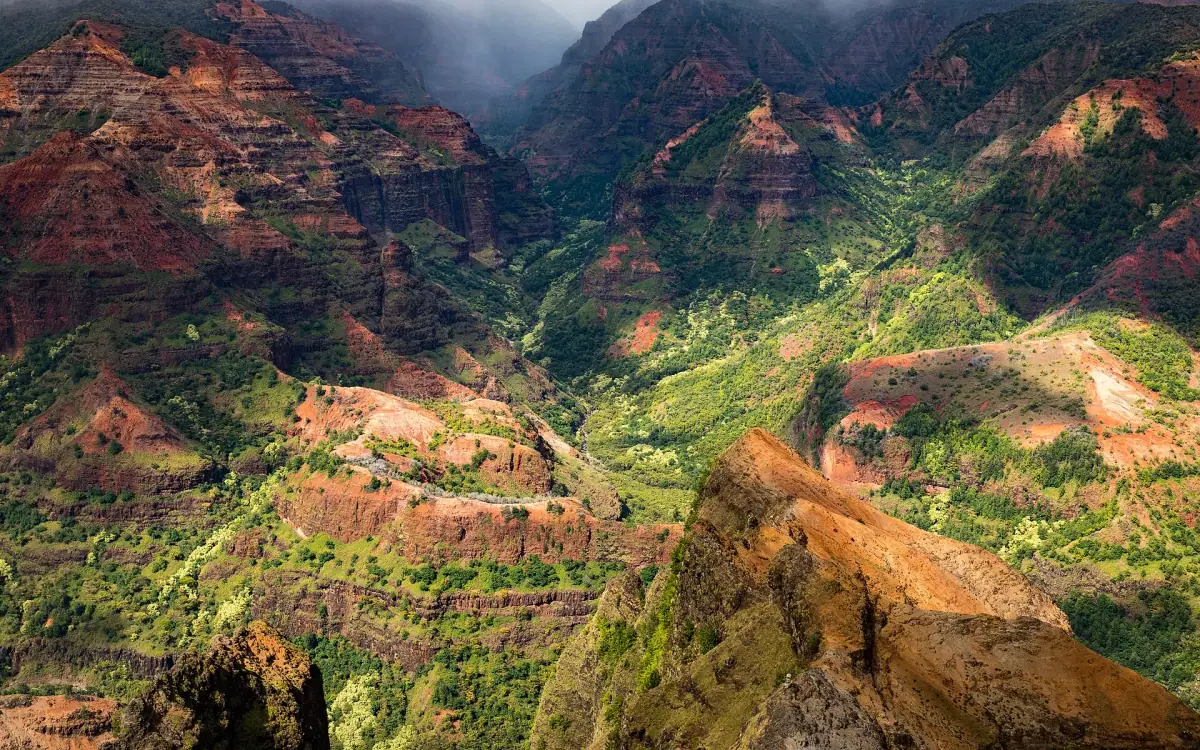
Waimea Canyon is one of the most unexpected landscapes in Hawaii. It is 16 kilometers (10 mi) long and 900 meters (2,950 ft) deep, and its walls of red, orange and green volcanic rock look utterly out of place on a tropical Pacific island. Mark Twain, it is said, nicknamed it the “Grand Canyon of the Pacific” on his visit in the late 19th century.
To get there from the north shore, allow 1 h 30 to 2 hours of driving. From Poipu or Lihue, allow 45 minutes. Route 550 (Waimea Canyon Drive) climbs gradually from the town of Waimea to Koke’e State Park at 1,100 meters (3,600 ft). The road is dotted with lookouts over the canyon.
The canyon lookouts
Waimea Canyon Lookout (marker 18): the main viewpoint over the canyon. Arrive early to avoid the clouds that often build in early afternoon. The plunging view of the canyon’s colorful layers is striking in good weather.
Pu’u Ka Pele Lookout and Pu’u Hinahina Lookout (markers 19-20): two more lookouts with different angles on the canyon. In clear weather, from the second lookout you can see the islet of Ni’ihau on the horizon (a private island closed to visitors).
Koke’e State Park
Continue 10 kilometers (6 mi) past the canyon to Koke’e State Park, at 1,100 meters (3,600 ft). The atmosphere is completely different: forests of redwood and Japanese cedar planted by Japanese immigrants, endemic birds found nowhere else, and cool mist in every season. The Koke’e Museum (suggested donation $5) presents the natural and cultural history of the area.
From the park, the Awaawapuhi Trail (11 km / 7 mi round trip) leads to an overhanging lookout 800 meters (2,600 ft) above the Na Pali Coast: a breathtaking view, but a demanding hike. For a shorter option, the Cliff Trail (1 km / 0.6 mi round trip) from Koke’e park offers a spectacular view over the valley.
The town of Waimea
On the way down, stop in Waimea, the westernmost town on Kauai. Captain James Cook landed here in 1778, on his first contact with Hawaiians. A statue in town pays tribute to him. Ishihara Market is a century-old local grocery where you will find authentic Hawaiian snacks and good poke bowls.
Day 6: the south coast and the Poipu beaches
Poipu Beach
The south coast is the sunniest part of Kauai. While the north shore receives up to 10 meters (33 ft) of rain a year, the south coast gets 300 days of sunshine annually. Poipu Beach Park is regularly ranked among the best beaches in the United States. It has two distinct areas: the east beach is ideal for swimming, the west beach for snorkeling.
It is one of the best places on Kauai to see Hawaiian monk seals, a critically endangered endemic species. These protected animals often lounge on the beach. Do not approach them within 15 meters (50 ft).
Tunnels Beach and Brennecke Beach
Tunnels Beach (Makua Beach), on the north shore, is one of the best snorkeling spots on the island. Its tunnel-shaped coral reefs shelter manta rays, green sea turtles and exceptionally varied tropical fish. The summer swell is moderate and conditions are generally excellent from May to September.
Near Poipu, Brennecke Beach is known for bodysurfing and boogie boarding. The hollow, regular waves make it an ideal spot for these activities, which are accessible to everyone.
Spouting Horn
A few miles west of Poipu, the Spouting Horn is an unusual geological phenomenon: waves rush into an underwater lava tube and shoot up as a geyser up to 15 meters (50 ft) high, with a characteristic blowing sound. The show is at its best in strong swells. Sellers of Hawaiian jewelry and souvenirs gather in the adjacent parking lot.
Allerton & McBryde Garden
If you like botany, the National Tropical Botanical Garden has two remarkable gardens on the south coast: the Allerton Garden and the McBryde Garden. Allerton is especially famous for its dramatic paths, its French-style gardens and the giant ficus trees that served as a set for the film Jurassic Park (1993). Visits are guided only ($50-60).
Evening in Koloa
The small town of Koloa (Old Koloa Town) has a colonial charm with its shops in old wooden buildings. It is a pleasant place for a last evening on the south coast. Koloa Fish Market is ideal for buying fresh poke to take to the beach. Brennecke’s Beach Broiler serves good beach food with an ocean view.
Day 7: last morning and departure
Enjoying the last hours
Depending on your flight time, your last morning can fit one final activity. If you are on the north shore, a sunrise from Hanalei Pier is an unforgettable memory. The morning mist clinging to the cliffs and Bali Hai Peak (Na Pali) in golden light is an image you will keep for life.
If you missed kayaking on the Wailua River, this may be the time for a short morning session. On the south coast, a last swim at Poipu or snorkeling in the early hours (the sea is often calmer in the morning) closes the stay perfectly.
Return your car early, especially if your flight is in the late afternoon. Lihue Airport is small: allow 1 h 30 to 2 hours before departure to be safe, especially in high season.
Practical tips for your Kauai road trip
Roads and driving
Kauai’s coastal road does not go all the way around the island. The north shore is cut off by the Na Pali Coast, which cannot be reached by road. The southwest part of the island (Polihale) is reached by dirt tracks passable with a 4x4. The Kuhio Highway (Route 56/560) to the north shore has several one-lane bridges: wait until the bridge is clear before you go on. Honk to signal your passage.
Respect the speed limits (often 35-45 mph); speed checks are frequent. GPS can sometimes mislead you on unpaved tracks.
Weather and microclimates
Kauai is the rainiest island in Hawaii, but the rain is very localized. The north shore (Hanalei) is much wetter than the south coast (Poipu). If the weather is bad in one area, change your route: it is probably sunny on the other side of the island. Mt. Waialeale (in the center of the island) receives up to 11 meters (36 ft) of rain a year, which makes it the rainiest place on Earth.
Lodging: book long in advance
Kauai lacks affordable lodging. Book 3 to 6 months ahead in high season. Options include the luxury resorts of Poipu and Princeville ($300-600 per night), local bed & breakfasts ($150-250 per night) and house or apartment rentals on Airbnb (often the best option for families). For advice on lodging across the archipelago, see our guide to cheap hotels in Hawaii.
Food
Food trucks and plate lunch are everywhere on the island and are the cheapest option ($10-15 per person). Local grocery stores like Big Save and Foodland sell fresh poke, bento boxes and Hawaiian sushi. Avoid eating only in restaurants: prices are high ($40-80 per person in the evening).
Permits and reservations
Several Kauai sites require paid permits:
- Kalalau Trail beyond 2 km (1.2 mi): permit required ($35 per person per night for non-residents, camping), booked online on the official Hawaii State Parks website
- Hā’ena State Park (access to Ke’e Beach): reservation required all year, about 30 days ahead ($5 per person entry + $10 per vehicle for parking for non-residents), through the same platform
- Kilauea Point NWR: $10 per adult (+ $1 fee), online reservation from age 16, open Wednesday to Saturday
Estimated budget for 7 days
| Item | Mid-range | Comfort |
|---|---|---|
| Lodging (7 nights) | $900 | $2,100 |
| Car rental | $500 | $700 |
| Food | $500 | $900 |
| Activities and entry fees | $400 | $800 |
| Total per person | $2,300 | $4,500 |
These amounts exclude international flights. For a complete estimate of your Hawaii budget, see our Hawaii budget guide.
Kauai compared with the other islands
Kauai is fundamentally different from Oahu (more touristy, more urban) and Maui (more cosmopolitan, busier). If you are torn between islands for a first trip to Hawaii, here is the gist:
Choose Kauai if you like wild nature, hiking, tranquility and an authentic Hawaii far from the crowds. It is the ideal island for a couple looking for romance or travelers who want to truly disconnect.
Skip Kauai if you want lively nightlife, fine-dining restaurants or luxury resort hotels with every amenity: Maui and Oahu suit you better. To compare the two most popular islands in detail, see our article Oahu vs Maui: which island to choose?.
For a first trip to Hawaii that combines several islands, our 7-day Hawaii itinerary offers a balanced structure between Oahu and Maui that can serve as a base for a multi-island trip including Kauai.
Is Kauai worth the detour?
The question comes up often among travelers planning their first Hawaii trip: is it better to do Oahu + Maui or include Kauai? The answer depends entirely on what you are looking for.
Kauai demands a bit more logistics (an extra inter-island flight, limited availability of cars and lodging) but rewards those who make the effort. The Na Pali Coast, Waimea Canyon, the Hanalei valley and the silence of the Koke’e forests are experiences you won’t find anywhere else.
If you have 10 days or more in Hawaii, include Kauai in your route. If you have only a week, Kauai alone is an excellent choice: you won’t have time to get bored and you will go home with images etched for life.
The Garden Isle will keep amazing you. Aloha, Kauai.
Sources
- Kilauea Point National Wildlife Refuge (U.S. Fish and Wildlife Service): figures checked November 2026
- Hawaii State Parks (DLNR): prices checked November 2026
Frequently asked questions
How many days do you need to visit Kauai?
Seven days is the ideal length to get to know Kauai in depth. With a minimum of 5 days, you can cover the essentials (Na Pali Coast, Waimea Canyon, Hanalei Bay). Ten days lets you add hikes and water activities without rushing.
Do you need to rent a car on Kauai?
Yes, a car is essential on Kauai. There is no efficient public transport and the sights are scattered across the island. Book your vehicle well in advance, especially in high season (December-March and June-August), because supply on the island is limited.
What is the best season to visit Kauai?
April, May, September and October offer the best compromise: less rain than winter, fewer people than summer, and more affordable rates. Summer (June-August) is high tourist season. Winter (December-March) brings big waves on the north shore and more rain, but prices are high.
Is the Na Pali Coast accessible all year?
Access to the Na Pali Coast depends on the season and how you visit. The Kalalau Trail (Hā'ena side) can be hiked all year but requires a permit. Boat trips are possible from May to September when the sea is calm. Helicopter flights run all year in good weather.
What budget should you plan for 7 days on Kauai?
Plan between $2,000 and $4,000 per person for 7 days (excluding the international flight), depending on your comfort level. That covers car rental (about $600 per week), lodging (about $150-300 per night), meals (about $80-120 per day) and activities. Kauai is one of the most expensive Hawaiian islands.
Can you do Kauai without hiking?
Absolutely. If hiking isn't your thing, you can enjoy Kauai through boat trips, helicopter flights, kayaking on the Wailua River, beaches and scenic drives. Many spectacular views are accessible without any particular physical effort.
More Hawaii guides
Keep reading
Visiting Kailua-Kona: complete guide to Big Island's coastal town
Kailua-Kona, gateway to Big Island: manta rays, Kona coffee, snorkeling with turtles, Ali'i Drive and Pacific sunsets.
Night snorkeling with manta rays in Kona: booking, prices, season and minimum age
Swimming with manta rays at night in Kona: prices ($80-140), booking, duration, kids, seasickness and rules to follow. A practical guide.
Snorkeling in Hawaii: the best spots
The best snorkeling spots in Hawaii: tropical fish, turtles and coral reefs on every island, with access, depths and practical tips.
Ready-made
Hawaii itineraries
5 days
Big Island road trip in 5 days
Kailua-KonaVolcano VillageHilo or Hamakua Coast
7 days
Maui 7-day itinerary: the complete guide to planning your trip
Maui in 7 days: Road to Hana, Haleakala, Wailea and Kaanapali beaches. A day-by-day plan to discover the pearl of the Hawaiian archipelago.