Itineraries
3 days in San Pedro de Atacama: a day-by-day itinerary
We may earn a commission when you book through links on this page, at no extra cost to you. We don't visit or try the places we cover: we summarize published sources. How we work
Day by day
- Day 1San Pedro village, Pukará de Quitor, Moon Valley at sunset
- Day 2Atacama salt flat, altiplano lagoons, stargazing evening
- Day 3El Tatio geysers at sunrise, free afternoon
Where to sleep
- San Pedro de Atacama3 nights
Weather through the year on this route
| Jan | Feb | Mar | Apr | May | Jun | Jul | Aug | Sep | Oct | Nov | Dec | |
|---|---|---|---|---|---|---|---|---|---|---|---|---|
| High °F (°C) | 6619 | 6820 | 6418 | 5915 | 5513 | 5010 | 489 | 5211 | 5412 | 5714 | 6116 | 6418 |
| Low °F (°C) | 5010 | 5010 | 489 | 468 | 457 | 415 | 394 | 415 | 415 | 436 | 468 | 489 |
| Rain in (mm) | 2.870 | 2.460 | 3.590 | 4.9125 | 6.7170 | 7.9200 | 6.7170 | 6.3160 | 4.1105 | 4.3110 | 3.590 | 3.180 |
Normals 1991–2020 at Puerto Varas: averages over 30 years, not a forecast. Source: NASA POWER (MERRA-2), grid of about 50 km. Figures computed by us in November 2026.
In short
- Three days climb gradually: day 1 near the village at about 2,400 m (7,870 ft), day 2 toward the altiplano, day 3 at El Tatio geysers at about 4,300 m (14,100 ft).
- Tours to El Tatio usually leave San Pedro between 4 am and 5 am; the geyser field is about 90 km (56 mi) away.
- Fly into Calama, about an hour and a half by road from the village; book popular tours ahead in high season.
- Entrance fees to sites are often billed separately from tours, so compare what each agency includes.
San Pedro de Atacama is the starting point for some of Chile’s most astonishing landscapes: lunar valleys, high-altitude lagoons mirroring volcanoes, geysers steaming at dawn and a night sky of rare clarity. But the desert imposes its own rhythm. Distances are long, tours often leave very early, and altitude is more tiring than you would imagine. Three well-organized days let you see the essentials without wearing yourself out.
This itinerary rests on a simple principle: climb gradually. The first day stays near the village, at about 2,400 m (7,870 ft), the second rises toward the altiplano, the third takes you to El Tatio geysers, whose field sits at about 4,300 m (14,100 ft). For a general introduction to the destination, see our guide San Pedro de Atacama: what to do. If you plan this stay as part of a larger trip, it fits naturally into our two-week Chile itinerary.
Before you go: what to know to organize your 3 days
A few practical benchmarks make preparation easier.
Arrival. You generally reach San Pedro from Calama airport, about an hour and a half by road from the village, by shuttle or private transfer. If your flight lands midday, treat the first afternoon as a half day of settling in: the program below takes this into account.
Season. The Atacama can be visited year-round. The austral summer (December to February) can bring rain at altitude, sometimes enough to disrupt some altiplano tours. Winter (June to August) offers very clear skies but freezing nights, with below-zero temperatures at dawn at the geysers. Our article on the best time to travel to Chile details the seasons.
Tours. Many sites are visited with village agencies, which offer group departures. Compare what is included (guide, breakfast, entrance fees, transfer from your accommodation) before booking, because site entrance fees are often billed separately. Prices and conditions change; check directly with the agencies.
Budget. San Pedro is one of the most expensive destinations in the country for tours, because everything is done by vehicle over long distances. Our guide to the budget in Chile will help you size your envelope.
Accommodation. The village is small and walkable. Choose a place close to the center so you can go out in the evening without a vehicle, with heating or thick blankets in winter: nights are cold, even in the shoulder seasons.
Where to stay in San Pedro de Atacama
Hotels, lodges and guesthouses in the village: compare prices and availability for your three nights.
Day 1: the village, Pukará de Quitor and Moon Valley
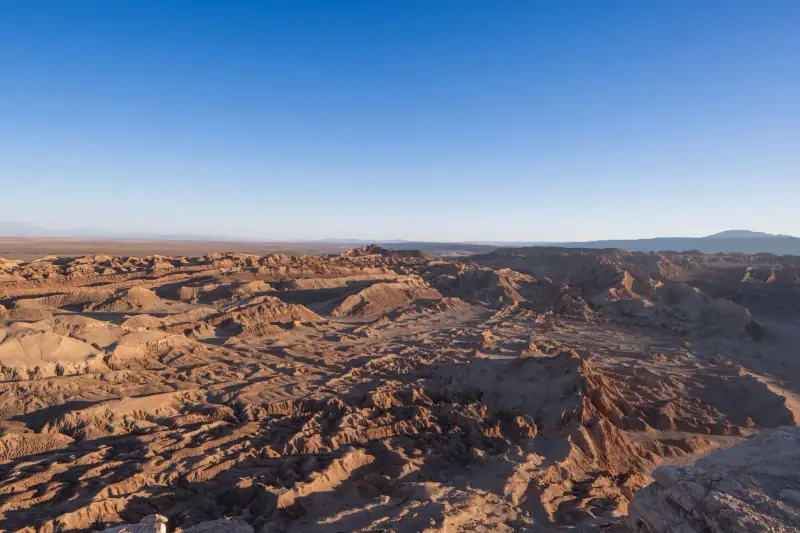
On the first day you settle in and stay near the village. This is the time to drop your bags, walk slowly, drink plenty of water and get your bearings.
Morning: the village. San Pedro is a town of dirt streets lined with adobe houses, centered on a small square and an old church. A relaxed stroll lets you spot the agencies, cafés and craft shops. It is also the best time to confirm your tours for the following days and choose a restaurant for the evening.
Early afternoon: Pukará de Quitor. This stone fortress, a few kilometers from the village, overlooks the San Pedro River valley. It dates from the pre-Columbian period and was the scene of fighting during the Spanish conquest. A short trail leads up, with a fine view of the oasis. The site can be visited on foot or by bike from the village, but avoid the hottest hours: the sun is fierce.
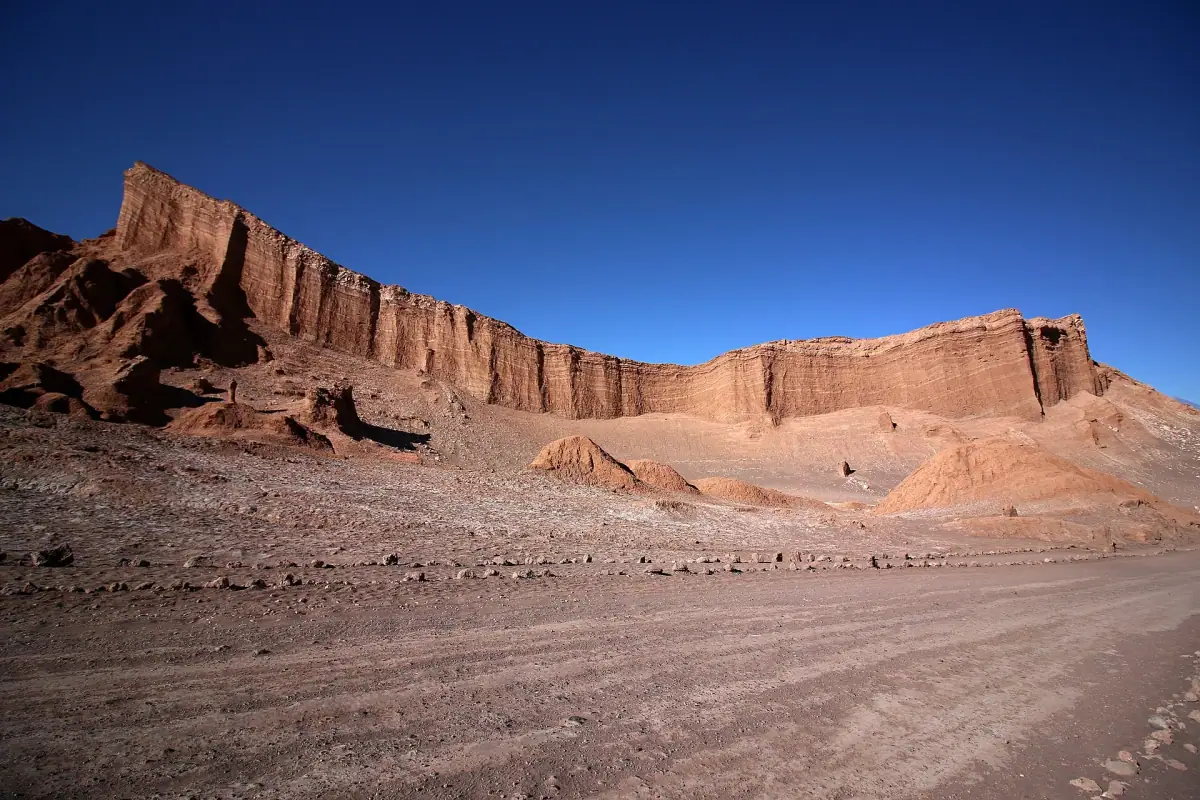
Late afternoon: Moon Valley. Located about 15 km (9 mi) west of the village, it is famous for its eroded salt and sand formations, dunes and ridges. Tours generally leave in the late afternoon so you can watch the sunset from a viewpoint, when the landscape takes on orange, red and mauve tones. Bring a jacket: as soon as the sun disappears, the temperature drops quickly.
Evening. Have dinner in the village and go to bed early: the next day starts with an early wake-up. For dishes to try, our article on typical Chilean dishes gives pointers that also apply to highland cooking.
Variation. If you arrive very early in the morning, you can add Death Valley (Valle de la Muerte), next to Moon Valley and often combined with it on tours. Otherwise, save that energy for the next day.
Tours in San Pedro de Atacama
Moon Valley, El Tatio geysers, altiplano lagoons: browse the guided tours you can book.
Day 2: Atacama salt flat, altiplano lagoons and starry sky
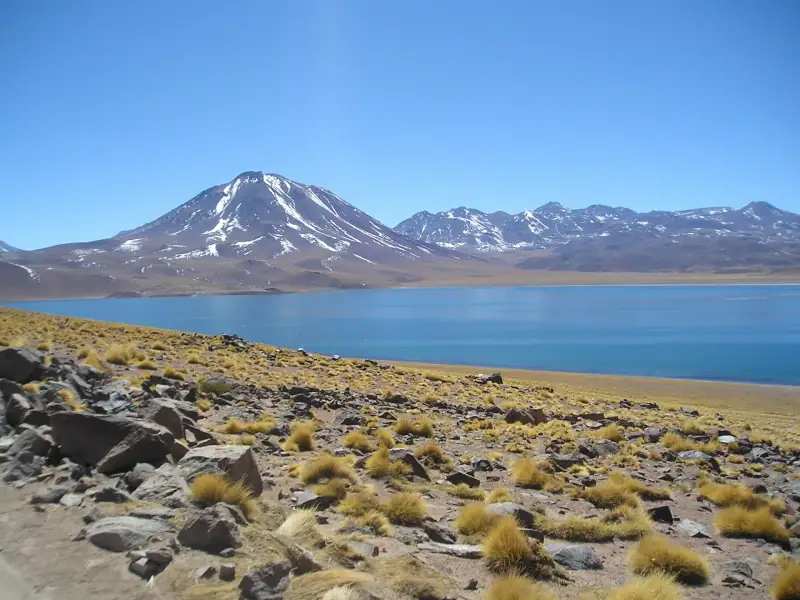
The second day climbs gradually in altitude and brings together landscapes of water and salt. It is the day richest in color.
Morning: the Atacama salt flat. The salar is an immense expanse of salt, the largest in Chile, edged with lagoons where you may see pink flamingos depending on the season. Some tours let you float in very salty lagoons, on the same principle as the Dead Sea, although access to some of them is sometimes limited or regulated to protect the environment. Ask the agency before booking: access rules change.
Midday: the oasis villages. Depending on the tour, you pass through villages such as Socaire or Toconao, with their small churches and volcanic-stone streets. A chance to discover local architecture and have a simple lunch.
Afternoon: the altiplano lagoons. Higher up, the Miscanti and Miñiques lagoons sit in high-altitude basins, between about 4,000 and 4,300 m (13,100 and 14,100 ft), surrounded by volcanoes. The deep blue water contrasts with the yellowish vegetation of the altiplano, and the wind is often strong. These sites are about a hundred kilometers (about 62 mi) from the village, a drive of about two hours. The day is long: bring water, a snack and warm clothes.
Evening: stargazing. The Atacama is one of the best places in the world for astronomy, thanks to its altitude, very dry air and near absence of clouds. Several agencies offer guided evenings with a telescope, lasting about two to three hours. Full-moon nights are less favorable for the Milky Way, so check the lunar calendar before choosing your date. Our article on accessories for traveling in Chile lists what is best to bring (warm clothes, red headlamp, etc.).
Tip. Altitude affects everyone differently. Feel free to shorten the program if the day feels like too much. Better to miss a lagoon than to spoil the rest of the stay. For health questions about altitude, ask your doctor or a travel clinic.
Day 3: El Tatio geysers at sunrise
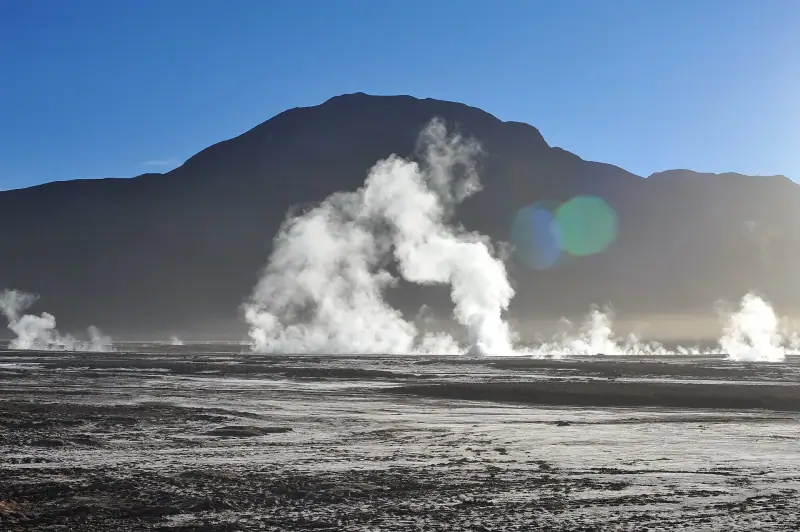
The third day starts very early, and that is the price to pay for one of the region’s most memorable spectacles.
Night departure. Tours generally leave San Pedro between 4 am and 5 am, to arrive at El Tatio geysers before or at sunrise. The geothermal field is about 90 km (56 mi) from the village, a drive of about an hour and a half to two hours, on a partly difficult track. This is why people usually book a tour rather than drive in the dark.
At the geysers. At dawn the air is freezing, sometimes well below zero, and the fumaroles form great plumes of steam in contact with the cold. The contrast is spectacular. The field is visited on foot, with rules to follow: stay on the marked paths, do not go near the edges of the pools and keep an eye on children. The ground is unstable and the water is scalding.
The hot springs. Many tours include a stop at a natural hot-water pool. Bring a swimsuit, a towel and sandals, as well as warm clothing for getting out of the water. The idea may seem absurd at 4,000 m (13,100 ft) in freezing weather, but the experience is memorable.
Return through the villages. On the way back, short stops let you see highland wildlife (vicuñas, viscachas, sometimes flamingos) and visit an altiplano village, such as Machuca, where you can try llama skewers. You are generally back in the village by late morning.
Free afternoon. After a short night, rest is a good idea. Use it to nap, drink plenty of water, browse the village’s craft shops or take one last bike ride in the oasis. The fittest travelers can add a last late-day tour, but it is not required.
El Tatio geysers and astronomy evenings
Book ahead the tours that fill up fast in high season, with guide and transfers.
Adapting the itinerary: variations by time and pace
The program above is a compromise between discovery and recovery, but several variations are possible.
With only two days. Keep Moon Valley at sunset on the first day, then choose between El Tatio geysers and the altiplano lagoons. Both are superb, but very different: the geysers appeal for the dawn atmosphere and hot baths, the lagoons for the colors and volcanoes. Drop one of the two rather than chaining two very early departures.
With four or five days. Add a day devoted to a hike or a more distant site. The Piedras Rojas, red rocks edged with turquoise lagoons, are often combined with the altiplano lagoons but make a full day in their own right. You can also set aside a rest day to enjoy the village atmosphere, or a bike ride in Moon Valley. For more walking ideas, see our hikes in Chile’s national parks.
With children. Very long days at altitude and 4 am departures suit young children poorly. Favor Moon Valley, the salt flat and the village, and avoid extreme altitude if your children are small. Ask your doctor for advice before you go.
On a tight budget. Rent bikes for nearby sites, share transfers, compare several agencies, and choose group tours over private ones. You can also cook for yourself if your accommodation has a kitchen.
By car. A car lets you visit at your own pace, but altiplano roads are long, with few gas stations. Fill up in San Pedro or Calama and never set out without water and warm clothes. After the desert, the central valley and its vineyards offer an excellent counterpoint.
Eating and drinking during your stay
San Pedro offers varied dining for a village of its size: Chilean cooking, highland dishes based on llama or quinoa, pizzas, cafés and small restaurants for travelers. Prices are rather high compared with the rest of the country, because everything is brought in from far away.
For tours, always pack a snack: dried fruit, cereal bars, fruit. Breakfasts provided by agencies are often simple. On the altiplano, water is essential: allow at least one to two liters (1 to 2 qt) per person per tour.
Coca tea (mate de coca) is a traditional infusion served in many places in the region. Note that it is forbidden to take coca leaves out of the region, particularly abroad. Drinking the infusion there is not a problem.
Practical tips for these 3 days
- Protect yourself from the sun. At this altitude, ultraviolet rays are intense. High-SPF sunscreen, a hat, sunglasses and lip protection are essential, even in winter.
- Keep cash. Although cards are accepted in many places in the village, some small businesses or tours do not take them. Withdraw pesos before heading out on a tour.
- Respect the environment. The desert is a fragile ecosystem: stay on the trails, do not take stones or salt, and leave no trash.
- Manage your energy. Dawn wake-ups, long drives and altitude are tiring. Keep rest periods, and do not stack two early-morning tours in a row without a break.
- Think about insurance. Tours at altitude, far from medical care, justify good health and repatriation coverage.
- Check entry rules. Entry rules depend on your passport. Check the official travel advice of your government before you book: travel.state.gov (US), GOV.UK (UK), travel.gc.ca (Canada), Smartraveller (Australia) (checked November 2026).
And after the Atacama?
Many travelers follow the desert with the Lake District, with its green climate, or with the central coast. Our 7-day road trip in the Lake District offers a striking contrast with the arid landscapes of the north. A domestic flight links the north of the country to Santiago, from where connections to the south depart.
Chile is long, and its climates vary completely with latitude. Each stage deserves time. If you only have a week, concentrate on a single region rather than multiplying flights: the Atacama alone, properly visited, is already worth the trip.
Compare flights to Calama
Calama is the arrival airport for San Pedro de Atacama: check available flights for your dates.
Frequently asked questions
Are three days enough to visit San Pedro de Atacama?
Yes, three days cover the classics: Moon Valley, the lagoon and salt flat, El Tatio geysers, the altiplano lagoons and an evening of stargazing. Two days force you to drop the altiplano or the geysers; four or five days leave room for longer hikes and a less intense pace.
In what order should you plan the tours, given the altitude?
Start with the lowest sites, around 2,400 m (7,870 ft) (the village, Moon Valley), then climb gradually toward the altiplano lagoons, and keep El Tatio geysers, at about 4,300 m (14,100 ft), for last. This is the logic of the program proposed here.
Do you need to book tours in advance?
In high season (austral summer, school holidays), the most requested tours, such as the geysers and stargazing, can be full. Booking a few days ahead, or on arrival with a village agency, avoids unpleasant surprises. The rest of the year there is generally room.
Can you do this itinerary without a car?
Yes. The village and several nearby sites (Pukará de Quitor, Moon Valley by bike or on a tour) are done without a vehicle, and distant sites are visited with local agencies. A car gives freedom but requires being comfortable on high-altitude roads and managing fuel well.
What clothes should you pack for these three days?
The desert has big temperature swings between day and night. Pack layers: a warm fleece and windbreaker for dawn at the geysers and the stargazing evening, strong sun protection (hat, sunglasses, sunscreen), closed shoes and a water bottle. The sun is intense at this altitude, even in cool weather.
What about altitude?
Ask your doctor or a travel clinic, and see the official travel health pages (CDC in the US, TravelHealthPro in the UK). Practical points: walk slowly, pace your days and avoid stacking early-morning tours back to back.
More Chile guides
Keep reading
Chile trip budget: real costs, 3 profiles and money-saving tips
How much does a trip to Chile cost? Prices by category (lodging, transport, meals, activities), three daily budgets and tips to spend less.
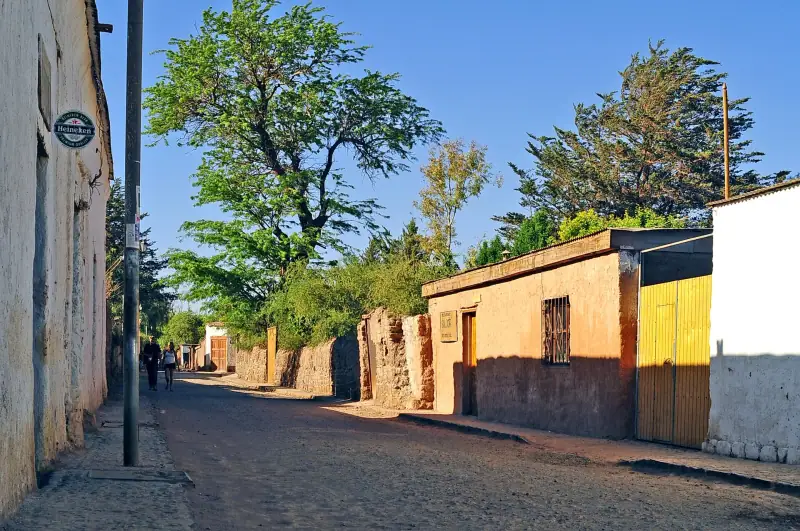
Where to stay in San Pedro de Atacama without a car: town center or outskirts?
No car in San Pedro de Atacama: stay near Caracoles Street or on the outskirts? Areas, walking distances, early-morning tours and pitfalls to avoid.
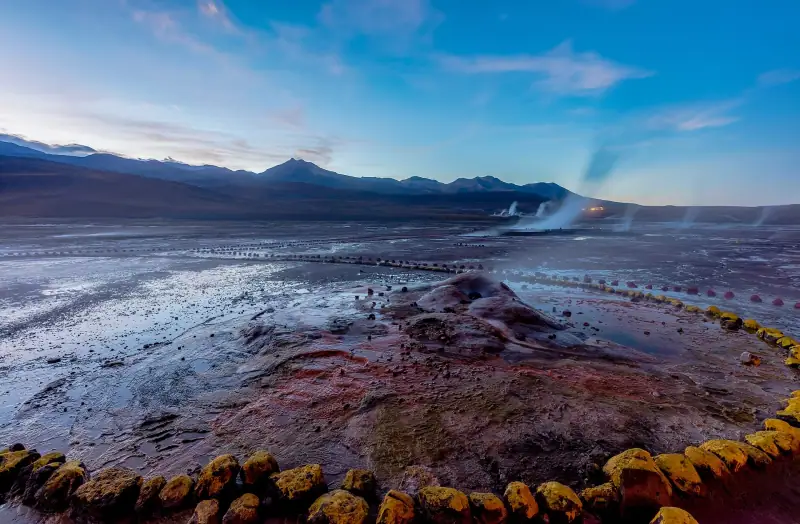
El Tatio geysers without a tour: car, entrance fee and hours
Visit El Tatio geysers without a tour: B-245 road, 15,000 CLP ticket, night departure, cold and altitude. The real conditions before you rent a car.
Ready-made
Chile itineraries
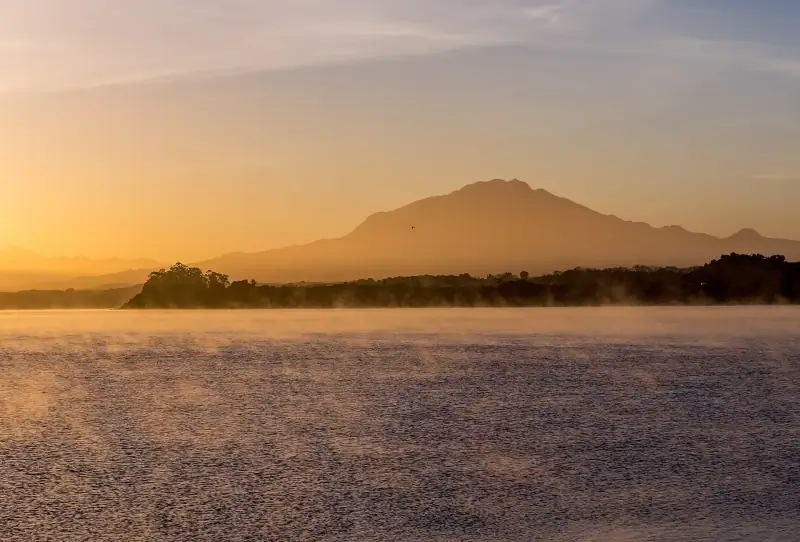
7 days
Chile's Lake District road trip: 7 days from Puerto Varas to Pucón
Puerto VarasPucón
Can be adapted in the planner
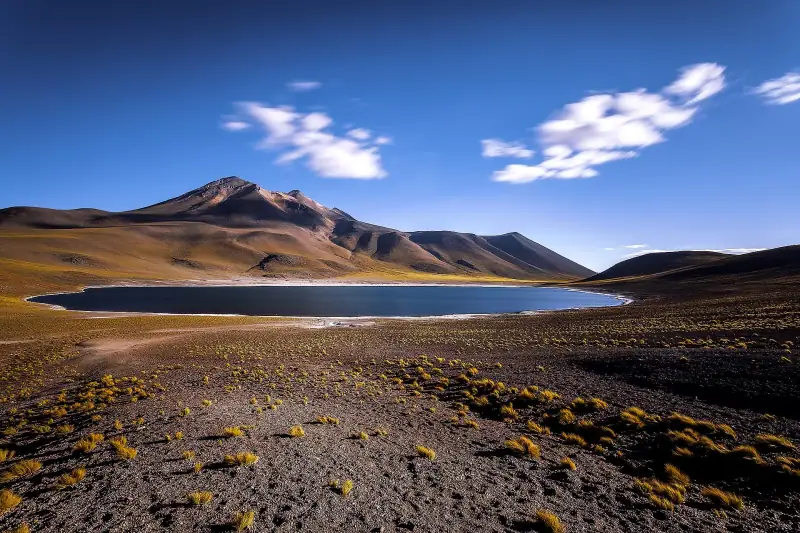
14 days
2-week Chile itinerary: Atacama, the Lakes and Chiloé
A 14-day Chile itinerary, day by day: Santiago, Valparaíso, the Atacama Desert, Pucón, Puerto Varas and Chiloé, with flights, durations and tips.