Where to stay
Where to Stay in Fuerteventura: Best Areas and Resorts
We may earn a commission when you book through links on this page, at no extra cost to you. We don't visit or try the places we cover: we summarize published sources. How we work
In short
- Corralejo (north) suits surfers and active travelers; Caleta de Fuste, with its sheltered bay, suits families with young children.
- Costa Calma is the calm, balanced choice for couples; Morro Jable and Jandía offer big beaches and large resorts in the far south.
- Expect about €50–90 (~$58–105) a night for a decent apartment in shoulder season, and €150 (~$175) or more for luxury hotels.
- The island is about 100 km (62 mi) long and public transport is limited, so a rental car is strongly recommended.
Fuerteventura is the Canary Island of extremes: the longest white-sand beaches in the archipelago, some of the most reliable winds in Europe, and desert landscapes that recall the nearby Sahara, with Africa less than 100 km (62 mi) away. The second-largest of the Canary Islands (after Tenerife), it stretches about 100 km (62 mi) from north to south, and its character changes a lot depending on where you base yourself.
Choosing where to stay in Fuerteventura really means choosing what kind of trip you want. Corralejo in the north pulses with surf and youthful energy, the resorts of Morro Jable and Jandía in the south offer all-inclusive comfort facing paradise beaches, Costa Calma appeals to couples looking for quiet, and Caleta de Fuste is the refuge of families with young children. This guide breaks down each area to help you choose according to your profile.
Fuerteventura’s main accommodation areas
Unlike Lanzarote or Gran Canaria, Fuerteventura has no single main tourist area that concentrates everything. The island is organized into several distinct geographic hubs, each with its own identity. A quick overview before the details:
- Corralejo (north): surf, nightlife, the iconic dunes, the ferry to Lanzarote
- El Cotillo (northwest): a fishing village turned bohemian, alternative spot
- Caleta de Fuste (central east): family resort, sheltered bay, close to the airport
- Costa Calma (south): calm, well-equipped resort, turquoise lagoon
- Morro Jable and Jandía (far south): huge beaches, large resorts, end of the world
Most visitors settle in one of these five areas and make day trips by car to see the rest of the island. A rental car is essential to make the most of it.
Corralejo: the epicenter of surf and nightlife
Hotels in Corralejo
Compare prices and availability for your stay in Fuerteventura.
Corralejo, in the north of the island, is the most international and liveliest resort in Fuerteventura. This fishing town turned tourist destination keeps an active center with real shopping streets, restaurants for every taste, and a moderately lively nightlife that contrasts with the stillness of the island’s other areas.
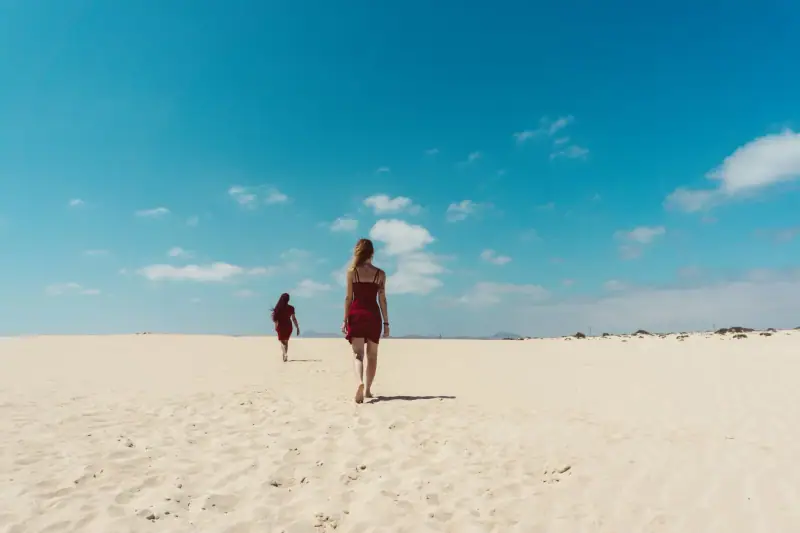
Corralejo’s main attraction is the Parque Natural de las Dunas, a natural park of nearly 2,600 hectares (about 6,400 acres) of white sand dunes stretching south of the town. These spectacular dunes, reminiscent of the Sahara, can be reached on foot from the resort and are among the most photographed sites in the Canary Islands.
What makes Corralejo an excellent choice:
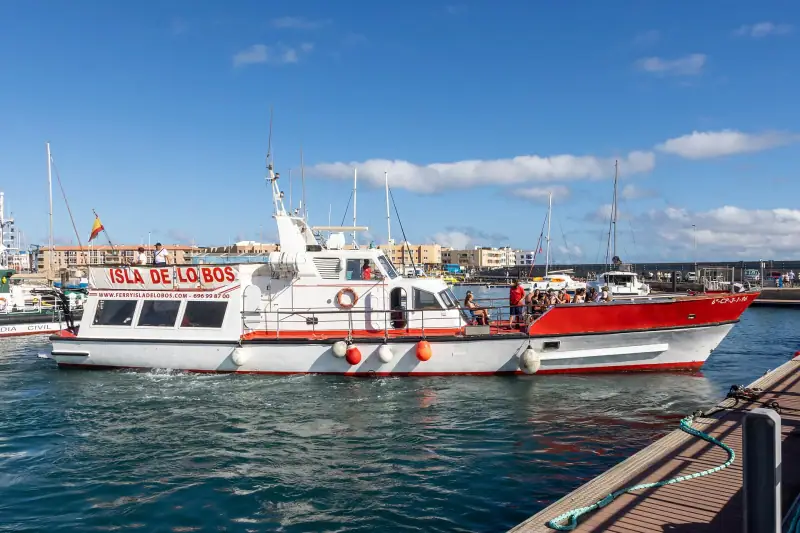
The town has an active port with ferries to Lanzarote (a crossing of about 25 to 35 min depending on the vessel, with Fred. Olsen Express or Naviera Armas; check schedules on the companies’ websites), which makes it an ideal base if you want to visit both islands. The port also hosts excursion boats to the islet of Lobos, a nearly pristine nature reserve a few minutes away by boat.
For water sports fans, the area between Corralejo and Jandía has some of the best windsurfing and kitesurfing spots in the world. Flag Beach, south of Corralejo, is a well-known spot where kite and windsurf competitions are sometimes held (check the calendar for the year).
Who it suits:
- Surfers and kitesurfers of all levels (many schools)
- Solo travelers and groups of friends
- Active couples who enjoy nightlife
- Travelers who want to combine Fuerteventura and Lanzarote
- Families with older children (teenagers)
Average price: €60-160 (~$70-185) a night for an apartment or hotel Atmosphere: International, laid-back, surf culture
For everything about this northern town, see our complete guide to Corralejo.
El Cotillo: the bohemian village for those in the know
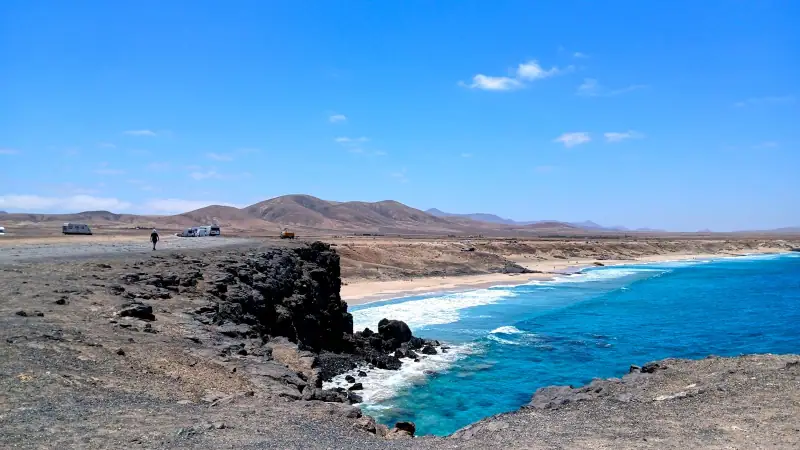
About 21 km (13 mi) west of Corralejo, El Cotillo is one of Fuerteventura’s best-kept secrets. This fishing village of about 1,300 residents has not yet given in to the big hotel chains and keeps an authentic, bohemian atmosphere that increasingly attracts travelers looking to escape the heavily touristed areas.
Lodging is mostly small vacation houses, private apartments and a few small boutique hotels. Prices are generally 20 to 30% lower than in Corralejo for equivalent quality.
Why choose El Cotillo:
El Cotillo’s beaches have a split personality. North of the village, a series of natural lagoons protected by reefs offer shallow, crystal-clear water, perfect for swimming with the family. To the south, Playa del Castillo and the wild beaches stretching toward Corralejo are exposed to Atlantic swell and make excellent surf and bodyboard spots.
The village has a few fresh fish restaurants (the local specialty) and bohemian cafés where the mood is total relaxation.
Ideal for: Couples seeking authenticity, intermediate to advanced surfers, budget travelers, families who enjoy quiet Average price: €45-100 (~$52-115) a night Drawback: Little nightlife, few shops, a car is essential
Caleta de Fuste: the ideal resort for families
Caleta de Fuste (also called El Castillo) is the tourist area closest to Fuerteventura International Airport, about 10 minutes to the south. It is the resort that has seen the most planned development on the island, with an artificial horseshoe-shaped marina, a well-kept promenade and many hotel complexes arranged around the bay.
Caleta de Fuste’s number one asset is its sheltered bay with calm, shallow water, a considerable advantage for families with young children who are wary of Atlantic currents. The sea is safe for swimmers of all ages.
Car rental in Fuerteventura
Essential for exploring the island at your own pace. Compare offers.
What Caleta de Fuste offers:
The resort has a well-stocked shopping center, supermarkets, varied restaurants and several water sports schools. Snorkeling outings are organized in the bay, and several dive clubs run trips to nearby underwater sites.
An 18-hole golf course (Fuerteventura Golf Club) adjoins the resort, reachable on foot or by car from most lodgings, a real plus for golfers.
Who it suits:
- Families with young children (sheltered sea)
- Golfers
- Travelers arriving late or leaving early (close to the airport)
- Seniors looking for comfort and convenience
- A first visit to Fuerteventura without a car (everything is walkable within the resort)
Average price: €70-180 (~$81-210) a night Atmosphere: Family-oriented, organized, maximum comfort
Costa Calma: the perfect balance
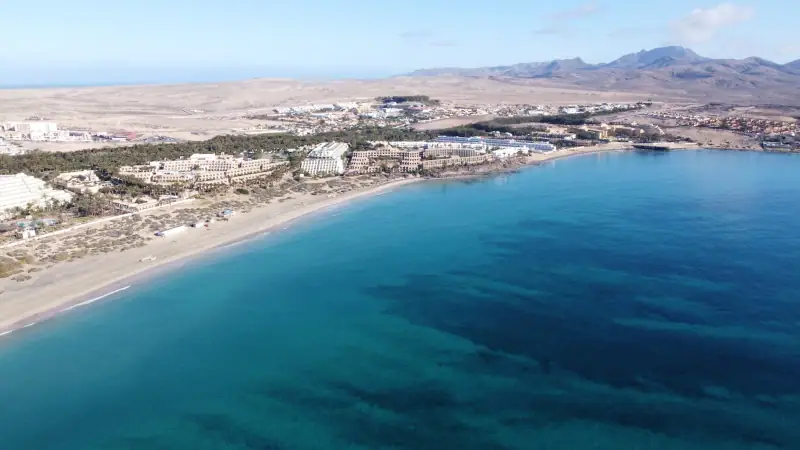
Costa Calma sits on the east coast of the Jandía peninsula, about 63 km (39 mi) south of the airport. It is a well-proportioned resort, neither too big nor too small, and offers one of the best balances in Fuerteventura between quiet, beautiful beaches and available services.
Playa de Sotavento, a few minutes south of Costa Calma, is regularly named among the most beautiful beaches in Europe. This vast stretch of white sand forms a shallow lagoon of an unreal turquoise at low tide, and the spot is known worldwide in the windsurf and kite community.
The atmosphere in Costa Calma:
Costa Calma is a resort built for tourism that has managed to keep a human scale. The main avenue concentrates shops, restaurants and bars without feeling overwhelming. The resort’s main beach is clean, well maintained and offers excellent swimming conditions.
Ideal for: Couples looking for quiet, families with independent kids, windsurfers and kitesurfers, photographers (extraordinary landscapes) Average price: €80-200 (~$93-230) a night
For the full context on this remarkable island, read our complete guide to Fuerteventura.
Activities in Fuerteventura
Kite, surf, Lobos excursion, snorkeling... book your activities.
Morro Jable and Jandía: the end of the world with every comfort
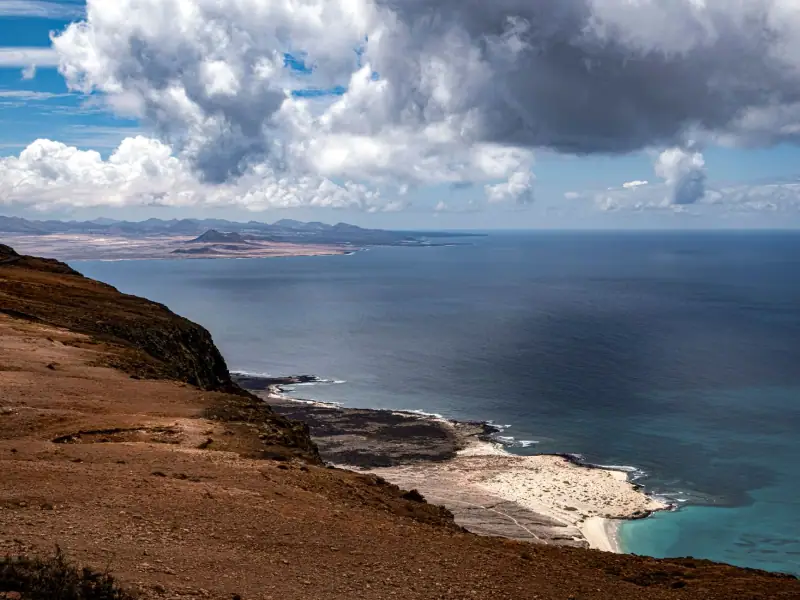
Morro Jable is the main town of the Jandía peninsula, at the far south of Fuerteventura. With its traditional fishing port on one side and its huge hotel complexes on the other, it perfectly embodies the island’s duality: Canarian authenticity and mass tourism in a limited space.
The Jandía peninsula is physically separated from the rest of Fuerteventura by an old military boundary (the Muro de Jandía), which still exists as a fence in some stretches. This geographic quirk gives the area an end-of-the-world feeling, heightened by the wildness of the landscapes at the western tip.
The beaches of Morro Jable and Jandía:
The area’s beaches (Playa de Morro Jable, Playa del Matorral and the wilder beaches toward Punta de Jandía) are among the finest sandy coasts in the Canary Islands. The sand is exceptionally white, and the sea is turquoise and generally calm on the east coast, rougher on the west.
What sets Morro Jable apart:
Unlike Caleta de Fuste or Costa Calma, Morro Jable has a real active port with ferries to Gran Canaria (Las Palmas, with Naviera Armas Trasmediterránea and Fred. Olsen Express; for the other islands, check with the companies). That is a considerable advantage for multi-island travelers.
The old part of Morro Jable, distinct from the Jandía hotel complexes farther north, keeps an authentic atmosphere with tapas bars frequented by locals, fish shops and a weekly market.
Who it suits: Families, couples, travelers who want the most beautiful beaches without worrying about nightlife, multi-island trips Average price: €70-220 (~$81-255) a night (wide range from budget apartments to big resorts) Drawback: Far from the rest of the island, so you need to plan your excursions
Recommendations by budget
Budget (under €50 / ~$58 a night)
The best value is in Corralejo apartments set slightly back from the waterfront, or in private lodgings in El Cotillo. Puerto del Rosario, the island’s administrative capital, also has budget guesthouses, but its appeal for visitors is limited.
Practical tips:
- Favor apartments with a kitchenette to cut dining costs
- Low season (May, June, October, November) offers much lower prices without sacrificing the weather
- Avoid Christmas week, Easter and the months of July and August for the best rates
Mid-range (€70-150 / ~$81-175 a night)
This is the most competitive category in Fuerteventura. The 3- and 4-star aparthotels in Corralejo, Caleta de Fuste and Costa Calma often offer excellent amenities (apartments with a terrace, a pool, a 24-hour front desk) at reasonable prices. Book ahead for the high-season months.
Recommended areas:
- Corralejo for nightlife and activities
- Caleta de Fuste for family comfort
- Costa Calma for exceptional beaches
Luxury (€150 / ~$175 and up)
Fuerteventura’s high-end offering is concentrated on the Jandía peninsula, with several large international-chain hotels offering big rooms, spas, infinity pools and fine-dining restaurants. A few charming boutique hotels are also developing in Corralejo and El Cotillo for a more intimate version of luxury.
Choosing by profile
Families with young children: Caleta de Fuste first: sheltered sea, amenities within walking distance, close to the airport. Morro Jable is also good for its big supervised beaches.
Couples: Costa Calma for the stunning Sotavento setting, or El Cotillo for the bohemian mood and sunsets over the lagoons.
Surfers and kitesurfers: Corralejo without hesitation for beginners and intermediates, the Jandía peninsula (west coast) for experts.
Active multi-island travelers: Corralejo, with an eye on the ferries to Lanzarote and the Lobos excursion.
Wild beach lovers: Morro Jable / Jandía or El Cotillo on the west side, the least crowded and most photogenic spots.
First visit: Corralejo or Costa Calma. Both give a good introduction to Fuerteventura’s diversity with reliable services.
To plan your stay in detail, see our 5-day Fuerteventura itinerary and discover all the island’s highlights.
When to book your Fuerteventura accommodation
Fuerteventura enjoys one of the most stable microclimates in the Canary Islands, with pleasant temperatures all year. It has no real bad season; even in midwinter, the thermometer hovers around 20-22 °C (68-72 °F) during the day. Prices and crowds, however, vary considerably.
High season (December-January and July-August): Prices can double or triple. Book 4 to 6 months ahead for the best options, especially in the Corralejo and Jandía areas, which attract an international crowd.
Low season (May, June, October): An ideal time to combine good weather, smaller crowds and attractive rates. The winds are favorable for kitesurfing, the beaches are less crowded, and lodgings often offer prices up to 40% below high season.
Spring and fall: March-April and November are pleasant transition periods with mid-range prices. Watch out for the Easter holidays (high prices, early booking recommended).
Practical tip: European tour operators (notably British, German and Scandinavian) block large allotments in the hotel complexes of Jandía and Caleta de Fuste. If you prefer small independent apartments or boutique hotels, book directly with owners or on the usual platforms; you will have more flexibility and often better cancellation terms.
Frequently asked questions
What is the best area to stay in Fuerteventura?
Corralejo is ideal for active travelers and surfers, with a lively atmosphere and direct access to the big dunes. Morro Jable and Jandía suit families and anyone who wants huge beaches. Costa Calma offers the best balance of calm and activity for couples.
Where should families stay in Fuerteventura?
Caleta de Fuste is the best resort for families with young children thanks to its sheltered bay with calm water. Costa Calma and Morro Jable also have large hotel complexes with pools and kids' activities.
Is accommodation expensive in Fuerteventura?
Fuerteventura has lodging for every budget. Self-catering apartments are very common and good value. Expect €50-90 (~$58-105) a night for a decent apartment in shoulder season, €30-50 (~$35-58) for budget lodging, and €150 (~$175) or more for luxury hotels from the big chains.
Do you need a rental car in Fuerteventura?
Yes, a rental car is strongly recommended. The island is long (about 100 km / 62 mi from north to south) and public transport is limited for linking the tourist areas and exploring the interior. Rentals are generally inexpensive on this island.
Which area is closest to Fuerteventura airport?
Fuerteventura International Airport is about 5 km (3 mi) from Puerto del Rosario, the capital. Caleta de Fuste is the closest resort, about 10 minutes south by car. Corralejo is about 40 minutes north and Morro Jable about 1 hour south.
Where can you surf in Fuerteventura, and where should you stay near the spots?
The best surf spots are concentrated in the north (Corralejo, El Cotillo, Flag Beach) and on the Jandía peninsula (Punta de Jandía). Corralejo is the best base for beginner and intermediate surfers, with many surf schools and an established surf culture.
More Canary Islands guides
Keep reading
Where to Stay in Lanzarote: Best Neighborhoods and Resort Areas
Choose where to stay in Lanzarote: Puerto del Carmen, Costa Teguise, Playa Blanca... Every area and budget, with typical nightly prices.
Where to Stay in La Palma: Best Places and Areas
Choose where to stay in La Palma: Santa Cruz, Los Llanos, Puerto Naos, Fuencaliente... Every area and budget, with prices.
La Gomera: a complete guide to the island of forests and whistled language
La Gomera travel guide: Garajonay, El Silbo, Valle Gran Rey, hiking and food. Everything you need to visit the quietest of the Canary Islands.
Ready-made
Canary Islands itineraries
5 days
Lanzarote in 5 Days: A Complete Itinerary for the Volcanic Island
5-day Lanzarote itinerary: Timanfaya, Jameos del Agua, Playa Papagayo, César Manrique. A day-by-day plan to make the most of the volcanic island.
Can be adapted in the planner
Island Hopping in the Canary Islands: Visiting Several Islands in One Trip
Island hopping in the Canary Islands: ferries, flights, multi-island itineraries and tips to combine Tenerife, Gran Canaria, Lanzarote and Fuerteventura.
5 days
Tenerife in 5 Days Without a Car: A Realistic Bus and Tram Itinerary
Puerto de la CruzLos Cristianos