Itineraries
Brittany road trip in 7 days: from Saint-Malo to the Gulf of Morbihan
We may earn a commission when you book through links on this page, at no extra cost to you. We don't visit or try the places we cover: we summarize published sources. How we work
Day by day
- Day 1Saint-Malo: ramparts, old town, beaches
- Day 2Drive to Perros-Guirec, Ploumanac'h, coastal path, Sept-Îles trip
- Day 3Drive to Brest, then the Crozon peninsula
- Day 4Pen-Hir and Cap de la Chèvre, then Quimper
- Day 5Quimper morning, Concarneau walled town
- Day 6Carnac alignments and the Quiberon peninsula
- Day 7Vannes old town and the Gulf of Morbihan
Weather through the year on this route
| Jan | Feb | Mar | Apr | May | Jun | Jul | Aug | Sep | Oct | Nov | Dec | |
|---|---|---|---|---|---|---|---|---|---|---|---|---|
| High °F (°C) | 489 | 4910 | 5211 | 5513 | 5915 | 6418 | 6720 | 6820 | 6519 | 6016 | 5513 | 5010 |
| Low °F (°C) | 426 | 426 | 436 | 468 | 5010 | 5513 | 5815 | 5915 | 5614 | 5312 | 489 | 447 |
Normals 1991–2020 at Saint-Malo and Perros-Guirec: averages over 30 years, not a forecast. Source: NASA POWER (MERRA-2), grid of about 50 km. Figures computed by us in November 2026. Rain is shown only where a weather station confirms the figures.
In short
- Seven days run from Saint-Malo to the Pink Granite Coast, Brest and the Crozon peninsula, Quimper, Concarneau, Carnac and Vannes, about 700 to 800 km (435 to 497 mi).
- Driving days stay short: the longest legs take about two hours, often more on coastal roads than on expressways.
- The circuit works from May to September; June and September balance mild weather and moderate crowds. In July and August, book early and leave early.
- Check tide times: they decide access to some islets, beaches and boat trips.
Brittany is best discovered by car. Its finest landscapes lie at the end of small roads: a windswept headland, a chaos of pink rocks, a fishing port hidden at the end of a ria, a row of standing stones in the middle of fields. This seven-day road trip follows the north and west coast before heading south, from Finistère to the Gulf of Morbihan.
The route is deliberately reasonable: one main stop a day, short drives, time to walk and have lunch. You will find the day-by-day plan, distance markers, ideas for adapting the program, a budget and practical tips. If you have only a few days, the 3-day itinerary between Saint-Malo, Cancale and Dinan can serve as a first leg or a short version.
Overview of the circuit
Here is the logic of the route over seven days:
- Day 1: Saint-Malo. Ramparts, beaches, the atmosphere of a corsair city.
- Day 2: Pink Granite Coast. Perros-Guirec, Ploumanac’h and the coastal path.
- Day 3: Brest and the Crozon peninsula. Drive west and arrive on the peninsula.
- Day 4: Crozon, Camaret and Quimper. Cliffs, wild headlands, then on to Cornouaille.
- Day 5: Quimper and Concarneau. Town of art and history, walled town, fishing ports.
- Day 6: Carnac and the Quiberon peninsula. Megalithic alignments and wild coast.
- Day 7: Vannes and the Gulf of Morbihan. Old town, harbor and walks along the gulf.
The total distance is around 700 to 800 km (435 to 497 mi), depending on detours. Driving days stay short: the longest legs take about two hours, often a little more if you take coastal roads rather than expressways. Do not underestimate this: in Brittany, 100 km (62 mi) on a coastal road takes longer than on an expressway.
When to go
The circuit works from May to September. June and September are the best compromises: long days, calmer sea, moderate crowds. To fine-tune your dates, see the guide on when to go to Brittany. In July and August, leave early in the morning to find parking and book your stops several weeks ahead.
Getting there and renting a car
Saint-Malo is served by the TGV from Paris, a trip of about two and a half to three hours. Rennes is the other classic gateway for picking up a car. To compare transport options once you are there, see the article on getting around Brittany.
Where to stay in Saint-Malo
For the first night of the circuit: hotels, guesthouses and apartments near the ramparts. Compare offers, especially in summer.
Day 1: Saint-Malo, the corsair city
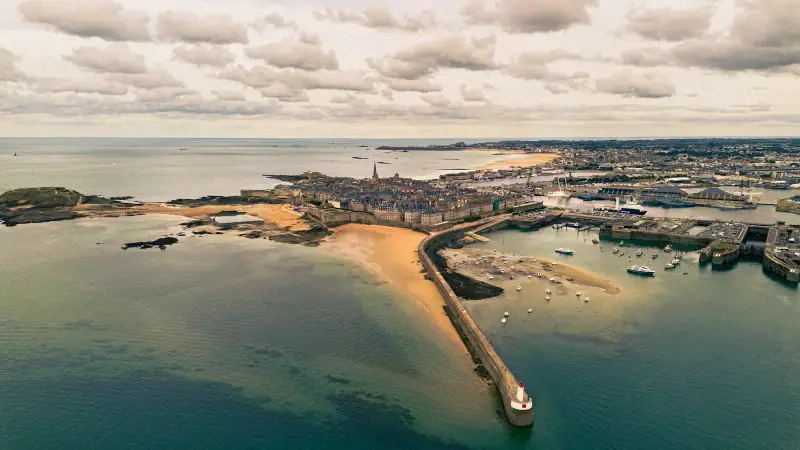
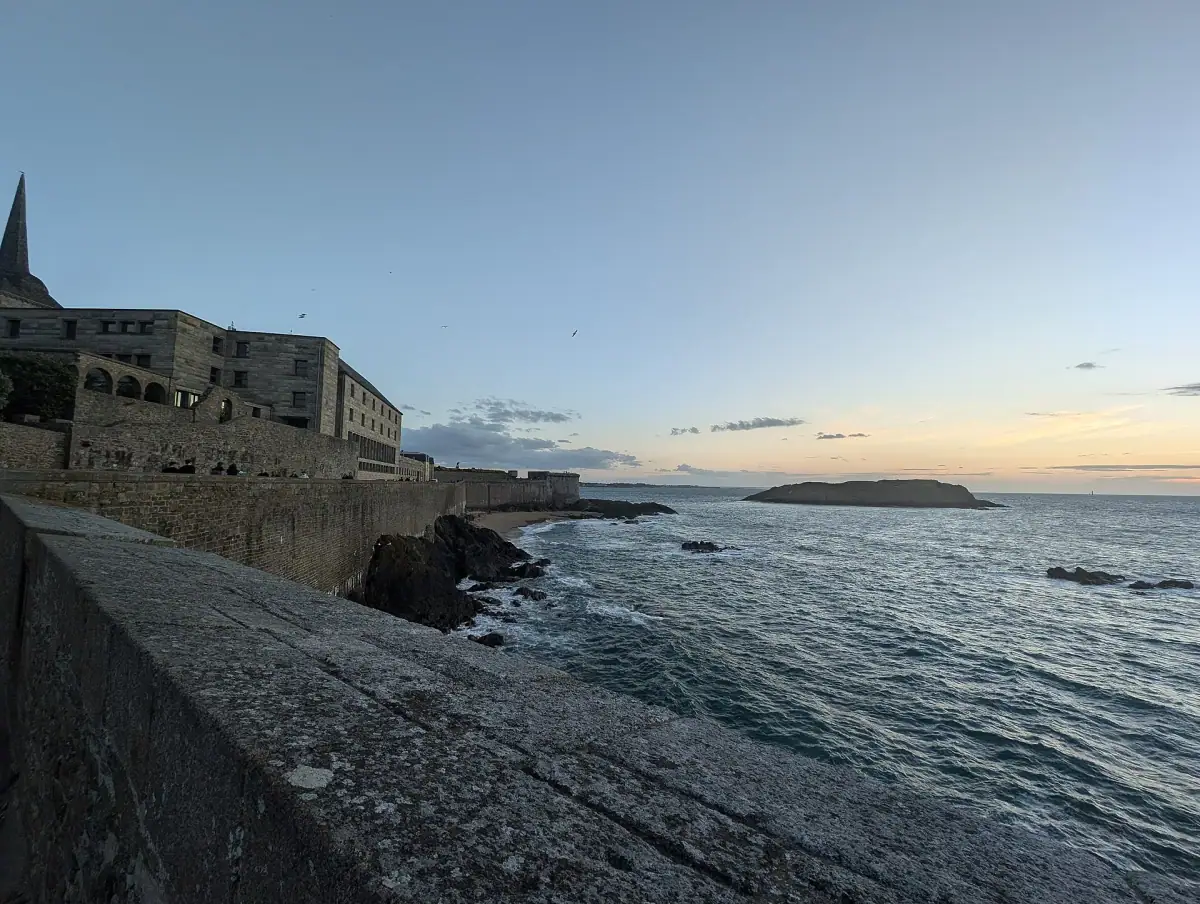
Saint-Malo is the ideal starting point: well connected, easy to visit on foot, and immediately a change of scene. The walled old town was largely rebuilt after the Second World War in a style faithful to the original, with its tall granite façades and narrow lanes.
Morning: the ramparts and the old town
Start with the rampart walk, a stroll of about an hour with views of the sea, the islets and the beaches. At low tide, some islets, such as the Grand Bé, can be reached on foot: always check the tide times before setting out and follow the safety instructions, because the sea comes back fast. Then get lost in the lanes inside the walls, among shops, galleries and old houses.
Afternoon: beaches, harbor and sunset
After lunch, go down to the beaches at the foot of the ramparts, or extend the walk to the neighboring Saint-Servan district. For dinner, a crêperie is the obvious choice: the guide to crêpes and galettes in Brittany helps you recognize a good address. End the day on the ramparts at dusk, when the granite turns golden.
Day 2: the Pink Granite Coast
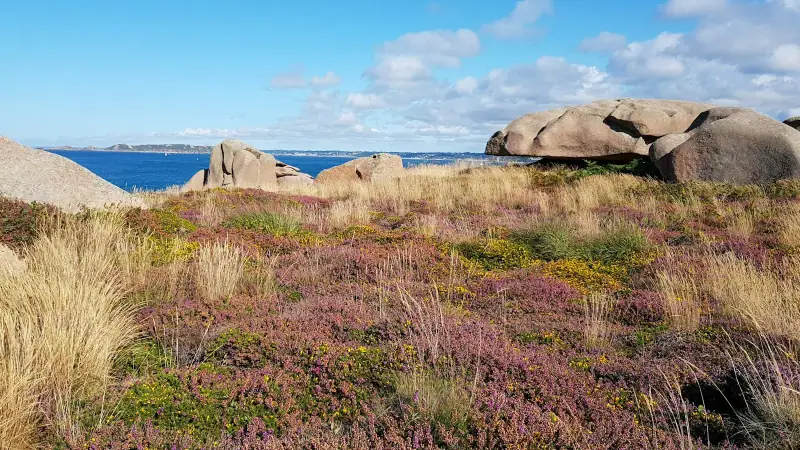
The road between Saint-Malo and Perros-Guirec is about 150 km (93 mi), a little over two hours. It passes the Emerald Coast and then the Bay of Saint-Brieuc: you can break the drive with a stop in Dinan, a medieval town perched above the Rance, or at Cap Fréhel, famous for its cliffs and lighthouse.
Perros-Guirec and Ploumanac’h
Perros-Guirec is the main resort of the Pink Granite Coast, a shoreline known for its pinkish granite blocks, sculpted by erosion into astonishing shapes. The hamlet of Ploumanac’h, part of the same municipality, has the finest scenery: rocks, a small lighthouse, coves and a coastal path. Sunset over the rocks is one of the high points of the circuit.
The customs officers’ path
The coastal path at Perros-Guirec lets you walk among the rocks without major difficulty. A loop of one to two hours is enough to enjoy the landscape. To go further, see the guide to the GR34, the customs officers’ path, which explains how to build stages to suit you. Bring good shoes: wet granite is slippery.
A trip to the islands
From Perros-Guirec, boat trips let you discover the Sept-Îles archipelago, a bird reserve where seabirds can be seen. Departures depend on the tide and the weather: ask locally or book ahead in high season. To compare trips, see also the article on the Breton islands.
Excursions and boat trips
Boat rides, guided visits and activities on the coast: compare offers and book ahead in high season.
Day 3: Brest and the Crozon peninsula
The third day is the longest by car. Between Perros-Guirec and Brest, allow about 110 km (68 mi), nearly two hours depending on traffic. Brest, a major port on its roadstead, was almost entirely destroyed during the war and then rebuilt: its interest lies mostly in its port, its castle and its maritime atmosphere. A stop of an hour or two is enough for lunch and a walk along the roadstead.
On to the peninsula
From Brest, the Crozon peninsula is about an hour’s drive. It packs very varied landscapes into a small area: cliffs, sandy beaches, rocky headlands, moors and small ports. It is one of the most spectacular places in Finistère, and one of the most pleasant for walking.
Evening in Crozon or Camaret
Settle in for the night at Crozon, Morgat or Camaret-sur-Mer, as you prefer. Camaret is a picturesque fishing port facing the Iroise Sea; Morgat has a large beach and the feel of a small seaside resort. For dinner, favor seafood: the guide to seafood and oysters in Brittany gives pointers for choosing well.
Day 4: Crozon’s wild headlands, then Quimper
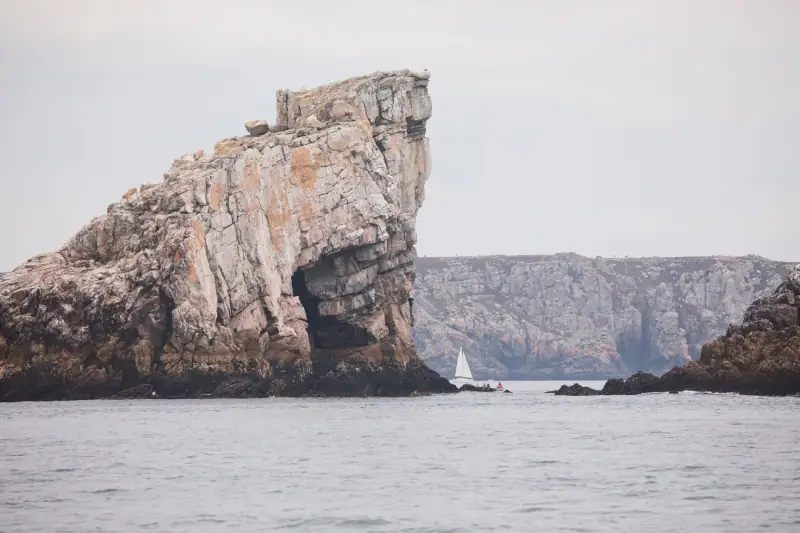
Spend the morning on the peninsula’s headlands. Among the most famous are Pointe de Pen-Hir, with its cliffs and views over the Iroise Sea, and Cap de la Chèvre, farther south, with a view of Douarnenez Bay. These sites are visited on foot from car parks, with easy paths and spectacular panoramas. The wind can be strong: a windbreaker is essential, even in summer.
From Crozon to Quimper
After lunch, take the road to Quimper, about an hour from the peninsula, via Châteaulin or Douarnenez. Quimper is the administrative seat (prefecture) of Finistère and the heart of Cornouaille: a town of art and history, built at the confluence of the Odet and the Steir, with a well-preserved old town.
A first stroll through Quimper
Late in the day, walk around the center: Saint-Corentin Cathedral, medieval lanes, half-timbered houses, the banks of the Odet. The town is famous for its faience, a local craft that is easy to discover in the shops of the center. Have dinner in one of the many crêperies of the old town.
Where to stay in Quimper
A practical base for visiting Cornouaille: city-center hotels, guesthouses and apartments to compare.
Day 5: Quimper and Concarneau
Keep the morning for Quimper: visit the cathedral, stroll along the Odet, and browse the market or shops depending on the day. Then head for Concarneau, about 30 km (19 mi) away, half an hour by road.
Concarneau’s walled town
Concarneau is a major fishing port, and its walled town, surrounded by ramparts and built on an islet, is one of the most photographed sights in Cornouaille. You reach it by a bridge and visit it on foot: lanes, shops, ramparts and views of the harbor. Allow one to two hours, then explore the fishing port and the quays opposite.
End of the day on the coast
If you have time, follow the coast east between Concarneau and Pont-Aven to discover small ports and quiet beaches. The area inspired many painters, and its landscapes of rias and little harbors suit a slow drive. For the next stops, the guide on where to stay in Brittany helps you choose an area according to your travel style.
Day 6: Carnac and the Quiberon peninsula
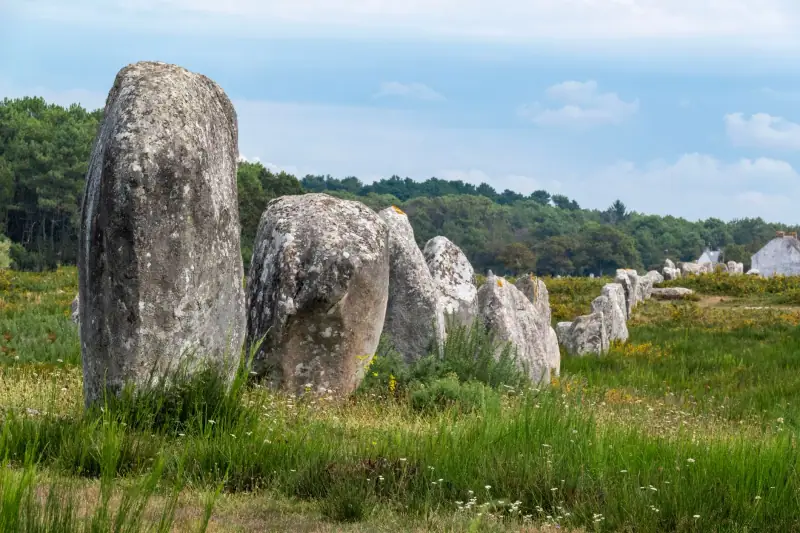
Head for Morbihan. Between Concarneau and Carnac, allow about 100 km (62 mi), an hour and a half by road depending on traffic. Carnac is known worldwide for its alignments of standing stones, among the most important megalithic sites in Europe, several thousand years old.
The alignments
The alignments spread over several sites around the town. Depending on the period, access to the fields of menhirs is regulated to protect the site: find out the visiting conditions and hours before you go. A visit of one to two hours is enough to grasp the scale of the site. The Maison des mégalithes, beside the alignments, offers useful explanations.
Quiberon’s wild coast
In the afternoon, continue to the Quiberon peninsula, a narrow strip of land pushing into the Atlantic. On one side, the wild coast, battered by waves; on the other, more sheltered beaches. The scenery is spectacular, but swimming is sometimes dangerous on the ocean side: find out about conditions before entering the water. If you have more time, Belle-Île can be reached by boat from Quiberon.
Day 7: Vannes and the Gulf of Morbihan
To finish, go on to Vannes, about 35 km (22 mi) from Carnac. The town is ideal for closing the circuit: a well-preserved medieval center, ramparts, gardens, a marina at the foot of the old town and direct access to the Gulf of Morbihan, a small inland sea dotted with islands.
Vannes’ center
Stroll the lanes lined with half-timbered houses around Saint-Pierre Cathedral. The ramparts and their gardens make a pleasant walk. For full details on the town, read the guide to visiting Vannes.
A trip on the gulf
Depending on the time you have, you can extend the day with a boat ride on the Gulf of Morbihan, whose islands and small ports give another perspective on the region. Trips depend on the season, the tides and the weather.
Heading home
Vannes has a station linked to Rennes and Paris, so you can end the circuit by train if you return your car there. By car, the road to Rennes or Saint-Malo takes several hours: allow a margin if you have a train or a flight to catch.
Last night in Vannes
A medieval center and a harbor within a short walk: compare places to stay to end the trip gently.
Budget: what to expect
The main items are fuel, accommodation, meals and activities. The points that make the bill vary most:
- Season: July and August are noticeably more expensive than May, June or September.
- Accommodation: a campsite, gîte or guesthouse generally costs less than a city-center hotel.
- Meals: a galette-saucisse or a crêpe at lunch stays cheap; a seafood platter weighs more on the budget.
- Parking: allow a few euros a day in tourist towns.
Prices change every year: check rates on the websites of accommodation and sights when you book.
Tips for a successful road trip
- Book accommodation in advance, especially in summer and on long weekends.
- Leave early in the morning: roads are quieter and parking is easier near the sights.
- Check tide times: they determine access to some islets, beaches and boat trips.
- Have a rainy-day plan B: museums, towns of art, harbors and crêperies.
- Pack layers: windbreaker, fleece and walking shoes, even in summer.
- Respect natural sites: stay on the paths, protect the dunes and do not climb on the megaliths.
- Do not overload the days: better one sight visited calmly than three seen on the run.
Adapting the itinerary
- With kids: favor beaches, harbors and short walks; swap the long walk on the Crozon headlands for a shorter stroll.
- As a couple: add a night in Perros-Guirec or Camaret, and keep time for sunsets.
- For walkers: lengthen the stages on the GR34, starting from the coastal sights along the route.
- With more time: add Belle-Île from Quiberon, or Bréhat from the north coast.
- With less time: concentrate on the north coast and the Crozon peninsula, or on Morbihan alone.
In short
This seven-day road trip is a concentrate of Brittany: ramparts, pink granite, the cliffs of Crozon, towns of art, megaliths and the Gulf of Morbihan. It asks for few kilometers each day and plenty of time to walk, taste and look. Choose the right season, book ahead, watch the tides and leave room for the unexpected.
Frequently asked questions
How many days do you need for a road trip in Brittany?
A week is a good minimum to link the north and south of the coast without rushing. With five days, you have to give up one stop (the Crozon peninsula or the Gulf of Morbihan, for example). With ten days, you can add an island such as Belle-Île or Bréhat and slow the pace.
What is the total distance of the circuit?
Allow about 700 to 800 km (435 to 497 mi) in total, detours included, with generally short driving days. No day exceeds about 150 km (93 mi) on main roads, which leaves time for visits. Coastal roads are slower than expressways.
What is the best time of year for this road trip?
May to September for the weather and long days. June and September are a good compromise between mild weather and crowds. In July and August, book accommodation very early and allow time for parking at the most visited sights.
Can you do this circuit without a car?
Partly. The big towns (Saint-Malo, Quimper, Vannes) are linked by train, but the Crozon peninsula, the Pink Granite Coast and the Carnac alignments are much easier with a car. The guide to getting around Brittany covers the alternatives.
Where should you sleep on a Brittany road trip?
The simplest approach is to pick fixed stops of one or two nights in well-placed towns: Saint-Malo, Perros-Guirec, Crozon or Camaret, Quimper and Vannes. Hotels, guesthouses and campsites should be booked ahead in summer.
Should you plan for rain?
Yes, in every season. Breton weather changes fast and showers alternate with clear spells. Pack a windbreaker and plan fallback activities: museums, harbors, crêperies, town visits. A gray day often makes for beautiful scenery.
How much does a one-week road trip in Brittany cost?
The budget depends mostly on accommodation and season. For two people, budget for fuel, nights in hotels or guesthouses, meals at crêperies or simple restaurants and a few admissions. Campsites and gîtes cut the bill noticeably; high season raises it.
More Brittany guides
Keep reading
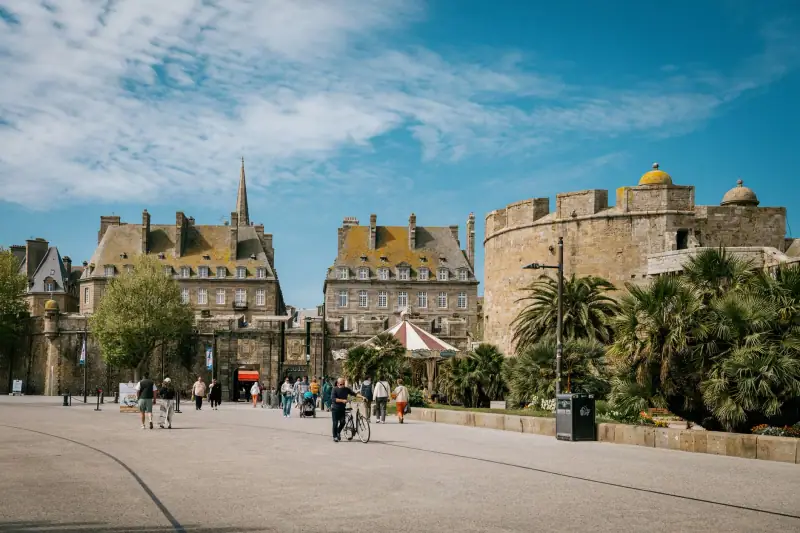
Where to stay in Saint-Malo: neighborhoods and types of accommodation
Where to stay in Saint-Malo? Intra-muros, Sillon, Paramé, Saint-Servan, Rothéneuf: compare areas and types of lodging for your budget and stay.
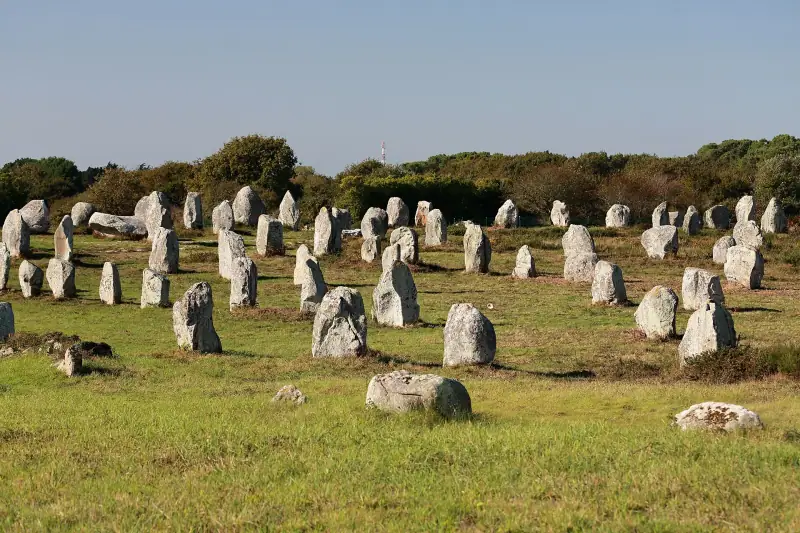
Carnac alignments: can you walk among the standing stones, and at what price?
Carnac alignments: free access October to March, €13 guided visit the rest of the year, rules, parking and dogs. What to know before you go.
What to see in Morbihan: 12 highlights between gulf, megaliths and islands
What to see in Morbihan? The gulf, Carnac's alignments, Belle-Île, Quiberon, Josselin, Rochefort-en-Terre: the highlights and a plan to link them.
Ready-made
Brittany itineraries
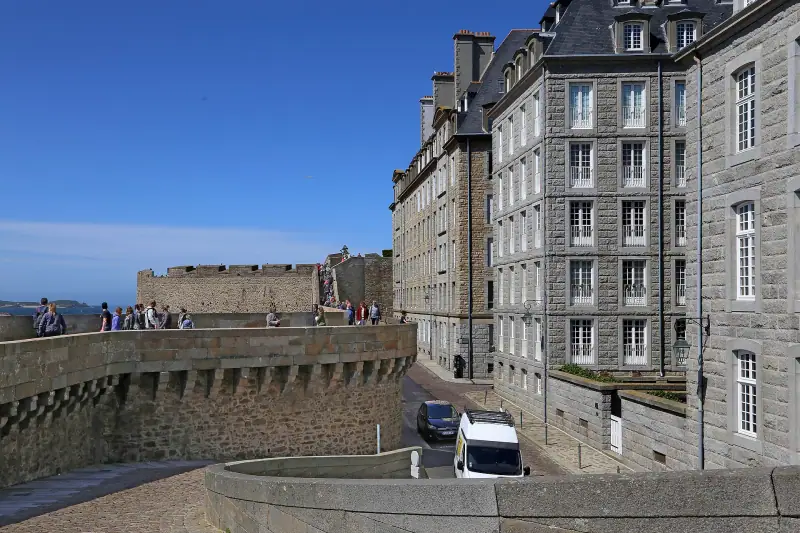
3 days
3 days in Saint-Malo, Cancale and Dinan: an Emerald Coast itinerary
A 3-day itinerary in northern Brittany: Saint-Malo's ramparts, Cancale's oysters, Dinan's medieval lanes. Daily plan, tides, transport and budget.
7 days
One week in Brittany without a car: a day-by-day itinerary by train and bus
RennesSaint-MaloQuimperVannes