What to see
What to see in the Chaîne des Puys: volcanoes, viewpoints and sights
We may earn a commission when you book through links on this page, at no extra cost to you. We don't visit or try the places we cover: we summarize published sources. How we work
In short
- The Puy de Dôme (1,465 m / 4,806 ft) is the essential stop, with a 360-degree view; climb in 1 to 1.5 hours or take the cog railway.
- One day covers the Puy de Dôme and a second volcano; two days is the ideal pace and adds Lemptégy, Vulcania or Lake Aydat.
- A car is the most practical way to link several sites; the Chaîne des Puys has been on the UNESCO World Heritage list since 2018.
- Best months are May-June and September-October. It is cooler and windier at the summit, even in summer.
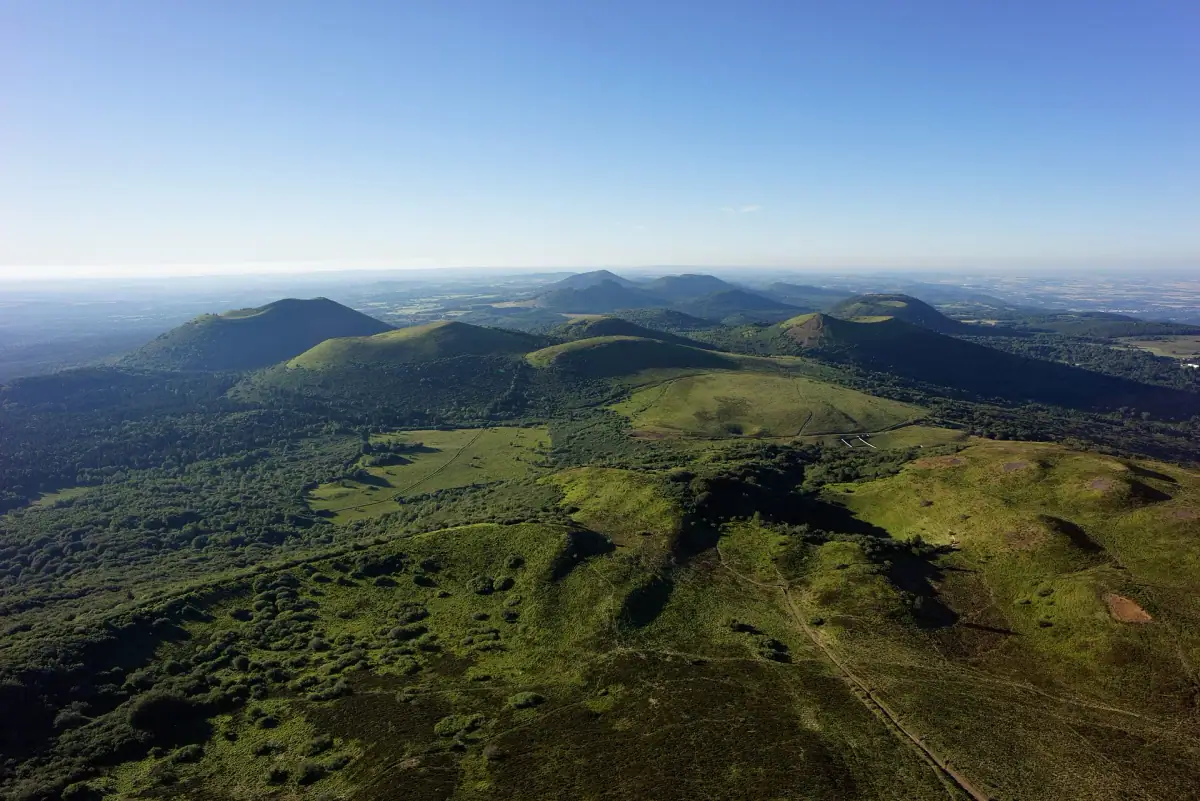
When you arrive in Clermont-Ferrand, you see them right away: a line of grassy cones lined up west of the city, dominated by the stocky silhouette of the Puy de Dôme. These are the puys, the volcanoes of the Chaîne des Puys, dormant for several thousand years but still perfectly readable in the landscape. Intact craters, frozen lava flows, quarries that reveal the inside of volcanoes: nowhere else in France do you understand so well how a mountain is born.
This guide answers a simple question: what to see in the Chaîne des Puys, and in what order? You will find the major sights, easy walks and more athletic ones, ideas for children, tips on season and transport, and a suggested plan for one to three days. This guide does not name specific restaurants or hotels: hours, rates and addresses change, and it is better to check them with the tourist office at the time of your trip.
The Chaîne des Puys at a glance
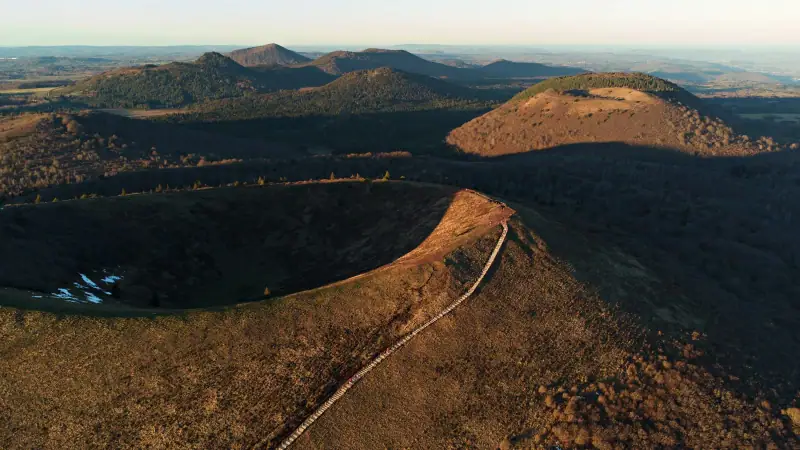
The Chaîne des Puys stretches north to south over several dozen kilometers, west of Clermont-Ferrand, within the Volcans d’Auvergne Regional Nature Park. It gathers about eighty small volcanoes, lined up along a great fracture in the earth’s crust: the Limagne fault. It is this alignment, visible from the plain as from the summits, that gives it its unique character.
These volcanoes are recent on a geological scale, and that is what makes them so readable. The youngest are only a few thousand years old: erosion has not had time to round their craters. You will find cones of reddish scoria, domes of viscous lava like the Puy de Dôme, explosion craters and flows that dammed valleys to form lakes. The whole has been on the UNESCO World Heritage list since 2018, together with the Limagne fault.
| Need | Short answer |
|---|---|
| Ideal length | 2 days (1 day minimum) |
| Base | Clermont-Ferrand, Volvic or Riom |
| Getting around | Car recommended |
| Highlights | Puy de Dôme, Puy de Pariou, Lemptégy, Vulcania, Lake Aydat |
| Best time | May-June and September-October |
| Watch out for | Wind and cool air at the summit, even in summer |
To place the chain among the other major areas of the region, see our complete guide to Auvergne.
The Puy de Dôme, the essential stop

The Puy de Dôme is the most famous summit of the chain, and it deserves it. It peaks at about 1,465 m (4,806 ft) and rises several hundred meters above its neighbors, which gives a 360-degree panorama: you see the line of puys to the north and south, the Limagne plain to the east, and on a clear day the Forez mountains on the horizon. It is the best place to understand the geography of the chain before going to explore its details.
There are two ways up. On foot, by the historic trail sometimes called the Chemin des Muletiers, allow one to one and a half hours of climbing for an average walker: the path is wide and well marked, but the slope is steady and without shade. By cog railway, you leave from the foot of the volcano and reach the summit in a few minutes, with a view that unfolds as you climb. In high season, book ahead and check the operating days, which vary from year to year.
At the top, you also find the remains of a Gallo-Roman temple dedicated to Mercury, a reminder that this volcano was already a sacred place almost two thousand years ago. The site is also known to paraglider and hang-glider pilots, who take advantage of its steady winds: the sight of sails in the sky is part of the scenery on fine days. To learn more about air activities and the train, read our article on activities in Auvergne other than hiking.
A few practical tips for a successful climb:
- Arrive early in the morning or late in the day to avoid the crowd and enjoy softer light.
- Always bring a warm layer and a windbreaker: it is much cooler and windier than on the plain.
- The summit can be in cloud even when Clermont-Ferrand is sunny: check the webcam or the day’s weather before leaving.
- Bring water, especially if you climb on foot in summer.
Stay near the volcanoes
Compare hotels, bed and breakfasts and apartments in Clermont-Ferrand, at the foot of the chain.
The Puy de Pariou, the perfect crater
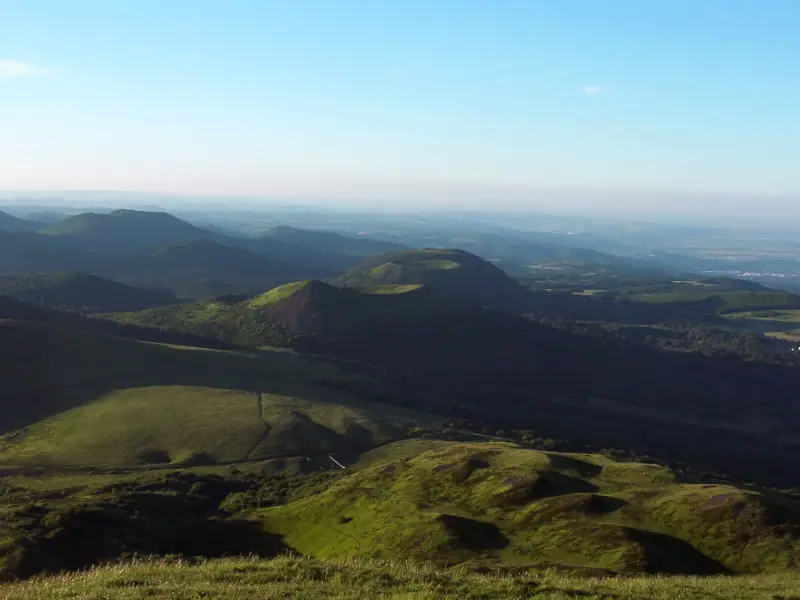
Just north of the Puy de Dôme, only a few kilometers away, the Puy de Pariou is one of the most photogenic volcanoes of the chain. It is made of several nested craters, the largest of which, with an almost perfect profile, is a cone of reddish scoria. Seen from the sky or from the neighboring heights, its concentric shape is impressive.
The walk is accessible to most walkers: the climb to the crater rim is short, and you can go around the ridge, then descend into the crater if the weather allows. Allow about two hours for the full loop, taking time for photos. Grassy slopes are slippery after rain: good shoes are better than city sneakers.
From up there, the view extends over the neighboring puys, notably the small Puy du Nid de la Poule, attached to the Pariou. It is a chance to grasp concretely what an “alignment of volcanoes” means: you see the cones follow one another along the fault, like pearls on a string. For other outing ideas, our guide to hiking in Auvergne details routes in the chain and in the Sancy.
Lassolas, Côme and the easy walks
If you are looking for less athletic walks, several puys are easy to reach. The Puy de Lassolas, in the Saint-Genès-Champanelle area, is a crater volcano whose lava flow joined that of the neighboring Puy de la Vache: together, they dammed a valley and formed Lake Aydat. The walk lets you tread on cooled lava ground, covered in forest and moss, with a real feeling of diving into a raw world.
The Puy de Côme and the Puy des Goules, in the south of the chain, form another landscape of twin craters. They are a little more demanding and less visited than the Puy de Dôme, which makes them good choices for walkers who want to get away from the crowd. Ask the tourist office about trail conditions and any access rules, as some areas are regulated to protect soil and vegetation.
A tip: always stay on marked paths. Scoria slopes are fragile and erode quickly under footsteps. The managers of the chain actively protect these sites, and reasonable visitor numbers are part of the deal for continuing to visit them.
Vulcania and Lemptégy: understanding volcanism
To understand how these volcanoes work, two neighboring sites complement each other well. Vulcania, in Saint-Ours-les-Roches, is a discovery park opened in 2002, devoted to volcanism and the Earth. It mixes partly buried buildings, exhibitions, eruption simulations and immersive shows. It is a very educational visit, particularly appreciated by families. Allow a full day, or a half day if you choose the main attractions.
Right next door, the Lemptégy volcano offers a radically different approach. A former pozzolan quarry, it was exploited until it was discovered that it let you see the inside of a volcano: chimney, flows, volcanic bombs, dikes. Today, you visit it on foot or by little train, on set routes, with guides who explain what you see. It is a rare experience: literally walking in the bowels of a volcano.
The two sites are close to each other. If you have only one day for both, start with Lemptégy in the morning (the most concrete) and Vulcania in the afternoon (the most playful), checking hours and opening periods, which vary by season. In case of rain, these two visits are also very good fallback plans. Find other ideas of this kind in our activities in Auvergne other than hiking.
Tours and activities around the volcanoes
Discovery parks, guided walks and nature outings around the Chaîne des Puys.
Volvic and Lake Aydat: water, stone and swimming
The chain is not just craters. To the north, the small town of Volvic is known for its gray lava stone, of which many monuments of the region are made, notably in Clermont-Ferrand, and for the mineral water that springs up after filtering through layers of lava and scoria. The Maison de la Pierre lets you discover the history of the extraction of this stone. Ask the tourist office about available visits, which vary by season.
To the southwest, Lake Aydat is a natural dammed lake, born when lava flows closed a valley. It is surrounded by meadows and forests, and is an ideal stop after a morning of walking: you can stroll, picnic and, in summer, enjoy the developed swimming areas. Children are at ease here, and the atmosphere is more peaceful than on the summits.
This stop complements the climb of a puy well: both belong to the same geological story, and you see how much lava has shaped the landscapes. If you feel like going farther south, the Sancy Massif and Lake Pavin are less than about an hour’s drive away: see our article on Le Mont-Dore for details.
Clermont-Ferrand and Riom: the lava towns
The towns near the chain also deserve a detour. Clermont-Ferrand, the “black city”, owes its color to the Volvic stone that makes up its Gothic cathedral and many buildings of the historic center. You can devote half a day to it at the end of your stay, with a walk in the lanes of the old town. Our article on visiting Clermont-Ferrand details the neighborhoods, museums and places not to miss.
Riom, to the north, is a historic town also built of Volvic stone, with an old center of well-kept mansions. It is a quiet stop, less visited than Clermont, useful for a lunch break between two sites.
Clermont-Ferrand is the best base for a stay in the chain: train station, shops, wide choice of lodging, and quick access to the puys in less than about half an hour’s drive. To choose your neighborhood, see our guide to where to stay in Clermont-Ferrand.
Planning your stay: 1, 2 or 3 days
With 1 day. Climb the Puy de Dôme early in the morning, on foot or by train, then come down for a second volcano: Pariou if you want to walk, or Lemptégy if you prefer a guided visit. Finish with a tour of the center of Clermont-Ferrand.
With 2 days. Devote the first day to the Puy de Dôme and the Puy de Pariou, the second to Lemptégy and Vulcania, with a break at Lake Aydat if the weather is fine. It is the ideal pace for a first discovery, without racing against the clock.
With 3 days. Add a longer hike on the southern puys (Côme, Goules), a visit to Volvic and a stop in Riom. You can also slip in a day toward the Sancy: our 3-day itinerary in Auvergne shows how to link the Chaîne des Puys, the Sancy and the Cantal.
In every case, stay flexible: the weather at altitude changes quickly, and it is better to postpone a climb than to go up in fog and see nothing.
How to get there and get around
Clermont-Ferrand is the natural gateway: the city has a train station, an airport and good road links. From the city, the main sites of the chain are about twenty minutes to half an hour away by road. The puys are scattered, however, and not all trailheads are served by public transport.
A car therefore remains the simplest way to link several sites in the same day. If you do not have one, concentrate on the Puy de Dôme, reachable with careful trip preparation, or on guided visits from Clermont-Ferrand. Our guide to getting around Auvergne compares car, train, bus and bike.
One detail to keep in mind: motorized access to the summit of the Puy de Dôme is regulated, and the rules change from year to year. Find out before you leave rather than counting on an open road.
When to go
The chain can be visited from spring to fall. May and June offer green meadows and clear light, with fewer people than in midsummer. July and August are the busiest months, with queues at the train and at the summit of the Puy de Dôme: come early. September and October are often excellent months, with fall colors on the slopes and often remarkable visibility.
Winter is possible, but wind, ice and snow can turn a simple walk into an expedition: check the weather and road access. To compare each season in detail, read our guide to choosing when to go to Auvergne.
Tips for a successful visit
- Start with the Puy de Dôme in clear weather: the overview gives meaning to everything else.
- Wear good walking shoes: scoria is slippery, especially after rain.
- Bring a windbreaker and water, whatever the season.
- Stay on marked trails and respect the site protection rules.
- Check hours and rates for Vulcania, Lemptégy and the train before you go.
- Have a plan B for fog: discovery visits, Clermont-Ferrand, Volvic.
- Book your lodging early for July and August.
The Chaîne des Puys is better discovered than summed up: a morning of light on the Puy de Dôme, an hour of walking on the edge of a red crater, a descent into the bowels of an old quarry. Give it two days, good shoes and a little weather flexibility, and you will leave with the feeling of having truly understood the landscape.
Frequently asked questions
What should you see first in the Chaîne des Puys?
The Puy de Dôme is the must-see, for its panorama over the whole chain. Add the Puy de Pariou with its perfectly drawn crater, a site to understand volcanism such as Vulcania or the Lemptégy volcano, then a walk by Lake Aydat. With two days, you cover the essentials without rushing.
How much time should you plan to visit the Chaîne des Puys?
One day is enough for the Puy de Dôme and a second volcano. Two days let you add a discovery site (Vulcania or Lemptégy) and a hike. Three days give time to walk several puys, visit Volvic and enjoy the lakes without hurrying.
Do you need a car to visit the Chaîne des Puys?
It is the most practical: the puys are scattered between Clermont-Ferrand and Riom, and public transport does not serve all trailheads. The Puy de Dôme remains reachable without a car if you prepare your trip. Check schedules and connections before leaving.
Can you go up the Puy de Dôme without walking?
Yes, a cog railway links the foot of the volcano to the summit. Book it in high season and check its operating days, as they vary from year to year. You can also climb on foot by a very popular trail, about one to one and a half hours for an average walker.
What is the best time to visit the Chaîne des Puys?
From spring to fall, with a preference for May-June and September-October: crisp light, fewer crowds than in midsummer. Winter is possible but snow and wind can complicate the summits. Always check the day's weather before climbing.
Is the Chaîne des Puys suitable for children?
Yes. The Puy de Dôme train, the volcanism parks, the little train at some visitor sites and the easy walks around the lakes suit younger children well. Save ridge hikes for children used to walking and watch them near craters.
Is the Chaîne des Puys a UNESCO site?
Yes, it has been on the World Heritage list since 2018, together with the Limagne fault, under the title "Chaîne des Puys - Limagne fault tectonic arena". It is the first natural site of mainland France to be listed.
More Auvergne guides
Keep reading
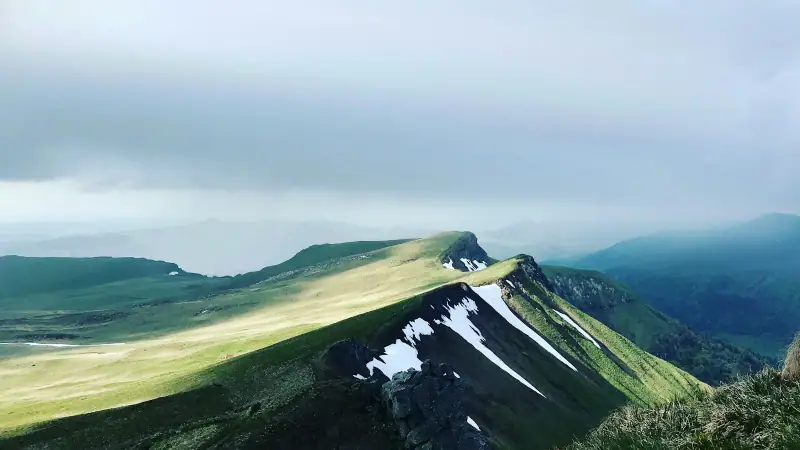
What to see in the Sancy Massif: summits, lakes and villages not to miss
What to see in the Sancy Massif: Puy de Sancy, Le Mont-Dore, Lake Pavin, Chambon, Murol, Saint-Nectaire, Besse and Orcival. Plan 2 to 4 days.
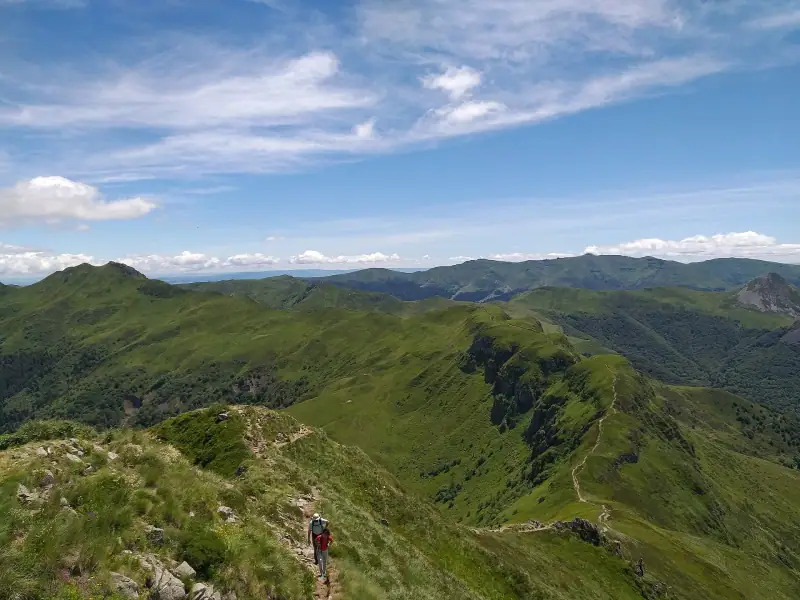
What to see in the Monts du Cantal: Puy Mary, Salers, Le Lioran and the valleys
What to see in the Monts du Cantal: Puy Mary, Plomb du Cantal, Salers, Murat, glacial valleys and summer pastures. Plan 2 to 4 days in the massif.
What to see in Livradois-Forez: Thiers, Ambert, La Chaise-Dieu and the high pastures
What to see in the Livradois-Forez nature park: Thiers knives, Ambert's fourme cheese, La Chaise-Dieu abbey, the Forez mountains. A guide for 2 to 4 days.
Ready-made
Auvergne itineraries
7 days
A week in Auvergne with kids: day-by-day itinerary
Clermont-FerrandLe Mont-DoreSalers
3 days
3 days in Auvergne: an itinerary of volcanoes, lakes and stone villages
Clermont-FerrandLe Mont-Dore or Besse-et-Saint-Anastaise
7 days
Auvergne road trip in 7 days: volcanoes, Cantal and Haute-Loire
A 7-day driving itinerary in Auvergne: Puy de Dôme, Sancy, Lake Pavin, Salers, Puy Mary, Le Puy-en-Velay. Stops, realistic drives and practical tips.