What to see
Visiting Khiva: a complete guide to the walled city of the Silk Road
We may earn a commission when you book through links on this page, at no extra cost to you. We don't visit or try the places we cover: we summarize published sources. How we work
In short
- Two days cover the essentials of Khiva, including all of Itchan Kala; three days allow a calmer exploration.
- The nearest airport is Urgench (UGC), 35 km (22 mi) away; Tashkent flights take 1 h 30-1 h 45, and Khiva has its own railway station.
- A combined pass for Itchan Kala costs about 200,000 to 250,000 UZS (about €15-20 / $17-23), to be confirmed at the ticket office; some monuments may charge extra.
- Sleeping inside Itchan Kala is described as one of Uzbekistan's most unique experiences; book at least 2 nights.
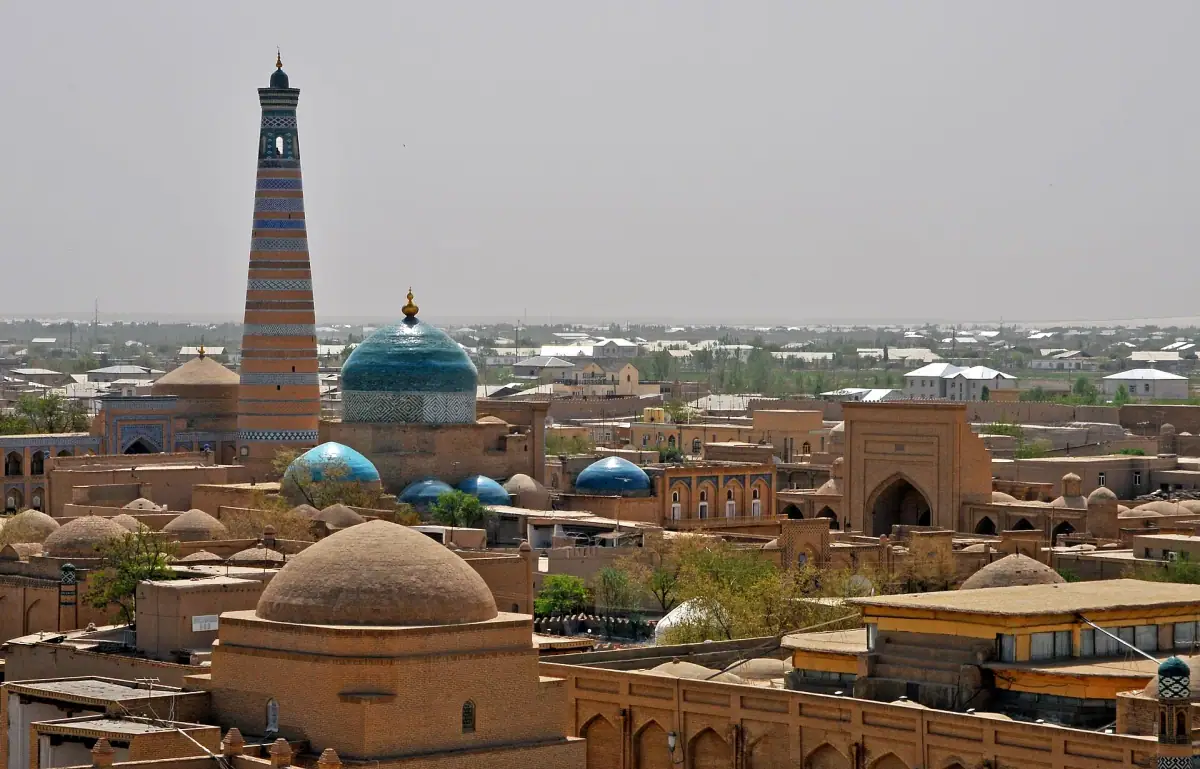
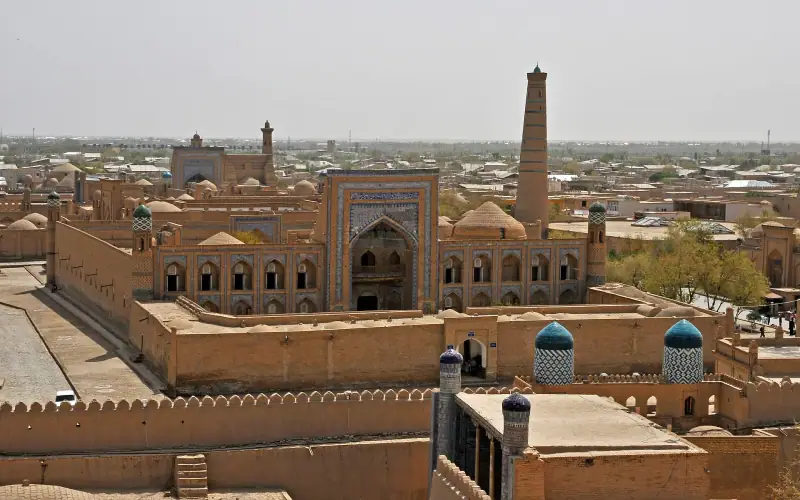
Khiva is the most intact museum city in all of Central Asia. Behind its imposing adobe walls, the old town of Itchan Kala unfolds like a journey through time: slender minarets, turquoise-tiled portals, madrasas decorated with ceramics, caravanserais turned into guesthouses. A UNESCO World Heritage site since 1990, Khiva is often the last stop on the Uzbek Silk Road, and for many the most spellbinding.
Unlike Samarkand or Bukhara, which are living, modern cities around a historic center, Khiva is almost entirely preserved in its original state. The walled city still houses thousands of residents, craft shops and active mosques while remaining extraordinarily authentic.
This guide helps you plan everything: the highlights, the lesser-visited secrets, lodging, transport and the best times to be alone with Khiva’s beauty.
Itchan Kala: the city within the city
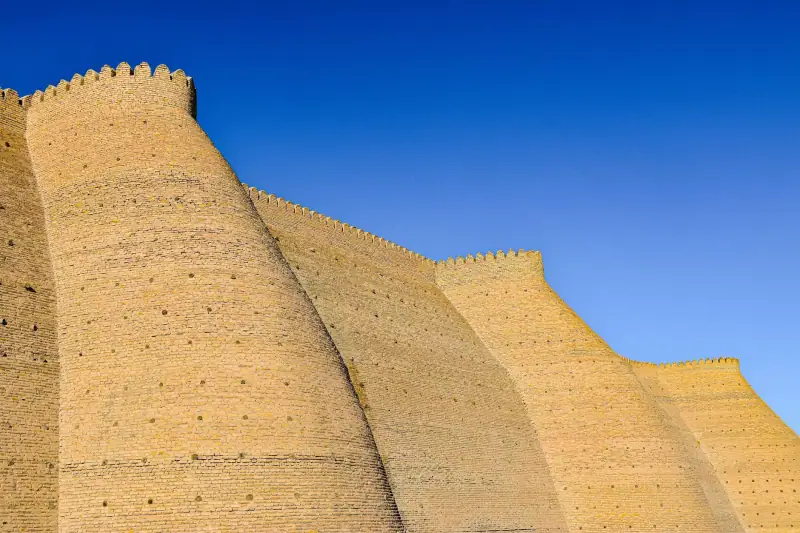
The ramparts: entering another world
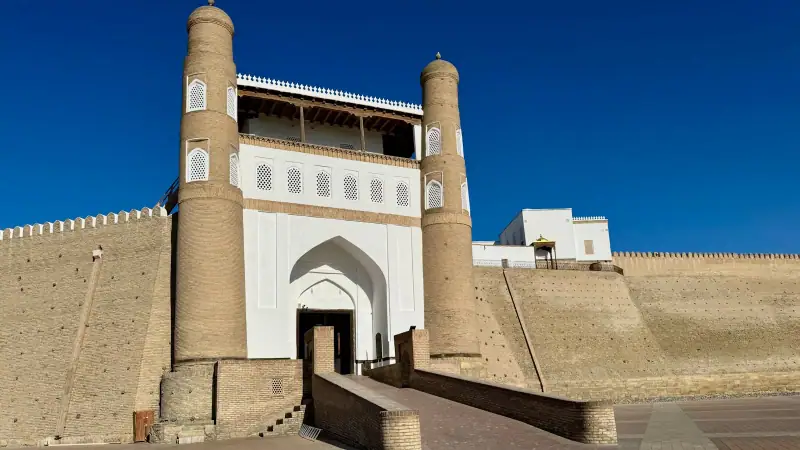
Itchan Kala literally means “inner city” in Uzbek. It is surrounded by adobe ramparts 8 to 10 meters (26 to 33 ft) high, dating from the 17th and 18th centuries, with four cardinal gates: Ata Darvaza (west), Palvan Darvaza (east), Bakcha Darvaza (north) and Tash Darvaza (south).
Passing through these gates, especially the west gate in the late afternoon when golden light floods the main street, is one of the most memorable moments of the trip. Inside, winding lanes are lined with adobe houses, hidden gardens and monuments of imposing proportions.
Tip: Climb the ramparts (access from the north gate) for a panoramic view of the city and its dozens of minarets. The blue hour, just after sunset, gives spectacular photos.
The Kalta Minor Minaret: the unfinished giant
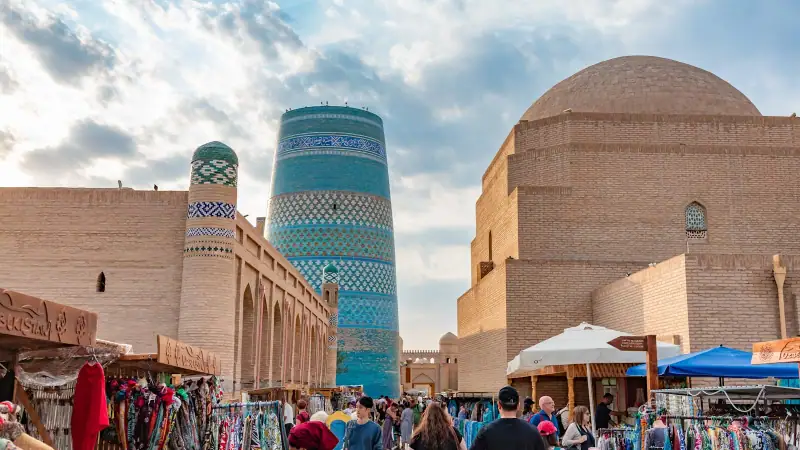
The Kalta Minor (the “short minaret”) is Khiva’s emblem and one of the most photographed monuments in Uzbekistan. Begun in 1851 on the orders of Khan Mohammed Amin, it was to be the tallest minaret in Central Asia, 70 to 80 meters (230 to 262 ft), visible from Bukhara according to legend.
The khan’s death in 1855, during the Crimean War, halted the work. It remained at a height of 26 meters (85 ft). But that height, combined with an exceptional diameter of 14.2 meters (47 ft) at the base, gives it a squat, massive silhouette, entirely covered with blue, green and white tiles in geometric patterns. Being unfinished paradoxically gives it a particular elegance.
The Islam Khodja Minaret: Khiva’s spire
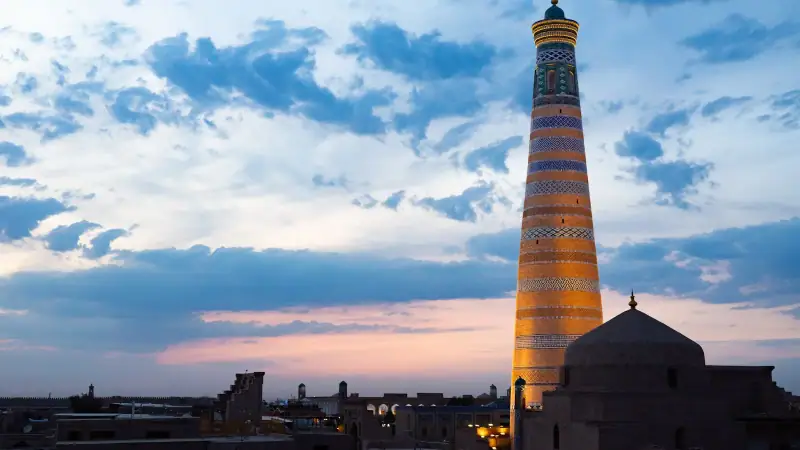
East of Itchan Kala, the Islam Khodja Minaret (1910) is the tallest in Khiva at 57 meters (187 ft). It stands out for its unusual shape: a series of brick rings alternating with bands of blue ceramic tiles, giving it a striped, luminous look.
You can climb the minaret (a supplement may apply on top of the global ticket, to confirm at the ticket office) via an inner spiral staircase for an unrivaled view over all of Itchan Kala. It is the only tower open for climbing in the city; save it for sunset.
Tosh-Hovli Palace: a thousand and one nights in adobe
The Tosh-Hovli (“stone” palace) is the largest and most sumptuous palace in Khiva, built between 1832 and 1841 by Khan Allah Kuli. It has more than 160 rooms arranged around three courtyards: the harem, the reception hall and the governor’s quarter.
The harem courtyard is the most decorated: carved wooden columns, painted ceilings and ceramic panels in blue and turquoise tones covering the walls from floor to ceiling are among the finest examples of Uzbek craftsmanship you will see in the country. Light filtered through the lattices creates unforgettable shadow play.
Do not miss: The small harem courtyard early in the morning (8-9 am) before the tour groups arrive.
The Mohammed Amin Khan Madrasa
Right next to the Kalta Minor, the Mohammed Amin Khan Madrasa (1851-1855) is Khiva’s largest madrasa. It has been turned into a hotel, the Orient Star Hotel, which lets travelers literally sleep inside the historic monument, in the refitted cells of the former students.
The madrasa’s exterior decoration, with its blue-tiled portals, corner towers and inner courtyard, is among the most impressive in the city.
The Juma Mosque: a thousand wooden columns
The Juma Mosque (Friday Mosque) is one of Khiva’s oldest and most unusual. Its interior is supported by 212 carved wooden columns arranged in a dense forest, some dating from the 10th and 11th centuries (reused in successive reconstructions). The light filtering through the central skylight creates a mystical atmosphere.
The mosque is still active and open to non-Muslims outside prayer times. Dress modestly and remove your shoes before entering.
Highlights outside Itchan Kala
Dishon Kala: the outer city
Dishon Kala is Khiva’s outer city, less visited by tourists but fascinating. It houses several important monuments:
- Nurullabay Palace (1906-1912): built under Russian influence, a curious mix of European classical architecture and Oriental decoration. It was the khans’ winter residence.
- Sherekhan Madrasa: a madrasa less restored than those of Itchan Kala, keeping a more authentic, less museum-like look.
- The bazaar: Khiva’s real bazaar is in Dishon Kala. Less touristy, livelier, with stalls of dried fruit, spices, textiles and local crafts. Ideal for purchases at reasonable prices.
Hotels in Khiva
Sleep in the old town or near the walls of Itchan Kala.
Crafts and shopping in Khiva
Khiva is known for quality crafts, more authentic and less standardized than in Samarkand or Tashkent. The main specialties:
Uzbek carpets
The Khiva region (Khorezm) produces carpets recognizable by their geometric patterns and red, ocher and golden tones. You will find carpets in many Itchan Kala shops. Haggling is appreciated, even expected.
Suzani embroidery
Suzani (large embroideries on fabric) are one of the most beautiful crafts in Central Asia. Floral and geometric patterns are hand-embroidered on cotton or silk. Prices vary with size and quality: from €20 (~$23) for a small piece to several hundred for a large, entirely handmade suzani.
Persian miniature
Many Khiva craftsmen practice miniature painting, a tradition inherited from classical Persian art. Court scenes, hunting scenes or Silk Road scenes are painted in ink on paper or silk. An excellent light souvenir to bring home.
Carved wood
Khiva is known for its carved wooden columns and doors. Craftsmen carry on the tradition in small workshops open to visitors in Itchan Kala. You can watch the craftsmen work and buy carved pieces directly.
Shopping tip: Prices inside Itchan Kala are higher than at the Dishon Kala bazaar. For textiles and carpets, always negotiate: a 20-30% reduction is normal.
Food in Khiva
Khiva’s cooking is that of Khorezm, an agricultural region known for its melons, dried fruit and generous cuisine. Local dishes to try:
Khivan plov
Plov (rice with carrots and lamb) is the Uzbek national dish, and each region has its version. Khorezm plov stands out for the addition of raisins, chickpeas and sometimes pieces of quail or chicken, giving it a characteristic sweet-and-salty softness.
Dimlama
Dimlama is a lamb stew with seasonal vegetables (potatoes, peppers, tomatoes, eggplant), cooked steamed in its own vapor. Nourishing and scented with local herbs, it is the classic family dish.
Khivan samsa
Samsa are small flaky turnovers filled with minced lamb, onions and spices, baked in a tandoor oven. In Khiva, the local version is slightly fattier and crisper than elsewhere. Buy them piping hot straight from the oven for 3,000-5,000 UZS each.
Recommended restaurants in Itchan Kala:
- Terrassa Restaurant (terrace with a view of the Kalta Minor): good value, typical dishes and grills
- Khiva Moon: popular with international travelers, multilingual menu, Wi-Fi available
- Milliy Taomlar (national cuisine): a small room run by a family, generous portions, plov served at lunchtime only
How to get to Khiva
From Tashkent
By plane (recommended): Urgench airport (UGC) receives daily flights from Tashkent (Uzbekistan Airways, 1 h 30-1 h 45). Tickets cost €40-80 (~$46-93) depending on the season. From Urgench airport, take a taxi to Khiva (35 km / 22 mi, 30 min, €5-8 / ~$6-9 negotiated).
By train: Khiva has had its own station since the railway extension (2018), about 1.5 to 2 km (1 to 1.2 mi) from the Itchan Kala ramparts. The fast Jaloliddin Manguberdi train links Tashkent to Khiva in about 7 h 30 via Samarkand and Bukhara, and night trains also run. Running days vary: check schedules on railway.uz before booking.
By bus: Direct Tashkent-Urgench buses leave from Tashkent’s bus station (12-15 hours, very uncomfortable). Not recommended.
From Bukhara
The Bukhara-Khiva distance is 450 km (280 mi) across the Kyzylkum desert. It is one of the most common trips on the Silk Road:
- Shared taxi: from Bukhara’s bus station, shared taxis leave at dawn for Urgench/Khiva (5-7 hours, €20-30 / ~$23-35 per person)
- Car with driver: more comfortable, about €80-120 (~$93-139) for a whole vehicle
- Train: trains link Bukhara to Khiva in about 3 h 30 to 4 hours (check running days on railway.uz)
- Bus: departures from Bukhara, slower and less comfortable than a shared taxi
From Urgench
Urgench is the big administrative city 35 km (22 mi) from Khiva. From Urgench’s station, airport or main bazaar:
- Taxi: €5-8 (~$6-9) for the ride to Itchan Kala (negotiate before getting in)
- Marshrutka (minibus no. 2): leaves from Urgench’s central bazaar, very cheap (a few cents), but slow and impractical with luggage
Where to stay in Khiva
Khiva offers two very different types of lodging:
Sleeping inside Itchan Kala: the unique experience
Several guesthouses and small hotels have settled in former historic homes inside the ramparts. Sleeping in Itchan Kala means living the empty lanes at dawn, the calls to prayer at sunrise and the atmosphere of the city before the groups arrive.
- Orient Star Hotel: in the former Mohammed Amin Khan Madrasa, a unique experience, rooms in the renovated student cells, high prices but unforgettable (€60-120 / ~$70-139 a night)
- Family guesthouses: many options from €15 to 40 (~$17-46) a night with breakfast, variable quality but a warm atmosphere. Search on Booking or directly on arrival.
Sleeping outside the walls
Urgench offers more choice of conventional hotels, but that means a 35 km (22 mi) round trip each day. Not recommended unless Khiva rooms are full.
Recommendation: Book at least 2 nights inside Itchan Kala to enjoy the evening and morning atmosphere. It is the key to experiencing Khiva as more than a simple tourist stop.
Car rental in Urgench
Explore the Khorezm region at your own pace with a rental car from Urgench airport.
2-day itinerary in Khiva
Day 1: Itchan Kala in depth
Morning (8 am-12 pm):
- Arrive in Itchan Kala before the groups
- Climb the Islam Khodja Minaret for the panoramic view
- Visit the Kalta Minor and its blue tiles
- Explore the Juma Mosque (forest of columns)
Afternoon (2 pm-6 pm):
- Tosh-Hovli Palace (harem courtyard, painted ceilings)
- Mohammed Amin Khan Madrasa (facade + courtyard)
- Shopping in the craft shops
- Walk through the side lanes of the northern district
Evening:
- Climb the ramparts for sunset
- Dinner on a terrace with a view of the minarets
Day 2: Dishon Kala and the region
Morning:
- Dishon Kala bazaar (peak activity 8-11 am)
- Nurullabay Palace (Russo-Oriental architecture)
- Back to Itchan Kala for monuments not visited the day before
Afternoon:
- Visit a craft workshop (carved wood, suzani)
- Khorezm State Museum (regional archaeology)
- Relax in a café in the old town
Practical tips
Daily budget: Plan €40-70 (~$46-81) per person per day in Khiva (guesthouse lodging + meals + monument entry + tips).
Currency: The Uzbek som (UZS). ATMs accept Visa/Mastercard cards in Urgench but are rare inside Itchan Kala; withdraw cash before entering the walled city.
Connectivity: Wi-Fi is available in almost all lodgings. Local SIMs (UCell, Beeline) are easy to buy in Urgench to stay connected with mobile data. You can also check your carrier’s international plan or use a travel eSIM.
Languages: Uzbek is the official language, and Russian is still widely understood (notably among shopkeepers). English is understood in guesthouses and tourist restaurants. Learning a few words of Uzbek (rahmat = thank you, salom = hello) is always appreciated.
Photos: The light is magnificent early in the morning and late in the afternoon. The blue hour just after sunset bathes the minarets in exceptional golden light. A tripod is useful for night photography of the lit monuments.
Khiva is to Samarkand what the provinces are to the capital: less spectacular at first sight, but more intimate, more authentic and ultimately more spellbinding. It is a city that reveals itself when the tour operators leave and the lanes recover their age-old silence.
To plan your circuit in Uzbekistan, see our Silk Road guide and our 7-day itinerary. If Bukhara also appeals to you, our guide to where to stay in Bukhara will help you choose your area.
Frequently asked questions
How many days do you need to visit Khiva?
Two days are enough to see Khiva's essentials, including all of Itchan Kala (the walled old town). Three days allow a calmer exploration, with time to get lost in the lanes, watch the sunset from the ramparts and visit the museums in more detail. If you are traveling the Silk Road (Samarkand-Bukhara-Khiva), plan 2 nights minimum.
How do you get to Khiva from Samarkand or Bukhara?
From Bukhara: the distance is about 450 km (280 mi). By shared taxi or bus from Bukhara's bus station, allow 5-7 hours on the road (€15-25 / ~$17-29 per person). From Samarkand: 650 km (404 mi), about 8-10 hours by road. The nearest airport to Khiva is Urgench (UGC), 35 km (22 mi) away; flights from Tashkent take 1 h 30 (€40-80 / ~$46-93). Khiva has its own station, served from Tashkent, Samarkand and Bukhara (about 3 h 30 from Bukhara and 7 h 30 from Tashkent by fast train).
Do you need a ticket to enter Itchan Kala?
Itchan Kala's monuments (minarets, palaces, museums) require a ticket. There is a combined pass valid for several days that gives access to most sites: plan about 200,000 to 250,000 UZS (about €15-20 / ~$17-23) depending on sources, fare to confirm at the ticket office. Some monuments such as the Islam Khodja Minaret may charge extra. Ask at the main ticket office at the west gate.
Is Khiva safe for solo travelers and women traveling alone?
Khiva is described as a very safe destination, including for women traveling alone, and Uzbekistan as one of the safest countries in Central Asia. The old town is small, well signposted and frequented by locals and tourists. It is advised to dress modestly (shoulders and knees covered) out of respect for local traditions and to avoid unwanted looks. At night Itchan Kala is very quiet: stay in lit areas. For current conditions, check your government's official travel advice.
What is the best time to visit Khiva?
Spring (April-May) is ideal: mild temperatures (18 to 28 °C / 64 to 82 °F), beautiful light and flowering vegetation. Fall (September-October) is also excellent. Summer (June-August) is very hot, sometimes stifling (40 to 45 °C / 104 to 113 °F in full sun), but the sunsets over the minarets are spectacular: go exploring early in the morning. Winter (December-February) offers a unique snowy atmosphere and few tourists, but temperatures fall below freezing.
Can you visit Khiva as a day trip from Urgench?
Yes, Urgench is only 35 km (22 mi) from Khiva (30-40 minutes by taxi, €5-8 / ~$6-9). However, a day trip is strongly discouraged: Khiva deserves at least one night in town to enjoy the magic of the empty lanes in the evening and the golden ramparts at dawn, when day-trippers have left. Sleeping inside Itchan Kala is one of the most unique experiences in Uzbekistan.
More Uzbekistan guides
Keep reading
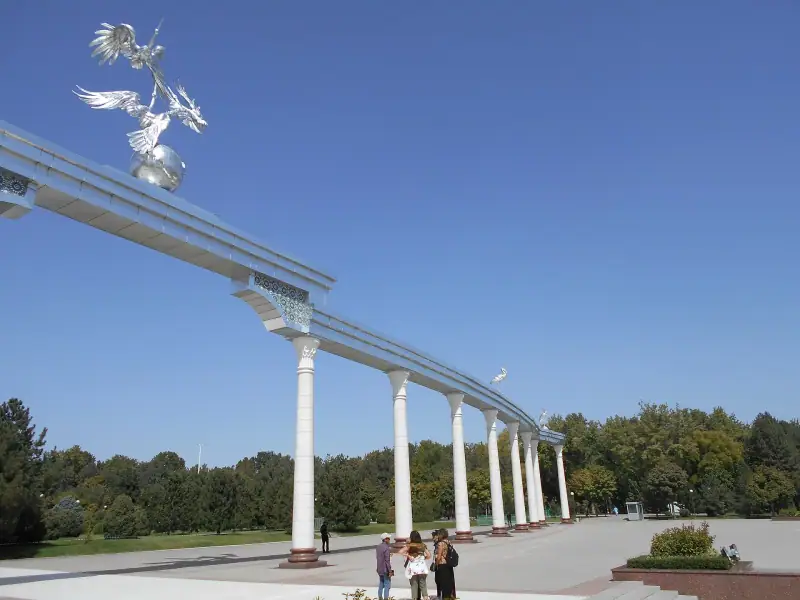
Tashkent top sights: what to see and do in Uzbekistan's capital
Tashkent's top sights: Chorsu Bazaar, Khast-Imam Mosque, museums, restaurants and neighborhoods in Central Asia's largest city.
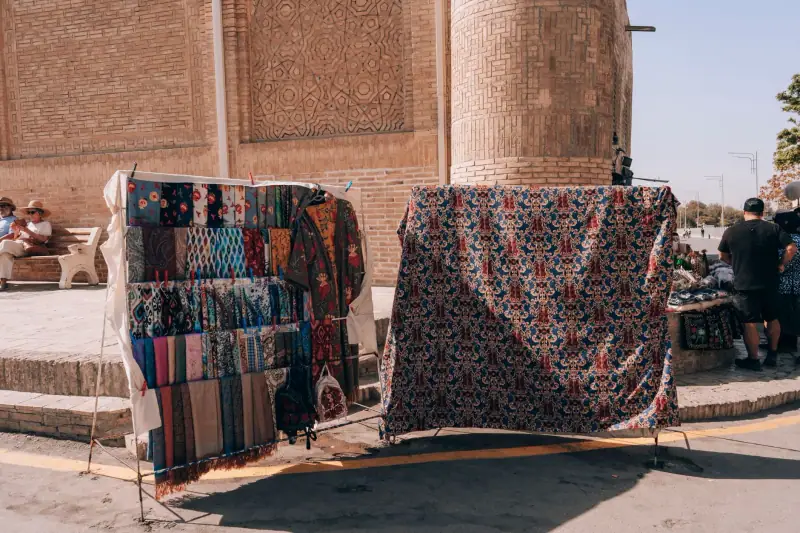
Visiting Ferghana: a complete guide to the Ferghana Valley
Visiting Ferghana and the Ferghana Valley: Margilan, Kokand, silk, bazaars and food. A complete guide to this little-known jewel of Uzbekistan.
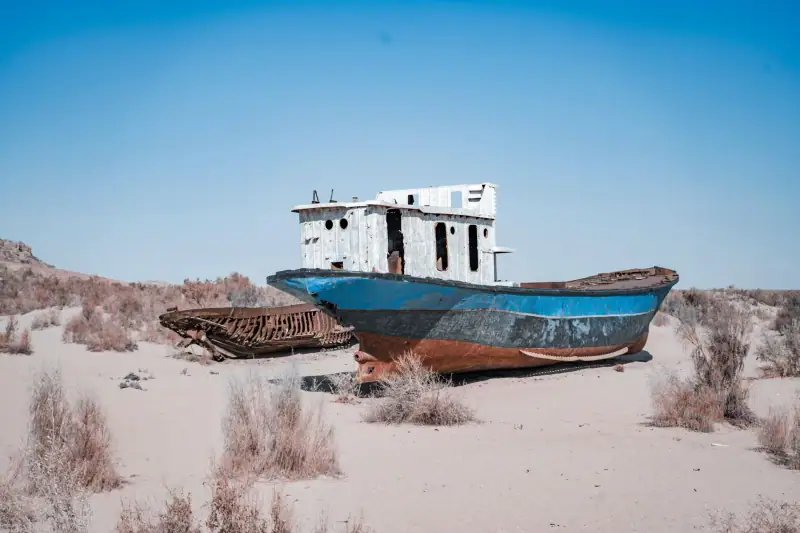
Visiting Karakalpakstan: a complete guide to Uzbekistan's forgotten region
Visiting Karakalpakstan: the Savitsky Museum, Khorezm fortresses, the Aral Sea. A complete guide to exploring this forgotten region of Uzbekistan.
Ready-made
Uzbekistan itineraries
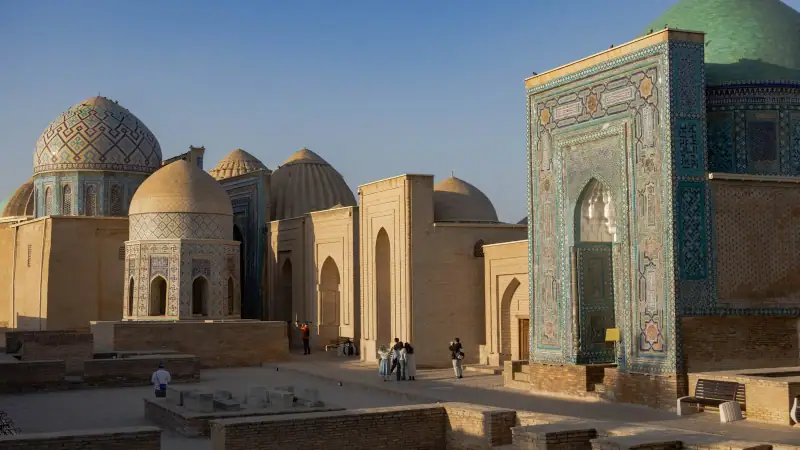
10 days
Uzbekistan in 10 days: a complete itinerary with the Ferghana Valley
TashkentFerghanaSamarkandBukharaKhiva
7 days
Uzbekistan in 7 days: the ideal Silk Road itinerary
TashkentSamarkandBukharaKhiva
9 days
Uzbekistan in 9 days with kids: stops and a family-friendly pace
TashkentSamarkandBukhara