Things to do
Colca Canyon: Complete Guide to Visiting from Arequipa
We may earn a commission when you book through links on this page, at no extra cost to you. We don't visit or try the places we cover: we summarize published sources. How we work
In short
- The Colca Canyon is about 160 km (99 mi) from Arequipa: 3 to 3 h 30 by road to Chivay, over the Patapampa pass at about 4,910 m (16,109 ft).
- Condors are best seen at the Cruz del Cóndor viewpoint between 8 and 10 am; a 2-day, 1-night excursion with a night in Chivay is much more comfortable than a day trip.
- A tourist ticket (boleto turístico) of about 70 soles (under €20 / $23) covers the main sites, including Cruz del Cóndor.
- The dry season, May to November, is best; the trek down to the Sangalle oasis takes 2 h 30 to 3 h 30 down and 3 to 5 hours back up, starting before 8 am.
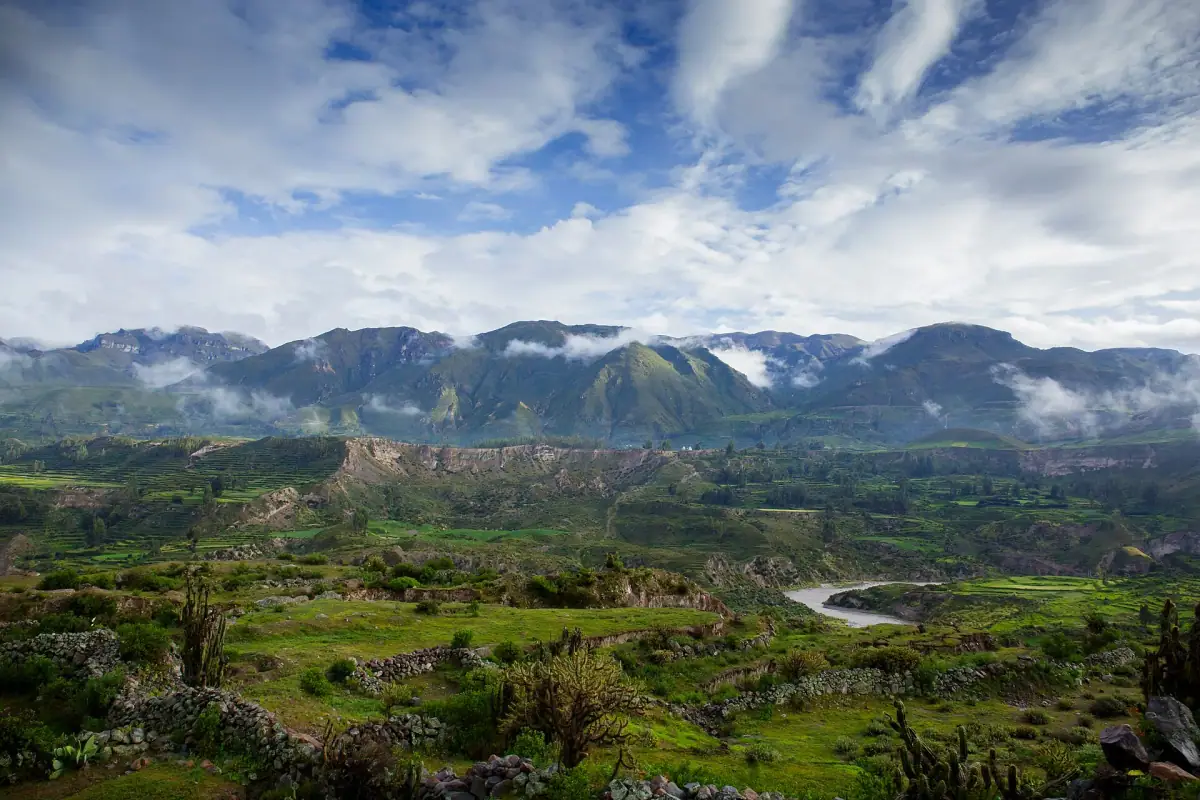
The Colca Canyon is one of Peru’s most spectacular natural wonders. Carved by the Colca River in the heights of the Andes, this dizzying canyon plunges more than 3,000 meters (9,840 ft) below the surrounding peaks, making it one of the deepest in the world. Its slopes are sculpted with ancient agricultural terraces, its villages preserve living Andean traditions, and its skies shelter the Andean condor, the largest flying bird on the planet.
About 160 km (99 mi) from Arequipa, the Colca Canyon is the essential excursion from the White City. This guide gives you all the keys to organizing your visit, whether you have 1 or 2 days.
The Andean condor: the star attraction of the Colca Canyon
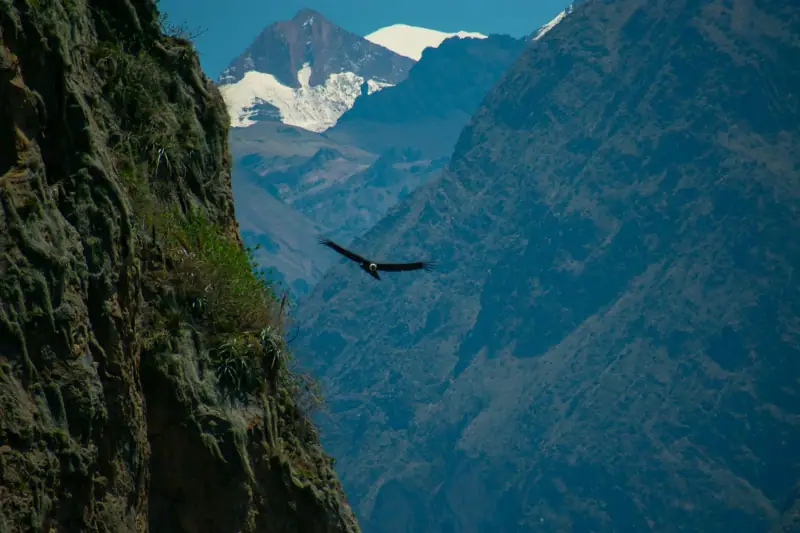
The Andean condor (Vultur gryphus) is the canyon’s most powerful symbol. With a wingspan that can exceed 3 meters (10 ft), it is one of the largest birds able to fly in the world. Seeing these majestic silhouettes rise from the bottom of the canyon and circle above your head is an experience that stays with travelers for a long time.
The Cruz del Cóndor viewpoint is the favored observation spot. Perched on a promontory overlooking the deepest point of the canyon reachable by road, this lookout gathers dozens of visitors each morning to watch the condors’ aerial ballet. The ideal time: between 8 and 10 am, when the first morning thermals let the birds rise with no apparent effort.
The condors of the Colca are not captive or fed animals: they are wild condors that nest in the rock walls of the canyon. Watching them is therefore always an authentic experience, even though their presence is never guaranteed.
Colca Canyon excursion from Arequipa
Book your guided circuit (1 or 2 days) with transport, a guide and entry tickets included.
How to get to the Colca Canyon from Arequipa
By bus or shared minivan
The great majority of travelers reach the Colca Canyon via Chivay, the main town of the Colca valley. Buses and shared minivans leave daily from the Arequipa terminal (Terminal Terrestre or Terminal Zonal) for Chivay. The trip takes 3 to 3 h 30 depending on the stop.
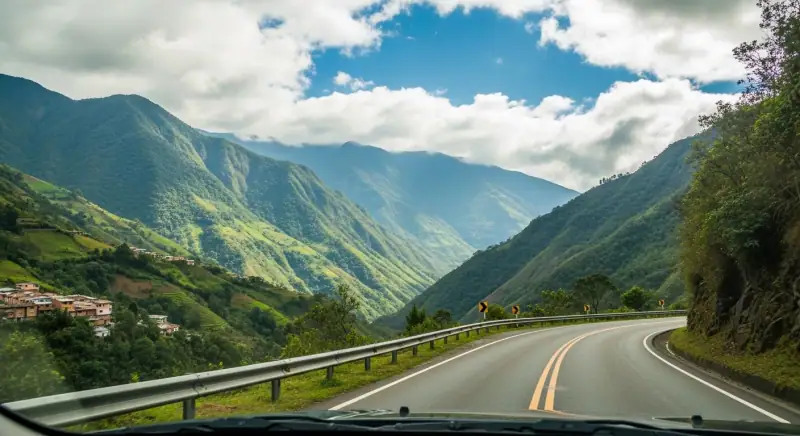
The road itself is impressive: after leaving Arequipa, it climbs quickly to the Altiplano, crossing the Patapampa pass at about 4,910 meters (16,109 ft), one of the highest points reachable by road in Peru. Up there, herds of vicuñas and alpacas graze freely on the Andean grasslands. Bring warm clothes.
On an organized excursion from Arequipa
Arequipa’s travel agencies offer turnkey excursions: round-trip transport, a guide, entry tickets included and sometimes accommodation for 2-day / 1-night packages. It is the simplest solution, especially if you travel alone or your time is limited.
By rental car
For more freedom and independence, renting a car in Arequipa is an excellent option. The road to Chivay is fully paved and well maintained. You can stop whenever you like to photograph vicuñas, volcanoes or Altiplano landscapes.
Car rental in Arequipa
Compare rates and book your vehicle at the best price to explore the Colca Canyon in complete freedom.
Chivay: the gateway to the canyon
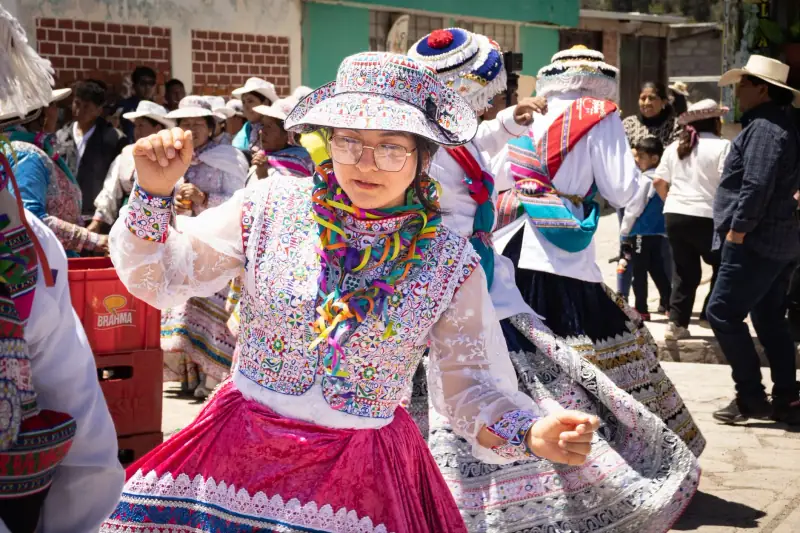
Chivay (about 3,630 m / 11,909 ft above sea level) is the main town of the Colca valley. This is where you will spend the night if you choose a 2-day stay, and where you can buy your boleto turístico (entry ticket) for the canyon area.
Chivay is a lively town on weeknights, with a pleasant Plaza de Armas and several restaurants serving traditional Andean cuisine: chupe de camarones (river shrimp soup), rocoto relleno (stuffed pepper), alpaca asada (roast alpaca). These regional specialties are often better than what you find in Arequipa itself, and cheaper.
The La Calera hot springs
A few kilometers from Chivay, the La Calera hot springs offer welcome relaxation after the road. These natural, mineral-rich hot springs form several pools at different temperatures. A welcome break after a long day on the road or hiking.
Trekking in the Colca Canyon
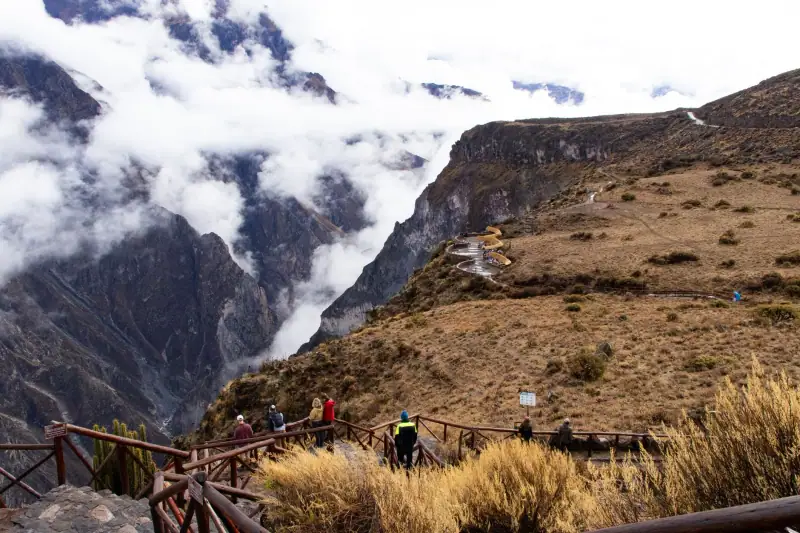
For hiking enthusiasts, descending to the bottom of the canyon is an unforgettable experience. From the village of Cabanaconde (about 3,280 m / 10,761 ft, 60 km / 37 mi from Chivay), two main routes lead to the oases at the bottom of the canyon.
Descent to the Sangalle oasis (Oasis del Colca)
The Sangalle oasis, sometimes called “the Colca Oasis,” is the most popular trek destination. This green palm grove planted at the bottom of the canyon, at about 2,200 meters (7,218 ft), offers a striking contrast with the arid walls around it. A few basic lodgings offer nights in a hammock or simple room, and spring-fed pools allow a refreshing swim.
Descent time from Cabanaconde: about 2 h 30 to 3 h 30 depending on pace.
Climb-back time: between 3 and 5 hours. The climb is demanding, especially at altitude. It is essential to climb back before 8 am to avoid the canyon heat, which can exceed 86 °F (30 °C) in the middle of the day.
Descent to the Llahuar oasis
Less visited than Sangalle, the Llahuar oasis is reached from Cabanaconde or from the village of Tapay by a longer and wilder trail. It has small natural hot springs by the river. The setting is more isolated and offers a more immersive experience for hikers looking to escape the crowds.
Places to stay in the Colca valley
Book your night in Chivay or Cabanaconde for a 2-day visit of the canyon.
1-day vs 2-day itinerary at the Colca Canyon
1-day option (express excursion)
The one-day package is the most common for travelers in a hurry, but it is also the most tiring. Here is a typical program:
- 4:30 am: Leave Arequipa by minivan
- 8 am: Stop at the Patapampa pass (vicuñas, photo stop)
- 9 am: Arrive at the Cruz del Cóndor viewpoint (condor watching)
- 10:30 am: Visit Chivay and lunch
- 12 pm: Return to Arequipa
- 3:30 pm: Arrive in Arequipa
This package lets you see the condors and get a glimpse of the valley, but the fatigue of the road can reduce the enjoyment. It suits mainly those who have only one day available.
2-day / 1-night option (recommended)
Two days let you experience the Colca Canyon at your own pace, do the trek to the oasis and watch the condors in better conditions.
Day 1:
- Leave Arequipa in the morning
- Panoramic stop at the Patapampa pass
- Arrive in Chivay in the early afternoon
- Stroll in Chivay, visit the craft market
- Relaxing evening at the La Calera hot springs
Day 2:
- Very early start, leave for Cabanaconde and Cruz del Cóndor (1 hour from Chivay)
- Condor watching between 8 and 10 am
- Trek in the canyon or visit the villages on the right bank
- Lunch in Cabanaconde
- Return to Arequipa in the late afternoon
The villages of the Colca valley
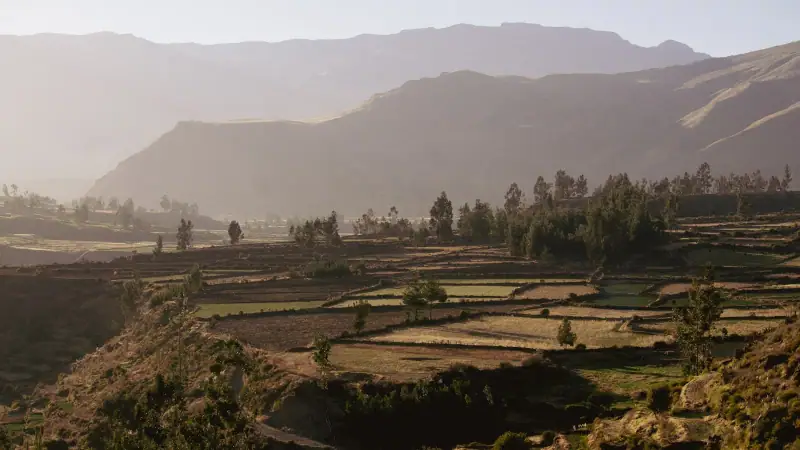
The Colca valley is more than a canyon. On its slopes cling many Andean villages that have preserved living traditions since pre-Hispanic times.
Yanque is one of the most beautiful. Its 17th-century baroque colonial church, dedicated to the Immaculate Conception, stands on a lovely paved square. The women of Yanque still wear the region’s traditional dress on many occasions: embroidered skirts and the wide-brimmed hats characteristic of the Colca valley.
Maca and Achoma are other authentic villages, less visited than Yanque, where you may see the inhabitants working in the terraced fields or taking part in community festivals depending on when you visit.
The andenes terraces covering the canyon’s slopes are one of the most impressive agricultural legacies of the pre-Hispanic world. Built by the pre-Inca Collagua and Cabana civilizations, then perfected under the Inca empire, these terraces allow corn, quinoa, potatoes and fava beans to be grown at altitudes where no intensive farming is possible elsewhere. Some are still cultivated today with ancestral techniques.
Flights to Arequipa
Arequipa has an international airport. Compare flights from Lima or from abroad.
When to visit the Colca Canyon
The Colca Canyon can be visited all year, but conditions vary noticeably by season.
Dry season (May to November): This is the best period. Skies are clear, landscapes bathe in magnificent light, trekking trails are passable and the risk of rockslides is low. July and August are the busiest months; expect more people at the Cruz del Cóndor viewpoint and in Chivay.
Rainy season (December to April): The bottom of the canyon is greener and lusher, waterfalls swollen and villages even quieter. But some paths become slippery or impassable, and clouds can hinder condor watching. Trekking in the canyon is not recommended in January and February.
Condors are present all year, but their behavior can vary with the weather. Cloudy or windy days reduce sightings, as the birds have less need to seek out thermals.
Budget for visiting the Colca Canyon
The Colca Canyon is accessible on every budget. Here is an estimate for a 2-day excursion from Arequipa:
| Item | Backpacker budget | Comfort budget |
|---|---|---|
| Transport (round trip) | €15-25 (~$17-29) | €50-80 (~$58-93) (private excursion) |
| Boleto turístico | ~€18 (~$21) | ~€18 (~$21) |
| Accommodation (1 night) | €10-20 (~$12-23) | €40-80 (~$46-93) |
| Meals (2 days) | €15-25 (~$17-29) | €30-50 (~$35-58) |
| La Calera hot springs | ~€4 (~$5) | ~€4 (~$5) |
| Estimated total | €60-90 (~$70-105) | €140-230 (~$165-265) |
These prices are indicative and may vary with the season, the currency and the providers chosen.
What to pack for the Colca Canyon
The Patapampa pass (about 4,910 m / 16,109 ft) on the road from Arequipa is freezing, even in the austral summer. The bottom of the canyon can exceed 86 °F (30 °C) at noon. This extreme temperature range calls for adaptable clothing:
- Layers: technical T-shirt, fleece, windbreaker or light down jacket
- Hat and gloves for the pass and the mornings at Cruz del Cóndor (it can be 36 to 41 °F / 2 to 5 °C at dawn)
- Waterproof hiking shoes if you do the trek
- SPF 50+ sunscreen: the sun at altitude is far more intense than at sea level
- Trekking poles for the descents and climbs of the canyon
- Water and snacks in abundance for the trek (plan at least 2 liters / 2.1 qt)
- For anything related to altitude, ask your doctor or a travel clinic before you leave, and see the official travel health pages (CDC in the US, TravelHealthPro in the UK)
Practical tips to prepare your visit
Buy your boleto turístico in advance: The tourist ticket is sold in Chivay (at the town entrance and in some agencies) as well as at the Cruz del Cóndor viewpoint. It is required to access the main sites of the canyon.
Take it slow: The jump in altitude from Arequipa (2,335 m / 7,661 ft) to Chivay (3,630 m / 11,909 ft), followed by the pass at about 4,910 m (16,109 ft), is considerable, so do not rush your first days.
Leave early: Whether you travel by bus or on an excursion, leaving Arequipa at 3 to 5 am lets you arrive at Cruz del Cóndor at condor time and avoid the biggest groups.
Respect wildlife and plants: The Colca Canyon is part of the Laguna del Indio biosphere reserve and a protected nature reserve. Do not make excessive noise at the viewpoint, do not drop litter, and do not feed the condors or other animals.
The Colca Canyon is arguably the most spectacular natural site of the Peruvian Andes after Machu Picchu. Between the majestic flights of condors, the thousand-year-old andenes terraces, villages with living traditions and the dizzying depths of a canyon cut into volcanic rock, the Colca region fully deserves two days of your Peruvian itinerary. It is an experience that perfectly complements a visit to Arequipa and an excellent introduction to the Andean world before heading to Cusco or Lake Titicaca.
Frequently asked questions
Is the Colca Canyon really the deepest in the world?
The Colca is one of the deepest canyons in the world, reaching about 3,270 meters (10,728 ft) in places, which places it among the two or three deepest on the planet. Its Peruvian rival, the neighboring Cotahuasi Canyon, also claims the title. In any case, the Grand Canyon in the United States (1,800 m / 5,906 ft) is much less deep.
What time should you see the condors at the Colca Canyon?
The best time to watch condors at the Cruz del Cóndor viewpoint is early in the morning, generally between 8 and 10 am. The condors use the first thermals to rise above the canyon. The later it gets, the lower the chances of seeing condors in flight.
Can you visit the Colca Canyon in 1 day from Arequipa?
Yes, most agencies offer day excursions from Arequipa, but it is very short. The outbound trip is about 3 to 3 h 30 by road. A 2-day excursion with a night in Chivay is much more comfortable and lets you watch the condors in better conditions.
Do you have to pay an entry fee for the Colca Canyon?
Yes, there is a tourist ticket (boleto turístico) for the Colca Canyon area. The price is about 70 soles (under €20 / $23) for foreign adults. The ticket is valid for several days and covers access to the main sites of the canyon, including the Cruz del Cóndor viewpoint.
Do you need to prepare for the altitude before visiting the Colca Canyon?
Take it slow. Chivay, the main access town, is at about 3,600 meters (11,811 ft). The Patapampa pass on the road from Arequipa exceeds 4,900 meters (16,076 ft). Arequipa itself is at 2,335 m (7,661 ft). For anything related to altitude, ask your doctor or a travel clinic, and see the official travel health pages (CDC in the US, TravelHealthPro in the UK).
What physical level is required for the Colca Canyon trek?
The descent to the bottom of the canyon (Llahuar or Sangalle oasis) is accessible to walkers in good physical shape. Allow 2 to 4 hours down depending on pace and destination. The climb back up is more demanding (3 to 5 hours) and should be done early in the morning to avoid the heat. Altitude can make the effort feel harder.
More Peru guides
Keep reading
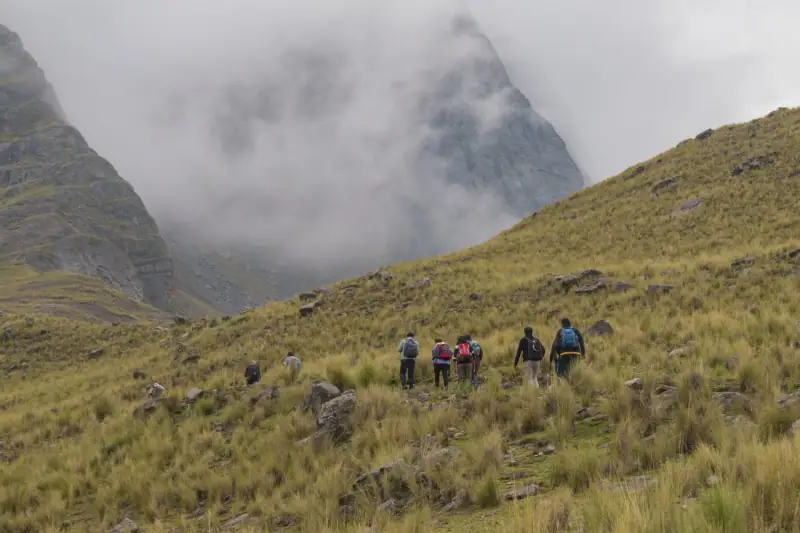
Hiking in Peru: The Best Treks and Trails
The best hikes in Peru: Cordillera Blanca, Inca Trail, Rainbow Mountain, Colca Canyon. Complete guide with levels and practical tips.
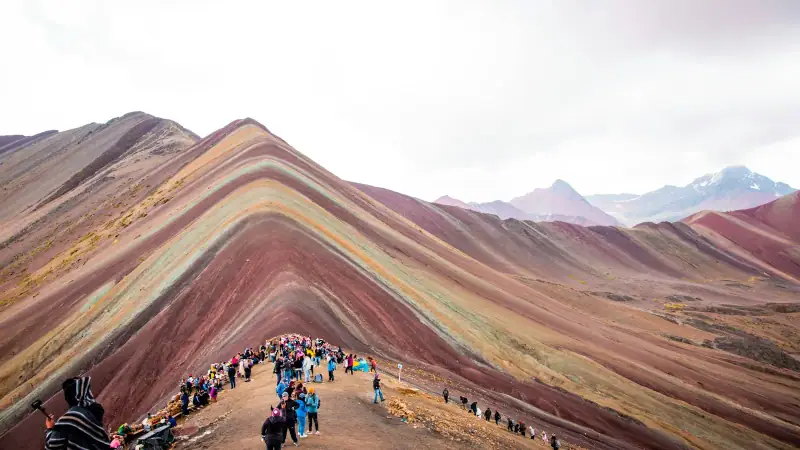
Vinicunca Without a Tour from Cusco: Prices, Transport and Difficulty
Visit Rainbow Mountain from Cusco without a tour: bus, taxi, entry fee, real budget, altitude and season. A practical step-by-step guide.
Peru Budget 2026: How Much Does a Trip to Peru Cost?
What budget for a trip to Peru? Accommodation, meals, transport, tourist sites: our complete guide with real 2026 figures.
Ready-made
Peru itineraries
7 days
Peru in 7 Days: The Ideal One-Week Itinerary
LimaCuscoAguas CalientesCusco
12 days
Peru Sierra Road Trip: 12 Days from Cusco to Huaraz
12-day Peruvian Sierra road trip: Cusco, Machu Picchu, Lake Titicaca, Arequipa, Colca, Huaraz. Complete itinerary with budget.
4 days
Lima, Paracas, Huacachina and Nazca in 4 Days by Bus: Doable Without a Car?
Lima, Paracas, Huacachina and Nazca in 4 days by bus: stages, km, real travel times, recommended departures and what to sacrifice to keep the pace.