What to see
Visiting the north coast of Papua New Guinea: Madang, Wewak and the Sepik
We may earn a commission when you book through links on this page, at no extra cost to you. We don't visit or try the places we cover: we summarize published sources. How we work
In short
- Madang is the diving base (wrecks, reefs, water around 28 to 30 °C / 82 to 86 °F); Wewak is the gateway to the Sepik River and its spirit houses.
- Air Niugini and PNG Air fly Port Moresby to Madang in about 1 h 15; Air Niugini flies to Wewak in about 1 h 20. Flying is by far the most practical option.
- Allow at least 3 to 4 days for Madang and 2 to 3 more for Wewak and a Sepik excursion; a full exploration takes a week to ten days.
- Sepik excursions are always done with a local guide; bring enough kina in small bills, as villages do not accept cards.
The north coast of Papua New Guinea is one of the most fascinating and least-trodden destinations in the Pacific. Here the coral reef comes up a short distance from fishing villages, World War II wrecks sleep in crystal-clear water and, a few hours by canoe inland, the Sepik River unrolls its meanders through primary jungle populated by crocodiles and villages with age-old spirit houses. Between Madang and Wewak, two coastal towns with very distinct characters, stretches a territory where nature and Melanesian culture assert themselves at every turn of the road.
Unlike the Highlands or Port Moresby, the north coast has not yet been shaped for mass tourism. That is both its constraint (infrastructure is modest) and its main appeal. The traveler who ventures here discovers an authentic Papua New Guinea, little retouched, where handshakes count for more than paper guides.
Madang: the prettiest town in the Pacific?
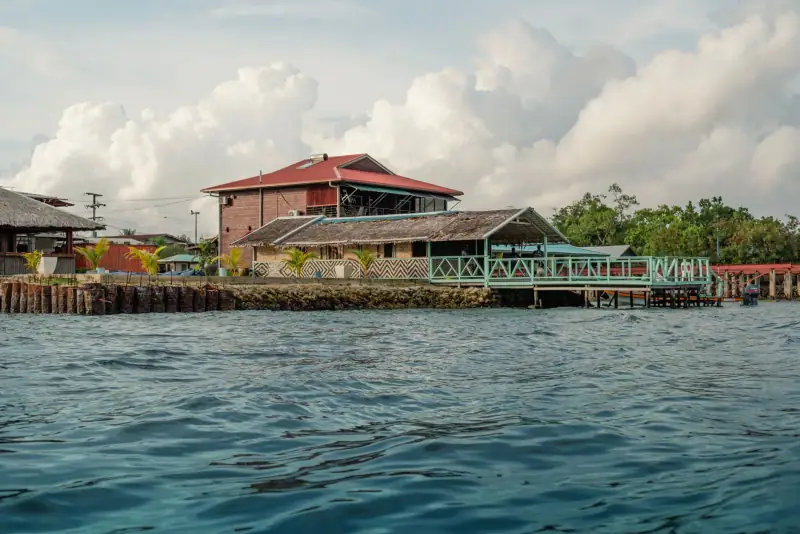
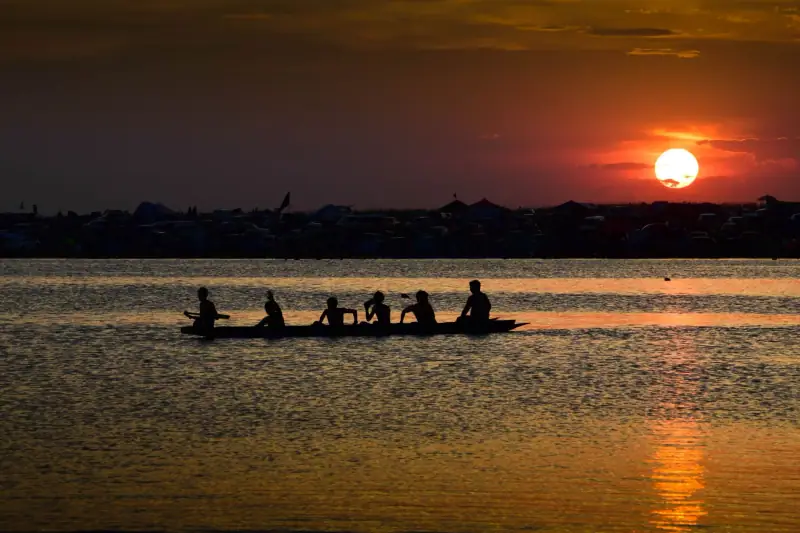
Madang has long been nicknamed “the prettiest town in the Pacific”, a slightly dated title, admittedly, but one that says something real about the exceptional natural environment of this port town. Set on a green peninsula between lagoon and open sea, Madang enjoys an idyllic geographic position: a bay sheltered by islets covered in tropical vegetation, waters whose color ranges from pale turquoise to deep cobalt blue, and a sea breeze that tempers the equatorial heat.
A peaceful town between sea and mangroves
Madang is a human-sized town where it is pleasant to wander on foot. The waterfront, along Coastwatcher Avenue, offers pleasant walks facing the lagoon. Local markets gather fresh fish, coconuts, betel nut and garden vegetables. The atmosphere is more relaxed than in many PNG towns, and the expatriates (researchers, missionaries, professional divers) have helped develop a few decent small places to eat and stay.
The town is also an easy access point for reaching the neighboring islands by motorized canoe. Several uninhabited or sparsely inhabited islets lie less than an hour away by boat: the beaches are often deserted and the waters clear, ideal for snorkeling or simply a break away from town.
Madang’s history in World War II
Madang played a strategic role in the Pacific campaigns between 1942 and 1944. Japanese forces occupied the town and established an important logistics and naval base in Madang Bay. The Allies waged long and costly campaigns to retake control of the north coast of New Guinea, where the jungle fighting was among the toughest of the Pacific theater.
Remains of this period are still very present on the seabed: wrecks of warships, submarines and aircraft rest on the lagoon floor at depths accessible to divers of all levels. On land, a few memorials and military cemeteries recall the scale of the fighting.
Flights to Madang
Compare plane tickets from Port Moresby to Madang and find the best fare for your north coast trip.
Diving in Madang: wrecks, reefs and exceptional biodiversity
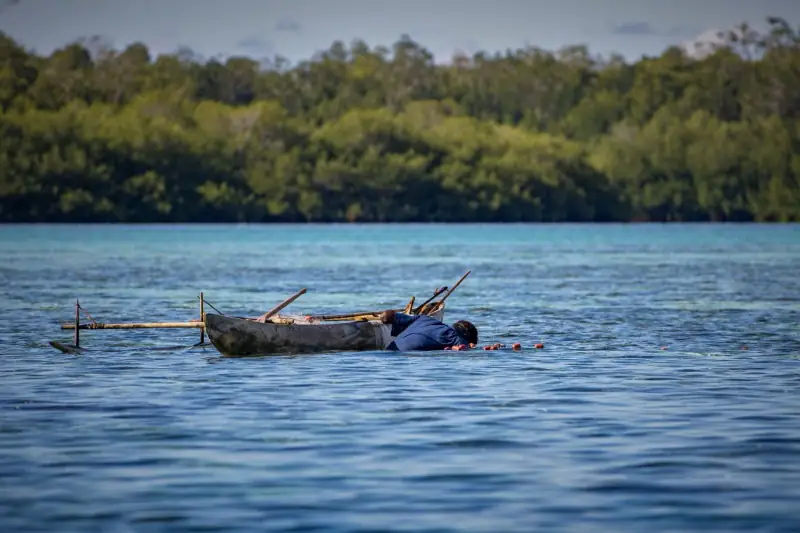
Madang is considered one of the richest dive destinations in Papua New Guinea, alongside Milne Bay, Kimbe Bay and Rabaul. The reasons for this enthusiasm are many: breathtaking marine biodiversity, warm water all year (around 28 to 30 °C / 82 to 86 °F), spectacular wrecks and visibility that can exceed 30 meters (98 ft) in the dry season.
The wrecks of Madang lagoon
Wrecks are the highlight for divers who come to Madang. Among the most visited sites:
- The Henry Leith wreck: a 33-meter (108 ft) coastal freighter intentionally scuttled in the 1980s to create an artificial reef, accessible at shallow depth (around 15 meters / 49 ft), ideal for beginner divers or for the end of the day.
- The Coaster wreck: a merchant ship that came to rest at a depth allowing a comfortable dive, covered with corals and home to schools of fish.
- The aircraft wrecks: several military aircraft rest in the lagoon at varying depths. Some are partly covered with corals and host populations of clownfish and lionfish.
These wrecks are generally well preserved because currents in the lagoon are moderate. Dive only with a local operator who knows the exact location of the sites and the day’s conditions.
Coral reef biodiversity
Beyond the wrecks, the living reefs of the Madang area are among the richest in the Coral Triangle, the Indo-Pacific zone recognized as the world center of marine biodiversity. You find hard and soft corals of several hundred species, manta rays in seasonal migration, green and hawksbill turtles, reef sharks, giant groupers and a profusion of nudibranchs especially sought by underwater photographers.
For everything about diving in Papua New Guinea, see the detailed guide: Diving in Papua New Guinea: the best sites.
Practical tips for diving in Madang
- Level required: sites range from beginner level (under 12 m / 39 ft) to advanced (over 30 m / 98 ft for some wrecks). A PADI Open Water certificate is the recommended minimum.
- Season: the dry season (May to October) offers the best visibility. The rainy season is still divable, but visibility may drop temporarily after heavy rain.
- Operators: several dive clubs operate from Madang with maintained equipment and experienced guides. Check certifications and equipment condition before booking.
Lodging in Madang
Find your hotel, dive lodge or guesthouse in Madang. Compare prices and book securely.
Wewak: gateway to the Sepik
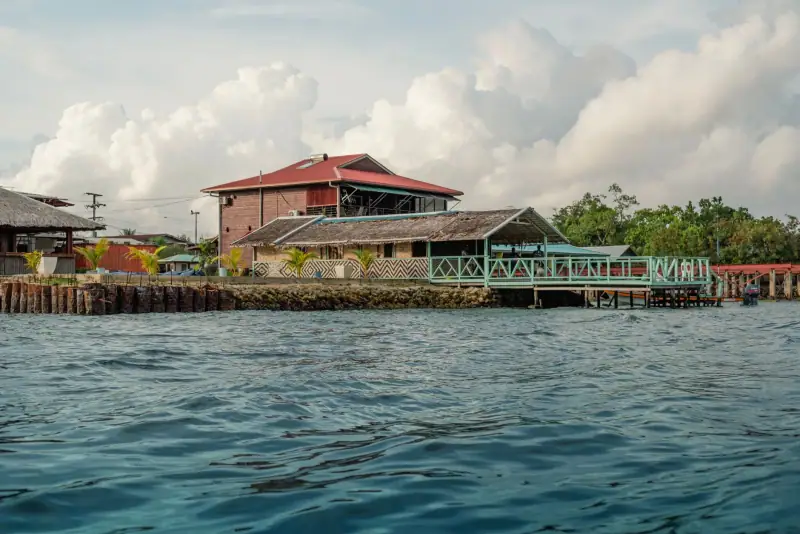
Wewak is a port town with a rawer look than Madang, but it is its geographic function that gives it all its importance: it is the main departure base for expeditions on the Sepik River, one of the most mythical rivers of the Pacific region. The town itself is lively, with a colorful central market, a few decent lodgings and an atmosphere of crossroads between the coastal world and the interior.
Wewak’s military history
During World War II, Wewak was one of the Japanese army’s most important air bases in New Guinea. The town and its surroundings suffered intense Allied bombing between 1943 and 1945. Ruins of bunkers, blockhouses and coastal artillery are still visible in the area, and a few sites have been set up for visitors interested in military history.
The Japanese memorial at Mission Hill, erected in 1980 by the Japanese government in tribute to the roughly 130,000 Japanese soldiers who fell in New Guinea, is a sober and poignant place of remembrance. It is a commemorative cenotaph, not a military cemetery with burials.
Getting to Wewak
Wewak is linked to Port Moresby by regular Air Niugini flights (about 1 h 20); PNG Air serves it mostly with stopovers (check schedules, which change often). The air link between Madang and Wewak is also available, although schedules vary by season. By road, the Sepik Highway theoretically links Wewak to Madang, but the state of this road is highly variable and a trip can take a whole day in the best conditions.
The Sepik River: the soul of the north coast
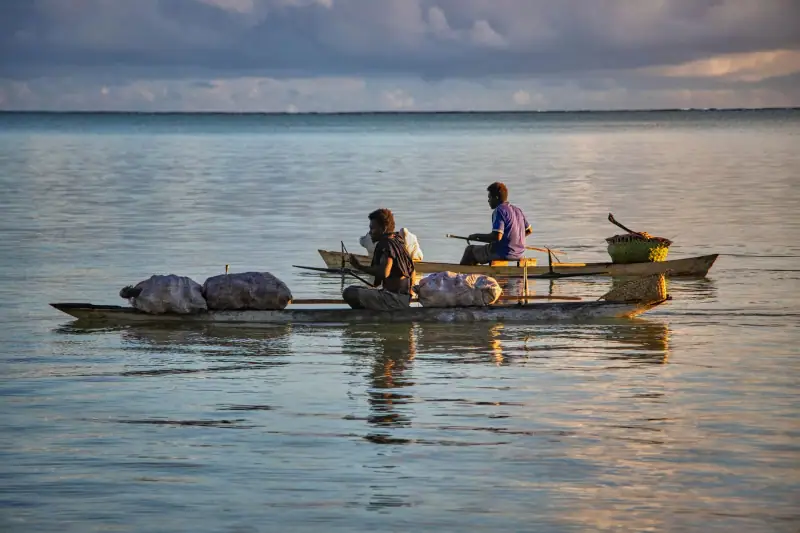
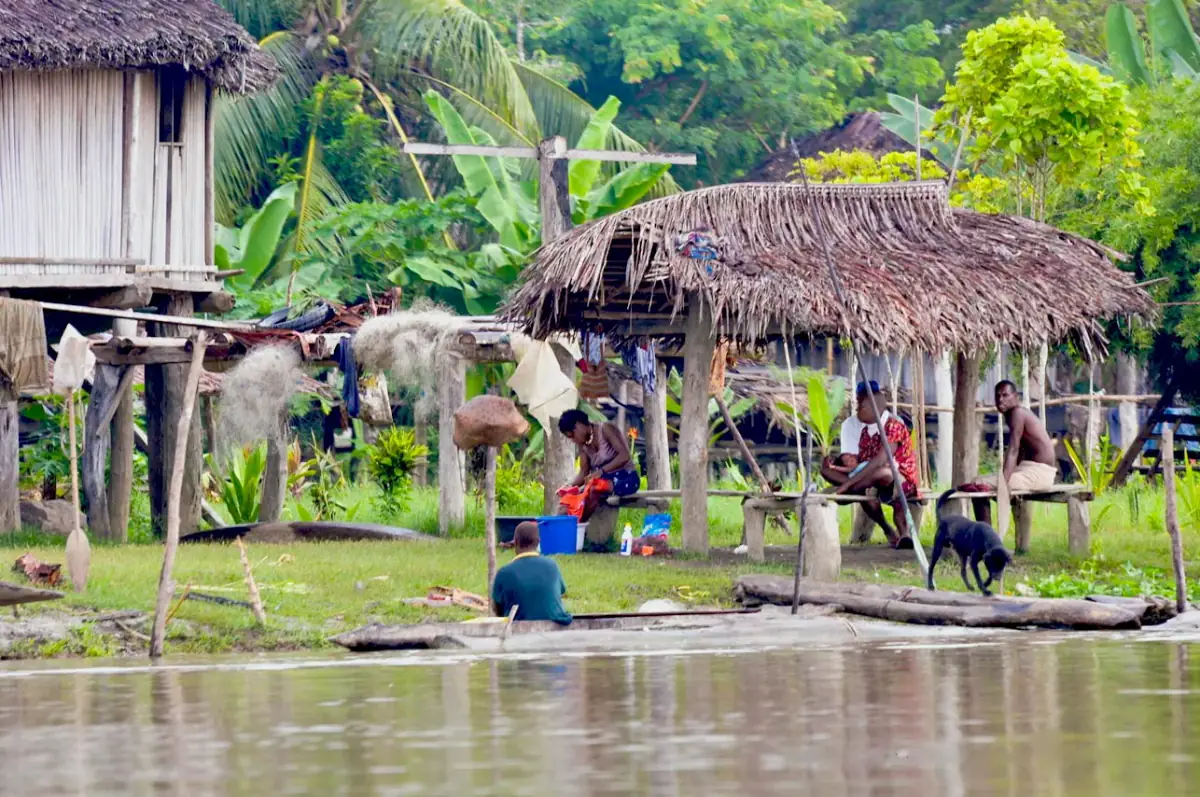
The Sepik is much more than a river. It is an axis of civilization, a corridor of cultural diversity, a universe of its own. About 1,126 km (700 mi) long, it rises in the mountains of central New Guinea and empties into the Bismarck Sea east of Wewak. Its watershed covers an immense area where dozens of distinct ethnic groups live, each with its own language, rituals and singular art.
Sepik villages and spirit houses
What makes the Sepik unique is the extraordinary vitality of its ceremonial traditions. At the heart of every village worthy of the name stands the haus tambaran, the spirit house. These monumental buildings, often decorated with carvings and ritual paintings, are at once places of worship, initiation spaces for young men and living archives of each clan’s ancestral knowledge. Their architecture, with carved wooden facades and roofs that sometimes rise more than fifteen meters (49 ft), is one of the most impressive expressions of Melanesian art.
Access to haus tambaran is generally reserved for initiated men; as an outside visitor, you can admire the exterior and, in some villages open to tourism, visit the interior with a guide who explains the symbolism of the carvings and associated rites.
Sepik art: carvings, masks and hook figures
Sepik art is internationally recognized and appears in the world’s greatest museum collections. The region’s carvers are renowned for the quality and complexity of their work: ceremonial masks, carved beams, ancestor figures, decorated canoes and the famous “hook figures”, carvings in the shape of a figure hanging from a hook, considered protectors of the clan.
Each Sepik village develops its own artistic style, recognizable to initiates: carvings from the Middle Sepik differ from those of the Iatmul region or the East Sepik. For the attentive traveler, going through the river’s villages amounts to crossing an open-air art gallery, constantly renewed by contemporary artisans who maintain ancestral techniques.
Sepik River excursions
Organize your canoe cruise on the Sepik with a certified local guide. Villages, spirit houses and tribal art.
How to travel on the Sepik
A Sepik excursion is prepared from Wewak. Several options exist depending on your budget and available time:
Day excursion: you board early in the morning from Wewak or from Pagwi (the main river port on the Middle Sepik, reachable from Wewak by road in 4 to 7 hours depending on the state of the track; allow about 5 hours on average in a 4x4), visit one or two villages and return in the evening. It is a useful introduction but only offers a superficial glimpse of life on the river.
Cruise of 2 to 5 days: the ideal option for immersing yourself in Sepik culture. You sleep in village guesthouses (very modest comfort but warm welcome), travel from village to village, watch craft demonstrations and sometimes take part in ceremonies open to visitors. These excursions are arranged with an operator in Wewak or through your lodging.
Long expedition: for very motivated travelers, multi-week trips up the Sepik are possible with an experienced guide. These expeditions reach remote villages little used to foreigners, at the price of comfort reduced to the essentials.
Logistics tips:
- Organizing from afar is difficult. Plan to arrive in Wewak with a few days of margin to finalize arrangements there.
- Negotiate clearly in advance the price, the number of days, the villages visited and any village entry fees.
- Bring enough kina (the local currency) in small bills, as villages do not accept cards.
- Insect repellent is essential in the low-lying areas of the Sepik.
Suggested itinerary: 7 days on the north coast
Here is a realistic program for a week on the north coast, organized in two parts: diving and islands around Madang, then river adventure from Wewak.
Day 1: arrival in Madang Flight from Port Moresby, transfer to your lodging. Stroll along the waterfront, discover the local market. A quiet dinner to recover from jet lag if you are coming from far away.
Day 2: diving the lagoon wrecks First day of diving with a local operator. Dive one or two wrecks depending on your level. Afternoon: canoe trip to a nearby islet to snorkel on the living reef.
Day 3: islands and coastal villages Boat trip to the islands of Madang lagoon. Visit a fishing village, grilled fish lunch on the beach. Return late in the afternoon.
Day 4: Madang–Wewak flight Morning flight (about 1 hour) from Madang. Settle in Wewak. Afternoon: discover the central market and, depending on interests, visit a World War II memorial site.
Days 5-6-7: Sepik excursion Early-morning departure to Pagwi or directly to the Sepik by 4x4 or local bus. Two to three days by canoe on the river with nights in villages, visits to the haus tambaran and meetings with carvers. Return to Wewak on the last evening, return flight to Port Moresby the next morning.
Practical tips for the north coast
Internal transport
- Between Port Moresby and Madang: Air Niugini and PNG Air flights, about 1 h 15. Several rotations a week.
- Between Port Moresby and Wewak: Air Niugini flights, about 1 h 30.
- Between Madang and Wewak: flight available (about 1 hour) or road (Sepik Highway, long and sometimes difficult).
- To the Sepik: from Wewak, bus or rental car to Pagwi (4 to 7 hours depending on the state of the track), then canoe.
Indicative budget
For the north coast, plan a higher daily budget than in the Highlands, especially for diving and river excursions:
- Diving (two dives + equipment): about 150 to 200 PGK per day, rates to check with local operators.
- Sepik excursion (guide + canoe + village lodging): rates vary with duration and number of participants, to negotiate locally.
- Lodging in Madang or Wewak: from 80 to 300+ PGK depending on standard (indicative rates, to check with the properties).
- Meals at local eateries: 15 to 40 PGK.
See the complete guide to travel budgets in Papua New Guinea for a detailed estimate.
Health and safety
- Health: ask your doctor or a travel clinic what applies to your trip, and see the official travel health pages (CDC in the US, TravelHealthPro in the UK).
- Travel insurance: insurance that includes emergency medical repatriation is essential. Medical facilities are limited in rural areas.
- Entry rules: they depend on your passport. Check the official travel advice of your government before you book: travel.state.gov (US), GOV.UK (UK), travel.gc.ca (Canada), Smartraveller (Australia) (checked November 2026). See also the article on visas and formalities for Papua New Guinea.
What to pack
- Light, breathable clothing (coastal heat and humidity)
- A warm layer for nights in a canoe on the Sepik (nights can be cool on the water)
- Waterproof walking shoes
- Headlamp (frequent power cuts)
- A small waterproof bag to protect cameras and documents on the water
- Cash in kina, in small bills
The north coast of Papua New Guinea is not the easiest destination in the world. Roads are sometimes battered, boat schedules approximate and comfort spartan. But for the traveler who accepts these conditions with the right mindset, it is a region that gives the rare feeling of being truly away from the formatted world, facing seascapes and riverscapes of striking beauty, and in contact with a human culture of unmatched richness in the Pacific.
Frequently asked questions
How do you get to the north coast from Port Moresby?
Air Niugini and PNG Air operate direct flights between Port Moresby and Madang (about 1 h 15), and between Port Moresby and Wewak with Air Niugini (about 1 h 20; PNG Air with stopovers). Flying is by far the most practical option. A road or sea trip from the capital is theoretically possible but very long and not advised for a first trip.
Is the north coast safe for travelers?
Madang has a relatively safe reputation for Papua New Guinea and is frequently chosen as a base by divers and independent travelers. Wewak requires standard precautions: avoid solo travel at night, stay in busy areas and use transfers recommended by your lodging. Sepik excursions are always done with a local guide.
What is the best season to visit the north coast?
The dry season (May to October) is ideal for diving in Madang (visibility can exceed 30 meters / 98 ft in good weather) and for Sepik excursions, where water levels ease navigation. The rainy season (November to April) swells the Sepik River, which gives access to villages normally hard to reach, but downpours can be intense.
How many days do you need to visit Madang and Wewak?
Allow at least 3 to 4 days for Madang (diving, neighboring islands, wrecks). Add 2 to 3 days for Wewak and a Sepik excursion. For a deeper exploration including several days by canoe on the Sepik with nights in a village, allow a week to ten days on the north coast.
Where can you buy authentic Sepik carvings?
Wewak's markets offer wood carvings, masks and hook figures (grigri). For the most authentic pieces, the best option remains buying directly in the villages during a Sepik excursion, dealing directly with the artisans. Check your own country's customs rules on bringing tribal art home before buying.
Do you need a visa to visit Papua New Guinea?
Entry rules depend on your passport. Check the official travel advice of your government before you book: travel.state.gov (US), GOV.UK (UK), travel.gc.ca (Canada), Smartraveller (Australia) (checked November 2026).
More Papua New Guinea guides
Keep reading
Visiting Port Moresby: a complete guide to Papua New Guinea's capital
Complete guide to Port Moresby: Hanuabada village, national museum, Nature Park, Kokoda, neighborhoods and safety tips for PNG's capital.
Port Moresby: the must-see sights of PNG's capital
What to see and do in Port Moresby? National museum, cultural village, national park and local markets: the best visits in Papua New Guinea's capital.
Visiting Madang: a complete guide to the pearl of the north coast
All about Madang in Papua New Guinea: wreck diving, market, Sepik culture, lodging and practical tips to plan your visit.
Ready-made
Papua New Guinea itineraries
7 days
Papua New Guinea in 7 days: the ideal first-trip itinerary
Port MoresbyGorokaMount HagenPort Moresby

5 days
10 days
Papua New Guinea in 10 days: Highlands, Madang and the Sepik
Port MoresbyGorokaMadangWewak and the Sepik